
Test 24 of 25 · 20 questions · Free 2026
AL Permit Practice Test 24
Jump to the test ↓A fixed 20 question set from the Alabama bank with answers and plain English explanations.
Question 1 of 20 · 0 right so far
All 20 questions in test 24
Every question below comes from the Alabama question bank on this page. Open a question to see the correct answer and the explanation. Nothing here is hidden behind a signup.
1. Your car breaks down at night in Alabama and you must walk for help. How should you walk?
- Walk in the travel lane on the right side with your back to oncoming traffic
- Carry a light and walk on the left edge of the road or shoulder, facing traffic
- Cross to the median and walk with traffic while waving one arm overhead
- Stay in the middle of the shoulder and walk away from traffic in darkness
Show answer
Carry a light and walk on the left edge of the road or shoulder, facing traffic. Walking beside a disabled car at night is risky because drivers may spot the vehicle but miss a person near it. A carried light makes you visible much sooner. Facing traffic lets you watch approaching headlights and step aside when a driver drifts or fails to see you. Stay on the left edge, well away from moving lanes. Wear or carry something bright when possible. Reach help, then return with assistance rather than working beside fast traffic longer than needed.
2. In Alabama, the traffic lane looks wide and a motorcycle rides far to one side. May you move into that same lane beside it?
- Yes, if your vehicle is narrow enough to fit
- No, never move into the same lane alongside a motorcycle
- Yes, when the rider stays close to the curb
- Yes, for a short distance while passing quickly
Show answer
No, never move into the same lane alongside a motorcycle. A rider needs the full width to shift position for view, surface hazards, and wind. Even a wide lane does not create a second lane for a car. Riding near one edge can change in a second when the rider dodges debris or a seam. Passing belongs in a separate lane with proper clearance. Stay behind or complete the pass in another lane, never sharing the rider space.
Study this in the handbook: Curves, bicycles, motorcycles and large vehicles
3. A wide center lane on a multi-lane Alabama road is marked for two-way left turns. A driver uses it to travel straight for a block to bypass stopped traffic. What is wrong with that use?
- The lane is open to through travel when the regular lanes are blocked
- Nothing at all, if the driver signals clearly while traveling straight there
- The lane is reserved only for left-turning vehicles from either direction
- Drivers may use it to bypass a queue during rush hour
Show answer
The lane is reserved only for left-turning vehicles from either direction. The center two way left turn lane in Alabama is reserved exclusively for left turning vehicles traveling in either direction. Driving straight through it to bypass a queue turns a turning refuge into a travel lane and meets drivers entering it head on for their own turns. Signaling does not change the reservation, and rush hour crowding gives no extra use. Enter the lane only to prepare and complete a left turn, and keep straight travel in the regular through lanes.
Study this in the handbook: Traffic signals, arrows and lane use signals
4. The centerline on your Alabama two-lane road shows a solid yellow stripe on your side beside a broken stripe. A slow tractor travels ahead. May you cross to pass?
- No, because the solid line on your side bars passing
- No, unless the tractor driver waves you around
- Yes, because the broken stripe faces the other side
- Yes, if you cross for only a few seconds
Show answer
No, because the solid line on your side bars passing. When the solid yellow line sits on your side of the centerline in Alabama, you may not pass. The broken stripe on the far side serves traffic facing it, not drivers on the solid side, so borrowing its permission reverses the marking. A brief crossing and a wave from the slow driver both leave the prohibition in place. Stay behind the tractor, keep a safe gap, and wait for a stretch where markings on your side and sight distance allow a lawful pass.
Study this in the handbook: Pavement markings
5. Traffic entering from the right will merge with an Alabama main route. Who yields, and how should the entering traffic join?
- Main route drivers yield to anyone entering from the right
- Entering drivers may force a space at any speed
- Entering drivers yield to main route traffic and merge via speed-change lanes
- Entering drivers stop on the main route after joining
Show answer
Entering drivers yield to main route traffic and merge via speed-change lanes. A merge succeeds when the smaller stream adjusts to the larger one already moving at route speed. Drivers coming from the right therefore wait for room, build speed in the provided change lane, and slide in without making through traffic brake sharply. Reversing the yield would invite sudden stops on the faster road. Forcing a space transfers the risk to strangers, and stopping after joining creates a fresh obstacle. Look over the shoulder early, match the flow, and slip into a gap that needs no one else to rescue the move.
Study this in the handbook: Warning, construction and guide signs
6. You stop at a red light in Alabama and then turn right or left. After that stop, who still has the right of way?
- You do, because stopping gave you the next turn
- Traffic and pedestrians already moving lawfully through the crossing
- Drivers behind you who stopped at the light later
- Only drivers turning in from side streets
Show answer
Traffic and pedestrians already moving lawfully through the crossing. Stopping at red does not hand you priority for the turn that follows. People already moving lawfully through the crossing, on foot or in vehicles, keep the right of way while you turn right or left after the stop. Wait until that movement clears, then turn smoothly without cutting across anyone. Drivers who stopped behind you do not jump ahead of crossing traffic either. A patient pause at the line prevents the common crash where a turning car swings into a pedestrian who started crossing with the signal.
Study this in the handbook: Stopping rules, school buses and emergency vehicles
7. While driving on an Alabama street or highway, how must you hold your position in a traffic lane?
- Stay in one lane without weaving or straddling lines
- Drift between lanes when traffic is light
- Straddle the marking to see ahead better
- Change lanes without signaling on empty roads
Show answer
Stay in one lane without weaving or straddling lines. Lane discipline keeps every driver's path predictable for neighbors traveling nearby. Holding one lane cleanly prevents the slow drift that forces others to brake or swerve. Light traffic does not relax the rule, because a single unseen vehicle can occupy the space you wander into. Straddling a marking for a better view blocks two paths at once and hides your intent. Even empty roads require signals, since a pedestrian, cyclist, or turning car may appear. Track straight inside the boundaries until a deliberate lane change begins.
Study this in the handbook: Good driving habits, turns and three point turns
8. Before switching on the ignition in Alabama, what should the driver do about safety belts for everyone in the car?
- Buckle your own belt and see that all passengers do likewise
- Buckle only after the car is moving and traffic has settled into a steady flow ahead
- Ask passengers to buckle only when the trip will use a freeway or rural highway
- Fasten the driver belt and leave passenger belts to each rider at any later time
Show answer
Buckle your own belt and see that all passengers do likewise. The entering routine finishes before the ignition is switched on. Buckle your safety belt and see that all passengers do likewise at that point, not after the car is rolling. Alabama law also requires each occupant to be restrained, so delaying passenger belts until later, or limiting them to freeway trips, leaves riders unprotected during the first part of the drive when a crash can still happen.
Study this in the handbook: Good driving habits, turns and three point turns
9. What does Alabama law forbid a driver to do while traveling downhill?
- Use a lower gear to help control speed
- Let the vehicle roll downhill with the engine switched off
- Slow down before a hazardous curve
- Coast downhill with the transmission in neutral
Show answer
Coast downhill with the transmission in neutral. Neutral removes engine braking just when gravity keeps adding speed on a descent. Staying in gear lets the engine share the slowing work, reduces brake heating, and keeps power available if a quick adjustment is needed. A lower gear is a helpful technique rather than a banned act, switching the engine off is not the stated ban, and slowing before a curve is sound practice. On long grades, select the gear early, watch speed creep between curves, and brake in controlled intervals instead of riding the pedal.
Study this in the handbook: Skids, hydroplaning, fog and hills
10. While driving in Alabama, your brake pedal feels spongy and slowly sinks as you press it. What is that feeling warning you about?
- Your brakes are starting to fail
- Your tires need more air pressure soon
- Your steering is about to lock up
- Your headlights are losing power fast
Show answer
Your brakes are starting to fail. A soft pedal that keeps sinking under steady pressure warns that braking power is fading. Pump the pedal to build pressure, keep your speed down, and use gentle parking brake pressure only if pumping fails. Low tire air changes steering feel and grip, yet it does not make the pedal sink. Treat the warning seriously even when the car still slows, because the next stop may demand full force. Pull to a safe place and have the system checked before driving farther.
Study this in the handbook: Driving emergencies
11. An Alabama driver is about to start a new prescription medicine and has a long drive planned the next morning. What should the driver do before deciding whether to drive after taking it?
- Take the first dose and see whether drowsiness appears while driving
- Ask the doctor how the new medicine may affect your driving ability
- Assume a prescribed medicine is safe because a doctor ordered it
- Skip the medicine on driving days without asking the prescriber
Show answer
Ask the doctor how the new medicine may affect your driving ability. Prescription medicine can affect the ability to drive safely, and effects may not be obvious before the first doses are taken. The manual advises a person taking prescription medicine to ask the doctor about possible side effects that relate to driving. That conversation should happen before a drive is planned around the medicine. Waiting to judge fitness from behind the wheel, skipping doses without advice, or assuming a prescription is automatically safe can leave impairment undiscovered until traffic demands a quick response.
12. You are entering an Alabama freeway on an entrance ramp that leads to an acceleration lane. How should you use the acceleration lane?
- Stop at the end of the ramp and wait for a large gap
- Enter the through lanes slowly, then speed up
- Increase speed to match vehicles in the through lanes, if possible
- Honk and expect through traffic to slow for you
Show answer
Increase speed to match vehicles in the through lanes, if possible. The acceleration lane exists so entering vehicles can build speed before joining faster traffic. Matching the flow lets a driver slip into a gap with little disruption for anyone nearby. Halting at the ramp end forces a slow start into fast lanes, which creates a sharp speed difference. Rolling in slowly and speeding up afterward causes the same problem inside the travel lanes. Pick a gap while accelerating, signal, and blend in smoothly once speeds are close.
Study this in the handbook: The Move Over Law
13. You see a yellow sign standing on its point in a diamond outline ahead on an Alabama road. What kind of message should you expect from that shape?
- Services such as fuel and lodging nearby
- A regulatory command that must be obeyed at once
- A warning of a hazardous condition ahead
- Directions to cities and highway routes
Show answer
A warning of a hazardous condition ahead. Warning signs in Alabama are usually diamond shaped, with a few exceptions, and they warn of hazardous conditions ahead that require extra caution. Shape alone gives an early cue before symbols or words become readable at speed. Regulatory commands, route directions, and service listings use other shapes and color schemes, so reading the diamond as an order or a guide misses its purpose. When the diamond appears, lift off the accelerator, widen your scan, and look for the hazard it announces.
Study this in the handbook: Sign types, regulatory signs and four way stops
14. You slow to enter an Alabama roundabout. A bicyclist is crossing the entry, and cars are already circling inside. Whom must you let go before entering?
- Pedestrians, bicyclists, and traffic already in the roundabout
- Only traffic entering from the street to your right
- No one, if you can reach the entry before the cars
- Only the circling cars, after the bicyclist hurries across
Show answer
Pedestrians, bicyclists, and traffic already in the roundabout. Before entering an Alabama roundabout, a driver yields to pedestrians and bicyclists and to traffic already traveling inside the circle. The bicyclist at the entry and the circling cars both hold claims that come before a new entry. Traffic from a side street does not outrank either group, and beating circling cars to the entry point creates a merging conflict. Wait outside the circle until the crossing clears and a safe interior gap arrives together.
Study this in the handbook: Roundabouts
15. At an Alabama intersection posted with NO TURNS, you need to change direction to reach a store on the cross street. What turns may you make at that corner?
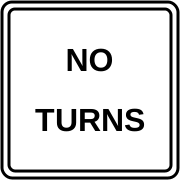
- Either turn, if you signal a full 100 feet ahead of the corner
- A right turn only, made slowly at the posted corner
- A left turn only, after yielding fully to all traffic
- Neither turn at that intersection
Show answer
Neither turn at that intersection. NO TURNS at an Alabama intersection bars turning either to the right or to the left at that corner. Choosing the slower or more careful turn does not create an exception, and early signaling cannot authorize a movement the sign forbids. The store can still be reached by going straight through and turning at a later corner where turns are allowed. Read the restriction before the intersection, stay in your through lane, and replan the route without a last second swerve.
Study this in the handbook: Sign types, regulatory signs and four way stops
16. An Alabama driver bumps an unattended parked vehicle and cannot find its owner nearby. What should the driver leave behind?
- A note giving only a first name and phone number
- Nothing, since no one witnessed the contact
- A written notice in a conspicuous place giving name and address
- A business card tucked under the rear license plate
Show answer
A written notice in a conspicuous place giving name and address. Property damage without witnesses still creates duties toward the absent owner. Vanishing shifts repair costs and suspicion onto an innocent party, while partial notes may reach nobody if they slip loose or lack identifying detail. A conspicuous spot on the struck vehicle gives the owner a fair chance to make contact. Notifying police or making a genuine effort to locate the owner also belong to a responsible response. Photographing damage for your own records adds clarity later. Handling a quiet parking lot scrape honestly mirrors how most people hope their own unattended car would be treated.
Study this in the handbook: Phones, fatigue, following distance and crashes
17. Unless another limit is posted, what is the Alabama statutory speed limit in locations other than urban districts, unpaved roads, and county paved roads?
- 45 miles per hour
- 65 miles per hour
- 70 miles per hour
- 55 miles per hour
Show answer
55 miles per hour. The statutory list sets thirty in an urban district, thirty five on unpaved roads, and forty five on county paved roads unless posted. Remaining locations carry fifty five as the listed figure. Seventy applies where posted on an interstate, while sixty five also depends on posting. Treat the fifty five figure as the default for those other locations, then obey any regulatory sign that establishes a different zone along your route.
Study this in the handbook: Speed limits
18. How does the Alabama manual advise you to prepare your route before a trip that includes a freeway?
- Wait to choose your exit until you reach the interchange
- Rely only on roadside signs, since they give all the notice you need
- Leave route planning to a passenger while you concentrate on traffic
- Use a map and decide exactly where to get on and off the freeway
Show answer
Use a map and decide exactly where to get on and off the freeway. The manual tells drivers to plan a freeway trip in advance. Use a map and decide exactly where to get on and off the freeway, so that you are never forced into a last second lane change or tempted to stop or back up after missing a ramp. Planning the route also lets you check fuel and your vehicle first, since there are no service stations directly on freeways. Signs help, but they do not replace a plan made before you start.
19. Before a freeway trip in Alabama, why should you check the gasoline gauge and get fuel if the tank is low?
- There are no service stations located directly on freeways
- Freeway fuel stations charge more, so a full tank is only a way to save money
- A low tank makes the car too light to hold its lane in freeway crosswinds today
- The gauge must be checked because freeway driving uses no fuel at steady speeds
Show answer
There are no service stations located directly on freeways. Trip planning includes the car as well as the route. Plan the trip in advance, check the gasoline gauge, and get fuel if you do not have enough for the trip, because there are no service stations located directly on freeways. Running dry on a freeway leaves the car on the shoulder in fast traffic. Price, vehicle weight, and fuel use claims do not supply the stated reason.
20. In a severe rainstorm in Alabama, at what speed do tires lose all contact with the road while hydroplaning?
- About 35 mph, when wiping first weakens
- About 45 mph on any wet roadway, even in light rain
- About 50 mph whenever water covers paint
- About 55 mph, when the tires lose all contact
Show answer
About 55 mph, when the tires lose all contact. Severe rain can lift tires completely off the pavement at fifty five miles per hour. At that point no friction remains for braking, acceleration, or steering. Thirty five marks the neighborhood where partial hydroplaning begins as tires struggle to wipe water aside. Forty five has no special threshold role here. Fifty applies when water depth exceeds tread depth, a related but distinct warning. Any float or lightness in steering demands an immediate speed reduction. Ease off the accelerator and let the tires regain contact before attempting a turn or firm braking.
Study this in the handbook: Skids, hydroplaning, fog and hills
Every question is written from the official Alabama Driver Manual. Need paper? Printable AL practice test with answer key.
Last verified 2026-10-05. How we check every question · Study all 500 as flashcards
Frequently asked questions
How many questions are on this Alabama practice test?
This fixed set has 20 questions. It is test 24 of 25 from the 500 question Alabama bank.
How does this fixed test relate to the full Alabama bank?
Each numbered test is a fixed set of questions in a fixed order, so you can retake the same test later and compare. Every test mixes road signs and the other topics in about the same proportion as the full bank. Tests 1 to 25 together cover every question in the Alabama bank once. The full practice page mixes the whole bank at random.
Last verified 2026-10-05. See the Alabama DMV facts page for sourced state details.