
Test 25 of 25 · 20 questions · Free 2026
AL Permit Practice Test 25
Jump to the test ↓A fixed 20 question set from the Alabama bank with answers and plain English explanations.
Question 1 of 20 · 0 right so far
All 20 questions in test 25
Every question below comes from the Alabama question bank on this page. Open a question to see the correct answer and the explanation. Nothing here is hidden behind a signup.
1. Overhead lane signals show a steady red X above the lane you are using on an Alabama freeway, while the next lane shows a downward green arrow. What must you do?
- Leave the lane under the red X when it is safe
- Use your lane only at a reduced speed until it reopens
- Follow the car ahead if it stays under the red X
- Stay in your lane until the red X turns yellow
Show answer
Leave the lane under the red X when it is safe. A steady red X in Alabama means a driver facing it shall not drive in the lane beneath that signal, and the indication modifies other traffic controls present. Reduced speed or another car ahead does not keep the lane open, and waiting for a yellow stage misunderstands a signal that already bars use. Signal early, check the neighboring lane that is open to you, and move over smoothly. Stay out of the barred lane until its indication changes to permit entry.
Study this in the handbook: Traffic signals, arrows and lane use signals
2. An Alabama ambulance with flashing red lights and a siren meets you head on along a two-lane road. What must you do?
- Stop at once in your lane without moving aside
- Speed up to clear the road beyond the ambulance
- Pull to the side of the roadway and stop
- Hold your lane and let the ambulance pass around you
Show answer
Pull to the side of the roadway and stop. Whether an emergency vehicle in Alabama is overtaking you or meeting you, the duty is to pull to the side of the roadway and stop when it displays flashing red or blue lights and sounds a siren. Meeting head on therefore calls for the same move as being overtaken from behind. Holding the lane or stopping in place without moving aside leaves the ambulance to thread past opposing traffic. Signal, ease to the edge, stop fully, and stay stopped until it passes.
Study this in the handbook: Right of way and yielding
3. In Alabama, how should a driver stop on packed snow or ice?
- Apply the brakes gently, and pump the brakes for a sudden stop on a slippery surface
- Press the brake pedal once as hard as possible and hold it until the car stops
- Shift into neutral first, then drag the parking brake during the entire stop
- Coast without braking until speed falls, then turn sharply toward the shoulder
Show answer
Apply the brakes gently, and pump the brakes for a sudden stop on a slippery surface. Packed snow and ice offer tires very little grip. A hard pedal press locks wheels quickly, and locked wheels slide straight onward while steering fades. Gentle pressure slows the car while tires keep rolling. For a sudden stop, repeated pumping lets grip return between applications. Leave much more space than usual before intersections and curves. Plan each stop early, test traction at low speed, and stay calm when the car needs a long distance to settle before halting completely.
Study this in the handbook: Night and winter driving
4. Midway through a curve in Alabama, your steering wheel suddenly spins without turning the front wheels at all. What is the safest first response?
- Turn the wheel rapidly back and forth
- Brake hard and shift gears to slow quickly
- Ease up on the accelerator without braking
- Accelerate to straighten the car by force
Show answer
Ease up on the accelerator without braking. When steering suddenly stops responding in Alabama and the wheel no longer turns the car, ease up on the accelerator but do not brake. The car may keep enough natural balance to roll straight while speed fades, whereas braking or shifting changes speed abruptly and can throw the vehicle off balance. Spinning a dead wheel adds no control, and acceleration carries you faster without direction. As speed drops, brake very gently only to finish the stop.
Study this in the handbook: Driving emergencies
5. In Alabama, when visibility is limited by fog or snow, how must a driver adjust speed?
- Keep the posted speed so traffic behind does not bunch up
- Speed up briefly to clear the fog bank as fast as possible
- Match the fastest vehicle ahead and follow its tail lights
- Reduce speed and be ready to stop within the limits of your vision
Show answer
Reduce speed and be ready to stop within the limits of your vision. Fog and blowing snow shrink the world to a short gray patch ahead of the hood. Hazards inside that patch must still leave room to brake. Slowing down stretches your reaction time and shortens stopping distance at once. Keep a steady pace that lets you halt for a stalled car or fallen branch at the edge of sight. Following tail lights tempts drivers to go faster than their own view allows. Set speed by what you can see yourself, not by braver traffic ahead.
Study this in the handbook: Skids, hydroplaning, fog and hills
6. The rear of your rear wheel drive car in Alabama begins to slide out in a skid. What does easing off the gas do?
- It lets the engine slow the rear wheels so the front can catch up
- It speeds the rear wheels so they can outrun the sliding front end of the car
- It locks the rear wheels, which is what straightens a conventional rear drive skid
- It has no effect, because only braking can change the speed of the rear wheels
Show answer
It lets the engine slow the rear wheels so the front can catch up. In any skid, the aim is to keep the rear end from outrunning the front. With a conventional rear wheel drive vehicle, easing off the gas lets the engine act as a brake and slow the rear wheels slightly. That slows the rear end slide and gives the front end time to catch up, and combined with steering it gets the vehicle going straight again.
Study this in the handbook: Night and winter driving
7. A driver in Alabama meets a school bus stopped in the opposing roadway of a divided highway with four or more lanes. Is a stop required?
- No stop is required when meeting the bus on that divided highway
- A stop is required at least 50 feet before reaching the bus from either direction
- A stop is required only when children are seen crossing the median toward traffic
- A stop is required in both directions on every wide highway in the state
Show answer
No stop is required when meeting the bus on that divided highway. Divided highways separate opposing flows with a median or barrier, and children are not permitted to cross that divided roadway to reach traffic on the far side. Meeting a stopped bus across that separation does not require a stop when at least two lanes run each way. Fifty feet is not the stopping distance used for school buses. Visibility of children does not switch the divided highway exception on or off. Undivided roads follow the stricter rule, so recognizing the physical separation before deciding is essential.
Study this in the handbook: Stopping rules, school buses and emergency vehicles
8. A vehicle ahead signals a turn in Alabama, but motorcycle signals may not cancel by themselves. Before turning across its path, what should you confirm?
- That its signal has flashed at least three times in a row without pause
- That the vehicle truly is turning, not going straight with a forgotten signal still blinking
- That the driver waves you across the intersection with an open hand gesture
- That no other vehicle is traveling anywhere behind your car on the road
Show answer
That the vehicle truly is turning, not going straight with a forgotten signal still blinking. A leftover blinker can announce a turn the rider no longer plans to make. Counting flashes tells you a lamp works, not where the vehicle will go. A wave is not a substitute for watching wheels, speed, and lane position. Traffic behind matters for your own move, yet it does not prove the other vehicle path. Wait until its nose actually commits and its speed drops for the turn.
Study this in the handbook: Curves, bicycles, motorcycles and large vehicles
9. In Alabama, where is it illegal for people on bicycles to ride, even though a bicycle lane may be nearby?
- On a designated bicycle path
- In a public park with a helmet on
- On a public roadway with traffic
- On the sidewalk
Show answer
On the sidewalk. Sidewalk riding by people on bicycles is illegal in Alabama. Sidewalks and multipurpose paths also do not count as designated bicycle lanes, so their presence does not change that rule. Roadway riding, bicycle paths, and park riding under the helmet rule for younger riders are treated differently. Motorists still need to watch for riders near driveways and crossings, while riders themselves should use lawful roadway space and signal turns or stops.
Study this in the handbook: Curves, bicycles, motorcycles and large vehicles
10. Smoke starts coming from under the hood of your car in Alabama. What should you do first?
- Keep driving slowly until the smoke clears
- Open the hood fully and pour water on the engine
- Get off the road and turn off the ignition
- Race the engine to burn off the smoke
Show answer
Get off the road and turn off the ignition. Smoke beneath the hood signals a possible fire, so leave the roadway and switch the ignition off as an early move. Water can spread burning gasoline rather than put it out, and pouring it over a hot engine invites injury. Continuing to drive feeds air to flames, while racing the motor adds heat and fuel flow. Once stopped away from traffic, keep people clear and use dirt or sand only when no extinguisher is at hand.
Study this in the handbook: Driving emergencies
11. An Alabama freeway entrance ramp has a YIELD sign and no acceleration lane. What must entering traffic do?
- Enter at full speed because freeway traffic must yield
- Stop in the acceleration lane even when a gap is available
- Merge from the right shoulder without yielding
- Stop if necessary rather than force in
Show answer
Stop if necessary rather than force in. Without an acceleration lane, an entering driver lacks the usual space to match freeway speed before joining. The yield sign therefore controls the entry fully: wait, and stop when the stream offers no safe opening, instead of squeezing in and making through drivers brake or swerve. Freeway traffic does not surrender priority here, a shoulder is not a substitute entry lane, and stopping applies when necessary rather than as a ritual despite a clear gap. Patience at the ramp protects both the entering car and the faster stream beside it.
12. How may bicyclists travel through an Alabama roundabout, according to the roundabout guidance?
- Through the roundabout, or by using the crosswalk
- Only by carrying the bicycle across the central island
- Only in the truck apron behind large vehicles
- Only against traffic on the outside edge
Show answer
Through the roundabout, or by using the crosswalk. Drivers should expect two lawful patterns near a circle: a rider continuing with traffic, or a rider crossing as a pedestrian would at the crosswalk. That expectation changes scanning at both entry and exit, where a bicycle can be close to the curb and easy to miss behind a pillar. The central island is not a crossing route, the apron serves large truck rear wheels, and riding against traffic removes predictability. Give riders room, avoid passing inside the circle, and check the exit crosswalk before accelerating away.
Study this in the handbook: Roundabouts
13. You signal for a lane change on an Alabama roadway. What does giving that signal by itself do?
- It requires nearby drivers to open a gap at once
- It allows crossing a solid line without checking
- It only announces intent; you must wait until the move is safe
- It transfers blame if another driver fails to yield
Show answer
It only announces intent; you must wait until the move is safe. A blinker or arm gesture communicates a plan, yet communication alone cannot manufacture space. The driver changing lanes still judges front, side, and rear clearance, then waits for a gap that does not force braking or swerving by others. Nearby drivers may cooperate, but cooperation cannot be demanded by a signal. The signal also cannot erase a solid line meaning or shift responsibility after a careless move. Signal early, keep checking while the intention is displayed, and cancel the plan without drama when the available space closes.
Study this in the handbook: Passing, backing, lane changes and loads
14. A KEEP RIGHT sign stands at a traffic island on your Alabama route, and the left side of the island looks wider. Where must you drive?
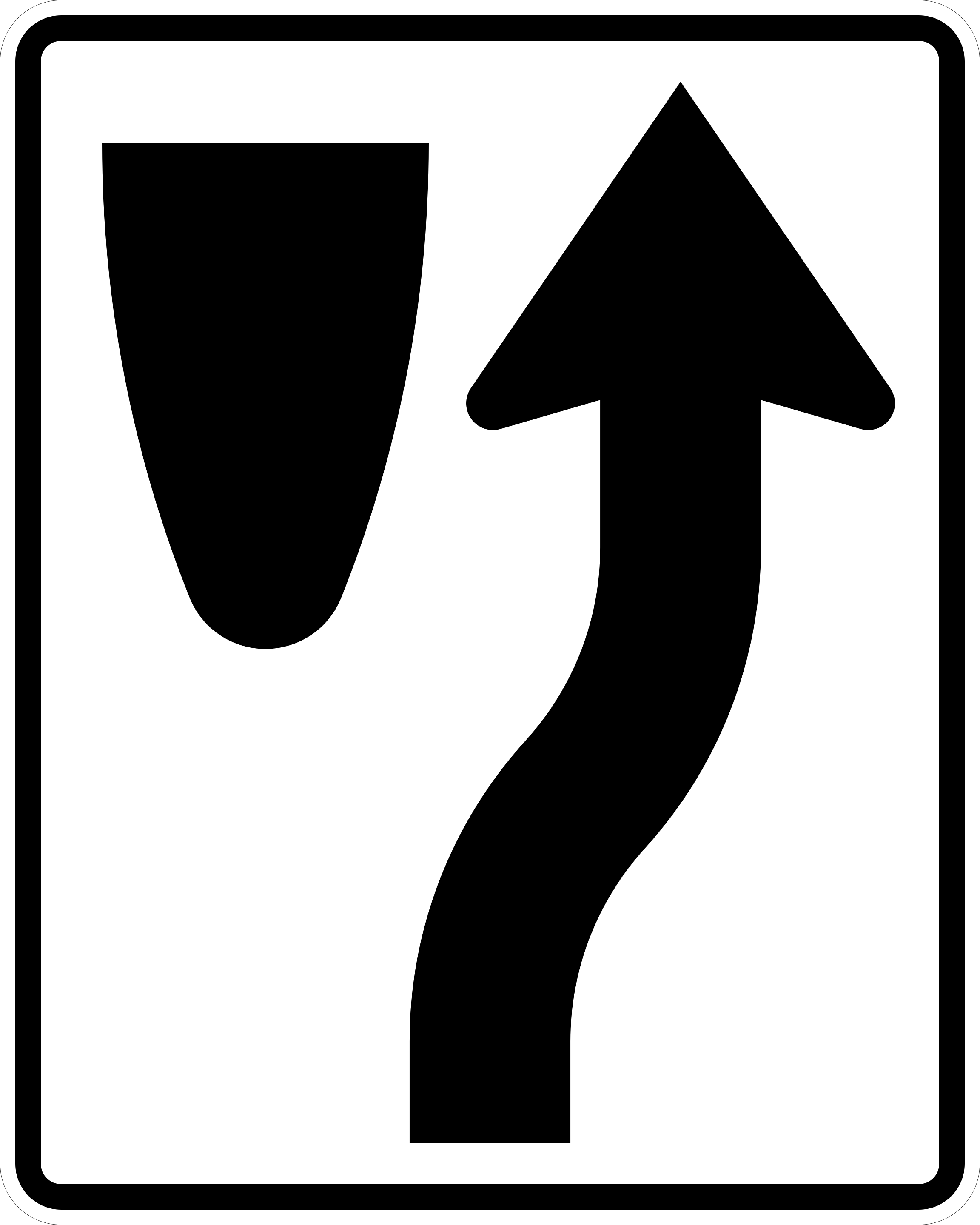
- To the right of the sign and the obstruction
- Straight over the island at reduced speed
- On whichever side gives the smoother path
- To the left of the sign when the island is empty
Show answer
To the right of the sign and the obstruction. At an island or obstruction marked this way in Alabama, you must not drive to the left of the sign, which places your car to the right of both sign and obstruction. Extra width on the left can belong to opposing traffic or a channel closed for safety, so a smoother line does not justify crossing over. Driving over the island risks curbs, signs, and people who may be standing there. Ease right early, keep speed modest, and rejoin the normal lane beyond the obstruction.
Study this in the handbook: Sign types, regulatory signs and four way stops
15. A curve warning on an Alabama road carries a smaller plaque showing 25. Your car enters the bend at 40 on dry pavement. What error have you made about that plaque?
- You obeyed a minimum speed meant for the bend
- You used a wet weather figure on dry pavement
- You treated a route speed limit as a curve warning
- You drove above the top safe speed advised for the turn
Show answer
You drove above the top safe speed advised for the turn. The smaller plaque beside a curve warning advises the top safe speed for making that turn in Alabama. Entering at 40 when 25 is advised carries the car wide toward the centerline or shoulder, even on dry pavement. The plaque does not set a route wide limit, a minimum to maintain, or a figure reserved for rain, although wet pavement would call for still more care. Spot the plaque early, brake while straight, and enter at or below the advised speed.
16. On an Alabama roadway with two or more lanes going the same direction, what do broken white lane lines allow?
- Crossing only to reach the shoulder
- Crossing when passing
- No crossing at any time
- Crossing only for emergency vehicles
Show answer
Crossing when passing. White broken dividers separate lanes that move the same way, and those breaks may be crossed while passing. Solid white treatment carries a different message about discouraging or barring a crossing, so the broken pattern matters. Reaching a shoulder and emergency travel are handled by other rules and markings. Before crossing a broken divider, check mirrors and the blind spot, signal the move, and confirm enough space ahead and behind for a smooth pass.
Study this in the handbook: Pavement markings
17. In Alabama, what do railroad crossings protected by electric or mechanical signal devices require a driver to do?
- Slow only if a train is visible from the road
- Cross quickly before the devices can activate fully
- Bring the vehicle to a complete stop
- Stop only when a gate blocks the travel lane ahead
Show answer
Bring the vehicle to a complete stop. Active protection at tracks calls for a full halt, not a rolling judgment based only on what can be seen. Trains may approach beyond a curve, building, or line of vegetation, and a second track can hide another movement. Stopping completely creates time to look both ways and listen before entering the rails. Racing the equipment or waiting for a physical gate adds danger and ignores the active warning. Once halted, remain clear of the nearest rail until crossing can be finished without stopping on top of it.
Study this in the handbook: Railroad crossings
18. Why can poor brake balance be serious in an emergency stop, according to the Alabama manual?
- One or more brakes may lock their wheels before the others fully take hold
- Uneven brakes stall the engine, and then the brake lights stop working
- Brake balance affects only how long the pads last before they wear out
- Weak brakes always grip too gently, so the car keeps rolling a full second longer
Show answer
One or more brakes may lock their wheels before the others fully take hold. The manual lists the type, condition, and balance of the brakes among the factors that decide how far a car needs to stop. In an emergency, a driver can be in serious trouble if one or more of the brakes lock the wheels before the others fully take hold. Locked wheels slide instead of gripping, which hurts both stopping distance and steering control, so regular brake maintenance matters.
Study this in the handbook: Phones, fatigue, following distance and crashes
19. You are driving on an Alabama freeway and realize you have just passed the exit you needed. Traffic behind you is moving at freeway speed. What should you do next?
- Stop on the shoulder, back up to the missed ramp, and exit there
- Continue to the next exit and leave the freeway there safely
- Turn across the median and drive back to the missed exit
- Slow sharply in your lane and reverse to the missed ramp
Show answer
Continue to the next exit and leave the freeway there safely. Freeway exits cannot be recovered by stopping or reversing in moving traffic. The manual directs a driver who passes an exit to continue to the next exit and come back to the missed one from there. That keeps the vehicle moving with the flow while the return is made on normal ramps and streets. Stopping, backing, or turning around in freeway lanes places a slow or reversing vehicle in front of fast traffic.
20. To avoid stalling on Alabama railroad tracks, what should a driver with a manual transmission avoid doing while crossing?
- Slowing down before reaching the rails
- Changing gears while crossing the track
- Looking both ways before entering the crossing
- Selecting a lower gear before the crossing
Show answer
Changing gears while crossing the track. A stall between rails leaves little time for escape. Alabama warns against shifting during the crossing because a missed gear or lost momentum can stop the vehicle on the track. Preparation belongs on the approach: slow down, scan, and settle into a lower gear that can pull steadily across. Once rolling over the rails, keep momentum smooth and avoid stopping for traffic beyond the crossing unless the far side offers complete clearance for the whole vehicle.
Study this in the handbook: Phones, fatigue, following distance and crashes
Every question is written from the official Alabama Driver Manual. Need paper? Printable AL practice test with answer key.
Last verified 2026-10-05. How we check every question · Study all 500 as flashcards
Frequently asked questions
How many questions are on this Alabama practice test?
This fixed set has 20 questions. It is test 25 of 25 from the 500 question Alabama bank.
How does this fixed test relate to the full Alabama bank?
Each numbered test is a fixed set of questions in a fixed order, so you can retake the same test later and compare. Every test mixes road signs and the other topics in about the same proportion as the full bank. Tests 1 to 25 together cover every question in the Alabama bank once. The full practice page mixes the whole bank at random.
Last verified 2026-10-05. See the Alabama DMV facts page for sourced state details.