
Test 8 of 10 · 20 questions · Free 2026
SC Permit Practice Test 8
Jump to the test ↓A fixed 20 question set from the South Carolina bank with answers and plain English explanations.
Question 1 of 20 · 0 right so far
All 20 questions in test 8
Every question below comes from the South Carolina question bank on this page. Open a question to see the correct answer and the explanation. Nothing here is hidden behind a signup.
1. How long must the National Safety Council Defensive Driving Course last for point reduction?
- Four hours of online instruction
- Eight hours of classroom training
- Ten hours of behind-the-wheel practice
- One hour at an SCDMV branch
Show answer
Eight hours of classroom training. The point-reduction course must provide eight hours of classroom training. The online option is especially misleading because the manual separately says the course cannot be completed online. Behind-the-wheel practice and a short branch visit do not satisfy the stated course format or duration. Also note that the course must be taken in South Carolina and after the violation date. The memory cue is classroom, eight hours, in state, after the violation.
Study this in the handbook: The point system and losing your license
2. Before making a turn, what should a driver search for?
- A clear space behind the vehicle without checking ahead
- Only vehicles approaching from the left
- Only pedestrians already in the crosswalk
- Traffic controls, pedestrians, and other vehicles at all corners
Show answer
Traffic controls, pedestrians, and other vehicles at all corners. The manual's turning guidance starts with a search of all corners for traffic controls, pedestrians, and other vehicles. It also tells the driver to signal the intended maneuver. Checking only the left side or only people already in a crosswalk leaves out hazards that can enter from other corners. Looking behind the vehicle alone does not prepare the driver for the path of the turn. Use the all-corners cue before moving: scan, identify the controls and road users, signal, and then turn into the proper lane when safe.
Study this in the handbook: Turnabouts, parking, lane changes and passing
3. At the pictured South Carolina STOP sign, where must you stop when a stop line or crosswalk is present?

- After entering the intersection for a better view
- Behind the stop line or crosswalk
- Beside the sign, regardless of the pavement markings
- Only after a vehicle approaches from another direction
Show answer
Behind the stop line or crosswalk. A STOP sign requires a full stop before the vehicle enters the crossing area. When the roadway supplies a stop line or crosswalk, that marking identifies the stopping point. Rolling beyond it to improve the view places the vehicle into the intersection too early. Waiting for another vehicle is unnecessary because the duty comes from the sign itself. Use the octagonal red shape as the cue, stop at the marked boundary, then look in every direction and yield as needed.
Study this in the handbook: Regulatory and guide signs
4. What might a warning sign notify a driver about?

- A hazard or special situation on the roadway ahead
- The exact amount of a parking fee
- The registered owner of a nearby vehicle
- The vehicle manufacturer warranty
Show answer
A hazard or special situation on the roadway ahead. Warning signs can notify drivers of a hazard or special situation on the roadway ahead. That message may concern a curve, a crossing, a lane change, or another condition requiring attention. A parking fee belongs to a payment notice, vehicle ownership is not conveyed by a warning sign, and a warranty is unrelated to traffic control. Treat the warning as advance information: scan beyond the sign, reduce speed when appropriate, and prepare for the roadway condition it identifies.
Study this in the handbook: Traffic lights
5. How often does the South Carolina manual say to stop on a long trip?
- Every 500 miles
- About every 100 miles or 2 hours
- Only for fuel
- Every 30 minutes
Show answer
About every 100 miles or 2 hours. Plan to stop about every 100 miles or two hours during long trips. Combined with 7 to 9 hours of sleep beforehand and a travel companion to watch your driving, the regular breaks keep fatigue from building. If you start feeling tired, pull off at the next exit or rest area for a 15 to 20 minute nap or find a place to sleep for the night.
Study this in the handbook: Fatigue, distraction and the hands free law
6. What can pavement markings tell drivers?
- When they may pass or change lanes and which lanes to use for turns
- The exact speed of every approaching vehicle
- Whether a vehicle is properly insured
- Which driver owns the roadway
Show answer
When they may pass or change lanes and which lanes to use for turns. The manual says pavement markings can tell drivers when they may pass other vehicles or change lanes and which lanes to use for turns. They also divide lanes, define pedestrian walkways, and show where to stop for signs or traffic signals. Markings do not measure another vehicle’s speed, verify insurance, or identify ownership. Before changing position, read the lines and arrows together with signs and traffic conditions. A permissive marking still requires a safe, legal maneuver and a clear view.
Study this in the handbook: Pavement markings, crosswalks and stop lines
7. What is the usual appearance of a South Carolina warning sign?
- Blue with orange symbols and triangular
- White with black letters and rectangular in every case
- Green with white letters and circular
- Yellow with black lettering or symbols and typically diamond shaped
Show answer
Yellow with black lettering or symbols and typically diamond shaped. South Carolina warning signs are usually yellow with black lettering or symbols and are typically diamond shaped. This combination helps drivers recognize that the sign is warning of a condition ahead rather than giving a destination or an enforceable traffic command. White regulatory signs, green guide signs, and blue service signs belong to other categories. The shape and color should trigger an early scan of the roadway. Then read the symbol or words so speed and lane position match the specific hazard.
Study this in the handbook: Warning, railroad and work zone signs
8. Who may supervise a South Carolina 15 year old's required practice driving, besides a parent or legal guardian?
- A person who has stood in place of a parent for at least sixty continuous days
- Any friend who is 18 or older
- Any licensed driver with no paperwork
- A classmate with a license
Show answer
A person who has stood in place of a parent for at least sixty continuous days. The practice hours must be with a listed person: father, mother, legal guardian, someone with custody and care, a person approved in writing by the Department of Social Services, a person standing in loco parentis for a continuous period of at least sixty days, or a responsible adult with notarized written permission from one of the others. A friend or classmate does not qualify, and a licensed adult needs the notarized permission to count.
Study this in the handbook: License classes and the beginner's permit
9. To get a South Carolina Temporary Alcohol License after an implied consent suspension, when must the administrative hearing be requested?
- Within 10 days
- Within 6 months
- Within one year
- Within 30 days
Show answer
Within 30 days. A Temporary Alcohol License is available for implied consent suspensions, implied consent under 21, a BAC of 0.15 percent, or a BAC of 0.02 or more under 21, if the driver has filed for an administrative hearing within 30 days. While the hearing is pending the TAL costs $100 and can be used until the SCDMV receives the result. Ten days, six months and one year are not the stated window.
Study this in the handbook: Provisional and temporary alcohol licenses
10. A South Carolina 15 year old is applying for a first license. What driver's education course must be completed?
- Thirty hours in the classroom only
- Eight hours in the classroom and six hours of driving
- Six hours in the classroom and no driving
- Forty hours of driving with an instructor
Show answer
Eight hours in the classroom and six hours of driving. A 15 or 16 year old applying for a first South Carolina license must have held the beginner's permit more than 180 days, completed a driver's education course of eight hours in the classroom and six hours of driving, be enrolled in school with satisfactory attendance, and have practiced at least 40 hours, ten at night. Thirty classroom hours is not the South Carolina course. Forty hours is the supervised practice total with a parent or other listed adult, not instructor time.
Study this in the handbook: License classes and the beginner's permit
11. For a suspension for failure to stop for a blue light, how many route-restricted licenses may a South Carolina driver receive in a lifetime?
- Two
- Three
- Only one
- Unlimited
Show answer
Only one. You may only receive one route-restricted license in your lifetime for suspensions for accident judgment, alcohol violation, controlled substance, failure to stop for a blue light, false insurance certification, and misrepresentation of identity. Drivers suspended for unpaid child support or driving under suspension (first or second offense within five years) may be eligible for more than one. Two, three and unlimited are not the rule for the blue light suspension.
Study this in the handbook: Provisional and temporary alcohol licenses
12. What do South Carolina speed-limit signs indicate about the legal maximum?
- A suggested speed that has no legal effect
- A speed that must be exceeded when traffic is light
- A minimum speed required in every condition
- The maximum legal speed allowed in ideal conditions
Show answer
The maximum legal speed allowed in ideal conditions. A speed-limit sign identifies the maximum legal speed allowed in ideal conditions. It is not a minimum, and it does not require a driver to reach that number when rain, traffic, visibility, or another hazard calls for slower travel. Calling the sign merely advisory understates its legal role. The cue is the phrase ideal conditions: the posted ceiling remains important, while safe conditions may require choosing a lower speed.
Study this in the handbook: Pedestrians, school zones and speed
13. What is the minimum age for a South Carolina Class G moped license?
- 15 years old
- 14 years old
- 16 years old
- 18 years old
Show answer
15 years old. The Class G classification is for operating a moped, and the manual sets its minimum age at 15. The age 14 choice is one year too early, while 16 and 18 describe older thresholds that are not the Class G minimum. The manual also explains that a person with another valid license or permit classification may not need a separate moped license. Remember the pairing: Class G means moped, with a minimum age of 15.
Study this in the handbook: License classes and the beginner's permit
14. What does a minimum following distance of four seconds provide a driver?
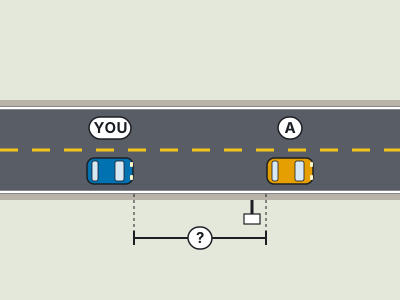
- More time to react to other roadway users
- Permission to ignore speed limits
- A guarantee that a collision cannot occur
- A reason to drive beside another vehicle
Show answer
More time to react to other roadway users. Maintaining at least four seconds behind the vehicle ahead creates a space cushion that gives the driver more time to adjust and react to other roadway users. It does not excuse speeding or guarantee that every collision is impossible. Driving alongside another vehicle concerns side space and blind spots, not the forward gap. To apply the rule, watch the vehicle ahead pass a fixed point, count to one thousand four, and reduce speed if you reach that point sooner. The count is a practical check, not a license to stop paying attention.
Study this in the handbook: Stopping distance, following distance and signaling
15. Which South Carolina applicants must complete the Selective Service supplement?
- All applicants over 18
- Only commercial license applicants
- Male U.S. citizens or immigrants under 26 applying for a permit, license or ID card
- Only applicants born outside the U.S.
Show answer
Male U.S. citizens or immigrants under 26 applying for a permit, license or ID card. You must complete the Supplement for SC Credential Selective Service Requirements if you are a male U.S. citizen or an immigrant less than 26 years of age when applying for a beginner's permit, driver's license or identification card. The SCDMV is required to send your name, address, date of birth, sex, Social Security number and application date to the Selective Service System.
Study this in the handbook: Golf carts, organ donation and other state laws
16. What does South Carolina's implied consent law mean for a driver suspected of impaired driving?
- A licensed driver is exempt from chemical testing
- The driver may choose any test location after leaving the scene
- Only a written confession can authorize testing
- The driver has implicitly consented to a lawfully requested alcohol test
Show answer
The driver has implicitly consented to a lawfully requested alcohol test. By obtaining a driver's license, a person implicitly consents to a lawfully requested breath, blood, or urine test when impaired driving is suspected. The rule does not let a driver postpone testing by choosing a location, replace testing with a confession, or avoid the requirement because a license is valid. Refusing a requested test can lead to loss of the driver's license or driving privileges. A good roadside cue is that implied consent is tied to the privilege of licensing and applies to the state where the arrest occurs.
Study this in the handbook: Alcohol, other drugs and implied consent
17. After an out-of-control acceleration, what must be done before driving the vehicle again?
- Apply the parking brake and resume immediately
- Continue driving after shifting to reverse
- Wait until the fuel tank is empty
- Have the pedal repaired at a service center
Show answer
Have the pedal repaired at a service center. After a vehicle accelerates out of control, the manual says the pedal must be repaired at a service center before the vehicle is driven again. That requirement follows the emergency sequence of turning off the engine, shifting to neutral and searching for an escape path, steering smoothly, braking gently, and pulling off the roadway. Resuming right away, continuing in reverse, or waiting for the fuel to run out does not correct the mechanical problem. The safety cue is repair first, then return to normal driving.
Study this in the handbook: Avoiding collisions and vehicle malfunctions
18. How many collisions occur between cars and commercial vehicles each year, according to the South Carolina manual?
- About 1,000
- More than 250,000
- About 10,000
- About 5 million
Show answer
More than 250,000. More than 250,000 collisions occur between cars and commercial vehicles each year, and many could be avoided by remembering that commercial vehicles are larger, less maneuverable, take longer to stop, and have bigger blind spots than cars. Never enter a roadway or change lanes in front of a large vehicle, and give it room to turn, since a truck or bus may swing wide to the left to make a right turn and a car squeezed in beside it can suffer a serious collision.
Study this in the handbook: Motorcycles and commercial vehicles
19. When following another vehicle at night, when does South Carolina require low beams?
- Only in fog
- When it is more than 1,000 feet ahead
- When the vehicle ahead is less than 200 feet in front of you
- Never while following
Show answer
When the vehicle ahead is less than 200 feet in front of you. South Carolina's night driving tips say to use your low beams when following another vehicle that is less than 200 feet in front of you. The same list says to dim your high beams when you are 500 feet or more away from any oncoming vehicle. In fog, rain or snow, use low beams too, because light from high beams may cause glare and make it harder to see ahead. Some vehicles also have fog lights for those conditions.
Study this in the handbook: Night driving and work zones
20. What does a red traffic light permit a driver to do in South Carolina when no sign prohibits it?
- Continue straight if no car is visible
- Turn left without stopping
- Turn right after stopping and yielding as required
- Make any turn without checking the crosswalk
Show answer
Turn right after stopping and yielding as required. A red signal requires a stop before entering, but an exception permits a right turn where no sign prohibits right on red. The driver must stop before the near-side crosswalk and yield to pedestrians lawfully in or beside it, as well as other lawful intersection traffic. A left turn or straight movement is not created by this exception, and stopping cannot be skipped just because the road looks empty. The cue is stop, check the crosswalk, yield, then turn only if allowed.
Study this in the handbook: Traffic lights
QualitySpace is expanding to South Carolina
We are a California-based independent insurance brokerage working on licensing in more states. We cannot help with South Carolina insurance yet. Leave your email and we will let you know when we can.
Every question is written from the official South Carolina Driver's Manual. Need paper? Printable SC practice test with answer key.
Last verified 2026-10-05. How we check every question · Study all 201 as flashcards
Frequently asked questions
How many questions are on this South Carolina practice test?
This fixed set has 20 questions. It is test 8 of 10 from the 201 question South Carolina bank.
How does this fixed test relate to the full South Carolina bank?
Each numbered test is a fixed set of questions in a fixed order, so you can retake the same test later and compare. Every test mixes road signs and the other topics in about the same proportion as the full bank. Tests 1 to 10 together cover 200 of the 201 questions in the South Carolina bank, each once. The full practice page mixes the whole bank at random.
Last verified 2026-10-05. See the South Carolina DMV facts page for sourced state details.
Return to the full South Carolina practice test · Study road signs