
Test 21 of 25 · 20 questions · Free 2026
SC Permit Practice Test 21
Jump to the test ↓A fixed 20 question set from the South Carolina bank with answers and plain English explanations.
Question 1 of 20 · 0 right so far
All 20 questions in test 21
Every question below comes from the South Carolina question bank on this page. Open a question to see the correct answer and the explanation. Nothing here is hidden behind a signup.
1. You are following a school bus that will soon reach a railroad crossing. What does the South Carolina manual say about your following distance?
- Keep the usual four seconds; buses are easy to see
- Shorten it so other cars do not cut in front
- It does not matter on roads with a crossing gate
- Increase it, because the bus must stop at the crossing
Show answer
Increase it, because the bus must stop at the crossing. Four seconds is the minimum following distance, and the manual lists situations that call for more. One is following vehicles required to stop at railroad crossings, such as transit buses, school buses, and vehicles carrying hazardous materials. Because these vehicles must stop at the crossing, extra room keeps you from being caught close behind them. The same list adds slippery roads, night, fog, inclement weather, and following large vehicles such as trucks, buses, RVs, and vehicles pulling trailers.
Study this in the handbook: Stopping distance, following distance and signaling
2. What does the South Carolina manual call the best way to avoid losing traction from hydroplaning?
- Slow down in rain or on roads with pooled water
- Brake firmly whenever you drive through a puddle
- Use cruise control so your speed stays steady
- Drive faster so the tires cut through the water
Show answer
Slow down in rain or on roads with pooled water. Hydroplaning happens when the steering tires ride on a layer of water on top of the road surface, similar to water skis. The manual says the best way to avoid that loss of traction is to slow down when driving in rain or on roads wet with pooled water or puddles. Driving faster is backwards. Firm braking is not the prevention the manual names, and cruise control is something it tells you to avoid in winter driving conditions.
Study this in the handbook: Visual search and speed management
3. When adjusting your seat, how high should the top of the steering wheel be?
- Level with your eyes so you look over it
- Even with your chin when sitting upright
- No higher than the top of your shoulders
- At least 10 inches above your shoulders
Show answer
No higher than the top of your shoulders. Seat and wheel position affect both control and air bag safety. The manual says the top of the steering wheel should be no higher than the top of your shoulders, with your back against the seat and your feet on the floor. A wheel up at eye or chin level sits above that line. The 10-inch figure in the same list is a different measurement: the minimum space between your chest and the steering wheel, which leaves appropriate space for air bag deployment.
4. Water across a road looks only about six inches deep. What does the South Carolina manual say that depth can do?
- Nothing, since deep water is the real risk to cars
- Slow you down a bit but not affect steering
- Reach most cars' undersides, causing stalls or loss of control
- Affect motorcycles but not passenger cars
Show answer
Reach most cars' undersides, causing stalls or loss of control. Six inches does not sound like much, but the manual says six inches of water will reach the bottom of most passenger cars, causing loss of control or possible stalling. Two feet of moving water can carry away most vehicles. Water can also hide dips and may have washed away the road surface underneath. Even if water appears shallow enough to cross, do not attempt it: turn around and find another route.
Study this in the handbook: Visual search and speed management
5. Why does the South Carolina manual say roundabouts are safer than traditional intersections?
- Drivers skip yielding once they reach the circle
- They allow higher speeds so traffic clears sooner
- They put a traffic signal at every entry point
- They eliminate head-on and high-speed right angle crashes
Show answer
They eliminate head-on and high-speed right angle crashes. The manual compares potential conflict points at traditional intersections with those at roundabouts and concludes that roundabouts are safer because they eliminate head-on and high-speed right angle collisions. They work through lower speeds and yielding: drivers slow down to enter and yield to traffic already circulating counterclockwise around the center island. Higher speeds and skipping the yield would undo that design, and roundabouts are not built around a signal at every entry.
Study this in the handbook: Turns, intersections and roundabouts
6. Snow and ice are on the highway. What does the South Carolina manual say about cruise control?
- Avoid using it in winter driving conditions
- Use it to keep your speed perfectly steady
- Use it on bridges, where ice forms first
- Set it 10 mph below the limit for safety
Show answer
Avoid using it in winter driving conditions. Winter driving calls for slower speeds, slower acceleration, slower steering, and slower braking. The manual's list of winter tips includes avoiding cruise control in winter driving conditions. A steady set speed may sound safe, but the manual instead tells you to test road conditions carefully, apply the brakes gently, approach intersections with caution, and allow additional distance on snow or ice. Bridges deserve extra care because they tend to freeze first.
Study this in the handbook: Rural roads, winter driving and trailers
7. At a rural stop sign with no stop line or crosswalk, a hedge blocks your view of cross traffic from the sign. What should you do after stopping?
- Go now, since you already made your full stop at the sign
- Creep up until you can see, without entering the cross lane
- Pull out into the cross lane so you can see around the hedge
- Honk, then drive through without looking again
Show answer
Creep up until you can see, without entering the cross lane. When there is no stop line or crosswalk, the manual says to stop at the point nearest the intersection where you can see in both directions without entering the cross traffic lane. If a hedge blocks your view from the sign, move up to that point before deciding to go. Pulling into the cross lane puts you in the path of traffic, and a horn is no substitute for looking. Yield to crossing vehicles and pedestrians before proceeding.
Study this in the handbook: Regulatory and guide signs
8. Why does the South Carolina manual say merging early can be a problem when a lane is closed and traffic is backing up?
- It can cause sudden lane switching, crashes, and road rage
- It is against South Carolina law to merge before the merge point
- It makes traffic in the open lane move far too fast
- It wastes more fuel than merging late does
Show answer
It can cause sudden lane switching, crashes, and road rage. The manual explains that the zipper merge asks drivers who were taught to merge early to think differently. According to the manual, early merging can bring unexpected, dangerous lane switching, along with collisions and road rage. Using both lanes until the merge point, then taking turns, reduces those dangers and can shorten the backup. The law does not require the zipper merge, so early merging is not illegal, but the zipper merge is the recommended practice in heavy traffic.
Study this in the handbook: Turnabouts, parking, lane changes and passing
9. Your infant rides in a rear-facing car seat, and the front passenger seat has an active air bag. Where may the seat go?
- In the front seat, if it is pushed all the way back
- In the front seat on short trips around town
- In the back seat, never in front of the air bag
- In either seat, as long as it is installed tightly
Show answer
In the back seat, never in front of the air bag. The manual says you must never place a rear-facing child safety seat in front of an air bag, and children age seven and younger must ride in a car seat in the back seat to avoid air bag injuries in a collision. Moving the front seat back, keeping trips short, or installing the seat tightly does not change that rule. Install the seat properly and follow the vehicle and car seat instructions.
10. Your engine shuts off while you are driving. What should you know about steering?
- It locks completely until the engine restarts
- It becomes lighter, so steer with small motions
- It may be hard to turn, but you can still steer
- It works normally, so no extra effort is needed
Show answer
It may be hard to turn, but you can still steer. If the engine shuts off while you drive, keep a strong grip: the steering wheel may be difficult to turn, but it can still be turned. Look for an escape path, brake with steady pressure rather than braking hard, slow down, and pull off the roadway. Then stop and try to restart the engine. If it will not start, raise the hood, turn on the emergency flashers, and call for help.
Study this in the handbook: Avoiding collisions and vehicle malfunctions
11. Your license requires corrective lenses. What does South Carolina law say about driving without them?
- It is allowed for short trips in your own neighborhood
- It is allowed in daylight if the sun is not in your eyes
- It is allowed if you carry the glasses in the car
- It is unlawful, since you need them to meet the standard
Show answer
It is unlawful, since you need them to meet the standard. A corrective lens restriction is added to your permit or license when you need glasses or contacts to meet the minimum vision standard, which is no greater than 20/40 corrected in one eye. Driving without those lenses is unlawful. Short trips, daylight, or having the glasses somewhere in the car do not change that; the manual says to always wear them when driving. If your vision improves, you need a new eye exam certificate and a renewal to remove the restriction.
Study this in the handbook: Vision rules
12. On a South Carolina multi-lane road, which lane is meant for passing slower vehicles?
- The right-most lane
- The paved shoulder
- The left-most lane
- Any lane that is open
Show answer
The left-most lane. The manual reserves the left-most lane of a multi-lane road for passing slower vehicles. Passing on the right is not the pattern it describes, and the shoulder is never a passing lane, paved or not, because it is meant as an emergency stopping lane. When you pass, do it as quickly and safely as possible, since the longer you stay alongside another vehicle, the longer you may be in its blind spot. Signal 100 feet or more before passing.
Study this in the handbook: Turnabouts, parking, lane changes and passing
13. What are drums, cones, and tubes used for in a South Carolina work zone?
- To show where the work zone speed limit ends
- To mark parking spots for construction crews
- To divide the road into two-way traffic lanes
- To keep traffic out of hazardous work areas
Show answer
To keep traffic out of hazardous work areas. Barriers such as drums, cones, and tubes, also called panels, are used to keep traffic out of hazardous work zones. Along with signs and road markings, they help guide you safely through the zone, and barriers may also keep drivers from entering closed roads or other areas where it is dangerous to drive. Treat them as a boundary you do not cross. The end of the zone is shown by the End Road Work sign, not by the cones.
Study this in the handbook: Warning, railroad and work zone signs
14. You see this orange diamond sign on a two-lane highway. What should you expect ahead?
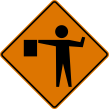
- A railroad crossing with gates
- A person with a flag directing traffic
- A school crossing guard at a crosswalk
- A police checkpoint stopping every car
Show answer
A person with a flag directing traffic. This orange work zone sign shows a flagger symbol and warns that a flagger is ahead. In work zones, traffic may be controlled by a person with a sign or flag who tells you which direction to travel or tells you to slow down or stop, and you must follow those instructions. Orange marks construction, maintenance, or emergency work zones, while school crossings use fluorescent yellow signs and railroad crossings use the round yellow RR sign and the crossbuck.
Study this in the handbook: Warning, railroad and work zone signs
15. This sign appears on a hilly road where you cannot yet see the intersection. What should you do?

- Speed up; you have the right-of-way ahead
- Slow down and get ready to stop at a stop sign
- Expect a traffic signal that may still be showing green
- Yield to traffic merging from the right
Show answer
Slow down and get ready to stop at a stop sign. The small stop sign symbol on this yellow warning diamond tells you a stop sign is ahead. Warning signs give you time to slow down and be prepared to stop. When you reach the intersection, stop behind the stop line or crosswalk, or at the point nearest the intersection where you can see both ways without entering the cross traffic lane, then yield the right-of-way before going.
16. Why does the manual tell you to slow down when driving next to parked or stopped vehicles?
- Pedestrians can walk out from between them
- Passing on that side is not allowed by law
- The pavement beside them is often slippery
- Their drivers have the right to go first
Show answer
Pedestrians can walk out from between them. When driving next to parked or stopped vehicles, the manual says pedestrians can walk out between them. It tells you to slow down and not to pass until you are sure there are no pedestrians crossing in front of the vehicle. The reason is people stepping out, not a legal ban, a slippery surface, or priority for the parked vehicle.
Study this in the handbook: Pedestrians, school zones and speed
17. You are about to turn right from a wide lane onto a narrow side street. How should you make the turn?
- Swing left first to make the turn wider
- Turn from the right-most part of your lane
- Start from the center of the lane and turn sharply
- Use the shoulder to make the turn easier
Show answer
Turn from the right-most part of your lane. The manual's right-turn rule is to start from the right-most portion of your lane and not swing wide to the left first. A narrow side street does not change that. Before turning, search the corners for traffic controls, pedestrians, and other vehicles, and signal your intention. Look through the turn to the farthest point along your path, accelerate smoothly, and make sure your signal cancels.
Study this in the handbook: Turns, intersections and roundabouts
18. Why does the manual tell you to check the sides and rear of your parked car before you open the door?
- A pedestrian may be crossing in front of you
- A bicyclist may be coming up beside the car
- Your mirrors may be blocking the view
- The curb may be too high to step over
Show answer
A bicyclist may be coming up beside the car. When parked on the street, the manual says to check to the sides and rear of the vehicle for bicyclists before you open your vehicle door. A bicyclist could be passing alongside as you open it. The manual's concern here is bicyclists, not a high curb or a blocked mirror. Check before you open the door, not after you have already pushed it into the street.
Study this in the handbook: Motorcycles and commercial vehicles
19. The car ahead is slow, and the road has a shared center left-turn lane. May you use that center lane to pass?
- No, it is for left turns, not for passing
- Yes, if you return to your lane within a block
- Yes, when no one is turning left at that moment
- Yes, but just on roads with three lanes or more
Show answer
No, it is for left turns, not for passing. The Shared Center Lane Left Turn Only sign marks a lane reserved for left-turning vehicles from either direction. The manual states it is not to be used for through traffic or for passing other vehicles. An empty center lane or a short distance does not change its purpose. If you need to pass, do it where passing is permitted, such as when a dashed line is on your side and it is safe.
Study this in the handbook: Regulatory and guide signs
20. A deer jumps out and you need to stop fast in a car with ABS. How do you use the brake pedal?
- Pump it quickly to keep the wheels from locking
- Press hard and keep steady pressure; do not pump
- Press lightly so the car does not skid
- Press, release, and press again every second
Show answer
Press hard and keep steady pressure; do not pump. With ABS, the manual says to press the brake pedal as hard as you can and keep applying constant pressure. Do not pump the brakes, because pumping deactivates ABS. The system lets you stop without skidding and keep steering control, so you can steer around the hazard while braking. You may feel the pedal vibrate and hear clicking; that is normal. Pumping is an old habit for cars without ABS.
Study this in the handbook: Avoiding collisions and vehicle malfunctions
Every question is written from the official South Carolina Driver's Manual. Need paper? Printable SC practice test with answer key.
Last verified 2026-10-05. How we check every question · Study all 500 as flashcards
Frequently asked questions
How many questions are on this South Carolina practice test?
This fixed set has 20 questions. It is test 21 of 25 from the 500 question South Carolina bank.
How does this fixed test relate to the full South Carolina bank?
Each numbered test is a fixed set of questions in a fixed order, so you can retake the same test later and compare. Every test mixes road signs and the other topics in about the same proportion as the full bank. Tests 1 to 25 together cover every question in the South Carolina bank once. The full practice page mixes the whole bank at random.
Last verified 2026-10-05. See the South Carolina DMV facts page for sourced state details.
Return to the full South Carolina practice test · Study road signs