
Test 20 of 25 · 20 questions · Free 2026
SC Permit Practice Test 20
Jump to the test ↓A fixed 20 question set from the South Carolina bank with answers and plain English explanations.
Question 1 of 20 · 0 right so far
All 20 questions in test 20
Every question below comes from the South Carolina question bank on this page. Open a question to see the correct answer and the explanation. Nothing here is hidden behind a signup.
1. Besides reducing injury, what two benefits of safety belts does the South Carolina manual name?
- They lower your insurance rate and prevent tickets
- They protect you from air bags and keep you awake
- They keep you in the car and help you keep control
- They let you sit closer to the wheel and see better
Show answer
They keep you in the car and help you keep control. Studies show that wearing a safety belt in a collision greatly reduces your chances of injury or death. The manual adds two more benefits: belts keep you from being thrown from the vehicle, and they help the driver keep control of the vehicle. That is why it says to always fasten your belt and make sure all passengers use belts or child restraints, even in vehicles equipped with air bags. Insurance rates and tickets are not the benefits it lists.
2. After adjusting your seat, your chest is about 6 inches from the steering wheel. What should you do?
- Leave it, since closer gives better control
- Recline the seat so your chest is farther away
- Move the seat back to at least 10 inches
- Raise the wheel above your shoulders
Show answer
Move the seat back to at least 10 inches. The manual says there should be at least 10 inches between your chest and the steering wheel, which leaves appropriate space for air bag deployment. Six inches is too close, so move the seat back while still being able to steer easily. The manual also says not to recline the seat, and the top of the wheel should be no higher than the top of your shoulders. Adjust the seat and mirrors before you start to drive.
3. A tarp covers the gravel in your truck bed, but some could still sift out through the tailgate. Is the load secure?
- Yes, because it is covered by a tarp
- Yes, if you stay under the speed limit
- Yes, since gravel is too small to matter
- No; nothing may sift, fall, or blow off
Show answer
No; nothing may sift, fall, or blow off. A load is considered secure only when nothing can slide, shift, fall, or sift onto the roadway or become airborne. A tarp helps, but if gravel can still sift out, the load does not meet that standard. Driving slowly does not change the rule, and small material counts. Driving with an unsecured load is against the law and dangerous, so close the gap and double check the load before you leave.
4. How does the South Carolina manual say to grip the steering wheel?
- With your palms pressed against the inside of the rim
- Hooking your thumbs inside the rim for a stronger hold
- With your fingers, thumbs up along the face of the wheel
- With one hand at the top and the other in your lap
Show answer
With your fingers, thumbs up along the face of the wheel. Both hands go on the outside of the steering wheel on opposite sides, with a grip that is firm but gentle. The manual specifies using your fingers rather than your palms and keeping your thumbs up along the face of the wheel. It also says never to turn the wheel while gripping it from the inside of the rim, which rules out palms or thumbs hooked inside. One hand resting in your lap is not normal driving; both hands stay on the wheel except for tasks like shifting or signaling.
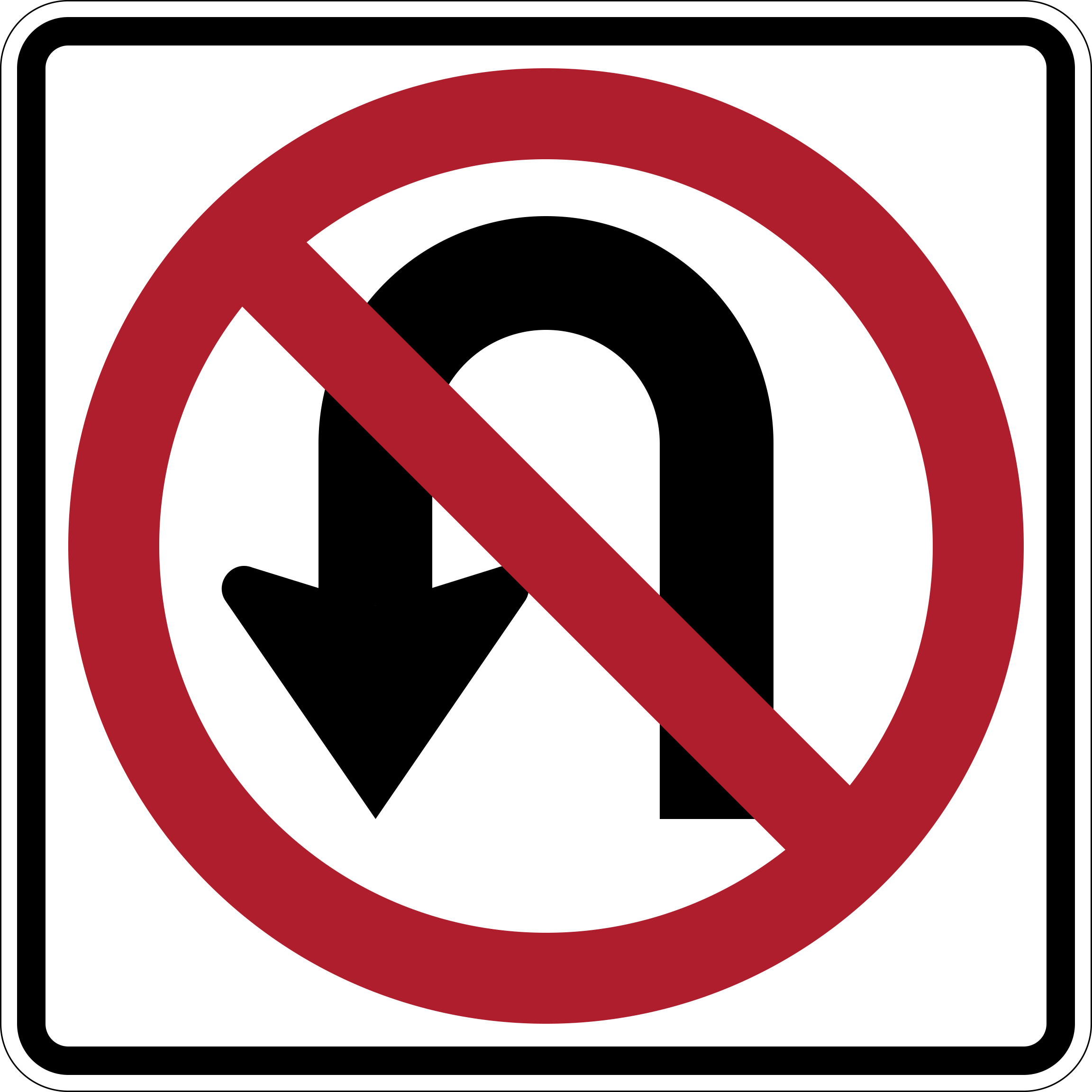
5. You realize you missed your street and see this sign at the next intersection. What may you not do there?
- Turn left onto the cross street
- Turn right onto the cross street
- Continue straight through
- Make a U-turn to go back
Show answer
Make a U-turn to go back. The U-shaped arrow under a red circle and slash is the No U-Turn sign, one of the common regulatory signs in the manual. The red circle and slash prohibit the action shown, so turning around at this location is not allowed. Left turns, right turns, and going straight are not banned by this sign, although other signs or signals may limit them. To get back to your street, continue to a place where turning around is legal, or go around the block.
Study this in the handbook: Regulatory and guide signs
6. You are planning a 400-mile trip. About how often does the South Carolina manual suggest stopping?
- About every 100 miles or 2 hours
- When the fuel tank is nearly empty
- About every 250 miles or 4 hours
- Once, at the halfway point of the trip
Show answer
About every 100 miles or 2 hours. The manual's trip planning tips include stopping about every 100 miles or 2 hours on long trips, so a 400-mile drive calls for several breaks. Waiting until you need fuel or stopping once at the halfway point leaves long stretches without rest. Other tips include getting adequate sleep beforehand, arranging for a travel companion to watch your driving, and checking medication labels for drowsiness warnings.
Study this in the handbook: Fatigue, distraction and the hands free law
7. A temporary traffic signal controls one lane through a work zone and shows red. Where should you stop?
- Right behind the last cone in your lane
- At the white line, if one is present
- Next to the signal pole, wherever it stands
- Beside the first worker you see in the lane
Show answer
At the white line, if one is present. Work zones sometimes use temporary traffic signals, and a warning sign showing a traffic signal symbol may alert you ahead of time. The manual says to stop at the white line if one is present. A temporary signal is obeyed like any other: at red, you stop and wait for green. Cones, the signal pole, or the first worker you see are not the stopping reference when a line is painted on the road.
Study this in the handbook: Warning, railroad and work zone signs
8. Rain is starting to fall as you pass this sign. What should you do?

- Keep your speed but brake harder in curves
- Slow down, since stopping and turning take longer
- Speed up so you spend less time on the wet stretch of road
- Use cruise control to keep a steady pace
Show answer
Slow down, since stopping and turning take longer. This yellow sign with a skidding car warns that the road is slippery when wet. When the roadway is slippery, tires do not grip as well, so it takes longer to stop and it is harder to turn without skidding. Reduce speed at the first sign of rain, increase your following distance, and remember that hard braking after entering a curve can cost you traction. Cruise control is not a substitute for adjusting your own speed.
Study this in the handbook: Visual search and speed management
9. You are driving beside a large truck, just behind its cab on the right side. What does the manual say about that spot?
- The truck driver may not be able to see you there
- The truck driver can see you in the right mirror
- It is the safest place to travel beside a truck
- It is a blind spot only on the left side
Show answer
The truck driver may not be able to see you there. The manual says trucks have a larger blind spot on their right side, starting behind the cab and extending up to the length of the truck. A car there may be hidden from the truck driver. It is not a safe place to travel, and the larger blind spot is on the right, not only the left. Do not linger there.
Study this in the handbook: Motorcycles and commercial vehicles
10. A 20-year-old driver says one sip of beer is fine because it is far below the adult limit. What do zero tolerance laws for drivers under 21 mean?
- Any amount under the adult limit is acceptable
- No alcohol in the driver's circulatory system
- Drinking is fine if you wait one hour per drink
- The law applies to drivers under 18, not 20
Show answer
No alcohol in the driver's circulatory system. All states have zero tolerance laws, or similar laws, for drivers under 21, and the manual explains that zero tolerance means no alcohol in the circulatory system. The adult limit is not the standard for a 20-year-old. In South Carolina, a driver under 21 who registers a BAC of 0.02 percent or greater has the privilege to drive suspended immediately for at least three months. It is also illegal for anyone under 21 to drink alcohol at all.
Study this in the handbook: Alcohol, other drugs and implied consent
11. On a two-lane road, the center has a solid yellow line on your side and a dashed yellow line on the other side. May you pass?
- Yes, since one of the lines is dashed
- No, passing is permitted only from the dashed side
- Yes, if the road ahead looks clear
- Yes, but just during daylight hours
Show answer
No, passing is permitted only from the dashed side. Yellow center lines mark a two-direction roadway. When a dashed line is on your side, passing is permitted when it is safe; when the solid line is on your side, you may not pass, even if the other side has a dashed line. A clear road ahead or daylight does not change a solid line. The manual's sample test makes the same point: a dashed yellow line on your side means passing is permitted on your side.
12. Which emblem on the back of farm equipment warns you it is a slow-moving vehicle?
- A blue square with a white letter H
- A round yellow sign with an X
- A white rectangle with black letters
- An orange and red reflective triangle
Show answer
An orange and red reflective triangle. A fluorescent or reflective orange and red triangle on the rear of an animal-drawn vehicle, farm equipment, or construction equipment means the vehicle travels less than 25 mph. Use caution when approaching and pass only when it is safe. A round yellow sign with an X warns of a railroad crossing, a white rectangle is a regulatory sign, and a blue square with an H marks a hospital route.
Study this in the handbook: Emergency vehicles, traffic stops and the Move Over Law
13. You have a green light, but a car on the cross street is approaching fast and does not seem to be slowing. What should you do?
- Be prepared to stop or avoid a collision
- Proceed, since the other driver must stop
- Speed up to clear the intersection first
- Honk and keep going at your normal speed
Show answer
Be prepared to stop or avoid a collision. Right-of-way rules guide drivers, but the manual warns that no one should assume they automatically have the right-of-way. Do not rely on other road users to obey signals or signs; you can control only your own driving. Some road users may not yield, so be prepared to avoid a collision. Having the green light does not protect you from a driver who fails to stop.
Study this in the handbook: Turns, intersections and roundabouts
14. You are towing a camper on an interstate posted at 70 mph. What top speed does the South Carolina manual recommend for most vehicle-trailer combinations?
- 70 mph, the posted interstate limit
- 65 mph, just under the posted interstate limit
- 45 mph, well below the posted limit
- 55 mph, the recommended towing maximum
Show answer
55 mph, the recommended towing maximum. The manual says the maximum recommended speed for most vehicle-trailer combinations is 55 mph, even where the posted limit is higher, and you must never exceed the posted limit. Driving slower saves fuel and reduces your chances of losing control. If conditions worsen, slow down even more. A combination needs more distance to stop and to pass, so allow extra space and never pass on hills or curves while towing.
Study this in the handbook: Rural roads, winter driving and trailers
15. You swerved right to avoid a hazard and have cleared it. What does the South Carolina manual say to do next?
- Keep steering to the right until the car comes to a full stop
- Brake as hard as possible while still turned right
- Let go of the wheel so it centers on its own
- Steer the opposite way to straighten and regain control
Show answer
Steer the opposite way to straighten and regain control. Quick steering, or swerving, can get you around a problem when stopping is not possible. Keep a good grip with both hands, steer in the direction you want to go while avoiding other traffic, and once you have cleared the problem, steer in the opposite direction to straighten out, gain control, and settle to an appropriate speed. Holding the turn or braking hard while turned does not straighten the car, and letting go of the wheel gives up control entirely.
Study this in the handbook: Avoiding collisions and vehicle malfunctions
16. Why does the South Carolina manual say to avoid driving beside another vehicle for long periods?
- It wastes fuel because of the extra wind resistance
- It is illegal to match another car's speed for long
- You may be in its blind spot with less room to escape
- It makes the other driver think you want to race
Show answer
You may be in its blind spot with less room to escape. Space to the sides gives you room to move right or left. When you ride next to another vehicle for a long time, you may be in that driver's blind spot, and you lose the space you might need to avoid a collision. The concern is visibility and escape room, not fuel or racing, and pacing another car is not described as illegal. The manual also says to avoid crowding the centerline and to make space for vehicles entering a highway.
Study this in the handbook: Stopping distance, following distance and signaling
17. What does the South Carolina manual say about where to keep your eyes while driving?
- Keep them moving and searching for possible problems
- Fix them on the center of the lane just ahead
- Keep them on the vehicle directly in front of you
- Watch the mirrors more than the road ahead
Show answer
Keep them moving and searching for possible problems. A good searching pattern means looking ahead, to the sides, and behind, and using it every time you drive. The manual warns against staring at any one thing, including the lane just ahead or the vehicle in front. Keep your eyes moving and searching for possible problems so you have time to change speed or road position. Ideally look 20 to 30 seconds ahead, and use your mirrors when changing lanes, slowing, or entering an intersection rather than watching them more than the road.
Study this in the handbook: Visual search and speed management
18. You are waiting at a side road to turn. A car coming toward you has had its right signal on for a while, but it has not slowed down. What is the right decision?
- Pull out, because the signal shows where it is going
- Pull out now and turn quickly ahead of it
- Wait until you are sure the car is really turning
- Pull out only if it is still a block away
Show answer
Wait until you are sure the car is really turning. The manual says not to turn into a lane just because an approaching vehicle has a turn signal active. The signal alone is not proof of what the car will do. A car that has not slowed down gives you even less reason to trust it. Wait until you are sure the car is really turning before you pull into the lane.
Study this in the handbook: Turns, intersections and roundabouts
19. Your brakes fail while driving, and the parking brake does not work either. What does the South Carolina manual say to do?
- Shift into park right away to lock the transmission
- Turn off the engine and find a safe place to stop
- Keep driving to a repair shop at a low speed
- Pump the brake pedal faster until the car stops
Show answer
Turn off the engine and find a safe place to stop. If the brakes stop working, the manual's first step is the parking brake, applied slowly so the rear wheels do not lock and skid. If the parking brake does not work either, turn off the engine and look for a safe place to slow to a stop, making sure the vehicle ends up off the roadway. Do not continue to drive without working brakes, even slowly to a repair shop. Shifting into park while moving is not the manual's advice.
Study this in the handbook: Avoiding collisions and vehicle malfunctions
20. You are about to pass a bicyclist on a narrow road. What does the South Carolina manual tell you to do?
- Slow down and leave as much space as possible
- Speed up so you spend less time beside the rider
- Tap the horn so the rider knows you are there
- Pass closely so you do not cross the center line
Show answer
Slow down and leave as much space as possible. When passing a bicyclist, the manual says to slow down, give as much space as possible between your vehicle and the rider, and consider the bicyclist's speed. Speeding past may feel quicker, but it is the opposite of the instruction. The horn is also a poor choice: sounding it close to a bicyclist may startle the rider into steering into your path. Squeezing past to stay off the center line takes away the space the rider needs, so wait until you can pass with room.
Study this in the handbook: Turnabouts, parking, lane changes and passing
Every question is written from the official South Carolina Driver's Manual. Need paper? Printable SC practice test with answer key.
Last verified 2026-10-05. How we check every question · Study all 500 as flashcards
Frequently asked questions
How many questions are on this South Carolina practice test?
This fixed set has 20 questions. It is test 20 of 25 from the 500 question South Carolina bank.
How does this fixed test relate to the full South Carolina bank?
Each numbered test is a fixed set of questions in a fixed order, so you can retake the same test later and compare. Every test mixes road signs and the other topics in about the same proportion as the full bank. Tests 1 to 25 together cover every question in the South Carolina bank once. The full practice page mixes the whole bank at random.
Last verified 2026-10-05. See the South Carolina DMV facts page for sourced state details.
Return to the full South Carolina practice test · Study road signs