
Test 25 of 25 · 20 questions · Free 2026
SC Permit Practice Test 25
Jump to the test ↓A fixed 20 question set from the South Carolina bank with answers and plain English explanations.
Question 1 of 20 · 0 right so far
All 20 questions in test 25
Every question below comes from the South Carolina question bank on this page. Open a question to see the correct answer and the explanation. Nothing here is hidden behind a signup.
1. Which of these counts as a traffic control device under the South Carolina manual?
- Hand waves from another driver offering to let you go
- Advice from a passenger about when to turn
- A GPS voice telling you to turn left ahead
- Directions given by a school crossing guard
Show answer
Directions given by a school crossing guard. The manual's list of traffic control devices goes beyond signals, signs, and pavement markings. It also includes directions given by law enforcement, highway personnel, and school crossing guards, so a guard's direction carries the same weight as a sign. A friendly wave from another driver, a passenger's opinion, or a GPS voice is not on that list and does not give you permission to go. At a school crossing with a traffic patrol, the manual says to stop and yield if you are signaled to do so.
Study this in the handbook: Yielding the right of way
2. Why do you need extra room when turning while towing a trailer?
- Trailer brakes lock up during sharp turns
- Turn signals do not work while towing
- Trailers must stay in the right lane on turns
- The trailer does not follow directly behind the car
Show answer
The trailer does not follow directly behind the car. When you turn with a trailer, the trailer does not follow directly behind your car, so it may require extra room to turn safely. Plan for that space and watch the trailer in clean, undamaged mirrors on both sides, since dirty or inadequate side mirrors restrict what you can see behind you. The manual also reminds you that a vehicle-trailer combination needs more time and distance to stop and to pass, so never pass on hills or curves while towing.
3. You plan to turn right soon and the car behind you is close. What should you do before you slow down?
- Tap your brakes quickly to warn the driver behind
- Signal in advance and leave more space in front
- Brake sharply right before the turn
- Speed up until you are past the turn
Show answer
Signal in advance and leave more space in front. To help the driver behind you stay at a safe distance, the manual suggests keeping a steady speed, signaling in advance, and keeping more space to the front of your vehicle before you reduce speed or turn. For your turn, signal early and open up the gap ahead first. Tapping the brakes or braking sharply is not on the list.
Study this in the handbook: Stopping distance, following distance and signaling
4. A green rectangular sign shows the distance to the next two towns. What type of sign is it?
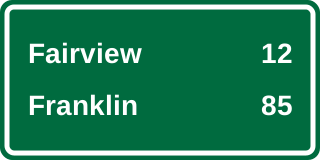
- A warning sign about the road ahead
- A regulatory sign you must obey
- A work zone sign showing a detour
- A guide sign giving route information
Show answer
A guide sign giving route information. Guide signs are square or rectangular and green, brown, or blue. They give information on intersecting roads, help direct you to cities and towns, and show points of interest along the highway. They can also help you find hospitals, service stations, restaurants, and hotels. A green sign with town names and mileage is a typical example. Yellow diamonds are warning signs, white signs are regulatory, and orange signs mark work zones.
Study this in the handbook: Regulatory and guide signs
5. You are in the acceleration lane at 40 mph, and highway traffic is moving at about 65 mph. What should you do?
- Merge now at 40 mph and let others adjust
- Stop at the end of the lane and wait
- Speed up to match traffic, then merge into a gap
- Drive along the shoulder until a big gap opens up
Show answer
Speed up to match traffic, then merge into a gap. The acceleration lane runs alongside the main roadway so you can reach the speed of other vehicles before pulling on. At 40 mph you are much slower than traffic, so use the lane to build speed, identify a gap, merge with the traffic flow, and cancel your turn signal. Pulling in slowly forces others to brake, stopping at the end of the lane makes merging harder, and the shoulder is for emergencies only.
Study this in the handbook: Turnabouts, parking, lane changes and passing
6. You are driving over a bridge on a wet morning when the air temperature is a few degrees above freezing. What does the manual warn about?
- Ice may still be present on a bridge
- The road is safe because it is above freezing
- Ice forms only on dirt or gravel roads
- Ice forms only after the sun goes down
Show answer
Ice may still be present on a bridge. Even at temperatures above freezing, if conditions are wet, you might encounter ice in shady areas or on exposed roadways like bridges. A bridge on a wet morning is such a place, so a reading above freezing does not make the road safe. Ice is not limited to gravel roads or to nighttime. Watch for slick spots in shady areas and on exposed roads even when the air feels warm.
Study this in the handbook: Rural roads, winter driving and trailers
7. You are towing a trailer and come to a long downhill grade. When does the South Carolina manual say to slow down?
- Halfway down, once speed builds
- At the bottom, where the road levels
- Before you start down the hill
- Only if the trailer begins to sway
Show answer
Before you start down the hill. Towing changes how a vehicle handles, and the manual tells you to change your driving to fit it. The recommended maximum for most vehicle-trailer combinations is 55 mph, and you must never exceed the posted limit. When going down a grade, slow down before starting down the hill rather than trying to lose speed partway down. A combination needs more distance to stop, so allow extra space ahead, and reduce speed even more when driving conditions worsen.
Study this in the handbook: Rural roads, winter driving and trailers
8. You are following a large truck about 150 feet back on the interstate. What does the South Carolina manual warn about that position?
- You are safe because trucks see 100 feet behind
- You may be in its rear blind spot, up to 200 feet
- You are close enough to draft and save fuel safely
- You are in the best view of the truck's mirrors
Show answer
You may be in its rear blind spot, up to 200 feet. Unlike cars, large vehicles have huge blind spots directly behind them that extend up to 200 feet. At 150 feet you may be inside that no zone, where the driver cannot see you and you cannot see what is ahead. If the truck brakes or stops suddenly, you have no place to go. Avoid following too closely and position your vehicle so the driver can see it in the side mirrors.
Study this in the handbook: Motorcycles and commercial vehicles
9. White arrows painted in your lane point to the left as you near an intersection. What are they telling you?
- The lane is for left turns
- The lane ends just past the corner
- Passing is permitted in this lane
- Parking is allowed along this lane
Show answer
The lane is for left turns. Pavement markings are lines, arrows, words, or symbols painted on the roadway to give directions or warnings. The manual says they divide lanes, tell you when you may pass or change lanes, tell you which lanes to use for turns, define pedestrian walkways, and show where you must stop for signs or signals. A left arrow in your lane marks it for left turns, so plan your lane position early if you are going straight.
Study this in the handbook: Pavement markings, crosswalks and stop lines
10. Your car keeps accelerating even though your foot is off the gas. What does the South Carolina manual tell you to do first?
- Pump the gas pedal rapidly to free it up
- Turn off the engine, then shift to neutral
- Brake as hard as you can and hold it there
- Shift into park while the car is moving
Show answer
Turn off the engine, then shift to neutral. For a vehicle accelerating out of control, the manual's steps are: turn off the engine, shift to neutral and search for an escape path, steer smoothly, brake gently, and pull off the roadway. Have the pedal repaired at a service center before driving again. Hard braking and shifting into park are not part of this procedure, and pumping the gas pedal does nothing to stop the acceleration.
Study this in the handbook: Avoiding collisions and vehicle malfunctions
11. Under normal circumstances, how should you use your horn to get another road user's attention?
- A light tap is all that is needed
- A long blast so no one can miss it
- Several short blasts in a row
- Hold it until the other driver reacts
Show answer
A light tap is all that is needed. Used properly, your horn gets the attention of other road users, and the manual says a light tap should be all that is needed under normal circumstances. Examples include pedestrians or bicyclists who seem to be moving into your lane, a driver starting to turn into your lane as you pass, or a driver who is not paying attention or may have trouble seeing you. Using the horn inappropriately could scare or anger another road user, so keep it short.
Study this in the handbook: Stopping distance, following distance and signaling
12. A driver took a cold medicine and later blows a BAC of 0.04. Could the driver still be convicted of impaired driving in South Carolina?
- No, a conviction requires a BAC of 0.08 or more
- No, over-the-counter medicine does not count as a drug
- Yes, a low BAC plus drugs can still mean a conviction
- Only if the driver was involved in a collision
Show answer
Yes, a low BAC plus drugs can still mean a conviction. The manual says you can still be convicted of driving impaired with a BAC of only 0.05, or a lower BAC, when it is combined with drugs, including prescription and over-the-counter medications. Cold medicines can make you drowsy on their own, and drugs could multiply the effects of alcohol. A low number on a breath test does not make you safe from a charge, and no collision is needed.
Study this in the handbook: Alcohol, other drugs and implied consent
13. How long should you keep obeying the posted signs in a South Carolina work zone?
- Until you see the End Road Work sign
- Until you pass the last worker you can see
- Until the orange cones stop for a mile
- Until you reach a regular speed limit sign
Show answer
Until you see the End Road Work sign. A work zone does not end when the workers disappear from view. The manual says to observe the posted work zone signs until you see the End Road Work sign. Inside the zone, reduce your speed, increase your following distance, watch the traffic around you, and be prepared to stop. Always reduce your speed in a work zone even if no workers are present, because narrower lanes and rough pavement can still create hazardous conditions.
14. You have a green light and want to turn left, but an oncoming car is approaching the intersection. What must you do?
- Wait for the oncoming car to pass, then turn
- Turn first, since the light is green for you
- Turn quickly before the oncoming car arrives
- Flash your lights and then make your turn
Show answer
Wait for the oncoming car to pass, then turn. A green light lets you go through the intersection if it is clear, but it does not give a left turn priority over oncoming traffic. The manual says that when making a left turn, you yield to oncoming traffic. Wait for a gap large enough to complete the turn and clear the lane. Be especially careful with trucks, which may be going faster than you think, and with motorcycles, which are harder to see.
Study this in the handbook: Turns, intersections and roundabouts
15. You are following a motorcycle on a wet road. What following distance does the South Carolina manual call for?
- About 2 seconds, since motorcycles stop quickly
- One car length for every 10 mph of speed
- At least 4 seconds, and more because the road is wet
- The same 4 seconds you use on a dry road
Show answer
At least 4 seconds, and more because the road is wet. The manual sets a minimum 4 second following distance behind a motorcyclist and says to allow more in wet conditions. Riders may suddenly change speed or lane position to avoid potholes, gravel, wet or slippery surfaces, pavement seams, railroad crossings, and grooved pavement, hazards that can be deadly to a motorcyclist. Two seconds or a car-length rule leaves too little time, and on a wet road the dry-road minimum is not enough.
Study this in the handbook: Motorcycles and commercial vehicles
16. You are turning at an intersection with no painted crosswalk lines, and a pedestrian starts across the street you are entering. What must you do?
- Keep going, since there is no marked crosswalk
- Yield if the pedestrian is a child
- Honk and continue if the person is not in your lane
- Yield; a crosswalk can exist without painted lines
Show answer
Yield; a crosswalk can exist without painted lines. Not all crosswalks are marked. The manual says you must yield when a pedestrian is in a crosswalk, even an unmarked one, and that includes mid-block crosswalks marked by warning signs and pavement markings. At an intersection without painted lines, the crossing still exists, so let the pedestrian cross. Be alert for pedestrians whenever you cross an intersection, and be prepared to yield even outside a crosswalk.
Study this in the handbook: Pedestrians, school zones and speed
17. Barricades block a flooded road on your way home, but the water looks shallow. What should you do?
- Drive around the barricades slowly
- Turn around and find another route
- Follow the car ahead through the water
- Cross if your vehicle sits high off the road
Show answer
Turn around and find another route. If you see a flooded roadway or barricades blocking one, the manual says to find another route to your destination. Even when water appears shallow enough to cross, it can hide dips and other hazards, and floodwater can wash away the road surface underneath. Six inches of water reaches the bottom of most cars, and two feet of moving water can carry away even SUVs and pickups, so a tall vehicle is no protection.
Study this in the handbook: Visual search and speed management
18. You are stopped at a red light when an ambulance with its siren on comes up behind you. What should you avoid as you make room?
- Moving toward the edge of the road
- Staying calm and checking your mirrors
- Pulling into and blocking the intersection
- Letting the ambulance pass before moving on
Show answer
Pulling into and blocking the intersection. When yielding to an emergency vehicle, the manual says to pull over toward the edge of the road and to avoid blocking intersections, roadways, or driveways whenever possible. Rolling forward into the intersection at a red light can put you in the path of cross traffic or in the very space the ambulance needs. Moving to the side, watching your mirrors, and waiting for the ambulance to pass are all part of yielding properly.
Study this in the handbook: Emergency vehicles, traffic stops and the Move Over Law
19. After turning your wheels to park on a hill, what else does the South Carolina manual say to do with a manual-transmission car?
- Leave it in neutral so the wheels rest against the curb
- Set the parking brake and leave it in first or reverse
- Leave the engine idling so the brakes stay powered
- Leave it in second gear with the parking brake off
Show answer
Set the parking brake and leave it in first or reverse. Turning the wheels correctly is just part of parking on a hill. In every case, the manual says to set the parking brake, put the vehicle in the proper gear or park, and turn off the engine. A manual transmission should be left in first or reverse. Neutral lets the car roll, an idling engine is not part of the procedure, and leaving the parking brake off gives up a key safeguard. When leaving the space, signal, check your mirrors and over your shoulder, and yield right of way.
Study this in the handbook: Turnabouts, parking, lane changes and passing
20. At a South Carolina stop sign with no stop line or crosswalk, where should you stop?
- Even with the stop sign post, wherever it is placed
- Where you can see both ways without entering the cross lane
- Inside the cross street so you can see past parked cars
- About 50 feet before the corner of the intersection
Show answer
Where you can see both ways without entering the cross lane. When a stop line or crosswalk is marked, you stop behind it. Without either, the manual says to stop at the point nearest the intersection where you can see in both directions without entering the cross traffic lane. The sign post is not the reference point, and pulling into the cross street to see better puts you in the path of traffic. A spot far back from the corner is not the point nearest the intersection. After stopping, look for crossing vehicles and pedestrians in all directions and yield the right-of-way.
Study this in the handbook: Regulatory and guide signs
Every question is written from the official South Carolina Driver's Manual. Need paper? Printable SC practice test with answer key.
Last verified 2026-10-05. How we check every question · Study all 500 as flashcards
Frequently asked questions
How many questions are on this South Carolina practice test?
This fixed set has 20 questions. It is test 25 of 25 from the 500 question South Carolina bank.
How does this fixed test relate to the full South Carolina bank?
Each numbered test is a fixed set of questions in a fixed order, so you can retake the same test later and compare. Every test mixes road signs and the other topics in about the same proportion as the full bank. Tests 1 to 25 together cover every question in the South Carolina bank once. The full practice page mixes the whole bank at random.
Last verified 2026-10-05. See the South Carolina DMV facts page for sourced state details.
Return to the full South Carolina practice test · Study road signs