
Test 2 of 10 · 20 questions · Free 2026
SC Permit Practice Test 2
Jump to the test ↓A fixed 20 question set from the South Carolina bank with answers and plain English explanations.
Question 1 of 20 · 0 right so far
All 20 questions in test 2
Every question below comes from the South Carolina question bank on this page. Open a question to see the correct answer and the explanation. Nothing here is hidden behind a signup.
1. What area do crosswalks define for pedestrians?
- The shoulder used for disabled vehicles
- A lane reserved for passing trucks
- A place where parking is always required
- The area where pedestrians may cross the roadway
Show answer
The area where pedestrians may cross the roadway. Crosswalks define the area where pedestrians may cross the roadway. A crosswalk is not a passing lane, a mandatory parking space, or a shoulder for disabled vehicles. Drivers should remain alert because not all crosswalks are marked, and they must yield to pedestrians entering or already in a crosswalk. The practical cue is the pedestrian crossing area itself: approach slowly, look for people, and stop behind the line or crosswalk when a sign or signal requires it.
Study this in the handbook: Pavement markings, crosswalks and stop lines
2. Why does the South Carolina manual say not to assume a motorcycle is turning when its signal flashes?
- Motorcycles are not required to have signals
- Motorcycle signals are decorative
- Riders signal only for lane changes
- Motorcycle turn signals may not self cancel and the rider may have forgotten them
Show answer
Motorcycle turn signals may not self cancel and the rider may have forgotten them. Do not assume a motorcycle is turning when you see its turn signal flashing. Motorcycle turn signals may not self cancel, and the rider may have forgotten to turn them off, so wait to be sure the rider is going to turn before you proceed. Allow at least a four second following distance behind a motorcycle, more in wet conditions.
Study this in the handbook: Motorcycles and commercial vehicles
3. What is the proper response when an emergency vehicle approaches from behind with flashing lights and a siren?
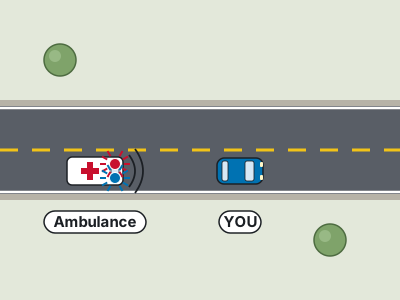
- Stop immediately in the travel lane regardless of location
- Pull over to the edge of the road so it can pass more easily
- Accelerate so the emergency vehicle cannot catch up
- Turn left across traffic to clear the lane
Show answer
Pull over to the edge of the road so it can pass more easily. An approaching emergency vehicle needs a predictable, open path. The manual says you must yield the right-of-way when its flashing lights and siren are on by pulling over to the edge of the road so it may more easily pass, and it adds that you should avoid blocking intersections, roadways, or driveways. Stopping in the lane can block the emergency response, while acceleration creates a moving obstacle. A sudden turn across traffic adds a new conflict. The roadside cue is lights and siren: signal, move to the edge, and let the vehicle clear.
Study this in the handbook: Emergency vehicles, traffic stops and the Move Over Law
4. If a driver under 17 receives six or more points before holding a license for one year, what suspension applies?
- Six months
- Thirty days
- Three months
- One year
Show answer
Six months. The graduated licensing rule calls for a six-month suspension when a driver under 17 receives six or more points before having held the license for one year. Thirty days and three months are shorter penalties than the stated consequence, while one year doubles the period. This is a threshold rule: both the driver's age and the timing of the points matter, not merely the existence of any conviction. For recall, connect six points with six months, and keep that pairing separate from the different point rules applying to older drivers.
Study this in the handbook: Conditional and special restricted licenses
5. How should you pass an animal-drawn vehicle or horseback rider?
- Accelerate close beside the animal
- Sound the horn repeatedly to make the animal move
- Pass cautiously without honking or revving the engine
- Pass on the shoulder whenever possible
Show answer
Pass cautiously without honking or revving the engine. Animal-drawn vehicles and horseback riders share the roadway and can be frightened by sudden noise. Slow down, pass with caution, and do not use the horn or rev the engine because the animal may react unpredictably and cause a collision. Repeated honking is therefore the most dangerous distractor, while accelerating close by reduces the rider’s margin for recovery. The shoulder is not a default passing lane and may be unsafe or unavailable. Approach with patience, leave generous room, and anticipate that an animal-drawn vehicle may turn into a field or driveway.
Study this in the handbook: Emergency vehicles, traffic stops and the Move Over Law
6. How should a driver respond when approaching a flooded roadway or barricade blocking one?
- Stop in the water and wait for traffic
- Drive through if the water appears shallow
- Turn around and find another route
- Follow the vehicle ahead through the flooded area
Show answer
Turn around and find another route. A flooded roadway or a barricade blocking one calls for finding another route to the destination. The manual notes that six inches of water reaches the bottom of most passenger cars and can cause loss of control or stalling, and two feet of moving water can carry away most vehicles, so entering behind another vehicle does not make the crossing safe. Stopping in floodwater adds the risk of stalling or losing control. The concrete cue is a visible flooded road: turn around before entering, choose higher or alternate ground, and never use another driver's crossing as proof that the water is safe for your vehicle.
Study this in the handbook: Visual search and speed management
7. About how many people are injured each year in work zone collisions, according to the South Carolina manual?
- About 500
- Approximately 40,000
- About 5,000
- About 1 million
Show answer
Approximately 40,000. Approximately 40,000 people per year are injured as a result of motor vehicle collisions in work zones, which have become increasingly dangerous for workers and drivers. Watch for signs, cones, barrels, large vehicles and workers. Work zone signs have orange backgrounds, and in a work zone you should reduce speed, increase following distance and be prepared to stop. Endangering a highway worker brings a fine and points.
Study this in the handbook: Night driving and work zones
8. At a red signal, what must happen before a South Carolina driver turns right where no sign forbids the turn?
- Only after the signal changes to green
- Stop first, check that no sign prohibits the turn, and yield before turning
- Whenever the driver sounds the horn first
- Only when another vehicle is turning left
Show answer
Stop first, check that no sign prohibits the turn, and yield before turning. A right turn on red is permitted after the driver stops, unless a sign prohibits the turn, and the driver must yield to pedestrians and other traffic lawfully using the intersection. Waiting for green is unnecessarily restrictive, while a horn or an opposing left turn does not create permission. The stop must occur before the near-side crosswalk, stop line, or intersection as applicable. The quick cue is stop, check the prohibition sign, then yield before turning, rather than treating red as an automatic green for right turns.
Study this in the handbook: Traffic lights
9. A South Carolina driver who is 15 or 16 starts getting points. At what totals does the SCDMV send a letter to drive more carefully?
- Six points
- Twelve points
- Two points and four points
- One point
Show answer
Two points and four points. For drivers 15 or 16, the SCDMV sends a warning letter when the record reaches two points and again at four points. Continued violations can cost the driving privilege. Six points is when a letter goes to drivers 17 or older, and it is also the excessive points level for permit, conditional and special restricted holders. Twelve points is the adult suspension level. One point does not trigger a letter.
Study this in the handbook: The point system and losing your license
10. What do pavement markings do on a South Carolina roadway?
- Replace the need to obey traffic signals
- Give directions or warnings and help control lanes and stopping points
- Guarantee that the roadway is free of hazards
- Identify the registered owner of a vehicle
Show answer
Give directions or warnings and help control lanes and stopping points. Pavement markings are lines, arrows, words, or symbols painted on the roadway to give directions or warnings. They can divide lanes, identify lanes for turns, define pedestrian walkways, and show where a driver must stop for a sign or signal. They supplement the roadway’s traffic controls and do not replace signals or guarantee safe pavement. A marking should be read together with signs, lights, traffic, and weather. The cue is that paint on the road communicates how to use the space ahead.
Study this in the handbook: Pavement markings, crosswalks and stop lines
11. A South Carolina teen is suspended for excessive points. Will completing a defensive driving course reinstate the license?
- Yes, immediately
- Yes, if taken online
- Yes, if the teen is over 16
- No, the course will not reinstate an excessive points suspension
Show answer
No, the course will not reinstate an excessive points suspension. The manual is direct: if you are suspended for excessive points, completing the National Safety Council Defensive Driving Course or an equivalent will not reinstate the suspension. The course can reduce points for other drivers before a suspension begins, but it must be taken in person in South Carolina, not online. Age does not change the rule. The points behind this suspension can also count in a later point system suspension.
Study this in the handbook: The point system and losing your license
12. Is South Carolina's six-month provisional driver's license available for a first DUI committed on or after May 19, 2024?
- Yes, for $100
- Yes, if the BAC was 0.14 or less
- No, it is not available for DUI or DUAC on or after that date
- Yes, after enrolling in ADSAP
Show answer
No, it is not available for DUI or DUAC on or after that date. The six-month provisional license was an option after a first DUI or DUAC suspension if the driver met conditions such as a BAC of 0.14 percent or less, enrollment in ADSAP, and a $100 fee. The manual now states that the provisional license is not available for any DUI or DUAC that takes place on or after May 19, 2024. The $100 fee, the 0.14 limit, and ADSAP enrollment were conditions of the old option, so none makes a post-cutoff driver eligible.
Study this in the handbook: Provisional and temporary alcohol licenses
13. How does South Carolina classify bicycles when they are traveling on roadways?
- As vehicles
- As stationary hazards
- As emergency vehicles
- As pedestrians in every situation
Show answer
As vehicles. Bicycles are considered vehicles when they are on roadways, and riders are expected to follow the same rules of the road as motorized vehicles. Calling every bicycle a pedestrian would overlook that roadway status. Emergency-vehicle treatment and stationary-hazard treatment are also unrelated. The driving cue is to scan for bicycles at intersections, yield as required, and give them room rather than assuming a motorist always has priority.
Study this in the handbook: Yielding to pedestrians and bicyclists
14. What does the South Carolina manual say about driving on a one-way street?
- Never drive the wrong way on it, and do not turn against the arrow
- Driving against the arrow is allowed for a short distance to reach a driveway
- Turning against the arrow is allowed when no traffic is visible
- Driving the wrong way is allowed at night if hazard lights are on
Show answer
Never drive the wrong way on it, and do not turn against the arrow. ONE WAY signs tell you that traffic flows only in the direction of the arrow, and the manual adds two plain commands: do not turn in the opposite direction of the arrow, and never drive the wrong way on a one-way street. The manual lists no exception for a short trip to a driveway, for an empty street, or for driving at night with hazard lights on. Before turning onto any street, look for the arrow and turn only in the direction it points, because drivers coming the other way do not expect to meet you head on.
Study this in the handbook: Regulatory and guide signs
15. What should a driver do after seeing a warning sign for a possible hazard ahead?

- Accelerate to clear the area before the hazard
- Slow down and be prepared to stop
- Pass without checking because the sign gives priority
- Stop only after reaching the hazard
Show answer
Slow down and be prepared to stop. The manual says warning signs may tell drivers to slow down and be prepared to stop when a hazard or special roadway situation lies ahead. The instruction applies before reaching the hazard, giving the driver time to assess traffic and roadway conditions. Accelerating reduces that margin, and a warning sign does not grant passing priority. Waiting until the hazard is reached is also too late for a controlled response. Use the sign as an advance cue, adjust speed smoothly, and keep a clear path for stopping.
Study this in the handbook: Traffic lights
16. What information can the shape, color, symbols, and words on this curve warning sign provide?

- Clues about the type of information the sign provides
- Proof that every driver must stop immediately
- The exact number of miles to the next town
- Permission to ignore the roadway ahead
Show answer
Clues about the type of information the sign provides. The manual teaches drivers to read several features together. A sign's shape, color, symbol, and wording provide clues about whether it warns, regulates, guides, or identifies a service. On the illustrated yellow curve sign, the curved arrow gives advance information about the road's path. It is not a stop command, a mileage marker, or permission to disregard conditions. Treat the sign as an early visual prompt: check the lane, look through the bend, and choose a speed that leaves room for the curve and any traffic beyond it.
Study this in the handbook: Traffic lights
17. When approaching a stopped authorized emergency vehicle in South Carolina, what should a driver do if traffic and safety permit?
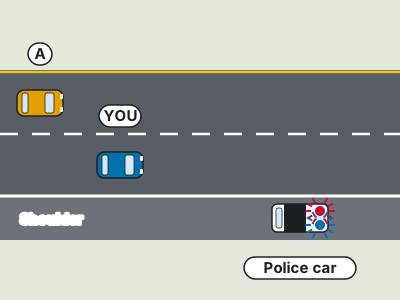
- Change lanes away from the emergency vehicle while slowing and yielding
- Maintain speed in the nearest lane and sound the horn
- Stop beside the emergency vehicle so traffic can pass
- Move toward the emergency vehicle before changing lanes
Show answer
Change lanes away from the emergency vehicle while slowing and yielding. The Move-Over Law guidance combines three actions: approach cautiously, slow down, and yield by moving into a lane away from the stopped authorized emergency vehicle when conditions make that safe. Staying beside the vehicle at the same speed leaves the people working there exposed. Stopping next to the vehicle can also obstruct the scene. The visual cue is the stopped emergency vehicle: create lateral space when possible, while preserving control and watching surrounding traffic.
Study this in the handbook: Emergency vehicles, traffic stops and the Move Over Law
18. How much does South Carolina charge for a new license with a special restricted waiver added?
- $50
- $15
- $25
- $100
Show answer
$25. Adding the waiver to a new license costs $25. The $15 and $50 amounts are not the fee named for this transaction, while $100 belongs to other license-related circumstances in the manual. The fee is only one part of the application: the applicant must also complete the required forms, bring activity and parental letters, pass the vision test, and visit an SCDMV branch. Pair the waiver fee with its documentation requirements.
Study this in the handbook: Conditional and special restricted licenses
19. How recent must a Certificate of Vision Examination be for the SCDMV to accept it?
- Within 30 days
- Within 12 months
- Within 5 years
- Dated within the past 36 months
Show answer
Dated within the past 36 months. The SCDMV offers vision screening at all branches, but it may accept a Certificate of Vision Examination from a licensed eye care professional if it is dated within the past 36 months. South Carolina licensed professionals submit the certificate through the SCDMV online portal, and out of state professionals complete the paper form. Effective May 18, 2024, standard certificates are valid for 36 months.
Study this in the handbook: Vision rules
20. Before entering where a yield sign controls your approach, what must happen?
- All approaching vehicles must stop for the yielding driver
- The driver must turn on hazard flashers and accelerate
- The driver may enter immediately if traveling below 20 mph
- Traffic with the right-of-way must be allowed to cross first
Show answer
Traffic with the right-of-way must be allowed to cross first. Yielding is about priority, not a fixed speed. The driver facing the sign must slow down and allow traffic that has the right-of-way to cross before entering. A low speed alone does not satisfy the rule if another vehicle or pedestrian still has priority. Hazard flashers and acceleration do not transfer right-of-way, and other vehicles are not required to stop simply because you are yielding. Look for conflicting traffic, stop if necessary, and enter only when the crossing movement is clear.
Study this in the handbook: Regulatory and guide signs
QualitySpace is expanding to South Carolina
We are a California-based independent insurance brokerage working on licensing in more states. We cannot help with South Carolina insurance yet. Leave your email and we will let you know when we can.
Every question is written from the official South Carolina Driver's Manual. Need paper? Printable SC practice test with answer key.
Last verified 2026-10-05. How we check every question · Study all 201 as flashcards
Frequently asked questions
How many questions are on this South Carolina practice test?
This fixed set has 20 questions. It is test 2 of 10 from the 201 question South Carolina bank.
How does this fixed test relate to the full South Carolina bank?
Each numbered test is a fixed set of questions in a fixed order, so you can retake the same test later and compare. Every test mixes road signs and the other topics in about the same proportion as the full bank. Tests 1 to 10 together cover 200 of the 201 questions in the South Carolina bank, each once. The full practice page mixes the whole bank at random.
Last verified 2026-10-05. See the South Carolina DMV facts page for sourced state details.
Return to the full South Carolina practice test · Study road signs