
Test 5 of 10 · 20 questions · Free 2026
SC Permit Practice Test 5
Jump to the test ↓A fixed 20 question set from the South Carolina bank with answers and plain English explanations.
Question 1 of 20 · 0 right so far
All 20 questions in test 5
Every question below comes from the South Carolina question bank on this page. Open a question to see the correct answer and the explanation. Nothing here is hidden behind a signup.
1. If a disabled vehicle is stopped on a highway, how far behind it should emergency flares be placed when available?
- Directly beneath the rear bumper
- About 20 to 30 feet
- At least one mile
- About 200 to 300 feet
Show answer
About 200 to 300 feet. Emergency flares create an advance warning zone for approaching drivers. The manual recommends placing them about 200 to 300 feet behind a disabled vehicle, giving other road users time to change lanes if necessary. A distance of 20 to 30 feet may leave almost no reaction time, while one mile is far beyond the stated guidance. Placing a flare under the bumper provides no useful warning. First get the vehicle away from traffic when possible, activate the flashers, and only place warnings when doing so can be done safely.
Study this in the handbook: Avoiding collisions and vehicle malfunctions
2. What is the average perception time for an alert driver, according to the South Carolina manual?
- One tenth of a second
- 5 seconds
- Three quarters of a second to 1 second
- 10 seconds
Show answer
Three quarters of a second to 1 second. Perception time is the time and distance it takes to recognize you must stop, and the average for an alert driver is three quarters of a second to 1 second. Reaction time, moving your foot from the gas to the brake, takes about the same. Braking distance is added on top; at 50 mph on dry pavement with good brakes it can take about 158 feet.
Study this in the handbook: Stopping distance, following distance and signaling
3. A driver age 17 or younger must hold a beginner's permit for how long before applying for a license?
- At least 90 days
- At least 30 days
- At least 180 days
- At least one year
Show answer
At least 180 days. For a driver who is 17 or younger, the beginner's permit must be held for at least 180 days before an application for a license can be made. The 30-day period belongs to applicants age 18 or older, so it is the most likely mix-up in this question. Ninety days and one year are not the waiting periods stated for this step. A useful memory cue is that the younger applicant waits through 180 days and may apply on day 181 or later, while the adult applicant follows the shorter 30-day rule.
Study this in the handbook: License classes and the beginner's permit
4. For a driver under 21 in South Carolina, what is the minimum loss of driving privileges after refusing an intoxicant test?
- At least three days
- At least six months
- At least three months
- No loss of privileges
Show answer
At least six months. Refusing the test causes an immediate loss of driving privileges for at least six months under the manual's under-21 rule. Three months is the minimum tied to registering a BAC of 0.02 percent or greater, so it describes a different event. A three-day period and no suspension understate the consequence. The comparison cue is simple: under 21, a test result at or above 0.02 brings three months, while refusal brings the longer six-month minimum.
Study this in the handbook: Alcohol, other drugs and implied consent
5. What is one purpose of pavement markings on a South Carolina roadway?
- They guarantee that the pavement is dry and free of hazards
- They replace every traffic signal at an intersection
- They can tell drivers when passing or lane changes are permitted
- They identify the registered owner of the vehicle ahead
Show answer
They can tell drivers when passing or lane changes are permitted. Road markings do more than decorate the pavement. They divide lanes, communicate when passing or changing lanes is allowed, identify turn lanes, define pedestrian areas, and show where a driver must stop for a sign or signal. They do not replace traffic lights, certify road conditions, or identify another vehicle's owner. When markings are present, read them as part of the traffic-control system. Before crossing a line or using a lane, confirm that the marking permits the movement and that surrounding traffic is clear.
Study this in the handbook: Pavement markings, crosswalks and stop lines
6. When should a driver assume that another road user has automatically yielded the right-of-way at an intersection?
- Never; consider the situation and circumstances at each intersection
- Whenever the driver is traveling on the wider road
- Whenever the vehicle is larger
- Whenever the driver reaches the intersection quickly
Show answer
Never; consider the situation and circumstances at each intersection. The manual warns against assuming automatic priority. Drivers must evaluate the actual situation and circumstances at each intersection, including other vehicles, pedestrians, signs, and traffic signals. Road width, vehicle size, or arrival speed does not create the blanket rule described by the other choices. The useful habit is to reduce speed, scan the intersection, and be prepared to yield even when a driver believes another person should yield first.
Study this in the handbook: Yielding the right of way
7. What is the purpose of the warning-sign examples that include a curvy road and right curve?

- To announce that the road has become a one-way street
- To alert drivers to possible danger or a special roadway situation ahead
- To identify the nearest hospital or service station
- To mark the end of all passing restrictions
Show answer
To alert drivers to possible danger or a special roadway situation ahead. The curvy-road and right-curve illustrations are examples of warning signs. Their purpose is advance notice of a condition that may require a driver to slow, steer carefully, or prepare to stop. They do not change the road to one-way operation, point to a service, or cancel passing rules. The useful habit is to react before the curve arrives: scan the pavement and traffic, reduce speed while the vehicle is straight, and keep attention on the next visible part of the roadway.
Study this in the handbook: Traffic lights
8. What posted speed limit applies to the secondary streets and highways where South Carolina golf carts may operate?
- Any posted speed
- Forty-five miles an hour or less
- Fifty-five miles an hour or less
- Thirty-five miles an hour or less
Show answer
Thirty-five miles an hour or less. Golf carts may use only secondary streets and highways with posted speed limits of 35 miles an hour or less. A 45 or 55 mile limit exceeds the manual's ceiling, and an unrestricted route ignores the road-type and speed condition. This restriction is separate from the four-mile daytime distance rule and the driver's license requirement. Check both the road classification and the posted number before entering the roadway.
Study this in the handbook: Golf carts, organ donation and other state laws
9. When a traffic signal flashes yellow, what action is required?
- Stop and wait for a green light
- Slow down and proceed with caution
- Accelerate before cross traffic enters
- Turn without checking the intersection
Show answer
Slow down and proceed with caution. A flashing yellow traffic light means slow down and proceed with caution. The driver should also be prepared to stop for traffic entering the intersection. A complete stop followed by waiting for green describes neither the stated flashing-yellow instruction nor the ordinary meaning of this signal. Accelerating reduces the time available to react, and turning without checking ignores the need to watch entering traffic. Treat the yellow flash as a warning to reduce speed, scan the intersection, and keep enough control to stop if another road user appears.
Study this in the handbook: Traffic lights
10. Which state's implied consent law applies when a driver is arrested for suspected impaired driving?
- The state that issued the driver's license
- The state where the arrest occurred
- The driver's state of birth
- The state where the vehicle was purchased
Show answer
The state where the arrest occurred. The manual explains that implied-consent law is applied by the state where the driver was arrested, rather than the state that issued the license. The license-issuing state is the tempting alternative because licensing normally follows the home jurisdiction, but this rule follows the arrest location. Birthplace and vehicle purchase have no role in the stated choice of law. For test questions, identify the arrest state first when an implied-consent issue crosses state lines.
Study this in the handbook: Alcohol, other drugs and implied consent
11. A South Carolina conditional license holder wants to drive at 9 p.m. in winter. What is required?
- A licensed driver who is at least 21 in the vehicle
- Nothing, the teen may drive alone
- A waiver letter from any teacher
- The teen may not drive at all until 6 a.m.
Show answer
A licensed driver who is at least 21 in the vehicle. With a conditional or special restricted license, the teen may drive with a licensed driver who is at least 21 from 6 p.m., or 8 p.m. during daylight saving time, until midnight. At 9 p.m. in winter that supervision is required. Driving alone ends at 6 p.m. outside daylight saving time. A waiver comes only with a special restricted license and needs school or work and parent letters. A complete ban until morning is too strict.
Study this in the handbook: Conditional and special restricted licenses
12. A South Carolina driver age 17 or older reaches six points. What does the SCDMV do?
- Sends a letter to drive more carefully
- Suspends the license for six months
- Revokes the license
- Requires a new road test
Show answer
Sends a letter to drive more carefully. For drivers 17 or older, six or more points bring a warning letter from the SCDMV, and a suspension comes when the total reaches 12 or more. A six-month suspension is the penalty for a driver under 17 who gets six or more points in the first year of licensing. Revocation and a new road test are not the six point response. Points are also cut in half one year after the violation date.
Study this in the handbook: The point system and losing your license
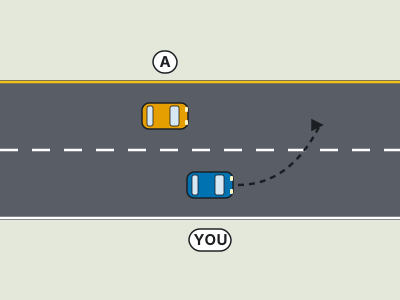
13. When changing lanes, which action helps a driver check an area hidden from the mirrors?
- Turn on the hazard flashers and move immediately
- Rely on the rearview mirror without turning the head
- Brake hard before crossing the lane line
- Look over the shoulder toward the intended lane
Show answer
Look over the shoulder toward the intended lane. The blind spot can hide a vehicle beside the car, so a mirror check alone is incomplete. Turning the head to look over the shoulder supplements the mirrors before the lane movement begins. Braking hard does not reveal the hidden area and may surprise following traffic. Hazard flashers are not a substitute for a deliberate signal and visual check. The practical cue is mirror, signal, shoulder check, then move when the path is clear.
Study this in the handbook: Turnabouts, parking, lane changes and passing
14. What action is required by a red octagonal stop sign?
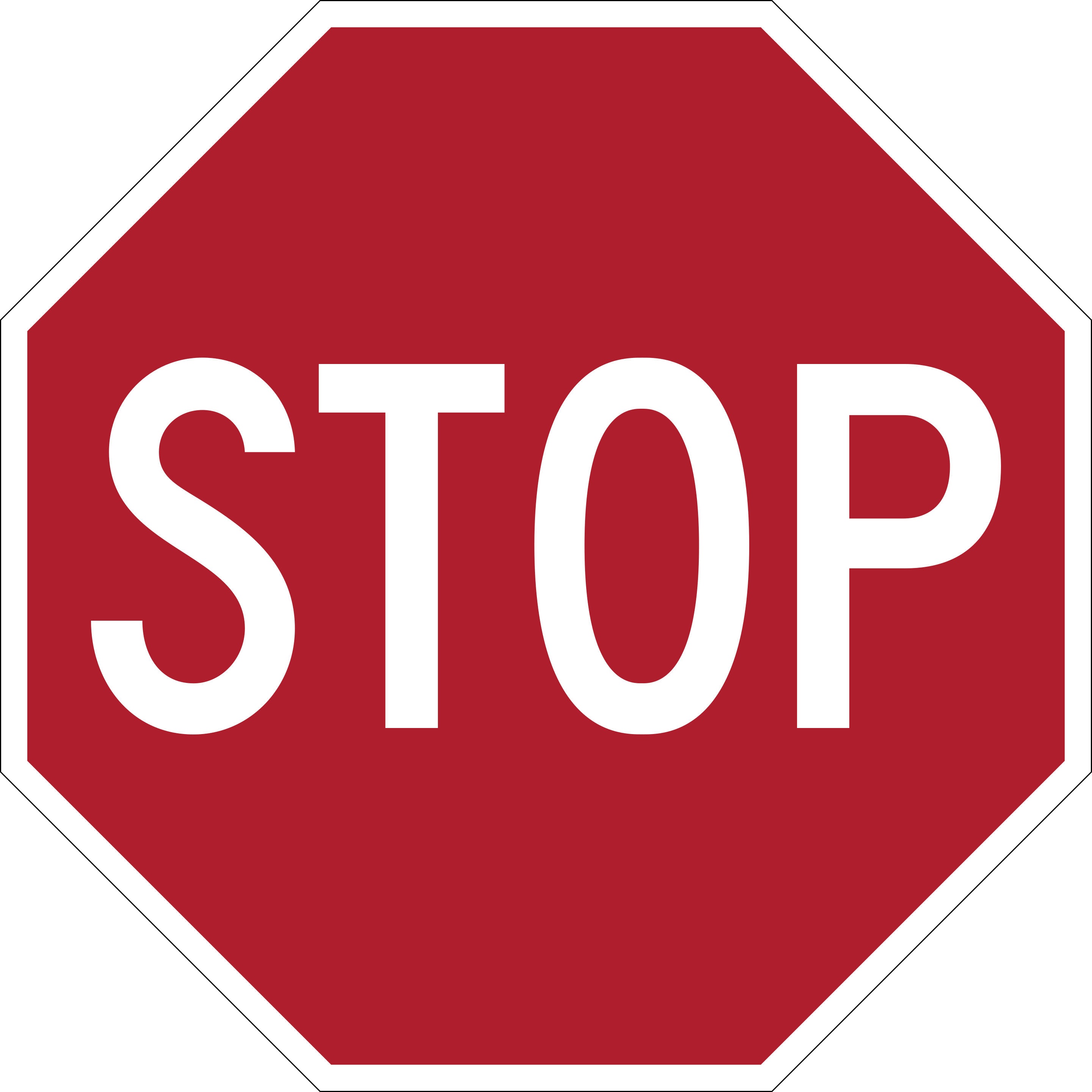
- Come to a complete stop before entering the intersection
- Reduce speed and continue if no vehicle is visible
- Stop only after entering the crosswalk
- Yield without stopping unless a pedestrian is present
Show answer
Come to a complete stop before entering the intersection. The octagonal shape is reserved for a stop instruction, so the vehicle must halt before entering the intersection. Rolling through after a speed reduction does not provide the required stop. Entering the crosswalk first places the vehicle beyond the safe stopping point. A yield without a stop changes the sign’s command. At an intersection, use the cue of the stop line or crosswalk, then check both directions before moving.
Study this in the handbook: Regulatory and guide signs
15. Which action is recommended after a tire suddenly goes flat?
- Stop in the travel lane and wait for help
- Brake hard and turn sharply toward the shoulder
- Accelerate until the tire regains pressure
- Grip the steering wheel firmly and keep the vehicle going straight
Show answer
Grip the steering wheel firmly and keep the vehicle going straight. A sudden loss of tire air can make the vehicle pull or wobble. A firm grip and a straight path reduce the chance of a panic correction while the driver begins a gradual slowdown. Hard braking and a sharp turn can upset the vehicle, and acceleration cannot restore a flat tire. Stopping in the lane exposes the vehicle to traffic. The cue is control first, then ease off the accelerator and move to a safe place.
Study this in the handbook: Avoiding collisions and vehicle malfunctions
16. What is the maximum recommended speed for most vehicle and trailer combinations in South Carolina?
- 70 mph
- 45 mph
- 55 mph
- The posted limit plus 5
Show answer
55 mph. Drive more slowly when towing. The maximum recommended speed for most vehicle and trailer combinations is 55 mph, which saves fuel and reduces the chance of losing control, and you must never exceed the posted limit. Reduce speed further when conditions worsen, allow extra space behind the vehicle ahead, and have plenty of clear highway ahead before passing, because a towing vehicle needs more time and distance to pass. Never pass on hills or curves while towing.
Study this in the handbook: Rural roads, winter driving and trailers
17. What testing is required when a South Carolina driver's license has been expired for more than nine months?
- Vision, knowledge, and skills tests
- Only a vision screening
- Only the knowledge test
- No testing if the address is unchanged
Show answer
Vision, knowledge, and skills tests. An expiration longer than nine months requires a branch visit and three tests: vision, knowledge, and skills. A vision-only or knowledge-only response leaves out required parts of the process. The no-testing option confuses an unchanged address with eligibility to renew without tests. Keep the threshold in mind as a switch: nine months or less permits branch renewal without testing, but more than nine months activates the full testing requirement.
Study this in the handbook: Knowledge and skills tests, moving and renewal
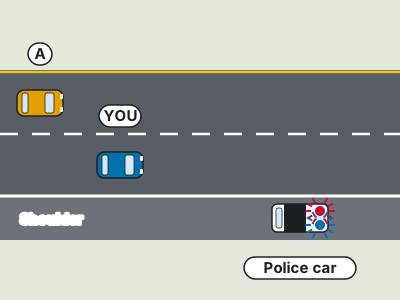
18. If moving into another lane is unsafe near a stopped authorized emergency vehicle, how should a South Carolina driver proceed?
- Keep the original speed because a lane change is unavailable
- Slow down and proceed cautiously at a safe speed for traffic conditions
- Stop in the travel lane until the emergency vehicle leaves
- Accelerate past the scene before another vehicle approaches
Show answer
Slow down and proceed cautiously at a safe speed for traffic conditions. The alternative to an unsafe lane change is not to keep speed or stop in the roadway. The driver should slow down and continue with caution at a speed suited to the traffic conditions. That preserves room to react while avoiding a maneuver that could create a second collision. Accelerating past the scene defeats the protective purpose of the law. When the lane change cannot be made safely, reduce speed first, then scan for workers, equipment, and nearby traffic.
Study this in the handbook: Emergency vehicles, traffic stops and the Move Over Law
19. Which type of information can South Carolina guide signs provide?
- Only penalties for traffic violations
- Only warnings about slippery pavement
- Directions to cities, towns, roads, and roadway services
- The driver's blood alcohol concentration
Show answer
Directions to cities, towns, roads, and roadway services. Guide signs direct drivers to intersecting roads, cities, towns, and points of interest. They can also help locate hospitals, service stations, restaurants, and hotels. Slippery pavement belongs to warning information, traffic penalties belong to law enforcement or regulatory material, and a driver's blood alcohol concentration is unrelated to roadway signs. The cue is navigation: use green, brown, or blue guide information to stay oriented and find a destination or service along the route.
Study this in the handbook: Regulatory and guide signs
20. Which teen is within the age range for a South Carolina conditional license?
- A driver who is 17 or older
- A driver who is 14 but under 15
- A driver who is 16 and a half but under 17
- A driver at least 15 and a half but under 16
Show answer
A driver at least 15 and a half but under 16. The conditional-license stage is for a teen who has reached 15 and a half but has not yet turned 16, provided the listed requirements are met. The other age ranges fall below, above, or outside this specific stage. Age alone does not issue the credential, since vision and skills testing also apply. For studying the graduated sequence, place conditional licensing between the beginner’s permit period and the later special restricted stage.
Study this in the handbook: Conditional and special restricted licenses
QualitySpace is expanding to South Carolina
We are a California-based independent insurance brokerage working on licensing in more states. We cannot help with South Carolina insurance yet. Leave your email and we will let you know when we can.
Every question is written from the official South Carolina Driver's Manual. Need paper? Printable SC practice test with answer key.
Last verified 2026-10-05. How we check every question · Study all 201 as flashcards
Frequently asked questions
How many questions are on this South Carolina practice test?
This fixed set has 20 questions. It is test 5 of 10 from the 201 question South Carolina bank.
How does this fixed test relate to the full South Carolina bank?
Each numbered test is a fixed set of questions in a fixed order, so you can retake the same test later and compare. Every test mixes road signs and the other topics in about the same proportion as the full bank. Tests 1 to 10 together cover 200 of the 201 questions in the South Carolina bank, each once. The full practice page mixes the whole bank at random.
Last verified 2026-10-05. See the South Carolina DMV facts page for sourced state details.
Return to the full South Carolina practice test · Study road signs