
Test 3 of 10 · 20 questions · Free 2026
SC Permit Practice Test 3
Jump to the test ↓A fixed 20 question set from the South Carolina bank with answers and plain English explanations.
Question 1 of 20 · 0 right so far
All 20 questions in test 3
Every question below comes from the South Carolina question bank on this page. Open a question to see the correct answer and the explanation. Nothing here is hidden behind a signup.
1. Which South Carolina license class covers a non commercial single unit vehicle over 26,000 pounds, such as a large motor home?
- Class D
- Class M
- Class A
- Class E
Show answer
Class E. Class E allows you to operate non commercial single unit vehicles that exceed 26,000 pounds GVW, such as large trucks and motor homes, and the holder may also operate a moped or three wheel vehicle. Class F is for non commercial combination vehicles over 26,000 pounds, and Class D covers ordinary cars and trucks up to that weight. Commercial vehicles need a CDL class.
Study this in the handbook: License classes and the beginner's permit
2. A South Carolina conditional license holder has no licensed adult in the car. When may the teen carry more than two passengers under 21?
- Never, under any circumstances
- On weekends only
- When transporting family members or students to and from school
- When all passengers are over 16
Show answer
When transporting family members or students to and from school. A conditional or special restricted license holder cannot have more than two passengers under 21 unless a licensed adult at least 21 is in the vehicle. The only exception is transporting family members or students to and from school. Saying never ignores that exception. Weekends and passenger age over 16 are not exceptions in the manual. After midnight, the teen must also be supervised by one of the licensed individuals listed in the code.
Study this in the handbook: Conditional and special restricted licenses
3. When operating a motor vehicle in South Carolina, what cellphone use is unlawful under the general distracted-driving rule?
- Speaking to a passenger while the vehicle is moving
- Using a hands-free voice call through an earpiece
- Listening to navigation directions through the vehicle speakers
- Using a wireless electronic communication device when it requires either hand
Show answer
Using a wireless electronic communication device when it requires either hand. South Carolina makes it unlawful to use a wireless electronic communication device while operating a motor vehicle when the use requires either hand. The earpiece choice describes a hands-free voice communication that the later hands-free law does not restrict. Navigation audio and ordinary conversation with a passenger do not match the prohibited device handling described here. The concrete cue is physical involvement: if the communication requires a hand on the wireless device, it creates the condition the rule addresses, even if the driver intends to use it only briefly.
Study this in the handbook: Fatigue, distraction and the hands free law
4. How long must a learner hold a beginner’s permit before applying for a driver’s license at age 18 or older?
- At least 30 days, with application on the 31st day or later
- At least 60 days, with application on the 61st day
- At least 180 days, with application on the 181st day
- No holding period applies after the applicant turns 18
Show answer
At least 30 days, with application on the 31st day or later. An applicant who is 18 or older must hold the beginner’s permit for at least 30 days before applying for a driver’s license. The manual allows the application on the 31st day or any later date. The 180-day period belongs to applicants who are 17 or younger, so using that figure here mixes two age groups. The cue is adult applicant, thirty days held, apply beginning day thirty-one.
Study this in the handbook: License classes and the beginner's permit
5. What must a person have to drive a golf cart on a South Carolina public road?
- Only parental permission at any age
- A beginner's permit at age 14
- A valid driver's license and age of at least 16
- A commercial driver license at age 18
Show answer
A valid driver's license and age of at least 16. South Carolina sets two basic driver conditions for a golf cart: the operator must be at least 16 and must hold a valid driver's license. A beginner's permit does not replace the license requirement, and parental approval cannot lower the age threshold. A commercial credential is not the stated standard. Before driving, also confirm that the cart carries its required permit or registration decal and that the route meets the manual's daytime road and distance restrictions.
Study this in the handbook: Golf carts, organ donation and other state laws
6. Who generally has the right-of-way on a narrow or single-lane bridge?
- The vehicle closest to the bridge center
- The driver traveling at the higher speed
- The larger vehicle in every case
- The driver who reaches the bridge first
Show answer
The driver who reaches the bridge first. On a narrow or single-lane bridge, the manual says drivers generally take turns and the first driver to reach the bridge has the right-of-way. Speed does not create priority, and vehicle size is not the deciding rule. The driver approaching second should slow, watch the bridge entrance, and wait rather than forcing two vehicles into a space that cannot accommodate them. Reduce speed early because a warning sign, limited sight distance, or bridge surface may require extra control. The cue is first to the bridge, then proceed carefully and give the other driver room.
Study this in the handbook: Rural roads, winter driving and trailers
7. What are pavement markings used to communicate to drivers?
- Restaurant menus and fuel prices
- Directions or warnings about roadway use
- Only the names of nearby towns
- Personal messages from other drivers
Show answer
Directions or warnings about roadway use. Pavement markings communicate directions or warnings on the roadway. Lines, arrows, words, and symbols can organize lanes, identify turn use, mark pedestrian areas, and show where a stop is required. Restaurant menus, fuel prices, town names, and personal messages belong nowhere in this marking system. The practical cue is to treat painted roadway information as an operating instruction: read it before changing position, turning, passing, or stopping.
Study this in the handbook: Pavement markings, crosswalks and stop lines
8. At what blood alcohol content does the South Carolina manual say vision is impacted for all drivers?
- 0.08 percent
- 0.02 percent
- 0.15 percent
- 0.05 percent
Show answer
0.02 percent. Alcohol blurs vision, slows focusing, causes double vision, and reduces the ability to judge distance, speed and movement. The manual says vision is impacted at 0.02 percent BAC for all drivers, not only young ones. Point zero eight is the general per se limit, 0.15 is the high BAC suspension level, and 0.05 is a level at which the manual warns a driver can still be convicted of impaired driving.
Study this in the handbook: Alcohol, other drugs and implied consent
9. About what share of fatal traffic collisions each year involve alcohol or other impairing drugs, according to the South Carolina manual?
- Approximately 40%
- Approximately 10%
- Approximately 75%
- Approximately 5%
Show answer
Approximately 40%. The manual says alcohol and other impairing drugs are involved in approximately 40% of all traffic collisions in which someone is killed each year. Ten and five percent understate the problem, and 75 percent overstates it. The manual adds that drinking or using impairing drugs even a little makes a collision much more likely, and that impairment starts with the first drink.
Study this in the handbook: Alcohol, other drugs and implied consent
10. A South Carolina school bus has stopped in a passenger loading zone completely off the main travel lanes, and pedestrians are not allowed to cross the roadway. Must passing drivers stop?
- Yes, every driver in both directions must stop until the bus moves
- Yes, unless the bus driver waves traffic on
- No, this is one of the situations where drivers do not have to stop
- Only drivers who are meeting the bus from the opposite direction
Show answer
No, this is one of the situations where drivers do not have to stop. The South Carolina manual lists a bus in a passenger loading zone completely off the main travel lanes, where pedestrians are not allowed to cross the roadway, as a situation in which drivers do not have to stop. Both conditions matter: the bus is fully out of the travel lanes, and no one may walk across the road. A wave from the bus driver is not the rule, and the exception does not fall only on oncoming traffic. Still pass slowly and watch for children near the zone.
Study this in the handbook: School buses
11. How should you adjust your following distance when driving on an unfamiliar road at night in South Carolina?
- Add at least one additional second
- Add at least two additional seconds
- Keep the normal four seconds
- Cut it to two seconds so you can follow taillights
Show answer
Add at least two additional seconds. South Carolina recommends a minimum following distance of four seconds. For night driving, add at least one additional second, and for driving on unfamiliar roadways at night, add at least two additional seconds. Adding one second is the general night adjustment, not the unfamiliar road figure. Keeping four seconds ignores the darkness, and shortening the gap to follow taillights is unsafe.
Study this in the handbook: Night driving and work zones
12. After stopping at a flashing red signal, what should the driver do before proceeding?
- Proceed without checking because the stop already ended the rule
- Look both ways and yield right-of-way when applicable
- Wait for a green arrow in every circumstance
- Turn on high beams and enter regardless of cross traffic
Show answer
Look both ways and yield right-of-way when applicable. Stopping is only the first part of handling a flashing red signal. Before entering, the driver must check both directions and yield when another road user has the right-of-way. The stop does not make the intersection automatically clear, and a green arrow is not required by the manual's flashing-red procedure. High beams do not resolve a conflict with cross traffic. Complete the stop behind the required line or crosswalk, search left and right, and proceed only when the movement is safe.
Study this in the handbook: Traffic lights
13. An emergency vehicle approaches with its flashing lights and siren operating. What is the driver's duty?
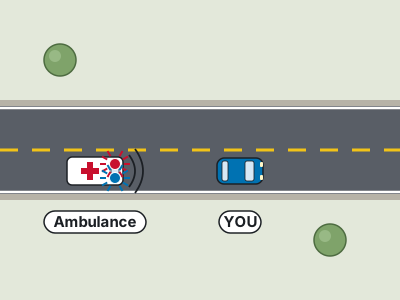
- Stop in the center of the intersection to reserve the lane
- Keep moving at the same speed so the emergency vehicle can follow
- Pull over to the edge of the road so the emergency vehicle can pass more easily
- Turn toward the emergency vehicle to make your position obvious
Show answer
Pull over to the edge of the road so the emergency vehicle can pass more easily. When an emergency vehicle uses both its flashing lights and siren, yield right-of-way by pulling toward the edge of the road. That creates a clearer path for the responding vehicle. Maintaining speed leaves the emergency vehicle trapped behind you, and stopping in an intersection can block its route and other traffic. A turn toward the vehicle is unpredictable and unsafe. Signal your intention, move over smoothly when possible, and remain stopped or pulled aside until the emergency vehicle has passed and the roadway is clear.
Study this in the handbook: Emergency vehicles, traffic stops and the Move Over Law
14. What shape and color identify a South Carolina stop sign?
- Eight-sided and red with white letters
- Round and yellow with black letters
- Diamond-shaped and orange with black symbols
- Rectangular and green with white letters
Show answer
Eight-sided and red with white letters. The manual describes a stop sign as having eight sides and being red with white letters. A round yellow sign is associated with railroad warnings, orange diamond signs mark work zones, and green signs guide drivers to roads and destinations. After identifying the stop sign, stop behind the stop line or crosswalk when one is present; if there is no stop line, stop at the point nearest the intersection where you can see in both directions without entering the cross traffic lane. Then look for crossing vehicles and pedestrians and yield the right-of-way.
Study this in the handbook: Regulatory and guide signs
15. What braking distance does the South Carolina manual give at 50 mph on dry pavement with good brakes?
- About 30 feet
- About 158 feet
- About 400 feet
- About 1,000 feet
Show answer
About 158 feet. The South Carolina manual says braking distance is the time and distance it takes for your brakes to slow and stop your vehicle, and at 50 mph on dry pavement with good brakes it can take about 158 feet. Total stopping distance also includes perception time and reaction time, and the manual gives an average of three quarters of a second to 1 second for each. The figures of 30, 400 and 1,000 feet do not match the manual.
Study this in the handbook: Stopping distance, following distance and signaling
16. At a highway-railroad grade crossing, what does the pictured white crossbuck sign identify?
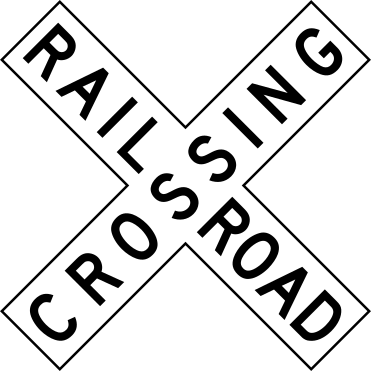
- A school crossing controlled by a patrol
- A railroad crossing far ahead where stopping is never needed
- The crossing itself, where a train requires you to stop until the intersection is clear
- A work zone where only construction vehicles may enter
Show answer
The crossing itself, where a train requires you to stop until the intersection is clear. The white X-shaped crossbuck is located at the highway-railroad grade crossing itself. If a train or railroad vehicle is approaching the intersection, the driver must stop behind the stop line or before the intersection and wait until it is clear. The round yellow RXR sign serves as the advance warning farther up the road. Do not treat the crossbuck as a school or construction marker. See the X, search for rail traffic, and be ready to stop.
Study this in the handbook: Warning, railroad and work zone signs
17. Which South Carolina applicants are exempt from the vision screening when renewing?
- Active duty military presenting a Leave and Earning Statement dated within 31 days and a valid military ID
- Anyone over 65
- Anyone renewing online
- Commercial drivers
Show answer
Active duty military presenting a Leave and Earning Statement dated within 31 days and a valid military ID. Effective May 18, 2024, active duty military personnel are exempt from the vision screening requirement when they provide a Leave and Earning Statement dated within 31 days of completing the transaction along with a non expired military ID. Those renewing by mail or online send copies of the documents. Everyone else passes a screening or provides a vision certificate dated within 36 months.
18. What places may use fluorescent-yellow warning signs?

- Parking areas with no curb markings
- Interstate route entrances and exits
- Restaurants, hotels, and service stations
- School zones, school crossings, and pedestrian crossings
Show answer
School zones, school crossings, and pedestrian crossings. The manual identifies school zones, school crossings, and pedestrian crossings as examples where warning signs may be fluorescent yellow. These signs draw attention to locations where people may enter or cross the roadway. Interstate route signs, guide signs for restaurants and hotels, and parking information serve different purposes and use different sign categories. When fluorescent yellow appears near a school or crossing, reduce speed, scan actively, and prepare for people in or near the travel path. The bright color is an attention cue, not permission to continue at normal speed.
Study this in the handbook: Traffic lights
19. Before turning right on red in South Carolina, where must the driver stop?
- Past the crosswalk after checking for traffic
- After entering the intersection beside the center island
- Only at the next stop sign
- Before entering the crosswalk on the near side of the turn
Show answer
Before entering the crosswalk on the near side of the turn. A right turn on red is permitted only where no sign prohibits it, and the driver must first stop before entering the near-side crosswalk. The driver must then yield to pedestrians lawfully in or beside that crosswalk and to other lawful intersection traffic. Stopping past the crosswalk gives pedestrians less protection, while the other options do not describe the signal rule. Use stop before the crosswalk as the immediate action cue, then yield before turning.
Study this in the handbook: Traffic lights
20. When entering a traffic circle, which traffic has priority?
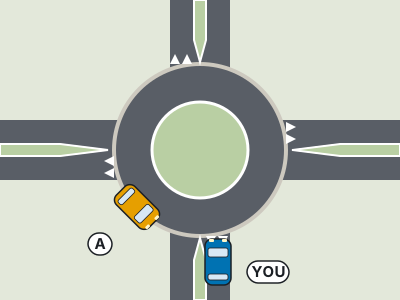
- Traffic already circulating in the roundabout
- Vehicles waiting on every approach
- Only traffic approaching from the left
- No one, because entering traffic has priority
Show answer
Traffic already circulating in the roundabout. Entering traffic must yield the right-of-way to vehicles already circulating in the roundabout. The manual describes traffic moving counterclockwise around a raised center island, so a driver at the entry should slow down, look for vehicles in the circle, and wait for a safe gap. Vehicles waiting on another approach do not automatically control the entry, and entering drivers do not receive priority merely because they reached the yield line. The useful cue is simple: circulating traffic goes first, then the entering vehicle joins the flow when clear.
Study this in the handbook: Turns, intersections and roundabouts
QualitySpace is expanding to South Carolina
We are a California-based independent insurance brokerage working on licensing in more states. We cannot help with South Carolina insurance yet. Leave your email and we will let you know when we can.
Every question is written from the official South Carolina Driver's Manual. Need paper? Printable SC practice test with answer key.
Last verified 2026-10-05. How we check every question · Study all 201 as flashcards
Frequently asked questions
How many questions are on this South Carolina practice test?
This fixed set has 20 questions. It is test 3 of 10 from the 201 question South Carolina bank.
How does this fixed test relate to the full South Carolina bank?
Each numbered test is a fixed set of questions in a fixed order, so you can retake the same test later and compare. Every test mixes road signs and the other topics in about the same proportion as the full bank. Tests 1 to 10 together cover 200 of the 201 questions in the South Carolina bank, each once. The full practice page mixes the whole bank at random.
Last verified 2026-10-05. See the South Carolina DMV facts page for sourced state details.
Return to the full South Carolina practice test · Study road signs