
Test 7 of 10 · 20 questions · Free 2026
SC Permit Practice Test 7
Jump to the test ↓A fixed 20 question set from the South Carolina bank with answers and plain English explanations.
Question 1 of 20 · 0 right so far
All 20 questions in test 7
Every question below comes from the South Carolina question bank on this page. Open a question to see the correct answer and the explanation. Nothing here is hidden behind a signup.
1. With a South Carolina conditional or special restricted license, during what hours may the teen drive alone?
- 6 a.m. to midnight
- 9 a.m. to 9 p.m.
- 6 a.m. to 6 p.m., or to 8 p.m. during daylight saving time
- Any time before midnight
Show answer
6 a.m. to 6 p.m., or to 8 p.m. during daylight saving time. Both the conditional license for 15 year olds and the special restricted license for 16 year olds allow driving alone from 6 a.m. to 6 p.m., extended to 8 p.m. during daylight saving time. From then until midnight the teen must drive with a licensed driver at least 21, and after midnight any listed supervisor is required. Six a.m. to midnight is the beginner's permit window with a qualified adult. A special restricted license with a waiver can allow driving alone until midnight for work or activities.
Study this in the handbook: Conditional and special restricted licenses
2. What kind of information does a regulatory sign provide?
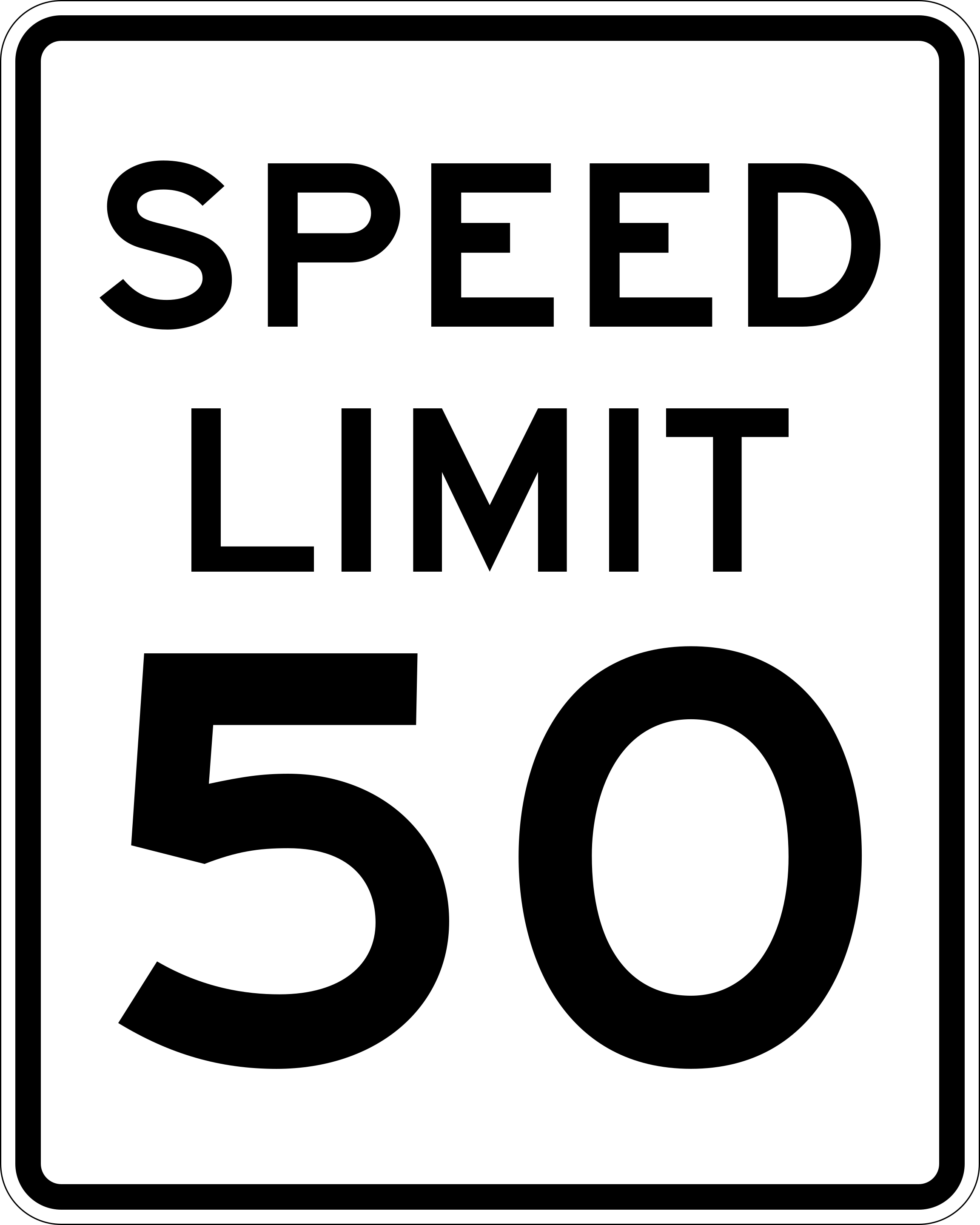
- A warning that a service station is closed
- A prediction that a curve may appear several miles ahead
- A list of nearby attractions and points of interest
- Specific laws that drivers must obey, including rules for lane use or turning
Show answer
Specific laws that drivers must obey, including rules for lane use or turning. Regulatory signs communicate enforceable requirements. The manual gives lane use, turning, speed, parking, and other special situations as examples of subjects covered by these signs. The pictured speed-limit sign is one example of a regulatory sign. A curve prediction is warning information, attractions are guide information, and a closed service station is not the function described here. When a regulatory sign is posted, follow its instruction for the road segment where it applies.
Study this in the handbook: Regulatory and guide signs
3. When does a conditional license holder earn full driving privileges under the South Carolina graduated program?
- Immediately after passing the skills test
- After one year with no traffic offenses and no at-fault collisions
- After six months with one traffic offense
- At age 16 regardless of driving record
Show answer
After one year with no traffic offenses and no at-fault collisions. Full privileges follow one year on the conditional license with no traffic offenses and no at-fault collisions. Passing the skills test is part of receiving the license, not an immediate upgrade to unrestricted driving. A six-month period with an offense fails the stated conditions, and age alone does not erase the record requirements. Use a two-part check: the holding period is one year, and the driving record must remain clean under the manual’s conditions.
Study this in the handbook: Conditional and special restricted licenses
4. What does the pictured round yellow RXR sign warn a driver about?

- A work zone with a temporary traffic signal
- A roundabout that requires traffic to circle left
- A bicycle-only crossing
- A highway-railroad grade crossing ahead
Show answer
A highway-railroad grade crossing ahead. The round yellow sign with an X and RR letters is an advance warning for a highway-railroad grade crossing. It tells the driver to slow down, look, and listen for a train or railroad vehicle, and to be prepared to stop if one is approaching. The sign is not a roundabout or bicycle symbol, and its warning function is not limited to construction areas. Use the RXR shape as an early cue to reduce speed and search both directions.
Study this in the handbook: Warning, railroad and work zone signs
5. In which direction do vehicles travel in a roundabout?
- In either direction depending on the exit
- Clockwise around the raised center island
- Straight across the center island
- Counterclockwise around the raised center island
Show answer
Counterclockwise around the raised center island. Vehicles in a roundabout travel counterclockwise around a raised center island. Entering traffic yields before joining that flow, and the driver proceeds to the appropriate exit after circulating in the marked direction. Clockwise travel would put the vehicle against the movement described by the manual. Driving across the center island is not a roundabout maneuver, and the direction does not change based on the chosen exit. Look for the central island, slow before entry, yield to circulating traffic, and maintain the counterclockwise path until the exit.
Study this in the handbook: Turns, intersections and roundabouts
6. What should a driver do at a flashing yellow traffic light?
- Treat the light as a yield sign only when turning left
- Stop behind the crosswalk and wait for a green signal
- Slow down and proceed cautiously, prepared to stop for entering traffic
- Continue at the posted speed without checking cross traffic
Show answer
Slow down and proceed cautiously, prepared to stop for entering traffic. A flashing yellow light calls for reduced speed and careful observation, not an automatic stop. The driver should be ready for traffic entering the intersection and should yield when the situation requires it. The choice requiring a green signal confuses this indication with a red signal. The option that permits normal speed removes the caution the signal is designed to create. A useful cue is yellow flashing means slow, look, and be prepared to stop.
Study this in the handbook: Traffic lights
7. What is the purpose of the South Carolina Driver's Manual?
- To explain only the process for renewing a license
- To replace every driving lesson with a printed checklist
- To help drivers learn traffic devices, signs, markings, and proper highway behavior
- To provide a complete copy of every motor vehicle statute
Show answer
To help drivers learn traffic devices, signs, markings, and proper highway behavior. The manual is a learning guide for people preparing to drive. It covers traffic control devices, signs, pavement markings, and behavior expected on the highway. The option about replacing driving lessons goes beyond what the book promises, while the renewal-only choice ignores its road-safety instruction. The statute option is also too broad because the manual's state law section says it highlights a few laws and does not address every law. A useful study cue is to treat the book as preparation for recognizing roadway information and making lawful driving decisions.
Study this in the handbook: License classes and the beginner's permit
8. In a South Carolina work zone, what must a driver do when a person with a sign or flag gives traffic instructions?
- Follow the instruction only if a police officer is also present
- Follow the person's direction to travel, slow down, or stop
- Ignore the person and follow the vehicle ahead
- Continue at the posted speed until a traffic signal changes
Show answer
Follow the person's direction to travel, slow down, or stop. A person controlling traffic in a work zone may use a sign or flag to direct travel, require a slower pace, or order a stop. The instruction is part of the temporary traffic control, so drivers must obey it just as they would obey a posted work zone device. Waiting for a police officer is not a condition in the rule. Continuing at the posted speed can be unsafe when workers have narrowed the roadway or created a sudden stop. Watch the worker's signal, adjust promptly, and proceed only when directed.
Study this in the handbook: Warning, railroad and work zone signs
9. How should a South Carolina driver adjust speed near residential areas and playgrounds?
- Speed up to leave the area sooner
- Maintain the limit without scanning for children
- Drive slower than the speed limit and be ready to stop quickly
- Use the shoulder to avoid parked vehicles
Show answer
Drive slower than the speed limit and be ready to stop quickly. The manual recommends driving slower than the speed limit in residential and playground areas because children may run out from between parked vehicles. Maintaining the limit without extra caution ignores the visibility risk, while speeding increases stopping distance. Using the shoulder is not a substitute for careful speed management. The concrete cue is the gap between parked cars: reduce speed, watch the spaces, and keep enough control to stop quickly.
Study this in the handbook: Pedestrians, school zones and speed
10. Before making a turn, what should a driver search for and communicate?
- Traffic controls, pedestrians, other vehicles, and the driver's intentions
- Only a clear lane behind the vehicle
- A parking meter and a fuel station
- The nearest highway exit and its distance
Show answer
Traffic controls, pedestrians, other vehicles, and the driver's intentions. Before turning, the manual directs drivers to search all corners for traffic controls, pedestrians, and other vehicles, then signal their intentions. Looking only behind the vehicle misses hazards at the corners and along the intended path. Parking meters, fuel stations, and highway exits are not the checklist given for beginning a turn. The practical sequence is to scan the complete turn area, identify people and traffic controls, signal early, and enter the lane closest to the direction of the turn. This creates time to respond before the vehicle changes path.
Study this in the handbook: Turnabouts, parking, lane changes and passing
11. When approaching a South Carolina work zone, which action is required even if no workers are visible?
- Maintain the normal roadway speed until a worker waves you down
- Reduce speed because narrowed lanes and rough pavement can create hazards
- Use the shoulder to bypass cones and construction equipment
- Follow the vehicle ahead more closely to limit merging
Show answer
Reduce speed because narrowed lanes and rough pavement can create hazards. The manual specifically says to reduce speed in a work zone even when workers are absent. Narrower lanes, rough pavement, cones, barrels, large vehicles, and changing traffic patterns can still create danger. Keeping normal speed ignores those conditions, using the shoulder bypasses the controlled path, and tailgating removes the time needed to react. Treat the work-zone signs as active instructions throughout the area. Slow early, increase following space, watch adjacent traffic, and be prepared for a sudden stop or lane shift.
Study this in the handbook: Night driving and work zones
12. How does the South Carolina manual define a roundabout?
- A straight roadway with a temporary lane closure
- A circular intersection with design features that promote safe and efficient traffic flow
- A railroad crossing controlled by a white crossbuck
- A parking area where vehicles travel in either direction
Show answer
A circular intersection with design features that promote safe and efficient traffic flow. The manual defines a roundabout, also called a traffic circle, as a circular intersection designed to promote safe and efficient traffic flow. It then explains that vehicles travel counterclockwise around a raised center island and that entering traffic yields. A lane closure, railroad crossing, or ordinary parking area does not describe this intersection design. When recognizing a roundabout, look for the circular roadway around the central island and prepare to yield before entering the circulating lane.
Study this in the handbook: Turns, intersections and roundabouts
13. Under what circumstance can a South Carolina driver be convicted of impaired driving at a BAC of 0.05 or lower?
- When the lower BAC is combined with drugs, including certain medications
- Only when the driver is under age 21
- Only when the BAC reaches 0.15 percent
- Never, because 0.08 percent is always required
Show answer
When the lower BAC is combined with drugs, including certain medications. The manual warns that impairment conviction can still occur at a BAC of 0.05 or lower when alcohol is combined with drugs, including prescription and over-the-counter medications. The age-only and 0.15 choices substitute different rules. The never option treats 0.08 as an absolute prerequisite, which the manual rejects. A useful safety cue is that a measured BAC does not make drug interactions harmless or guarantee freedom from an impaired-driving charge.
Study this in the handbook: Alcohol, other drugs and implied consent
14. For which suspension may a South Carolina driver potentially qualify for a six-month provisional driver's license?
- Every speeding suspension
- Any parking-ticket suspension
- A routine expired-registration suspension
- A first-offense DUI or DUAC suspension
Show answer
A first-offense DUI or DUAC suspension. The provisional license is a limited option for a first-offense Driving Under the Influence or Driving with an Unlawful Alcohol Concentration suspension, if the applicant satisfies the manual's additional conditions. It is not presented as a general remedy for parking, registration, or every speeding suspension. Those choices ignore the narrow alcohol-related trigger. Remember that the manual also lists eligibility requirements, a 100-dollar fee, and a cutoff for violations taking place on or after May 19, 2024.
Study this in the handbook: Provisional and temporary alcohol licenses
15. What can happen if a South Carolina driver cancels insurance before returning the license plate?
- Fees of up to $400
- A one year suspension
- A $25 fine
- Nothing, the plate expires automatically
Show answer
Fees of up to $400. The South Carolina manual says that before you cancel your SC insurance, you should turn in your SC license plate to the SCDMV. If you do not return your plate before you cancel the insurance, you could owe up to $400 in fees. The plate does not simply expire on its own, a $25 fine understates the stated amount, and a one year suspension is not the consequence the manual lists for this mistake. The order matters: return the plate first, then cancel.
Study this in the handbook: Knowledge and skills tests, moving and renewal
16. What supervision is required for a South Carolina conditional-license driver traveling after midnight?
- No supervision on weekends
- Supervision by a licensed individual listed in SC Code section 56-1-100(A)(1-7)
- Supervision only by a parent under age 21
- A passenger with a beginner's permit
Show answer
Supervision by a licensed individual listed in SC Code section 56-1-100(A)(1-7). From midnight until 6 a.m., the conditional-license driver must be supervised by a licensed individual from the categories listed in the cited South Carolina code section. A weekend exception is not stated. The supervisor does not have to be a parent under 21, and another beginner's-permit holder is not the required credential. The time window is the key cue: the evening supervised period ends at midnight, then the specifically listed supervisor requirement applies.
Study this in the handbook: Conditional and special restricted licenses
17. How should a driver use the parking brake during brake failure?
- Pull it slowly so the rear wheels do not lock
- Pull it suddenly as hard as possible
- Ignore it and turn off the engine first
- Use it only after steering into oncoming traffic
Show answer
Pull it slowly so the rear wheels do not lock. The parking brake can help slow the vehicle, but applying it abruptly may lock the rear wheels and cause a skid. A slow pull preserves the driver’s ability to release it if the vehicle begins to slide. Turning off the engine first is not the stated first technique, and steering into opposing traffic creates a separate danger. The cue is parking brake gently, monitor the vehicle, and release pressure if a skid starts.
Study this in the handbook: Avoiding collisions and vehicle malfunctions
18. What is the minimum corrected vision South Carolina requires?
- No greater than 20/40 corrected in one eye
- 20/70 in both eyes
- 20/100 in one eye
- 20/20 in both eyes
Show answer
No greater than 20/40 corrected in one eye. The minimum vision standards do not require a greater degree of vision than 20/40 corrected in one eye. If you reach that standard only with glasses or contact lenses, a corrective lens restriction is added to the permit or license, and if your vision later improves you must submit a new certificate of vision examination and renew the license to remove the restriction.
Study this in the handbook: Vision rules
19. Why should you avoid pulling in front of a large vehicle until you can see its whole front in your rear-view mirror?
- Commercial vehicles cannot use mirrors
- The truck driver must keep your speed
- Large vehicles need more distance to stop
- A large vehicle always has priority in every lane
Show answer
Large vehicles need more distance to stop. A large vehicle has greater size and weight, so it takes longer to stop than a passenger car. Waiting until the whole front appears in your rear-view mirror gives the truck or bus more following space after you return to its lane. The driver is not required to match your speed, and commercial vehicles do use mirrors, although those mirrors still leave blind areas. The vehicle does not gain universal priority. The useful cue is to finish the pass completely, maintain speed, and leave a visible safety margin before moving back.
Study this in the handbook: Motorcycles and commercial vehicles
20. What colors are normally used on South Carolina work zone signs?
- Green backgrounds with red symbols
- Blue backgrounds with white letters only
- Purple backgrounds with yellow letters
- Orange backgrounds with black letters or symbols
Show answer
Orange backgrounds with black letters or symbols. Work zone signs normally use orange backgrounds with black letters or symbols so drivers can recognize construction, maintenance, or emergency operations ahead. The color is a warning cue, not an invitation to keep normal speed. Reduce speed, watch for workers and equipment, and follow temporary directions from signs, cones, barrels, or a flagger. Blue and green signs serve other roadway communication purposes, while purple is not the work zone standard described here. Spotting orange early gives you time to create space and prepare for changed lanes or pavement.
Study this in the handbook: Warning, railroad and work zone signs
QualitySpace is expanding to South Carolina
We are a California-based independent insurance brokerage working on licensing in more states. We cannot help with South Carolina insurance yet. Leave your email and we will let you know when we can.
Every question is written from the official South Carolina Driver's Manual. Need paper? Printable SC practice test with answer key.
Last verified 2026-10-05. How we check every question · Study all 201 as flashcards
Frequently asked questions
How many questions are on this South Carolina practice test?
This fixed set has 20 questions. It is test 7 of 10 from the 201 question South Carolina bank.
How does this fixed test relate to the full South Carolina bank?
Each numbered test is a fixed set of questions in a fixed order, so you can retake the same test later and compare. Every test mixes road signs and the other topics in about the same proportion as the full bank. Tests 1 to 10 together cover 200 of the 201 questions in the South Carolina bank, each once. The full practice page mixes the whole bank at random.
Last verified 2026-10-05. See the South Carolina DMV facts page for sourced state details.
Return to the full South Carolina practice test · Study road signs