
Test 11 of 25 · 20 questions · Free 2026
SC Permit Practice Test 11
Jump to the test ↓A fixed 20 question set from the South Carolina bank with answers and plain English explanations.
Question 1 of 20 · 0 right so far
All 20 questions in test 11
Every question below comes from the South Carolina question bank on this page. Open a question to see the correct answer and the explanation. Nothing here is hidden behind a signup.
1. Why does the South Carolina manual want you to look 20 to 30 seconds ahead while driving?
- It lets you watch the car directly ahead more closely
- It is needed on interstates above 55 mph alone
- It lets you stop checking your mirrors
- It gives you time to plan and avoid emergency moves
Show answer
It gives you time to plan and avoid emergency moves. Looking well down your planned path helps you see the road, other road users, and traffic conditions early. The manual says that extra time lets you make better decisions and possibly avoid being forced into emergency braking and steering. Ideally, look at what is happening 20 to 30 seconds ahead, though in cities you may not be able to see as far as on a highway. Looking ahead does not replace checking to the sides and rear with your mirrors.
Study this in the handbook: Visual search and speed management
2. This sign appears before a curve on a country highway. What should you be ready for?
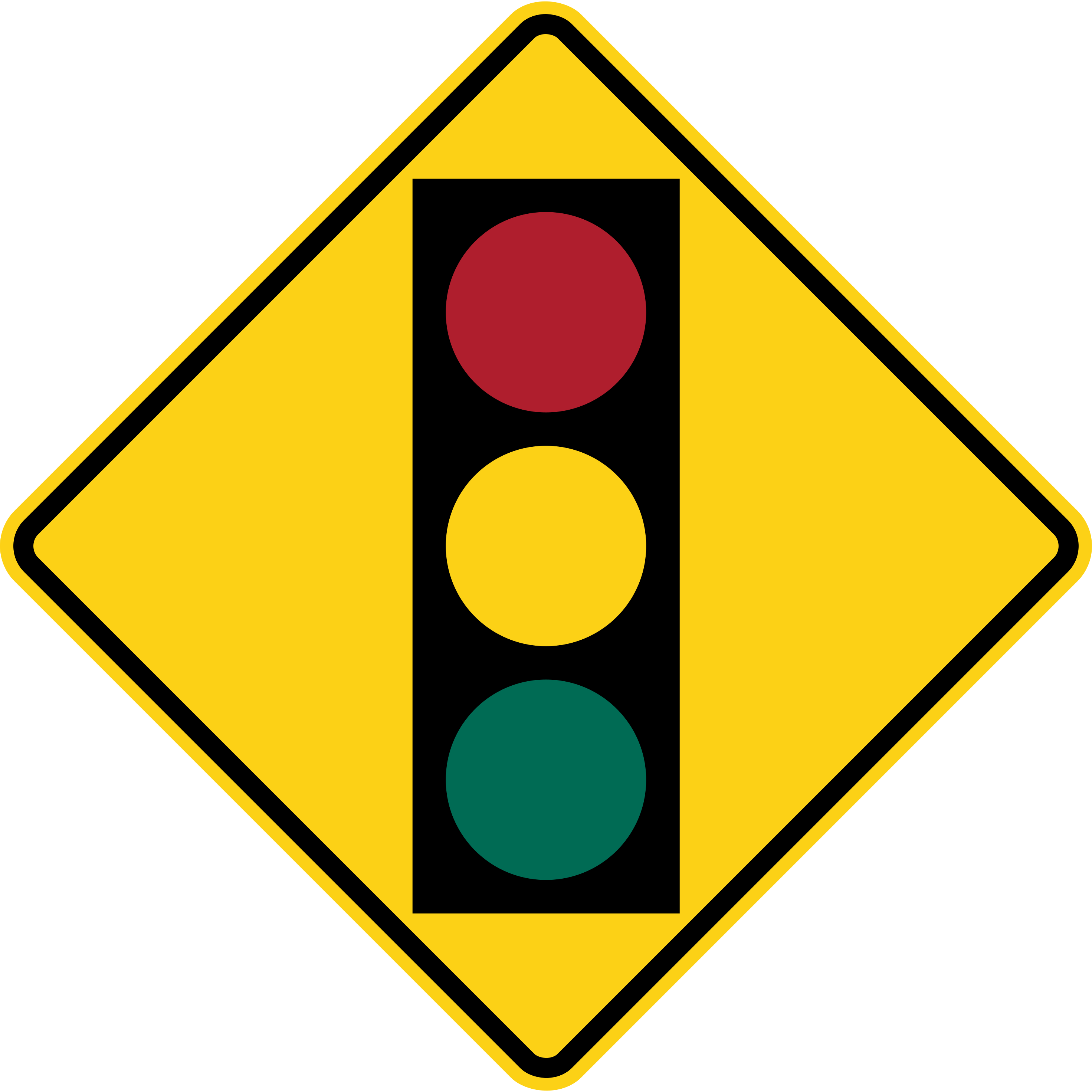
- A railroad crossing with flashing lights and a gate arm
- A four-way stop with no signals at all
- A traffic signal ahead that may soon require a stop
- A lane that is closed ahead for road work crews
Show answer
A traffic signal ahead that may soon require a stop. The traffic light symbol on this yellow diamond means a traffic signal is ahead. Warning signs like this tell you about possible danger ahead, such as a need to slow down and be prepared to stop. Ease off early so you can stop if the signal is red when it comes into view. Railroad crossings use the round yellow RR sign and the crossbuck, and work zone lane closures use orange signs.
3. You reach a railroad crossing with two sets of tracks, but no sign shows the number of tracks. What should you do?
- Assume there is one track, since no number sign is posted
- Check for more than one track and train anyway
- Cross without looking if the gates are up
- Stop on the first track to check the second
Show answer
Check for more than one track and train anyway. Crossings with more than one track often post the number of tracks to warn that more than one train may be crossing. The manual cautions that not all such crossings have these signs, so it is important to check for more than one track, train, or railroad vehicle at every crossing. A missing sign proves nothing. Never stop on the tracks; if you need to stop, stop at the stop line before them.
Study this in the handbook: Warning, railroad and work zone signs
4. When might the South Carolina manual's advice be to accelerate to avoid a collision?
- When a vehicle is about to hit you from behind or the side
- When the vehicle ahead stops suddenly in your lane
- When a deer steps onto the road just ahead of you
- When the light turns yellow as you near the stop line
Show answer
When a vehicle is about to hit you from behind or the side. Braking is the first reaction for most drivers, but it is not always the answer. The manual says it may be necessary to accelerate to avoid a collision when another vehicle is about to hit you from behind or from the side. Speeding up toward a stopped vehicle or an animal in the road ahead would do the opposite of helping, and at a yellow light the manual says you should stop and wait for the next green.
Study this in the handbook: Avoiding collisions and vehicle malfunctions
5. When does the South Carolina manual recommend hand-over-hand steering?
- When changing lanes at highway speeds above 45 mph
- At low speeds, such as at intersections or when parking
- When steering through a long, gentle curve on a highway
- When steering with one hand while you work the wipers
Show answer
At low speeds, such as at intersections or when parking. The manual matches steering methods to speed. Hand-over-hand steering is for turning the wheel at low speeds, such as at an intersection or when parking, using the top third of the wheel on the side you are turning toward. For normal driving going forward above 10 to 15 mph, the manual calls for hand-to-hand, or push/pull, steering instead, so highway lane changes and gentle curves are not hand-over-hand situations. One hand steering is limited to backing up or briefly reaching for a control.
6. A road has both a stop line and, beyond it, a crosswalk. When you must stop, which marking do you obey first?
- The crosswalk, stopping with your bumper on its far edge
- Either one, since they mean the same thing
- The stop line, which comes before the crosswalk
- The crosswalk, because pedestrians have priority there
Show answer
The stop line, which comes before the crosswalk. Crosswalks define where pedestrians may cross, and when a sign or signal requires you to stop, you stop behind the stop line or crosswalk. Where both are painted, the manual says the stop line must be obeyed first, so you stop before reaching the crosswalk at all. Stopping on or past the crosswalk puts your vehicle in the area pedestrians use, and you must yield to pedestrians entering or in a crosswalk. Treat the stop line as the front edge of where your vehicle may be.
Study this in the handbook: Pavement markings, crosswalks and stop lines
7. When does South Carolina's manual say one hand steering is appropriate?
- On long, straight highways when traffic is light
- Whenever your vehicle has power steering to help you
- When you are driving slowly through a parking lot
- When backing up or briefly reaching for a control
Show answer
When backing up or briefly reaching for a control. One hand steering is reserved for two situations: backing up, and operating controls such as wipers, flashers, or lights that require a temporary reach. Even then, the manual says the other hand stays in the normal operating position of 8 to 9 o'clock or 3 to 4 o'clock to keep the vehicle stable and limit steering reversals. Light highway traffic, power steering, or slow parking lot driving are not on the list; forward driving uses both hands.
8. Under South Carolina's Hands-Free and Distracted Driving Act, which action is illegal while driving on a public road?
- Talking through an earpiece connected to your phone
- Using a wrist-worn device for a voice call
- Holding or supporting a phone with any part of your body
- Asking a passenger to answer your call for you
Show answer
Holding or supporting a phone with any part of your body. The Act lists what a driver on any South Carolina public road must not do, and the first item is physically holding or supporting a mobile electronic device with any part of the body. A phone in your hand or propped against you while you drive fits that ban. The same law expressly allows earpieces and wrist-worn devices used for voice communication, so those choices are legal. A passenger handling the call is not the driver holding the device, so it is not the banned act.
Study this in the handbook: Fatigue, distraction and the hands free law
9. You stopped behind a school bus. Its lights have stopped flashing and the stop arm is folded away. What should you do?
- Proceed slowly, watching for children
- Pass the bus quickly before it starts moving again
- Wait until the bus turns off your road completely
- Honk once so children know you are about to go
Show answer
Proceed slowly, watching for children. You must stay stopped the entire time a school bus is stopped or preparing to stop with red or amber lights flashing or its stop arm extended. Once the lights stop flashing and the stop arm is no longer visible, the manual says to proceed slowly while watching for children. Rushing past the bus ignores the children the manual tells you to watch for, and you do not need to wait for the bus to leave your road before moving on carefully.
Study this in the handbook: Turns, intersections and roundabouts
10. Thick fog settles in, and your car has fog lights. Which lights should you use?
- High beams, to see farther through the fog
- Low beams, plus fog lights if you have them
- Parking lights alone, to reduce glare
- No lights, so the fog does not reflect them
Show answer
Low beams, plus fog lights if you have them. Low beams are the manual's choice for fog, rain, or snow, since high beams can create glare that makes it harder to see ahead. Some vehicles have fog lights that can be used in fog, snow, or rain as well. Headlights also help other drivers see you, so parking lights alone or no lights at all make your car harder to spot. Slow down and increase your following distance in fog.
Study this in the handbook: Night driving and work zones
11. A bicyclist is riding in the travel lane ahead of you. What rights does that rider have compared with you?
- Fewer rights, so the rider must yield to all cars
- More rights, so you must always stop for bikes
- No rights on roads posted above 35 mph
- The same rights, privileges, and responsibilities
Show answer
The same rights, privileges, and responsibilities. Bicycles are considered vehicles on roadways, and bicyclists are expected to follow the same rules of the road as motorized vehicles. As a motorist, the manual says, you should know that a bicyclist has the same rights, privileges, and responsibilities as you. Riders do not have to give way to every car, and you do not have to stop for every bicycle; normal right-of-way rules apply. Allow space and slow down when passing.
Study this in the handbook: Pedestrians, school zones and speed
12. Traffic is crawling, and the bike lane beside you is empty all the way to the next corner. May you drive in it to reach your turn?
- Yes, as long as no bicyclists are riding in it
- Yes, for up to one block before your turn
- No, not unless entering or leaving a driveway or alley
- Yes, if you turn on your hazard lights first
Show answer
No, not unless entering or leaving a driveway or alley. The manual says not to stop, park, or drive on a designated bicycle path or lane unless you are entering or leaving an alley or driveway, performing official duties, directed by a police officer, or facing an emergency. Slow traffic and an empty lane are not on that list, and there is no one-block allowance before turns. Hazard lights do not create an exception either. Wait your turn in the travel lane.
Study this in the handbook: Yielding to pedestrians and bicyclists
13. A lane closed ahead sign appears, but traffic is moving at highway speed with no backup. What does the South Carolina manual suggest?
- Move over sooner to the lane that will stay open
- Stay in the closing lane until the very last point
- Stop at the merge point and wait for a gap
- Speed up to pass cars in the open lane first
Show answer
Move over sooner to the lane that will stay open. The zipper merge is meant for heavy, slow traffic that is backing up. When traffic is moving at highway speeds and there are no backups, the manual says it makes sense to move sooner to the lane that will remain open. Holding the closing lane to the last point, stopping at the merge, or racing ahead is wrong for that situation. The bottom line in the manual is to merge when it is safe to do so.
14. Why does the South Carolina manual say never to drink alcohol while taking other drugs, including over-the-counter medicines?
- The drugs could multiply alcohol's effects or add their own
- Alcohol cancels the drug so the medicine stops working
- Mixing them is a concern for prescription drugs alone
- The combination matters for drivers under 21 and no one else
Show answer
The drugs could multiply alcohol's effects or add their own. Combining alcohol with prescription or over-the-counter drugs is dangerous because the drugs could multiply alcohol's effects or have additional effects of their own. The warning names over-the-counter products, not just prescriptions, and it applies to drivers of every age. Nothing in the manual suggests the two cancel each other out. Its bottom line is that no one is able to drink alcohol or use other impairing drugs and still operate a vehicle safely.
Study this in the handbook: Alcohol, other drugs and implied consent
15. You see this sign on a rural highway. What should you be watching for?

- A hospital or first aid station nearby
- The road ending at a T-intersection
- A railroad crossing just over the next rise in the road
- Traffic crossing from both the left and right
Show answer
Traffic crossing from both the left and right. The plus-shaped symbol on this yellow diamond warns of a crossroad ahead, a place where another road crosses yours and traffic may enter from either side. Like other warning signs, it gives you time to slow down and get ready to stop. Some rural intersections have no stop or yield signs at all, so approach carefully and be ready for crossing traffic. A T-intersection sign and a railroad warning sign look different.
Study this in the handbook: Traffic lights
16. Besides rainy, snowy, or foggy days, when does the South Carolina manual say turning on headlights is especially important?
- When you are parked on the shoulder waiting for a friend
- At dusk, or when driving away from a rising or setting sun
- During midday driving on a clear, sunny highway
- Only after the streetlights in town have come on
Show answer
At dusk, or when driving away from a rising or setting sun. Turning on your headlights helps other roadway users see you. The manual says this is especially important on rainy, snowy, or foggy days, when you should use low beams and slow down, and also when it begins to get dark or when you are driving away from a rising or setting sun. Waiting until full darkness or streetlights is later than the manual's advice. Making your vehicle visible to others is described as your responsibility as a driver.
Study this in the handbook: Stopping distance, following distance and signaling
17. A motorcyclist ahead is riding in the left part of the lane, leaving room on the right. May you pull up beside the rider in that space?
- Yes, if you stay close to the lane edge
- Yes, at low speeds in city traffic
- Yes, if the rider waves you alongside
- No, the motorcycle is entitled to the full lane
Show answer
No, the motorcycle is entitled to the full lane. Motorcyclists have the same rights and responsibilities as other drivers. Give the rider a full lane width rather than sharing the lane, since the motorcycle needs room for the rider to react to other traffic. Riders often change lane position to avoid hazards such as potholes or gravel, so the open space is part of their lane. Stay behind the rider at a following distance of at least 4 seconds.
Study this in the handbook: Motorcycles and commercial vehicles
18. In South Carolina, on a two-lane road, a school bus coming toward you stops and turns on its flashing red lights. What must you do?
- Stop and stay stopped while the bus is stopped
- Keep going, since the bus is in the other lane
- Slow to 15 mph and pass carefully
- Stop if children are crossing in front of you
Show answer
Stop and stay stopped while the bus is stopped. On any two-lane highway, the manual says you must stop for the entire time a school bus is stopped or preparing to stop with its red or amber lights flashing or its stop arm extended, whether you are meeting the bus or traveling behind it. The bus being in the opposite lane does not matter on a two-lane road. After the lights stop flashing and the stop arm is no longer visible, proceed slowly while watching for children.
Study this in the handbook: Turns, intersections and roundabouts
19. A horseback rider is ahead on a narrow rural road, and you want the rider to know you are behind. What should you do?
- Tap the horn so the rider moves aside
- Pass with caution without honking or revving
- Rev the engine so the horse hears you coming
- Follow closely until the rider waves you by
Show answer
Pass with caution without honking or revving. Horseback riders and animal-drawn vehicles have the same right to use the road as motor vehicles. The manual says to pass with caution and not to use your horn or rev your engine, because this may scare the animal and cause a collision. Following closely adds risk, and you do not need a wave to pass when it is safe. Also be ready for animal-drawn vehicles to turn left into fields and driveways.
Study this in the handbook: Emergency vehicles, traffic stops and the Move Over Law
20. Why does the South Carolina manual tell you to turn your wheels to the right when parking uphill with no curb?
- So other drivers can see your parking lights
- So the car rolls off the road if the brakes fail
- So the car can pull out faster later
- So the tires grip the pavement edge harder
Show answer
So the car rolls off the road if the brakes fail. Uphill without a curb, the manual says to turn the wheels to the right so that the vehicle will roll off the road if the brakes fail. With nothing to catch the tire, the goal is to send a rolling car away from traffic. Lights, pulling out faster, and tire grip are not the reasons given. Set the parking brake, put the car in park or the proper gear, and turn off the engine as well.
Study this in the handbook: Turnabouts, parking, lane changes and passing
Every question is written from the official South Carolina Driver's Manual. Need paper? Printable SC practice test with answer key.
Last verified 2026-10-05. How we check every question · Study all 500 as flashcards
Frequently asked questions
How many questions are on this South Carolina practice test?
This fixed set has 20 questions. It is test 11 of 25 from the 500 question South Carolina bank.
How does this fixed test relate to the full South Carolina bank?
Each numbered test is a fixed set of questions in a fixed order, so you can retake the same test later and compare. Every test mixes road signs and the other topics in about the same proportion as the full bank. Tests 1 to 25 together cover every question in the South Carolina bank once. The full practice page mixes the whole bank at random.
Last verified 2026-10-05. See the South Carolina DMV facts page for sourced state details.
Return to the full South Carolina practice test · Study road signs