
Test 4 of 10 · 20 questions · Free 2026
SC Permit Practice Test 4
Jump to the test ↓A fixed 20 question set from the South Carolina bank with answers and plain English explanations.
Question 1 of 20 · 0 right so far
All 20 questions in test 4
Every question below comes from the South Carolina question bank on this page. Open a question to see the correct answer and the explanation. Nothing here is hidden behind a signup.
1. At what point total does the South Carolina manual say a driver's license will be suspended for excessive points?
- 10 points after two years
- 6 or more points for every driver age 17 or older
- 12 or more points for a driver age 17 or older
- 4 points for any licensed driver
Show answer
12 or more points for a driver age 17 or older. For a driver who is 17 or older, the manual describes a warning at six or more points and suspension when the total reaches 12 or more. The six-point choice confuses the warning threshold with the suspension threshold. Ten and four points are not the stated trigger for this adult-age rule. Separate graduated-license holders can face suspension at six or more points, so always identify the driver’s age and license category before applying the number.
Study this in the handbook: The point system and losing your license
2. After moving permanently to South Carolina with a valid out-of-state license, when must a resident apply for an SC license?
- Within 10 days of moving
- Within 45 days of moving
- Within 90 days of moving
- Only when the other license expires
Show answer
Within 45 days of moving. A person who permanently relocates to South Carolina generally has 45 days to apply for an SC license or identification card. The 10-day and 90-day options substitute different deadlines, and waiting for the prior license to expire ignores the residency requirement. Active-duty military members and US Government employees are identified exceptions in the surrounding rule. The key trigger is permanent relocation, followed by the 45-day clock.
Study this in the handbook: Knowledge and skills tests, moving and renewal
3. What must a person who has never held a driver's license obtain first in South Carolina?
- A beginner’s permit
- A regular Class D license without testing
- A special restricted license
- A commercial learner credential
Show answer
A beginner’s permit. A first-time driver begins with a beginner’s permit rather than moving directly to a full license. The regular Class D choice skips the required starting stage, and a special restricted license belongs to a later graduated licensing step. A commercial learner credential concerns commercial driving and is unrelated to this first-license rule. When studying the sequence, connect no prior license with beginner’s permit first, then review the testing, supervision, and practice conditions that follow.
Study this in the handbook: License classes and the beginner's permit
4. In a South Carolina RCUT intersection, how does a driver make a left-turn or through movement from a cross street?
- Cross directly through the median without turning
- Turn right onto the main road, then make a U-turn at a one-way median opening
- Wait for a four-way stop before turning left normally
- Use a bus-only lane to reach the opposite direction
Show answer
Turn right onto the main road, then make a U-turn at a one-way median opening. An RCUT removes left-turn and through movements from cross-street approaches. To continue in the desired direction, the driver turns right onto the main road and later makes a U-turn at a one-way median opening. Directly crossing the median and making a conventional left turn describe the movements the design eliminates. The bus-lane option invents a restriction. Look for the sequence right turn, main road, median U-turn when recognizing an RCUT.
Study this in the handbook: Turnabouts, parking, lane changes and passing
5. What does South Carolina's implied consent law require when a police officer lawfully requests an alcohol test?
- The request applies only in the state where the license was issued
- The driver may choose never to test without consequence
- Only a saliva test can be required
- The driver must take a breath, blood, or urine test
Show answer
The driver must take a breath, blood, or urine test. Implied consent means obtaining a license carries consent to a lawfully requested breath, blood, or urine test when impaired driving is suspected. Refusal can cost the driver a license or driving privilege. The rule is not limited to saliva testing, and it follows the state where the arrest occurs rather than the state that issued the license. The practical cue is to separate the testing duty from the later suspension consequence: both arise from the refusal decision.
Study this in the handbook: Alcohol, other drugs and implied consent
6. What must a South Carolina driver do when a pedestrian crossing the street is guided by a dog or carrying a white cane?
- Pass quickly before the pedestrian reaches the lane
- Sound the horn and continue
- Come to a complete stop
- Stop only if a traffic signal is red
Show answer
Come to a complete stop. A pedestrian using a guide dog or white cane is treated as visually impaired, and the driver must come to a complete stop. Honking does not substitute for yielding, and passing quickly creates the very danger the rule addresses. The duty does not depend on a red signal because it is based on the pedestrian's protected crossing. The visual cue is the dog or white cane, followed by a full stop and a safe wait.
Study this in the handbook: Yielding to pedestrians and bicyclists
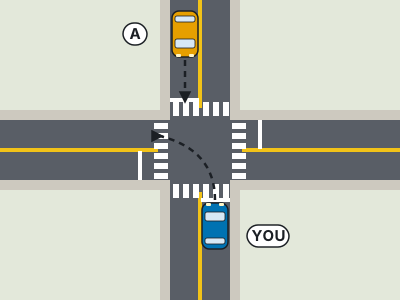
7. When making a left turn, whose path must a driver yield to?
- No one if the turn signal is activated
- Only vehicles behind the turning driver
- Vehicles parked along the curb
- Oncoming traffic
Show answer
Oncoming traffic. A driver making a left turn must yield to oncoming traffic. Signaling communicates the intention to turn but does not remove the obligation to wait for vehicles traveling toward the intersection. Cars behind the turning vehicle and parked vehicles are not the specific opposing movement identified by this rule. The safest cue is to search the oncoming lane before crossing it: signal, position for the turn, and allow approaching traffic to pass before completing the left turn.
Study this in the handbook: Turns, intersections and roundabouts
8. What is the recommended response if the vehicle's brakes stop working while driving?
- Use the parking brake slowly and release it if the rear wheels begin to skid
- Pump the accelerator to restore hydraulic pressure
- Continue driving until the next service station without slowing
- Pull the parking brake sharply and keep it locked regardless of the vehicle's response
Show answer
Use the parking brake slowly and release it if the rear wheels begin to skid. A failed service brake calls for controlled use of the parking brake. Pull or press it slowly so the rear wheels do not lock and start a skid. Be ready to release it if the vehicle begins to slide. The accelerator cannot restore braking, and continuing to drive with no working brakes is unsafe. A sudden, fully locked parking brake can create the very loss of control the procedure is meant to avoid. After slowing, get off the roadway if possible and do not continue operating the vehicle without working brakes.
Study this in the handbook: Avoiding collisions and vehicle malfunctions
9. During daylight, how close to its registered address may a South Carolina golf cart operate on an approved public road?
- Within one mile
- Within four miles
- Within ten miles
- Anywhere in the state
Show answer
Within four miles. The daylight operating area reaches four miles from the address listed on the registration certificate. A one-mile boundary is narrower than the manual rule, while ten miles extends beyond the stated limit. The cart also has to satisfy the separate requirements for a valid driver license, an SCDMV decal, a secondary road, and a posted limit of 35 miles an hour or less. The practical cue is to check the registration address before a daylight trip and measure the planned route against the four-mile boundary.
Study this in the handbook: Golf carts, organ donation and other state laws
10. When searching ahead on a South Carolina roadway, how far in front of your vehicle should you ideally look?
- About 3 to 5 seconds
- About 20 to 30 seconds
- About 8 to 10 seconds
- Only as far as the next vehicle
Show answer
About 20 to 30 seconds. The manual recommends looking 20 to 30 seconds ahead along your planned path. That horizon helps you notice traffic conditions, road users, and developing problems early enough to adjust speed or position. The shorter intervals in the choices “About 3 to 5 seconds” and “About 8 to 10 seconds” leave less time to make a decision, while watching only the next vehicle can hide a problem farther down the road. Use the practical cue of scanning beyond the immediate car in front, then keep your eyes moving toward the sides and rear as conditions change.
Study this in the handbook: Visual search and speed management
11. When facing a green traffic light, when may you proceed through the intersection?
- Only if you turn right instead of going straight
- Only after every vehicle behind you has stopped
- Without checking because green guarantees a clear path
- When the intersection is clear and you proceed with caution
Show answer
When the intersection is clear and you proceed with caution. A green light permits movement through the intersection only when the path is clear, and the manual still calls for caution. Green does not guarantee that a vehicle, pedestrian, or late-moving road user will not be in your path. Waiting for traffic behind you is unnecessary, and the signal applies to permitted movements beyond just a right turn. Scan the intersection before moving, keep your speed controlled, and be ready for another road user’s mistake. The cue is permission plus caution, not an unconditional command to accelerate.
Study this in the handbook: Traffic lights
12. What penalty applies to a second violation of South Carolina's Hands-Free and Distracted Driving Act?
- A $100 fine only
- A six month suspension
- A $200 fine and two points on your driving record
- Four points and a $500 fine
Show answer
A $200 fine and two points on your driving record. Second and subsequent offenses under the Hands-Free and Distracted Driving Act bring a $200 fine and two points on the driving record. A $100 fine alone is the first offense penalty. The act does not list a six month suspension, and four points with a $500 fine is not the stated penalty. For a new driver, those two points can matter, because six points triggers an excessive points suspension for permit and conditional license holders.
Study this in the handbook: Fatigue, distraction and the hands free law
13. What does a round yellow railroad warning sign with an X and black RR letters tell a driver to do?

- Increase speed so the crossing is cleared before looking
- Stop immediately on the tracks to inspect both rails
- Slow down, look and listen, and be prepared to stop for a train
- Turn around whenever the sign is visible
Show answer
Slow down, look and listen, and be prepared to stop for a train. The round yellow railroad warning sign appears before a highway-railroad crossing and tells drivers to slow down, look, and listen for a train or railroad vehicle. The driver should be prepared to stop if one is approaching. Stopping on the tracks creates danger, speeding removes the observation step, and turning around is not the sign's general command. A strong visual cue is the black X and RR on yellow: it announces a crossing ahead, so reduce speed and actively check for rail traffic.
Study this in the handbook: Warning, railroad and work zone signs
14. What does South Carolina’s hands-free law prohibit a driver from doing with a mobile electronic device?
- Physically holding or supporting it with any part of the body
- Using an earpiece for a voice conversation
- Listening to a navigation instruction without holding the device
- Keeping the device secured in a mounted holder
Show answer
Physically holding or supporting it with any part of the body. The state law prohibits physically holding or supporting a mobile electronic device with any part of the body while operating on a public road. An earpiece for voice communication is specifically not restricted by this provision, and a secured holder avoids the physical holding described in the rule. Navigation audio alone does not mean the device is being held. The cue is hands and body off the phone, with permitted equipment used without gripping it.
Study this in the handbook: Fatigue, distraction and the hands free law
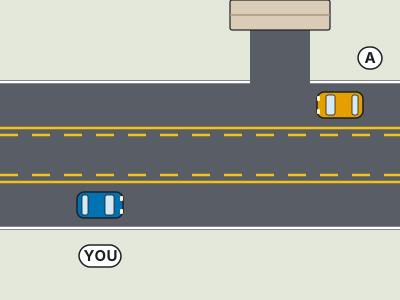
15. What is a shared center left-turn lane reserved for?
- Long-term parking
- Straight-through travel and passing
- Left-turning vehicles from either direction
- Vehicles traveling only in the opposite direction
Show answer
Left-turning vehicles from either direction. A shared center left-turn lane is reserved for vehicles turning left from either direction. It is not a through lane and cannot be used to pass other vehicles. Long-term parking also defeats the lane's turning purpose, while restricting it to the opposite direction ignores that both directions may use it for a left turn. The practical cue is the center lane's arrows or sign: enter only to prepare for the left turn, then complete that movement safely.
Study this in the handbook: Pavement markings, crosswalks and stop lines
16. How should a driver respond when the vehicle begins to skid?
- Release pressure from the brake or accelerator and steer where the driver wants to go
- Pump the accelerator repeatedly to restore traction
- Turn sharply away from the intended path
- Lock the brakes and keep the steering wheel centered
Show answer
Release pressure from the brake or accelerator and steer where the driver wants to go. When a skid begins, the manual directs the driver to release pressure from the brake or accelerator, look where the vehicle should go, and steer in that direction. Pumping the accelerator does not address the loss of tire grip, and locking the brakes can worsen control. A sharp turn away from the intended path works against the recovery described. The useful cue is eyes and steering first: choose the open path, ease off the pedal creating the problem, and make the vehicle follow the direction you want rather than fighting the skid.
Study this in the handbook: Avoiding collisions and vehicle malfunctions
17. A South Carolina applicant under 18 registers as an organ donor. Who makes the final decision about donation?
- The applicant, since registration is binding
- The parent or legal guardian
- The SCDMV
- The hospital
Show answer
The parent or legal guardian. Registering as an organ donor on a South Carolina credential is a legally binding agreement under the Uniform Anatomical Gift Act, but if you choose to be a donor before your 18th birthday, your parent or legal guardian makes the final decision regarding donation. You can change your decision or update your information later through the Donate Life SC registry.
Study this in the handbook: Golf carts, organ donation and other state laws
18. What can guide signs help a driver find along a South Carolina highway?
- Hospitals, service stations, restaurants, and hotels
- Only a no-passing restriction
- Only a sharp-curve warning
- The legal age for a beginner's permit
Show answer
Hospitals, service stations, restaurants, and hotels. Guide signs can help drivers find roadway services, including hospitals, service stations, restaurants, and hotels. A no-passing restriction is regulatory, a sharp curve is warning information, and a permit age is licensing information. The sign color is a useful first cue, but read the wording and symbol for the exact service or destination. When a guide sign appears, use it to make a safe navigation decision without confusing it with a hazard warning.
Study this in the handbook: Regulatory and guide signs
19. What happens when a South Carolina driver under 21 registers a BAC of 0.02 percent or greater?
- No action occurs until BAC reaches 0.08 percent
- The driver receives only a written warning
- The license is suspended for exactly seven days
- Driving privileges are suspended immediately for at least three months
Show answer
Driving privileges are suspended immediately for at least three months. For a driver under 21, a BAC of 0.02 percent or greater causes immediate suspension of driving privileges for at least three months. The warning and seven-day options understate the consequence, while waiting for 0.08 ignores the under-21 threshold. This rule is separate from the adult standard and reflects the manual’s zero-tolerance discussion. Memorize the linked figures: under 21, 0.02, immediate suspension, minimum three months.
Study this in the handbook: Alcohol, other drugs and implied consent
20. What action does the pictured South Carolina YIELD sign require before entering?

- Enter first and yield only to vehicles behind you
- Come to a complete stop every time, even when the way is empty
- Speed up to enter before cross traffic arrives
- Slow down and let traffic with the right-of-way cross first
Show answer
Slow down and let traffic with the right-of-way cross first. The downward-pointing red and white triangle tells the driver to slow down and allow traffic that already has the right-of-way to cross before entering. A complete stop may be needed for safety, but the sign does not demand a stop in every empty approach. Speeding into the gap reverses the intended order. Spot the triangle early, reduce speed, scan for vehicles and pedestrians, and stop if that is what safe yielding requires.
Study this in the handbook: Regulatory and guide signs
QualitySpace is expanding to South Carolina
We are a California-based independent insurance brokerage working on licensing in more states. We cannot help with South Carolina insurance yet. Leave your email and we will let you know when we can.
Every question is written from the official South Carolina Driver's Manual. Need paper? Printable SC practice test with answer key.
Last verified 2026-10-05. How we check every question · Study all 201 as flashcards
Frequently asked questions
How many questions are on this South Carolina practice test?
This fixed set has 20 questions. It is test 4 of 10 from the 201 question South Carolina bank.
How does this fixed test relate to the full South Carolina bank?
Each numbered test is a fixed set of questions in a fixed order, so you can retake the same test later and compare. Every test mixes road signs and the other topics in about the same proportion as the full bank. Tests 1 to 10 together cover 200 of the 201 questions in the South Carolina bank, each once. The full practice page mixes the whole bank at random.
Last verified 2026-10-05. See the South Carolina DMV facts page for sourced state details.
Return to the full South Carolina practice test · Study road signs