
Test 6 of 10 · 20 questions · Free 2026
SC Permit Practice Test 6
Jump to the test ↓A fixed 20 question set from the South Carolina bank with answers and plain English explanations.
Question 1 of 20 · 0 right so far
All 20 questions in test 6
Every question below comes from the South Carolina question bank on this page. Open a question to see the correct answer and the explanation. Nothing here is hidden behind a signup.
1. Where may a South Carolina driver go with a route-restricted license?
- To and from work, college or residence, ADSAP, or a court-ordered drug program
- Anywhere during daylight
- Only to medical appointments
- Any trip under 20 miles
Show answer
To and from work, college or residence, ADSAP, or a court-ordered drug program. A route-restricted license lets a suspended driver operate a non-commercial vehicle only to and from employment, college or residence, to and from the Alcohol and Drug Safety Action Program, and to and from a court-ordered drug program. The driver must carry a copy of the approved route. Daylight driving anywhere and a mileage radius are not the rule, and medical appointments alone are not the listed purposes. The license lasts for the length of the suspension and costs $100.
Study this in the handbook: Provisional and temporary alcohol licenses
2. A South Carolina driver's license is about to be suspended for points. When must a defensive driving course be finished to help?
- Within 30 days after the suspension begins
- Any time during the suspension
- Only after the suspension ends
- Before the suspension begins
Show answer
Before the suspension begins. If you take a defensive driving course because your license is in danger of being suspended, you must complete it before the suspension begins. Once the suspension begins, the point reduction will not cancel or reduce it. Finishing during or after the suspension does nothing for that suspension, and there is no 30 day grace period. The course must be eight classroom hours in South Carolina.
Study this in the handbook: The point system and losing your license
3. What may happen to a South Carolina driver who endangers a highway worker in a work zone?
- The driver automatically loses the vehicle registration for one year
- The driver receives only a warning if the worker is uninjured
- The driver may receive a fine but no points for a first incident
- The driver may be fined and have points assessed against the driving record
Show answer
The driver may be fined and have points assessed against the driving record. South Carolina warns that endangering a highway worker in a work zone can bring both a fine and points on the driver's record. The manual does not limit the consequence to cases involving an injury, and it does not remove points for a first incident. Automatic registration loss is also not the stated consequence. Think of the work zone as a place where ordinary impatience can create a record consequence. Slow down, leave room, and be prepared for sudden stops near workers and equipment.
Study this in the handbook: Regulatory and guide signs
4. When are points on a South Carolina driving record reduced by half?
- After six months from the court date
- Immediately after the conviction is entered
- One year after the violation date on the ticket
- Only when the driver completes a defensive course
Show answer
One year after the violation date on the ticket. The manual says points are cut in half one year after the violation date shown on the ticket. The conviction-entry and six-month choices use different starting points or timing. Completing a defensive course can be a separate way to seek reduction, but it is not the automatic half-reduction described here. Anchor the rule to the ticket’s violation date, not the later court event, and remember that four points would become two after a year.
Study this in the handbook: The point system and losing your license
5. When must a driver obey a slower speed limit in a South Carolina school zone?
- When the lights are flashing or children are present
- Only after sunset
- Only when a school bus is loading
- Only when a police officer is standing nearby
Show answer
When the lights are flashing or children are present. The slower school-zone limit applies when the lights are flashing or children are present. Waiting for darkness, a school bus, or an officer adds conditions the manual does not require. The driver should reduce speed early, watch for children and crossing activity, and be ready to stop. The two-part cue is lights or children, so either condition is enough to trigger obedience to the posted slower limit.
Study this in the handbook: Pedestrians, school zones and speed
6. Which description matches the yellow crossroad symbol shown here?

- A guide sign directing drivers to cities and towns
- A warning of a possible hazard or special roadway situation ahead
- A regulatory sign requiring a turn into a particular lane
- A service sign identifying a restaurant or hotel
Show answer
A warning of a possible hazard or special roadway situation ahead. The plus-shaped crossroad is displayed with South Carolina's common warning-sign examples. Warning signs communicate that a possible danger, hazard, or special situation is ahead. They are different from guide signs, which help direct travelers to destinations, and from regulatory signs, which state laws about actions such as turning or parking. A restaurant or hotel belongs with guide information as well. Seeing the crossroad symbol should make you search for intersecting traffic, reduce speed as needed, and be ready for vehicles entering from either side.
Study this in the handbook: Traffic lights
7. A yellow warning sign with an arrow turning sharply should prompt the driver to do what?

- Follow the arrow as a mandatory one-way direction
- Accelerate so the vehicle clears the warning area immediately
- Slow down and be prepared to stop for the danger or special situation ahead
- Park on the shoulder before the turn
Show answer
Slow down and be prepared to stop for the danger or special situation ahead. A yellow diamond with a turning arrow warns about what lies ahead; it does not prescribe a mandatory travel direction in the way a regulatory sign does. The manual says warning signs may tell a driver to slow down and be prepared to stop, which is the appropriate response to a sharp bend. Accelerating reduces the time available to steer, and parking on the shoulder creates a separate hazard. Read the arrow as advance notice, ease off before the turn, and keep enough control to respond if the view around the bend is limited.
Study this in the handbook: Traffic lights
8. When crossing railroad tracks and no train is approaching, what does the manual advise?
- Look both ways and cross quickly without stopping
- Stop on the first rail and check again
- Cross slowly while following another vehicle closely
- Wait until a crossing gate lowers and rises
Show answer
Look both ways and cross quickly without stopping. When a driver needs to cross railroad tracks, the manual advises looking both ways and crossing quickly without stopping. Stopping on a rail places the vehicle in the track area, while following another vehicle closely can hide a second train or reduce escape space. Waiting for a gate cycle is not the stated procedure when no train is approaching. The practical cue is scan, then clear the tracks: make the observation before entering and keep moving across rather than pausing between rails.
Study this in the handbook: Warning, railroad and work zone signs
9. At an intersection, which road users should a South Carolina driver yield to?
- Pedestrians, bicyclists, and drivers still in the intersection
- Only vehicles that arrive after the driver
- Only the largest vehicle present
- No one if the driver is traveling straight
Show answer
Pedestrians, bicyclists, and drivers still in the intersection. South Carolina's right-of-way guidance says to yield to pedestrians, bicyclists, and other drivers who are still in the intersection. Traveling straight does not erase the duty to avoid someone already occupying the conflict area, and vehicle size does not determine priority. The choice “Only vehicles that arrive after the driver” reverses the concern by focusing on later arrivals. A useful intersection cue is to scan for people and vehicles already committed to the crossing before proceeding, even when your intended movement seems simple.
Study this in the handbook: Yielding the right of way
10. On a two-lane highway, what must a driver do when a school bus is stopped or preparing to stop with its red or amber lights flashing?
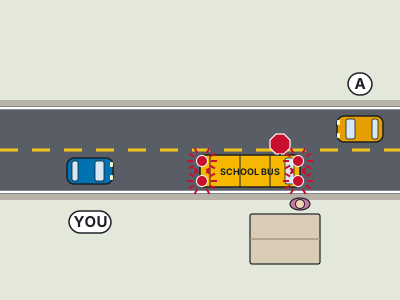
- Pass slowly if the driver cannot see children near the roadway
- Stop for the entire time the bus is stopped or preparing to stop
- Stop only when following the bus, never when meeting it
- Continue at 15 mph until the bus driver waves
Show answer
Stop for the entire time the bus is stopped or preparing to stop. On any two-lane highway, the stopping duty applies whether you are meeting the school bus or traveling behind it. You must remain stopped while the bus is stopped or preparing to stop with red or amber lights flashing or its stop arm extended. A clear view of children does not cancel the rule, and it is not limited to vehicles behind the bus. Wait until the red and amber lights have stopped flashing and the stop arm is no longer visible, then proceed slowly while watching for children.
Study this in the handbook: School buses
11. A South Carolina driver is arrested for impaired driving while visiting another state. Whose implied consent law applies?
- The law of South Carolina, where the license was issued
- The stricter of the two states
- No implied consent law applies out of state
- The law of the state where the driver was arrested
Show answer
The law of the state where the driver was arrested. Implied consent laws vary by state, and the manual says the law applies to the state where you were arrested, not the state where you got your license. A South Carolina license does not carry South Carolina's test rules into another state. There is no stricter-of-two rule, and implied consent still applies away from home. Refusing a test can still cost you your license or driving privileges.
Study this in the handbook: Alcohol, other drugs and implied consent
12. How far ahead does South Carolina law require you to signal before changing lanes, turning or merging?
- 50 feet
- 500 feet
- As soon as you begin to turn
- 100 feet or more
Show answer
100 feet or more. It is state law in South Carolina that you must use a turn signal 100 feet or more before changing lanes, turning left or right, or merging into traffic, and cancel the signal once the move is complete. Fifty feet is too short, and signaling as you begin the turn gives others no warning. Five hundred feet is the distance for dimming high beams, not signaling. The same 100 foot figure applies before passing.
Study this in the handbook: Stopping distance, following distance and signaling
13. What feature identifies some regulatory signs that prohibit a particular action?
- A yellow diamond with black lettering
- A green rectangle with a route number
- A red circle with a red slash over a symbol
- A blue panel showing a service symbol
Show answer
A red circle with a red slash over a symbol. A red circle with a red slash over a symbol marks a prohibited action on some regulatory signs. The symbol underneath shows what movement or conduct is barred, so the slash is read together with that image. Yellow diamonds warn about hazards, green route panels guide travelers, and blue service panels identify facilities. When a slash crosses a maneuver symbol, do not perform that maneuver at the controlled location. Look at the complete sign instead of treating the red color alone as the message.
Study this in the handbook: Regulatory and guide signs
14. How is a South Carolina conviction for driving under the influence of drugs treated?
- Like a parking violation
- Like a DUI or DUAC conviction
- Like a license renewal error
- Like a civil equipment warning
Show answer
Like a DUI or DUAC conviction. A conviction in South Carolina for driving under the influence of drugs is treated like a DUI or DUAC conviction. The other choices minimize the legal and licensing significance by recasting the offense as parking, paperwork, or equipment conduct. The manual places prescription, over-the-counter, and illegal drugs in its impairment discussion, so the rule is not limited to alcohol. When a drug affects driving, do not assume the absence of alcohol makes the consequences minor.
Study this in the handbook: Alcohol, other drugs and implied consent
15. Why should a driver avoid relying on other road users to obey traffic signs and signals?
- Right-of-way rules remove the need to search at intersections
- Traffic signs apply only to commercial vehicles
- A driver may ignore signals whenever the road appears empty
- Other road users may fail to yield, so the driver must remain ready to avoid a collision
Show answer
Other road users may fail to yield, so the driver must remain ready to avoid a collision. South Carolina’s intersection guidance recognizes that a driver cannot control another person’s behavior. A vehicle may enter without yielding even when the signal or sign favors you, so active searching and a collision escape plan remain necessary. The commercial vehicle claim narrows a rule that applies broadly. An empty-looking road still needs checking, and right-of-way never guarantees that others will comply. Use the cue: legal priority is not a safety shield.
Study this in the handbook: Turns, intersections and roundabouts
16. How often must a South Carolina driver who uses bioptic telescopic lenses submit vision documentation?
- Only once at licensing
- Every year, to the SCDMV Driver Improvement unit
- Every 10 years
- Never, if the lenses are prescribed
Show answer
Every year, to the SCDMV Driver Improvement unit. If you use bioptic telescopic lenses to operate a motor vehicle, you must submit the low vision acuity screening form to the SCDMV's Driver Improvement unit every year. Ordinary drivers who need corrective lenses simply carry a restriction and must always wear them when driving, and standard vision certificates are valid for 36 months. The yearly check tracks whether the low vision driver still meets the standard.
Study this in the handbook: Vision rules
17. When two vehicles reach a four-way stop at the same time, which vehicle has priority?
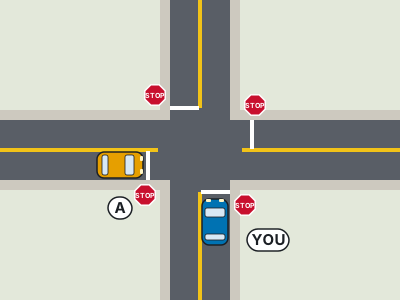
- The vehicle with the larger engine
- The vehicle on the other driver’s left
- The vehicle on the other driver’s right
- The vehicle that signals first
Show answer
The vehicle on the other driver’s right. The same-time rule resolves a tie at a stop-controlled four-way intersection by giving priority to the driver on your right. Engine size does not create priority, and a turn signal only communicates an intention. The vehicle on the left should wait rather than force the issue. A useful cue is to pause after stopping, identify the vehicle beside you, and yield to the one on your right when arrival was simultaneous.
Study this in the handbook: Yielding the right of way
18. What identification must be affixed to a South Carolina golf cart before it is used on a public road?
- A commercial vehicle inspection sticker
- A school-zone placard
- An SCDMV-issued permit or registration decal
- A county route number sign
Show answer
An SCDMV-issued permit or registration decal. The cart needs an SCDMV-issued permit or registration decal attached to it. A school-zone placard describes a traffic area, not cart registration. A commercial inspection sticker and a county route marker serve different purposes and do not meet this requirement. The decal is one checkpoint in a larger set of rules, so the driver should also verify the license, minimum age, daytime operation, distance from the registered address or gated-community entrance, and the road's posted speed limit.
Study this in the handbook: Golf carts, organ donation and other state laws
19. At a flashing red traffic light, what must a driver do before entering the intersection?
- Slow down without stopping if no vehicle is immediately visible
- Come to a complete stop, then look both ways and yield when applicable
- Continue through because flashing red means the signal is inactive
- Stop only if a pedestrian is already in the crosswalk
Show answer
Come to a complete stop, then look both ways and yield when applicable. A flashing red signal requires the same basic procedure as a stop sign. Stop behind the stop line, crosswalk, or intersection before entering, then check both directions and yield right-of-way when another road user has priority. Merely slowing is the treatment for flashing yellow, not flashing red. The signal remains meaningful even when the intersection appears empty, and waiting for a pedestrian is not the only condition that triggers the stop. Make the full stop first, then proceed only after the path is safe.
Study this in the handbook: Traffic lights
20. On a four-lane highway, when must you stop for a school bus traveling in the opposite direction?
- You stop only after the bus has moved again
- You must stop for every bus regardless of direction
- You stop only if the bus driver waves
- You generally do not have to stop when meeting it in the opposite direction
Show answer
You generally do not have to stop when meeting it in the opposite direction. On a four-lane or wider highway, a driver meeting a stopped school bus in the opposite direction generally does not have to stop. The exception described in the manual is different from traveling behind the bus, where a driver must stop. The bus lights and stop arm still demand caution, and children may be nearby, so never pass recklessly or proceed while your own lane is affected. The cue is to identify both roadway type and direction: multi-lane opposite traffic is the narrow exception, not a universal permission around school buses.
Study this in the handbook: School buses
QualitySpace is expanding to South Carolina
We are a California-based independent insurance brokerage working on licensing in more states. We cannot help with South Carolina insurance yet. Leave your email and we will let you know when we can.
Every question is written from the official South Carolina Driver's Manual. Need paper? Printable SC practice test with answer key.
Last verified 2026-10-05. How we check every question · Study all 201 as flashcards
Frequently asked questions
How many questions are on this South Carolina practice test?
This fixed set has 20 questions. It is test 6 of 10 from the 201 question South Carolina bank.
How does this fixed test relate to the full South Carolina bank?
Each numbered test is a fixed set of questions in a fixed order, so you can retake the same test later and compare. Every test mixes road signs and the other topics in about the same proportion as the full bank. Tests 1 to 10 together cover 200 of the 201 questions in the South Carolina bank, each once. The full practice page mixes the whole bank at random.
Last verified 2026-10-05. See the South Carolina DMV facts page for sourced state details.
Return to the full South Carolina practice test · Study road signs