
Test 10 of 10 · 20 questions · Free 2026
SC Permit Practice Test 10
Jump to the test ↓A fixed 20 question set from the South Carolina bank with answers and plain English explanations.
Question 1 of 20 · 0 right so far
All 20 questions in test 10
Every question below comes from the South Carolina question bank on this page. Open a question to see the correct answer and the explanation. Nothing here is hidden behind a signup.
1. What do warning signs tell a driver about the roadway?
- A possible danger or hazard may be ahead
- A specific parking law must be obeyed
- A nearby service station is available
- The route number identifies an interstate
Show answer
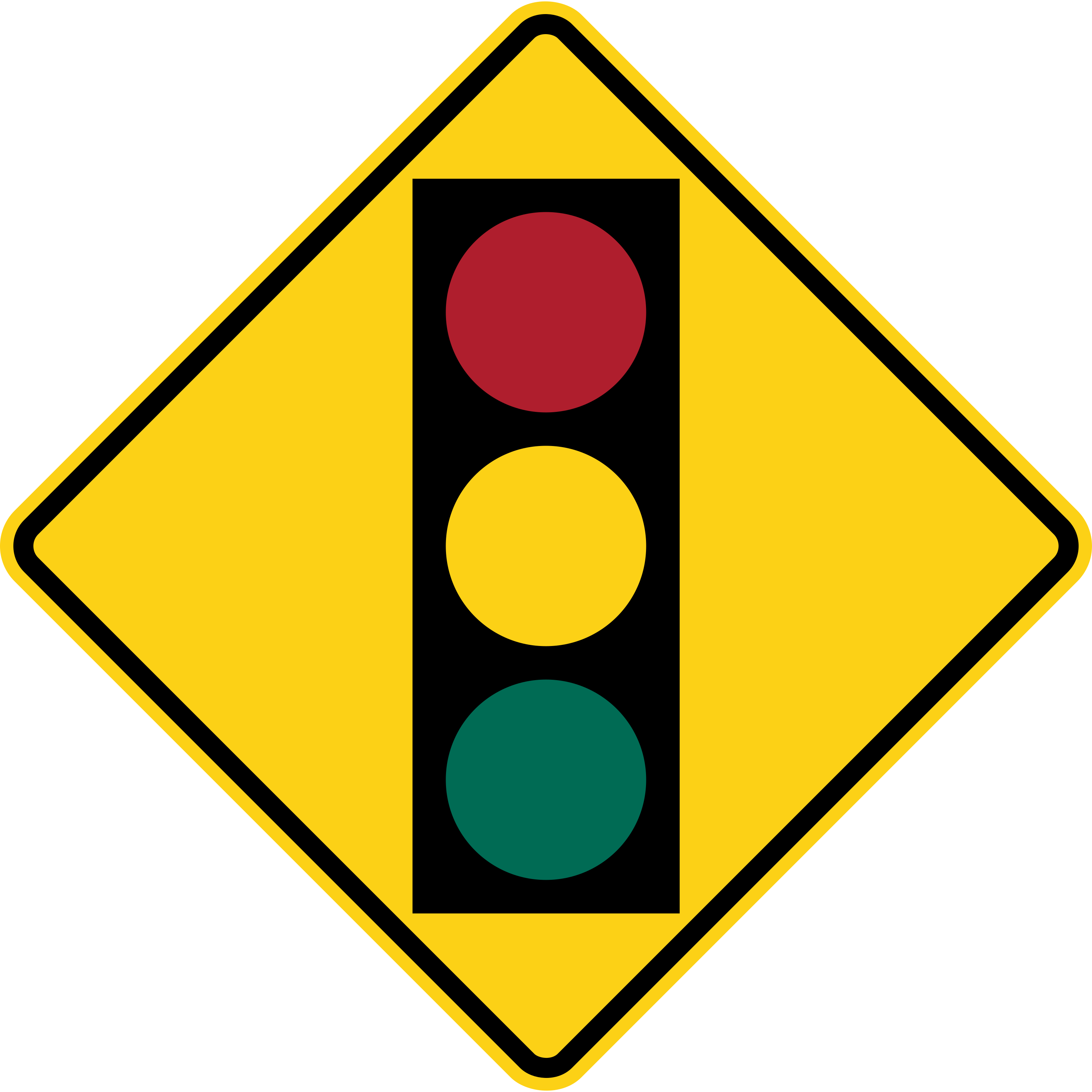
A possible danger or hazard may be ahead. Warning signs alert drivers to possible danger ahead, including a hazard or special roadway situation. They may tell a driver to slow down and be prepared to stop. Regulatory signs state laws such as parking or turning restrictions, guide signs identify services and destinations, and route signs identify roadway types. The practical response to a warning is early preparation: read the symbol, reduce speed when appropriate, and scan the area ahead. Waiting until the hazard is immediately visible removes the time the sign was designed to provide.
Study this in the handbook: Traffic lights
2. What kind of information does a warning sign provide?

- A route number for an interstate highway
- A law that sets the maximum legal speed
- The name of a nearby service station
- Notice of possible danger or a hazard ahead
Show answer
Notice of possible danger or a hazard ahead. Warning signs alert a driver to possible danger, a hazard, or a special roadway situation ahead. That notice gives the driver time to slow down, scan the roadway, and be ready to stop. A maximum legal speed is communicated by a speed limit regulatory sign, while service locations and route numbers belong to guide or route signs. When the pictured warning appears, treat it as advance information rather than the place where the hazard has already arrived. Reduce risk before reaching the condition.
Study this in the handbook: Traffic lights
3. What should you do before moving into another lane?
- Signal only after the lane change is complete
- Check mirrors, check the blind spot, signal, and look again
- Look only in the inside mirror
- Move first, then check whether the gap was large enough
Show answer
Check mirrors, check the blind spot, signal, and look again. A safe lane change requires a sequence: check the mirrors, look over your shoulder toward the blind spot, identify a gap, signal, look again, adjust speed, and steer into the lane. A signal announces intent but cannot make an occupied gap safe. Looking only in one mirror misses areas beside the vehicle, and moving before checking reverses the order that protects against a hidden car or motorcycle. Build the habit of a second visual check immediately before steering, because traffic can enter the gap after your first scan.
Study this in the handbook: Turnabouts, parking, lane changes and passing
4. Your vehicle is stuck in snow on a South Carolina road. What does the manual suggest to regain traction?
- Spin the wheels at full throttle
- Pour water on the tires
- Let air out of all four tires
- Clear snow from the wheels and pour sand, cat litter, gravel or salt in the path of the wheels
Show answer
Clear snow from the wheels and pour sand, cat litter, gravel or salt in the path of the wheels. If you are stuck in snow, use a shovel to clear snow from the wheels and underside of the car, then pour sand, cat litter, gravel or salt in the path of the wheels to help get traction, or place cardboard, newspaper or brush under them. Spinning the wheels only digs the vehicle in deeper. If the vehicle skids, ease off the accelerator and steer where you want to go.
5. At a red traffic light, when may a driver generally turn right?
- Without stopping if the cross street appears empty
- After stopping and yielding, unless a sign prohibits the turn
- Only after waiting for a green right-turn arrow
- Before reaching the crosswalk so the vehicle can roll through
Show answer
After stopping and yielding, unless a sign prohibits the turn. South Carolina permits a right turn on red as an exception to the normal stop rule, but the driver must first stop before the near-side crosswalk and yield to pedestrians and lawful traffic. An empty appearance does not erase the stop. A green arrow is not always necessary, and rolling through the crosswalk violates the required stopping position. The cue is stop, check, yield, and turn only when no prohibition applies.
Study this in the handbook: Traffic lights
6. What is the purpose of using low-beam headlights on a rainy, snowy, or foggy day?
- To replace the need to slow down
- To make high-speed driving safe in reduced visibility
- To help other roadway users see your vehicle
- To signal that the vehicle is parked
Show answer
To help other roadway users see your vehicle. Turning on headlights helps other roadway users see your vehicle, and the manual specifically pairs rainy, snowy, or foggy days with low-beam lights and reduced speed. Lights do not make high-speed travel safe in poor visibility, remove the need to slow, or indicate that the vehicle is parked. The driving cue is visibility plus speed control: select low beams so you can be seen, then slow enough to handle the shorter sight distance and changing road conditions.
Study this in the handbook: Stopping distance, following distance and signaling
7. When must a South Carolina driver dim high beams for an oncoming vehicle?
- When 500 feet or more away from the oncoming vehicle
- Only when the other driver flashes
- Within 100 feet
- Never on rural roads
Show answer
When 500 feet or more away from the oncoming vehicle. Use high beams whenever there are no oncoming vehicles, because they let you see twice as far as low beams, but dim them when you are 500 feet or more away from any oncoming vehicle. If a vehicle approaches with its high beams on, glance toward the right side of the road to avoid being blinded. Use low beams in fog, rain or snow.
Study this in the handbook: Night driving and work zones
8. What happens when hydroplaning begins?
- The steering tires ride on water over the road
- The brakes lock because the pavement is dry
- The engine loses power after a tire heats up
- The vehicle gains traction from pooled water
Show answer
The steering tires ride on water over the road. Hydroplaning occurs when the steering tires ride on a layer of water on top of the road surface, similar to the action of water skis, so the tires lose traction. The claim about locked brakes on dry pavement confuses a traction problem with a brake fault, an overheated tire is unrelated, and pooled water reduces traction rather than adding it. The manual says the best way to avoid traction loss from hydroplaning is to slow down when driving in the rain or on a road that is wet with pooled water or puddles.
Study this in the handbook: Visual search and speed management
9. What does the South Carolina manual recommend when you start feeling tired while driving?
- Drink coffee and keep going
- Open the windows and turn up the radio
- Pull off at the next exit or rest area for a 15 to 20 minute nap, or sleep for the night
- Drive faster to finish sooner
Show answer
Pull off at the next exit or rest area for a 15 to 20 minute nap, or sleep for the night. If you start feeling tired, stop driving and pull off at the next exit or rest area to take a 15 to 20 minute nap, or find a place to sleep for the night. Try not to drive late at night, and remember that the best way to avoid fatigue is plenty of rest before you leave. Coffee, fresh air, music, and driving faster are not what the manual recommends; its answer to tiredness is to stop driving and rest.
Study this in the handbook: Fatigue, distraction and the hands free law
10. What is the first speed adjustment a driver should make before entering a curve?
- Brake hard after reaching the middle of the curve
- Reduce speed before entering the curve
- Accelerate sharply before the curve begins
- Maintain the same speed regardless of traction
Show answer
Reduce speed before entering the curve. The manual recommends reducing speed before entering a curve to a safe speed that permits slight, constant acceleration through the curve. Hard braking after entry can cause the tires to lose traction, so the middle-of-curve braking choice creates the very risk the guidance warns about. Sharp acceleration and an unchanged speed ignore visibility, traction, and roadway conditions. A concrete driving cue is set the speed early, before the bend, then use smooth control while looking through the curve rather than waiting until the vehicle is already turning.
Study this in the handbook: Visual search and speed management
11. At a four-way stop, if you and another driver arrive at the same time, who should go first?
- The driver with the larger vehicle
- The driver on your left
- The driver on your right
- The driver who sounds the horn first
Show answer
The driver on your right. When two drivers arrive at the same time at a four-way intersection controlled by stop signs, yield the right-of-way to the driver on your right. The rule creates a predictable order and avoids two vehicles moving into the intersection together. Vehicle size, horn use, and arrival from the left do not replace that priority. Still scan for pedestrians, bicyclists, and other traffic before entering, because a right-of-way rule never excuses a collision. The simple cue is same arrival time plus four-way stop: check right, yield, then proceed when clear.
Study this in the handbook: Yielding the right of way
12. Which school requirement must a South Carolina 15 or 16 year old meet to get a first driver's license?
- Have a B average or better
- Have graduated from middle school with honors
- No school requirement applies
- Be enrolled in school, not suspended or expelled, with satisfactory attendance
Show answer
Be enrolled in school, not suspended or expelled, with satisfactory attendance. South Carolina ties a young driver's first license to school. The applicant must be enrolled in school, not suspended or expelled, with satisfactory attendance, and the driver's education program provides the certification form (PDLA) covering school attendance, driver education and practice. The manual sets no grade point average and no honors requirement. Saying no school rule applies ignores this listed condition.
Study this in the handbook: License classes and the beginner's permit
13. What free study resource does the South Carolina manual recommend for practicing the beginner's permit test?
- A paper test mailed by the DMV
- A required paid classroom course
- A smartphone app named SC DMV Driver Exam
- A commercial driving simulator subscription
Show answer
A smartphone app named SC DMV Driver Exam. The manual points applicants to a free smartphone app called SC DMV Driver Exam for beginner's permit practice. It describes the practice test as a series of randomly selected questions based on information in the manual. A paid course, mailed paper test, or commercial subscription is not the resource named in this section. The cue is the app name and the fact that it is free, which distinguishes the official study aid from private products.
14. How often can a South Carolina driver use a defensive driving course to reduce points?
- Once a year
- Only one time in a three-year period
- Any number of times
- Once in a lifetime
Show answer
Only one time in a three-year period. A defensive driving course certified for four-point reduction can lower your points, but a reduction may only be made one time in a three-year period. The course must be eight hours of classroom training, taken in South Carolina after the violation date, and cannot be completed online. Once a year and unlimited use are too generous. Once in a lifetime is stricter than the rule.
Study this in the handbook: The point system and losing your license
15. A South Carolina beginner's permit holder accumulates six points. What happens?
- A warning letter only
- Driving privileges are suspended for excessive points
- Nothing until 12 points
- Points are erased at age 17
Show answer
Driving privileges are suspended for excessive points. If you hold a beginner's permit, conditional license or special restricted license and accumulate six or more points, your driving privileges will be suspended for excessive points. The six point warning letter and the 12 point suspension line are the general rules for drivers 17 and older. The manual does not erase points at 17; points are only cut in half one year after the violation date. The points used for this suspension can also count in a later point system suspension.
Study this in the handbook: The point system and losing your license
16. How does South Carolina handle license suspensions for driving under the influence?
- They are mandatory suspensions outside the point system
- They add six points
- They add twelve points
- They are handled only by a warning letter
Show answer
They are mandatory suspensions outside the point system. Certain violations, such as driving under the influence, require mandatory license suspensions and are not under the point system. So a DUI does not work by adding a set number of points toward a total. Six and twelve points are point system thresholds. A warning letter is how the point system first responds to young drivers, not how DUI is handled. A driver under 21 at 0.02 or more is also suspended immediately for at least three months.
Study this in the handbook: The point system and losing your license
17. At what minimum age may a qualified driver receive a South Carolina conditional license?
- At least 18
- At least 14
- At least 16 and one-half
- At least 15 and one-half
Show answer
At least 15 and one-half. The conditional-license stage is available once the applicant is at least 15 and one-half but still under 16, provided the other listed requirements are met. Fourteen is below the stated age, while 16 and one-half and 18 miss the earlier graduated-license stage. The applicant must also pass the vision and skills tests. A helpful study cue is that the half-year age belongs to the conditional license for a 15-year-old, not to the regular license stage.
Study this in the handbook: Conditional and special restricted licenses
18. What BAC limit applies to a South Carolina provisional license after a DUI on or after October 1, 2014?
- The driver must have had a BAC of 0.14 percent or less
- 0.08 or less
- Any BAC qualifies
- 0.20 or less
Show answer
The driver must have had a BAC of 0.14 percent or less. To qualify for a provisional license after a DUI or DUAC violation that occurred on or after October 1, 2014, the driver must have had a BAC of 0.14 percent or less, must have met all requirements for prior suspensions, must be enrolled in the Alcohol and Drug Safety Action Program, and must pay $100. The provisional license is not available for offenses on or after May 19, 2024.
Study this in the handbook: Provisional and temporary alcohol licenses
19. A conditional license holder under 16 is driving without a licensed adult age 21 or older and is not transporting family members or students to or from school. How many passengers under 21 may be in the vehicle?
- No more than three
- No more than one
- No more than two
- Any number if they are seated in back
Show answer
No more than two. A conditional license limits an unsupervised driver under 16 to no more than two passengers under 21. The limit is not one, and allowing three would exceed it. Seating the passengers in the back does not create an exception. The manual lists only one exception, transporting family members or students to and from school, and the limit also does not apply when a licensed adult who is at least 21 is in the vehicle. When reviewing this rule, pair the number two with the age under 21, then check whether the supervising adult or the family and school exception changes the situation.
Study this in the handbook: Conditional and special restricted licenses
20. What does an orange roadway sign generally identify?
- A normal speed limit
- A recreational campground entrance
- A hospital location
- A construction, maintenance, or emergency operation work zone
Show answer
A construction, maintenance, or emergency operation work zone. Orange signs identify work-zone information involving construction, maintenance, or emergency operations. They alert drivers to workers, reduced speeds, detours, equipment, or a road surface that may change suddenly. A campground or hospital belongs to guide or service information, and a normal speed limit is regulatory information. The practical cue is orange near the roadway: reduce speed, watch for people and shifting paths, and be prepared to stop rather than treating the sign as a destination marker.
Study this in the handbook: Warning, railroad and work zone signs
QualitySpace is expanding to South Carolina
We are a California-based independent insurance brokerage working on licensing in more states. We cannot help with South Carolina insurance yet. Leave your email and we will let you know when we can.
Every question is written from the official South Carolina Driver's Manual. Need paper? Printable SC practice test with answer key.
Last verified 2026-10-05. How we check every question · Study all 201 as flashcards
Frequently asked questions
How many questions are on this South Carolina practice test?
This fixed set has 20 questions. It is test 10 of 10 from the 201 question South Carolina bank.
How does this fixed test relate to the full South Carolina bank?
Each numbered test is a fixed set of questions in a fixed order, so you can retake the same test later and compare. Every test mixes road signs and the other topics in about the same proportion as the full bank. Tests 1 to 10 together cover 200 of the 201 questions in the South Carolina bank, each once. The full practice page mixes the whole bank at random.
Last verified 2026-10-05. See the South Carolina DMV facts page for sourced state details.
Return to the full South Carolina practice test · Study road signs