
Test 17 of 25 · 20 questions · Free 2026
SC Permit Practice Test 17
Jump to the test ↓A fixed 20 question set from the South Carolina bank with answers and plain English explanations.
Question 1 of 20 · 0 right so far
All 20 questions in test 17
Every question below comes from the South Carolina question bank on this page. Open a question to see the correct answer and the explanation. Nothing here is hidden behind a signup.
1. A traffic light over the intersection ahead is flashing yellow, and cross traffic is approaching from the right. What should you do?
- Slow down and be ready to stop for that traffic
- Come to a full stop as you would at a stop sign
- Keep your speed; flashing yellow gives you priority
- Stop and wait for the light to turn green
Show answer
Slow down and be ready to stop for that traffic. A flashing yellow light means slow down and proceed with caution, prepared to stop for any traffic that may be entering the intersection. It does not require a full stop the way a flashing red does, but it does not give you priority either. With cross traffic approaching, be ready to stop and let it clear. Waiting for a green light is not the procedure for a flashing yellow.
Study this in the handbook: Traffic lights
2. On a three-lane interstate, you are in the middle lane behind a slow truck. Which lane should you use to pass it?
- The right lane, since it is often empty
- The paved shoulder on the right side
- The left-most lane, the one meant for passing
- Stay behind it; passing trucks is not allowed
Show answer
The left-most lane, the one meant for passing. On multi-lane roads, the manual says the left-most lane is to be used for passing slower vehicles. Moving right to get around the truck is not the pattern it describes, and the shoulder is an emergency stopping lane that must never be used to pass. Passing large trucks is allowed; do it as quickly and safely as possible, and look for the truck's whole front in your rearview mirror before moving back in.
Study this in the handbook: Turnabouts, parking, lane changes and passing
3. You need to go left at an intersection posted with this sign. What may you do?

- Turn left after coming to a full stop
- Turn left if no cars are coming
- Turn left on a green arrow alone
- Do not turn left here; find another way
Show answer
Do not turn left here; find another way. This sign shows a left-turn arrow under a red circle and slash. The red circle and slash prohibit the action shown, so left turns are not allowed at this intersection, whether or not traffic is coming and whatever the signal shows. Stopping first does not make the turn legal. Continue to a place where you can legally change direction. Regulatory signs like this one tell you about specific laws you must obey.
Study this in the handbook: Regulatory and guide signs
4. You are behind a horse-drawn buggy on a rural road. What turn should you anticipate, according to the South Carolina manual?
- A left turn into a field or driveway
- A U-turn in the middle of the road
- A sudden stop on the shoulder
- A right turn onto a paved shoulder
Show answer
A left turn into a field or driveway. Animal-drawn vehicles and horseback riders have the same right to use the road as motor vehicles and must follow the same rules. The manual singles out one hazard: be sure to anticipate left turns made by animal-drawn vehicles into fields and driveways, which matters most when you are thinking about passing. When you do pass, go with caution and do not use your horn or rev your engine, because that may scare the animal and cause a collision.
Study this in the handbook: Emergency vehicles, traffic stops and the Move Over Law
5. You slept five hours before a long drive. How does that compare with what the South Carolina manual says most people need?
- It is enough, since 5 hours is the minimum
- It matters for drivers under 18 alone
- It is short of the 7 to 9 hours most people need
- It is fine if you drink coffee before leaving
Show answer
It is short of the 7 to 9 hours most people need. The manual's first fatigue tip is to get adequate sleep, noting that most people need 7 to 9 hours a day to maintain proper alertness throughout their waking hours. Five hours falls short, which raises the risk that fatigue will affect your vision and slow your decisions. Coffee is not offered as a substitute for sleep, and the advice applies to drivers of every age. If you start feeling tired on the trip, stop and rest.
Study this in the handbook: Fatigue, distraction and the hands free law
6. A bus ahead swings wide to the left before making a right turn, leaving a gap at the curb. What should you do?
- Slip into the gap on the right and turn first
- Pass it on the left while it is swinging wide
- Wait; do not turn until the bus has finished its turn
- Honk so the driver knows you are on the right
Show answer
Wait; do not turn until the bus has finished its turn. When a truck or bus turns right, the driver will sometimes swing wide to the left to clear the curb or another obstruction, and may use space from other lanes. The gap that opens at the curb is a trap: if you try to get between the vehicle and the curb, you can be squeezed and suffer a serious collision. The manual's instruction is to not turn until the truck or bus has completed its turn, and to give large vehicles plenty of room to maneuver.
Study this in the handbook: Motorcycles and commercial vehicles
7. How should you position your car for a right turn?
- Swing wide to the left first to make the turn easier
- Turn from the right-most part of your lane
- Move into the center of the lane and turn sharply
- Turn from the left part of your lane so others can pass
Show answer
Turn from the right-most part of your lane. For a right turn, the manual says to avoid swinging wide to the left before turning and to always turn from the right-most portion of your lane. Before the turn, search all corners for traffic controls, pedestrians, and other vehicles, and signal your intentions. Enter and stay in the lane closest to the direction you want to turn. Look through the turn to the farthest point possible along your path, then accelerate smoothly and make sure the signal cancels.
Study this in the handbook: Turns, intersections and roundabouts
8. After stopping at an intersection, in what order should you look before entering?
- Left, then right, then left again
- Right, then left, then right again
- Straight ahead, then into the mirrors
- Left once, then go if the lane is clear
Show answer
Left, then right, then left again. Before moving again after a stop, the manual says to take extra time to check for crossing traffic and bicyclists, looking left, then right, and left again before entering the intersection. One glance is not enough, and mirrors do not show cross traffic. The manual also warns not to rely on other road users to obey traffic control signals or signs, because you can control only your own driving. Be prepared to avoid a collision with someone who does not yield.
Study this in the handbook: Turns, intersections and roundabouts
9. Which is a place where the South Carolina manual says not to attempt to pass?
- On a straight road with a dashed yellow line on your side
- On a multi-lane road using the left-most lane
- On a long straight stretch with clear visibility ahead
- Just before a railroad crossing or a bridge
Show answer
Just before a railroad crossing or a bridge. The manual lists situations where you should not attempt to pass: when an oncoming vehicle is approaching, when a curve or hill blocks your view, at intersections, and before a highway-railroad crossing or bridge. A straight road with good visibility and a dashed yellow line on your side, or the left-most lane of a multi-lane road, are conditions where passing can be done when it is safe. Signal 100 feet or more before passing and return only when the passed vehicle's front is visible in your rearview mirror.
Study this in the handbook: Turnabouts, parking, lane changes and passing
10. On a four-lane highway, a police car with flashing lights is stopped on the right shoulder. The lane to your left is clear. What should you do?
- Keep your speed and lane, since it is on the shoulder
- Slow down and move into the lane away from it
- Stop behind the police car until it leaves
- Speed up so you pass the police car quickly
Show answer
Slow down and move into the lane away from it. South Carolina's move-over law covers stopped authorized emergency vehicles. When you approach one, proceed with caution, slow down, and yield the right-of-way by changing into a lane away from the vehicle if safety and traffic conditions permit. With the left lane clear, that is exactly what to do. Holding your lane, stopping behind the car, or speeding past it does not give the officer the space the law intends.
Study this in the handbook: Emergency vehicles, traffic stops and the Move Over Law
11. Your car begins to skid on a wet curve. What two things does the South Carolina manual tell you to do?
- Brake hard and steer the opposite way
- Press the gas harder and hold the wheel still
- Turn the wheel sharply away from the skid and brake
- Ease off the brake or gas and steer where you want to go
Show answer
Ease off the brake or gas and steer where you want to go. Skids happen when you travel too fast for conditions, stop suddenly, or the tires lose their grip. When a skid starts, the manual says to release pressure from the brake or accelerator, look where you want to go, and steer the vehicle in that direction. Hard braking or more gas keeps the tires from regaining grip, and sharp steering can make the skid worse. Smooth, gentle inputs give the tires a chance to grip again.
Study this in the handbook: Avoiding collisions and vehicle malfunctions
12. You are on a highway and want to leave at the next exit. Which step does the manual list first?
- Signal that you intend to leave
- Brake hard to reach the ramp speed
- Move to the shoulder and slow down
- Check the speed posted for the ramp
Show answer
Signal that you intend to leave. The manual lists the steps for leaving a highway in order: signal your intention, move to the deceleration lane, check the posted speed, and adjust your speed accordingly. Signaling comes first. Braking hard on the main lanes, using the shoulder, or checking the ramp speed first would skip or reorder the steps. Only after those steps do you slow to the speed that is posted for the ramp.
Study this in the handbook: Turnabouts, parking, lane changes and passing
13. You are driving to a town you have never visited. How does the South Carolina manual suggest using route number signs on the trip?
- Ignore them and rely on landmarks you recognize
- Use them to judge the speed limit for each road
- Look at them when you are already lost
- Follow them during the trip to avoid getting lost
Show answer
Follow them during the trip to avoid getting lost. Route number signs use shape and color to show the type of road: interstate, US, state, city, county, or local. The manual's trip advice is to plan your route with a road map or GPS device, then follow the route signs during the trip to prevent getting lost in an unfamiliar area. Route signs do not show speed limits, and waiting until you are lost defeats their purpose. Landmarks are hard to use in places you have never seen.
Study this in the handbook: Regulatory and guide signs
14. A light rain begins on a road that was dry all day. When does the South Carolina manual say to reduce speed?
- After the road is fully soaked
- Once you see standing water
- At the first sign of rain
- When your tires start to slip
Show answer
At the first sign of rain. The manual says to reduce speed at the first sign of rain, snow, sleet, or ice. When the roadway is slippery, tires do not grip as well, it takes longer to stop, and it is harder to turn without skidding. Waiting until the road is soaked, until water pools, or until the tires slip means slowing down after the danger has already arrived. Increase your following distance on slippery roads as well.
Study this in the handbook: Visual search and speed management
15. What is the first step the South Carolina manual lists for stopping the vehicle?
- Check your mirrors for traffic behind you
- Shift into neutral to save the brakes
- Press the brake hard to stop quickly
- Turn on your hazard flashers
Show answer
Check your mirrors for traffic behind you. Stopping starts with knowing what is behind you. The manual says to check your mirrors for traffic at the rear of your vehicle, then move your foot from the accelerator to the brake pedal and press with steady pressure until you stop. Hard braking, shifting to neutral, or turning on the flashers is not part of a normal stop. Signaling in advance and keeping more space ahead also helps the driver behind you keep a safe distance.
16. Using the South Carolina manual's rule for a red circle and slash, what does this sign mean?
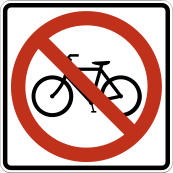
- A bicycle lane begins here
- Bicycles are not allowed here
- Watch for bicyclists crossing
- Bicycles must ride on the shoulder
Show answer
Bicycles are not allowed here. The manual explains that some regulatory signs have a red circle with a red slash over a symbol, and those signs prohibit the action shown. Here the symbol is a bicycle, so bicycles are prohibited on this road or path. A bike lane would not be marked with a red slash, and a bicycle crossing warning is a yellow sign. The same pattern appears on the No Left Turn, No Right Turn, and No U-Turn signs.
Study this in the handbook: Regulatory and guide signs
17. Floodwater covers the only road to your destination. What does the South Carolina manual tell you to do?
- Cross slowly if the water looks shallow enough
- Follow a larger vehicle through at a steady speed
- Drive through quickly to avoid stalling in it
- Go to higher ground and wait for the water to go down
Show answer
Go to higher ground and wait for the water to go down. The manual's flood rules are firm: do not drive through flooded areas, and do not attempt to cross even when the water looks shallow, because it can hide dips and other hazards and may have washed away the road surface beneath. If there is no other route, proceed to higher ground and wait for the water to subside. Following a bigger vehicle or speeding through does not make the crossing safe, since two feet of moving water can carry away even SUVs and pickups.
Study this in the handbook: Visual search and speed management
18. A South Carolina driver wants to join a video call with the phone sitting in a dash mount. What does state law say?
- It is legal because the phone is not being held
- Viewing a video call while driving is prohibited
- It is legal if the call lasts under one minute
- It is legal on roads posted at 35 mph or lower
Show answer
Viewing a video call while driving is prohibited. Holding the phone is just one of the banned actions. The Hands-Free and Distracted Driving Act also says a driver on a public road must not view moving images, and it names videos, movies, games, and video calls. A dash mount solves the holding problem but not the viewing problem, so the call is still illegal. The Act gives no exception for short calls or slow roads. Voice communication through an earpiece or a wrist-worn device is the kind of use the law leaves open.
Study this in the handbook: Fatigue, distraction and the hands free law
19. You took an over-the-counter allergy medicine before driving. What risk does the South Carolina manual warn about?
- It is safe because no prescription was needed
- It can make you drowsy and affect your driving
- It is a problem only if you also drank alcohol
- It sharpens alertness for the first few hours
Show answer
It can make you drowsy and affect your driving. Over-the-counter does not mean harmless. The manual says medicines for headaches, colds, allergies, or calming nerves can make you drowsy and affect your driving, even without alcohol. Other products, such as pep pills and diet pills, can make you nervous, dizzy, or unable to concentrate. Before taking any drug, check the label for warnings about its effect, and if you are unsure whether it is safe to drive, ask your doctor or pharmacist about known side effects.
Study this in the handbook: Alcohol, other drugs and implied consent
20. You just had a heated argument and feel angry. What does the South Carolina manual suggest before you drive?
- Drive right away so the trip can calm you down
- Drive, but take the highway instead of side streets
- Give yourself time to cool off before you drive
- Turn the radio up loud and focus on the music
Show answer
Give yourself time to cool off before you drive. Strong emotions interfere with thinking, attention, and processing information, so the manual advises waiting until anger or worry passes. A short walk or a nap may help, and it is best to stay off the road until your symptoms have passed. Another option is to have someone else drive. Driving immediately in hopes of calming down puts you on the road while still upset, and a different route or loud music does not fix the cause. Leaving several minutes early also reduces pressure on any trip.
Every question is written from the official South Carolina Driver's Manual. Need paper? Printable SC practice test with answer key.
Last verified 2026-10-05. How we check every question · Study all 500 as flashcards
Frequently asked questions
How many questions are on this South Carolina practice test?
This fixed set has 20 questions. It is test 17 of 25 from the 500 question South Carolina bank.
How does this fixed test relate to the full South Carolina bank?
Each numbered test is a fixed set of questions in a fixed order, so you can retake the same test later and compare. Every test mixes road signs and the other topics in about the same proportion as the full bank. Tests 1 to 25 together cover every question in the South Carolina bank once. The full practice page mixes the whole bank at random.
Last verified 2026-10-05. See the South Carolina DMV facts page for sourced state details.
Return to the full South Carolina practice test · Study road signs