
Test 12 of 25 · 20 questions · Free 2026
SC Permit Practice Test 12
Jump to the test ↓A fixed 20 question set from the South Carolina bank with answers and plain English explanations.
Question 1 of 20 · 0 right so far
All 20 questions in test 12
Every question below comes from the South Carolina question bank on this page. Open a question to see the correct answer and the explanation. Nothing here is hidden behind a signup.
1. While backing up, why does the South Carolina manual say you should not rely on your mirrors alone?
- Using them while reversing is illegal in South Carolina
- They fog over whenever the car is in reverse gear
- They do not show the area immediately behind the vehicle
- They are angled for night driving while you back up
Show answer
They do not show the area immediately behind the vehicle. When backing, the manual has you grasp the wheel at 12 o'clock with your left hand, put your right arm on the back of the passenger seat, and look directly through the rear window. Mirrors are for occasional checks, because they do not show the area immediately behind your vehicle. A rearview camera, if you have one, should also be checked occasionally. Children and small objects cannot be seen from the driver's seat, which is why you check behind the vehicle before you get in.
2. What three options does the South Carolina manual give for avoiding a collision or reducing its impact?
- Braking, honking, or flashing headlights
- Braking, steering, or accelerating
- Steering, shifting to neutral, or honking
- Braking, turning on hazards, or stopping
Show answer
Braking, steering, or accelerating. Every driver has a responsibility to do all they can to prevent collisions. The manual names three ways to avoid one or lessen its impact: braking, steering, and accelerating. Braking is the first reaction for most drivers, steering around a problem can work when stopping cannot, and accelerating may be needed when another vehicle is about to hit you from behind or the side. A horn or hazard lights can communicate, but they are not among the three avoidance options.
Study this in the handbook: Avoiding collisions and vehicle malfunctions
3. A passenger finds the shoulder belt uncomfortable and wants to tuck it behind the back. What does the South Carolina manual say?
- That is fine as long as the lap belt stays snug across the hips
- Placing it under the arm is the safer alternative
- It is acceptable on trips shorter than a few miles
- Don't; worn wrong it could cause serious internal injuries
Show answer
Don't; worn wrong it could cause serious internal injuries. The shoulder harness belongs across the shoulder and chest with minimal slack, if any. The manual specifically says not to wear it under the arm or behind the back, because wearing it the wrong way could cause serious internal injuries in a collision. A properly fastened lap belt does not make up for a misplaced harness, and the manual gives no exception for short trips. Lap belt position matters too: it should be snug and lie low across the hips.
4. You finished a lane change, but your turn signal is still blinking. Why does the South Carolina manual say to cancel it?
- Because the bulb burns out if left on too long
- Because a blinking signal drains the battery fast
- Because officers ticket drivers for any blinking signal
- To avoid confusing other drivers about your plans
Show answer
To avoid confusing other drivers about your plans. An appropriate signal gives other roadway users time to react, and South Carolina law requires one 100 feet or more before changing lanes, turning, or merging. Once the action is done, the manual says to cancel the signal to avoid confusing other drivers. A leftover signal is the reason the manual warns you not to trust another driver's blinker, since that driver may have forgotten to turn it off. Bulb life and battery drain are not the reason given.
Study this in the handbook: Stopping distance, following distance and signaling
5. During a hard stop in a car with ABS, the brake pedal vibrates and clicks. What does that mean?
- The brakes are about to fail completely
- The brake pads are worn and need service
- ABS is working, which is normal
- You are braking too hard and should ease off
Show answer
ABS is working, which is normal. When ABS is working, you may feel the brake pedal vibrate and hear a clicking noise, and the manual says this is normal. ABS works only while you keep pressure on the pedal, so easing off or pumping undoes it; pumping actually deactivates ABS. Keep pressing and steer as needed, since you can still steer while ABS is active. The vibration is not a sign of failing brakes or worn pads.
Study this in the handbook: Avoiding collisions and vehicle malfunctions
6. You want to turn at an intersection posted with this sign. What does it tell you?
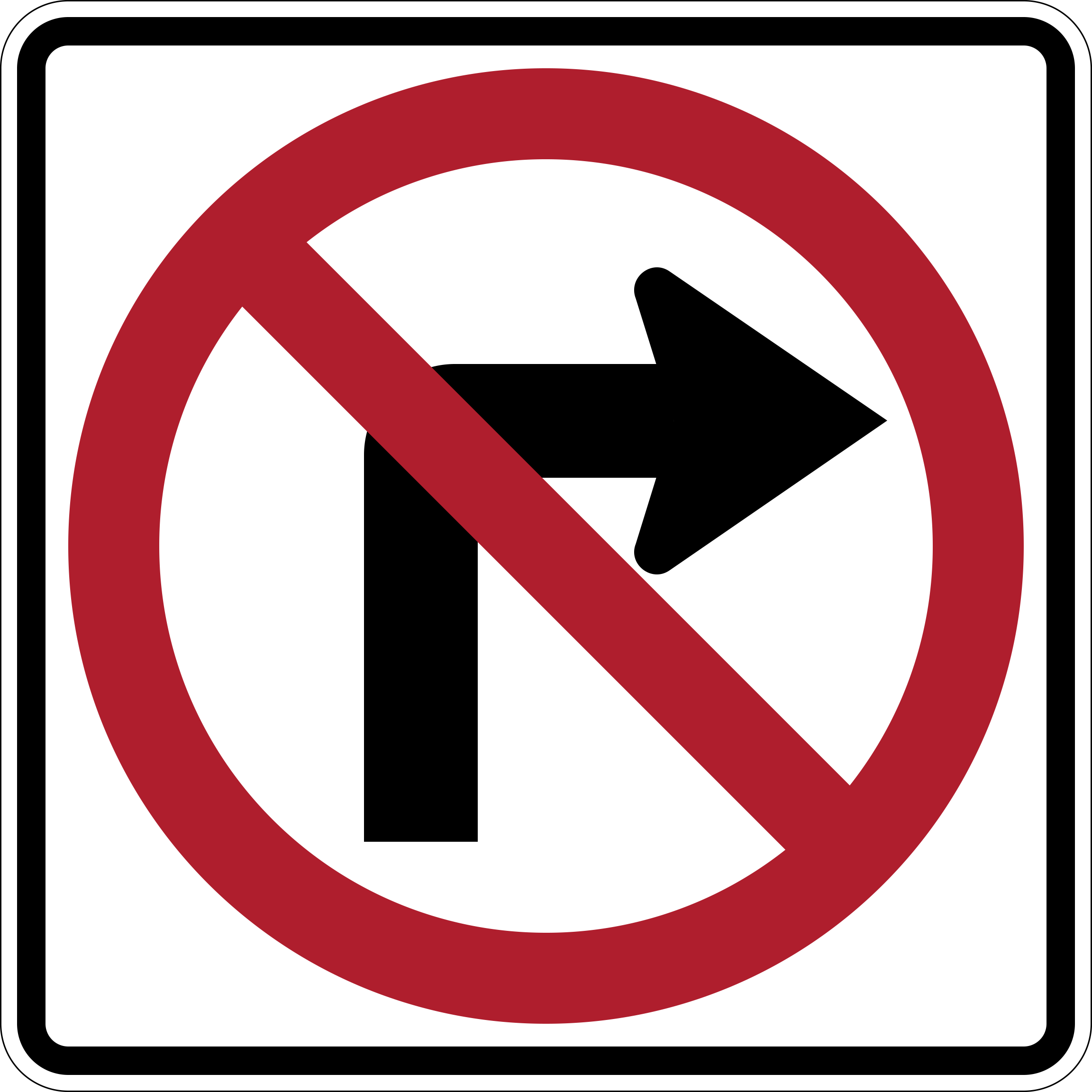
- You may not turn right here
- You may turn right after a full stop
- Right turns are allowed on red alone
- You may not turn left here
Show answer
You may not turn right here. This regulatory sign shows a right-turn arrow under a red circle with a red slash. The manual explains that a red circle and slash over a symbol prohibits that action, so right turns are not allowed at this location. It does not create a stop-then-turn rule or a red-light exception; it bans the movement. Regulatory signs tell you about specific laws you must obey, including turning rules, and they are white with black, red, or green letters or symbols.
Study this in the handbook: Regulatory and guide signs
7. You stop at a four-way stop at the same moment as a pickup truck on your right. What do you do?
- Go first, since you are on the pickup's left
- Let the pickup go first, since it is on your right
- Go first if you are turning right
- Wave the pickup through if it is larger
Show answer
Let the pickup go first, since it is on your right. At a four-way intersection controlled by stop signs, when two drivers arrive at the same time, you yield to the driver on your right. Here the pickup is on your right, so it goes first. Your planned direction does not change the order, and vehicle size has nothing to do with it. The manual's sample test asks about this exact situation. Even so, never assume the other driver will follow the rule; watch before you move.
Study this in the handbook: Yielding the right of way
8. You approach this sign where your street joins a busier road, and cars are coming on that road. What must you do?
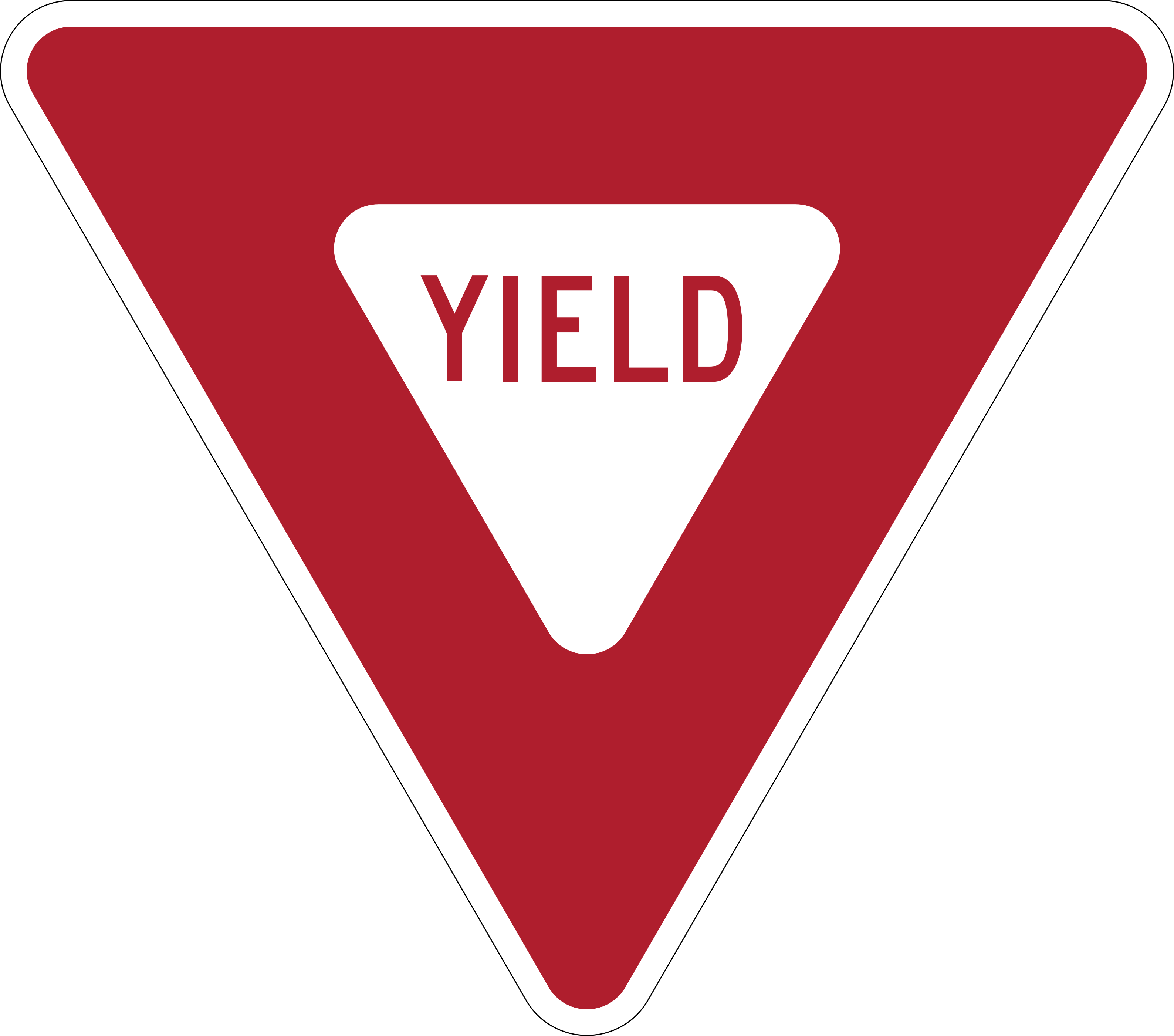
- Keep your speed; cross traffic must make room
- Slow down and let that traffic pass before you enter
- Come to a full stop every time, even if it is clear
- Speed up so you can merge in ahead of the approaching cars
Show answer
Slow down and let that traffic pass before you enter. A yield sign means you must slow down and allow traffic that has the right-of-way to cross before you enter. When traffic is coming, you let it go first, stopping if that is what it takes. The sign does not demand a full stop when the way is clear, and it never lets you force your way in or race ahead of other vehicles. The yield sign is a red and white downward-pointing triangle with red letters.
Study this in the handbook: Regulatory and guide signs
9. Two lanes are marked for left turns, and you are in the right one of the two. Where should your car be when the turn is finished?
- In whichever lane looks emptier after the turn
- In the far left lane of the new road
- In the matching lane on the new road
- In the far right lane, ready for the next turn
Show answer
In the matching lane on the new road. When several lanes turn together, the manual says to identify and enter the lane from which you will turn and stay in that lane until the turn is completed. From the right-hand turn lane, that means finishing in the corresponding lane on the new road. Switching lanes during the turn is what the rule forbids. If you need a different lane, change lanes later, after signaling and checking your blind spot.
Study this in the handbook: Turns, intersections and roundabouts
10. You drive through a work zone where workers are close to the lane. Which approach matches the manual?
- Keep your normal speed and follow the car ahead closely
- Speed up so you leave the zone sooner
- Pass slow cars when workers are not in sight
- Slow down, don't tailgate, and be ready to stop
Show answer
Slow down, don't tailgate, and be ready to stop. The manual says to give construction workers a brake: reduce your speed in work zones and be prepared to stop suddenly. It also says not to tailgate in work zones. Keeping your normal speed, speeding up to get through, or passing slow cars all go against that advice. The manual wants you ready to react to anything sudden near the workers.
Study this in the handbook: Regulatory and guide signs
11. How dangerous does the South Carolina manual say mental distractions are compared with taking your eyes off the road?
- Less dangerous, because your hands stay on the wheel
- Harmless unless you are driving in heavy traffic
- A concern only for drivers with a learner permit
- Just as dangerous as visual or manual distractions
Show answer
Just as dangerous as visual or manual distractions. The manual defines a distraction as anything that takes your attention away from driving. Taking your eyes off the road or your hands off the wheel creates obvious risks, but activities that pull your mind away are described as just as dangerous. Keeping both hands on the wheel does not make a heated conversation safe, and the warning is not limited to heavy traffic or new drivers. That is why the manual tells drivers to avoid arguments and stressful or emotional conversations with passengers.
Study this in the handbook: Fatigue, distraction and the hands free law
12. How does following too closely behind a large truck affect your visual search, according to the South Carolina manual?
- It improves your view by shielding glare
- It limits how far ahead you can see
- It has no effect if the truck is moving fast
- It helps you see the truck's brake lights better
Show answer
It limits how far ahead you can see. How far you can look down the road depends on where you drive, and the manual says to avoid situations that limit it, such as following too close to a larger vehicle. Ideally you look 20 to 30 seconds ahead so you have time to adjust. Riding close behind a truck blocks that view, and the truck driver also cannot see you in the rear no zone, which can extend up to 200 feet. Adjust your speed and road position so you can see best.
Study this in the handbook: Visual search and speed management
13. Your usual following distance is the 4 second minimum. At night on a road you know well, what is the least you should allow?
- 4 seconds
- 5 seconds
- 3 seconds
- 6 seconds
Show answer
5 seconds. The manual's minimum following distance is 4 seconds, and night driving calls for more. Add at least one additional second for night driving conditions, which makes at least 5 seconds on a familiar road. On an unfamiliar road at night, add at least two seconds instead, for at least 6. Keeping the daytime 4 seconds ignores the night adjustment, and 3 seconds is below even the daytime minimum.
Study this in the handbook: Night driving and work zones
14. A white rectangular sign with black letters is posted at the roadside. What does that tell you about it?
- It is a regulatory sign stating a law you must obey
- It is a warning sign about a hazard on the road ahead
- It is a guide sign pointing to a city
- It is an optional courtesy request
Show answer
It is a regulatory sign stating a law you must obey. Regulatory signs are square or rectangular, or have a special shape, and are white with black, red, or green letters or symbols. They tell you about specific laws you must obey, such as rules for traffic direction, lane use, turning, speed, and parking. Speed limit signs are an example. Warning signs are usually yellow diamonds, guide signs are green, brown, or blue, and a regulatory sign is never optional.
Study this in the handbook: Regulatory and guide signs
15. After parallel parking, you notice your tires are about two feet from the curb. What does South Carolina require?
- Move closer; you may be no more than 18 inches away
- Nothing; up to three feet from the curb is allowed
- Leave it; the distance matters on hills alone
- Move closer if a posted sign requires it
Show answer
Move closer; you may be no more than 18 inches away. The manual repeats the 18-inch rule in both its general parking advice and its parallel parking steps: do not park more than 18 inches from the curb or edge of pavement. Two feet is 24 inches, so you need to adjust. The goal is to keep your vehicle as far from the flow of traffic as possible so it is not an obstruction. The rule applies on flat streets as well as hills, with or without a posted sign.
16. What does the South Carolina manual tell you to watch for as you approach a yellow light?
- Pedestrians alone, since every car must stop on yellow
- Nothing special, as yellow lasts several seconds
- Mistakes by drivers beside, ahead of, and behind you
- Police officers timing the signal change
Show answer
Mistakes by drivers beside, ahead of, and behind you. The manual says you must observe and allow for errors made by other drivers at your side, front, and rear when you are approaching a yellow light. A yellow signal follows the green and warns that red is coming, so you should stop and wait for the next green if you can. If you are already in the intersection when the light changes, clear it as quickly as possible. Pedestrians matter too, but they are not the whole picture.
Study this in the handbook: Traffic lights
17. You face a steady red light and plan to go straight. What must you do?
- Stop behind the stop line and wait for green
- Stop, then go when no cross traffic is coming
- Slow down and proceed if the way is clear
- Stop inside the crosswalk so you can see better
Show answer
Stop behind the stop line and wait for green. A steady red light means stop before entering the intersection and wait behind the stop line, crosswalk, or intersection until the light turns green. Treating it like a stop sign and going when the way looks clear is what a flashing red allows, not a steady red. The one exception to waiting is a right turn on red where no sign prohibits it, and even then you stop before the crosswalk and yield to pedestrians and other traffic.
Study this in the handbook: Traffic lights
18. A driver's BAC is 0.02 percent after a single drink. Which ability does the South Carolina manual say is already impacted at that level?
- Vision, for drivers of all ages
- Hearing, for drivers under 21
- Nothing until a BAC of 0.08
- Muscle strength in the legs
Show answer
Vision, for drivers of all ages. Vision is the most important sense you use in driving, and the manual says it is impacted at 0.02 percent blood alcohol content for all drivers. Alcohol blurs vision, slows your ability to focus, can cause double vision, and reduces your ability to judge distance, speed, and the movement of other vehicles. Effects begin long before any adult limit. With even one drink in the bloodstream, a person could be arrested for driving under the influence.
Study this in the handbook: Alcohol, other drugs and implied consent
19. Tall corn blocks your view at a rural intersection that has no stop or yield signs. What should you do?
- Keep your speed; you have no sign to obey
- Slow down and be ready to stop for crossing traffic
- Speed up to get through before anyone arrives
- Expect the other road's drivers to yield to you
Show answer
Slow down and be ready to stop for crossing traffic. Uncontrolled rural intersections, with no stop or yield signs, can be very dangerous if approached without caution. The manual says to slow down and be prepared to stop for crossing or oncoming traffic. Crops growing in fields can also create blind corners that limit how far you can see, which is another reason to reduce speed. Having no sign does not give you the right-of-way, and you cannot count on others yielding.
Study this in the handbook: Rural roads, winter driving and trailers
20. Your right wheels drop off the edge of the pavement onto a low shoulder. What should you do?
- Slow down gradually, then steer gently back on
- Jerk the wheel left right away to get back on
- Brake hard while turning back onto the road
- Speed up to climb the edge quickly
Show answer
Slow down gradually, then steer gently back on. If your vehicle leaves the paved surface because of an uneven drop-off, the manual says to slow down gradually when it is safe and steer gently back onto the pavement. The turn of the wheel should be slight. Jerking the wheel to get back on immediately is the panic steering the manual warns against, and hard braking or speeding up adds to the risk of erratic vehicle behavior on an uneven shoulder.
Study this in the handbook: Avoiding collisions and vehicle malfunctions
Every question is written from the official South Carolina Driver's Manual. Need paper? Printable SC practice test with answer key.
Last verified 2026-10-05. How we check every question · Study all 500 as flashcards
Frequently asked questions
How many questions are on this South Carolina practice test?
This fixed set has 20 questions. It is test 12 of 25 from the 500 question South Carolina bank.
How does this fixed test relate to the full South Carolina bank?
Each numbered test is a fixed set of questions in a fixed order, so you can retake the same test later and compare. Every test mixes road signs and the other topics in about the same proportion as the full bank. Tests 1 to 25 together cover every question in the South Carolina bank once. The full practice page mixes the whole bank at random.
Last verified 2026-10-05. See the South Carolina DMV facts page for sourced state details.
Return to the full South Carolina practice test · Study road signs