
Test 1 of 10 · 20 questions · Free 2026
SC Permit Practice Test 1
Jump to the test ↓A fixed 20 question set from the South Carolina bank with answers and plain English explanations.
Question 1 of 20 · 0 right so far
All 20 questions in test 1
Every question below comes from the South Carolina question bank on this page. Open a question to see the correct answer and the explanation. Nothing here is hidden behind a signup.
1. What should a driver do on a slippery road covered with rain, snow, sleet, or ice?
- Follow more closely to reduce spray
- Keep the posted speed until the tires begin to slide
- Brake hard before every change in direction
- Reduce speed at the first sign of the slippery condition
Show answer
Reduce speed at the first sign of the slippery condition. On a slippery road, the manual says to reduce speed at the first sign of rain, snow, sleet, or ice. Tires grip less effectively in those conditions, which lengthens stopping distance and makes turning without a skid harder. Waiting for the tires to slide delays the response, hard braking can upset traction, and following more closely removes the space needed to stop. The cue is early adjustment: slow as soon as the surface becomes slippery, then preserve extra control and room around the vehicle.
Study this in the handbook: Visual search and speed management
2. When yielding to an emergency vehicle, what should a driver avoid whenever possible?
- Using a turn signal before pulling over
- Blocking intersections, roadways, or driveways
- Stopping at the edge of the road
- Allowing the emergency vehicle to pass
Show answer
Blocking intersections, roadways, or driveways. An emergency response needs a continuous route, so a driver who pulls aside should avoid blocking an intersection, roadway, or driveway. The signal helps communicate the move, and stopping at the edge creates the open path the emergency vehicle needs. Allowing it to pass is the purpose of yielding. The cue is to look beyond your own lane: leave access points open so the responding vehicle can continue without weaving around you.
Study this in the handbook: Emergency vehicles, traffic stops and the Move Over Law
3. What must a driver do at a flashing red traffic light before entering the intersection?
- Wait for the signal to become a steady green
- Slow down without stopping if the road looks clear
- Make a complete stop and then follow the stop-sign procedure
- Accelerate through before cross traffic arrives
Show answer
Make a complete stop and then follow the stop-sign procedure. A flashing red signal requires a complete stop behind the stop line, crosswalk, or intersection before entry. The driver then looks both ways and yields when applicable, using the same procedure as at a stop sign. Merely slowing is insufficient, and waiting for a steady green invents a requirement not stated for this signal. Accelerating through reverses the safety instruction. Treat the flashing red as a stop sign in your mental checklist: stop fully, scan both directions, yield, and proceed only when the way is clear.
Study this in the handbook: Traffic lights
4. What information do regulatory traffic signs provide?
- Specific laws governing traffic direction, lane use, turns, speed, or parking
- General scenic information about nearby attractions
- Advance notice of a railroad crossing only
- Weather forecasts for the roadway
Show answer
Specific laws governing traffic direction, lane use, turns, speed, or parking. Regulatory signs communicate specific laws that drivers must obey, including rules for direction, lane use, turning, speed, parking, and other special situations. Scenic information belongs to guide signs, and a railroad warning is only one specialized warning situation. Weather information is not the role of this sign category. The phrase to remember is must obey: when a white regulatory sign states a lane, turn, speed, or parking rule, it carries a legal instruction rather than a general suggestion about the road ahead.
Study this in the handbook: Regulatory and guide signs
5. What colors do South Carolina guide signs use, and what do they help you do?
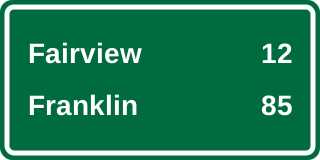
- Green, brown, or blue; they give information on intersecting roads and direct you to cities
- Red and white; they order you to stop or yield
- Yellow with black symbols; they warn of hazards ahead
- Orange; they mark construction zones
Show answer
Green, brown, or blue; they give information on intersecting roads and direct you to cities. Guide signs are square or rectangular and are green, brown, or blue. The manual says they give information on intersecting roads, help direct you to cities and towns, and show points of interest along the highway, and they can also help you find hospitals, service stations, restaurants, and hotels. Red and white signs such as STOP and YIELD are regulatory, yellow signs warn of possible danger ahead, and orange signs mark work zones. When you are unsure of your route, read the guide signs early so you can choose your lane well before the turn or exit.
Study this in the handbook: Regulatory and guide signs
6. While the results of the administrative hearing on an alcohol-related suspension are pending, what may an eligible South Carolina driver receive?
- A six-month license for $25
- A permanent license at no charge
- A TAL for $100
- A commercial license for $100
Show answer
A TAL for $100. While the hearing results are pending, an eligible driver may receive a Temporary Alcohol License for $100. The TAL remains usable until the SCDMV receives the hearing results, so it is a temporary privilege rather than a permanent replacement license. The free permanent license and the $25 six-month option are not the terms stated in this passage. A commercial license is a different credential entirely. The memory cue is hearing pending plus a $100 TAL, followed by returning it when the suspension outcome is resolved.
Study this in the handbook: Provisional and temporary alcohol licenses
7. What do regulatory signs tell drivers about?
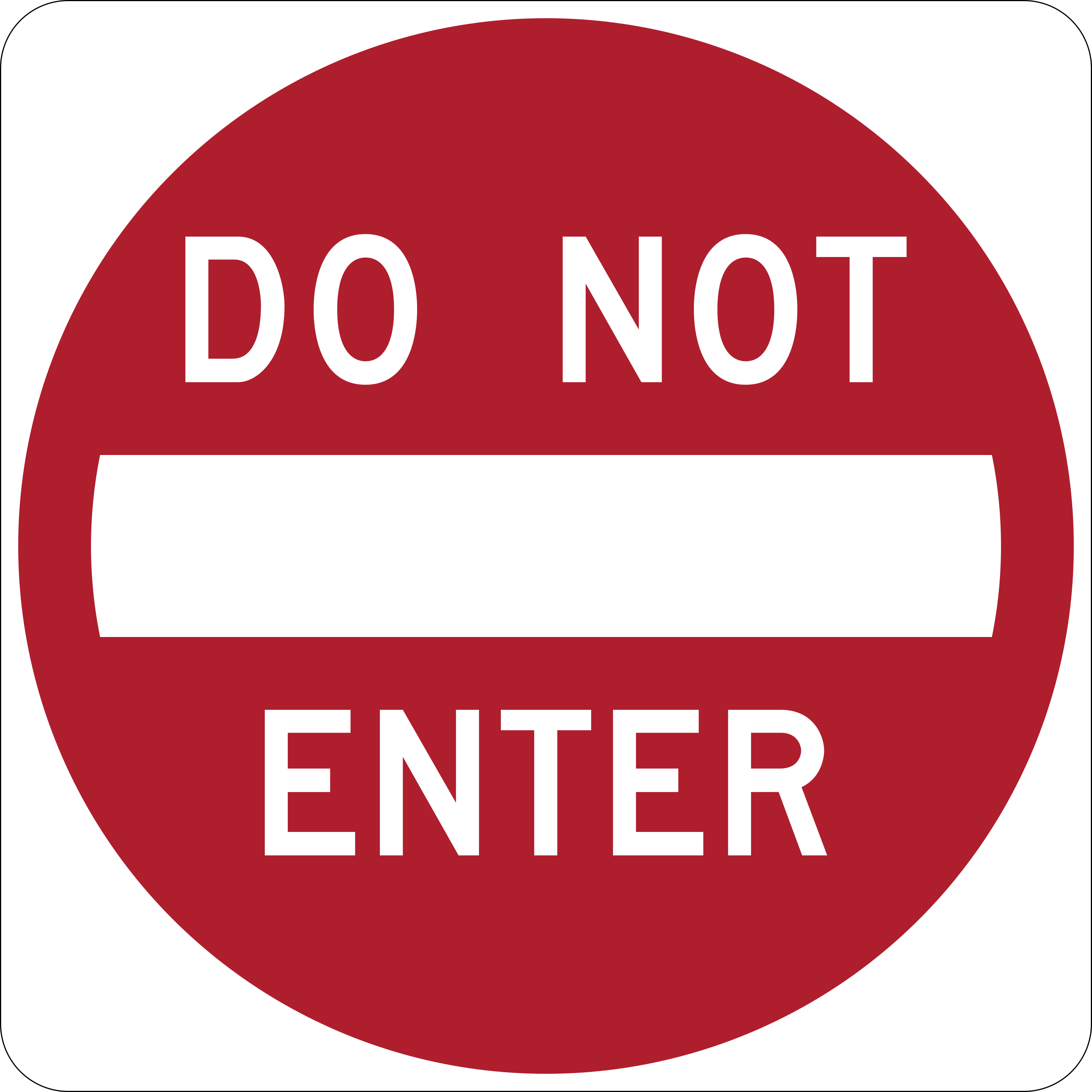
- The route number of the highway
- The location of nearby restaurants and hotels
- Possible danger that might be ahead
- Specific laws they must obey
Show answer
Specific laws they must obey. Regulatory signs communicate enforceable rules about how traffic must move. The manual gives examples involving traffic direction, lane use, turning, speed, parking, and other special situations. A restaurant or hotel location belongs with guide signs, while possible danger ahead describes warning signs. A route number identifies a roadway rather than a driving command. When a sign presents a required movement or restriction, treat its instruction as part of the traffic law and follow it before continuing.
Study this in the handbook: Regulatory and guide signs
8. What does the pictured fluorescent yellow school sign warn a driver to expect?

- A school zone or school crossing
- An adult pedestrian-only recreation area
- A railroad crossing at the next intersection
- A hospital entrance with emergency traffic
Show answer
A school zone or school crossing. The manual says some warning signs may be fluorescent yellow, such as school zones, school crossings, and pedestrian crossings, and it shows the school crossing sign among its common warning signs. The sign warns the driver to watch carefully for children. It is not the round railroad advance sign, and it does not mark a hospital or an adult only area. Slow down as conditions require, obey the slower school zone limit when lights are flashing or children are present, and stop if a school traffic patrol signals you to.
Study this in the handbook: Traffic lights
9. For what age range is South Carolina's graduated driver license program designed?
- Individuals 12 to 14 years old
- Individuals 15 to 17 years old
- Individuals 18 to 20 years old
- Individuals 21 years old and older
Show answer
Individuals 15 to 17 years old. South Carolina's graduated driver license program is for individuals from 15 through 17 years of age. It gives newer drivers an opportunity to develop driving skills while restrictions on nighttime and unsupervised driving are gradually lifted. The 12 to 14 range is below the program's stated ages, while adults 18 and older are outside this specific graduated program. Remember the range as the three teen ages beginning at 15 and ending at 17, then review the separate license stages for the specific restrictions that apply.
Study this in the handbook: Conditional and special restricted licenses
10. Before turning right on red in South Carolina, what pedestrian-related duty applies?
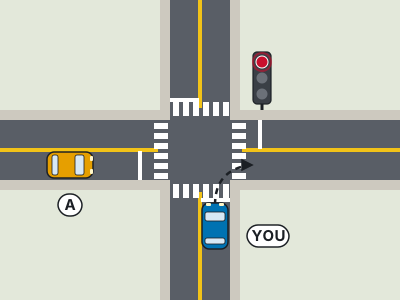
- Proceed without checking because red permits the turn
- Pedestrians must always yield to the turning vehicle
- Be prepared to yield the right-of-way to pedestrians
- Yield only to pedestrians behind the vehicle
Show answer
Be prepared to yield the right-of-way to pedestrians. A right turn on red does not remove the driver's obligation to watch for pedestrians and be prepared to yield. The turning vehicle does not gain automatic priority, and the driver must not treat the red signal as permission to skip the scan. The rule covers pedestrians in the turn area, not only someone behind the vehicle. Before moving, stop as required, check the crosswalk and intersection, then yield and turn only when clear.
Study this in the handbook: Yielding to pedestrians and bicyclists
11. How should cargo weight be distributed in a trailer, according to the South Carolina manual?
- Sixty percent in the front nearest the towing vehicle and 40 percent in the back
- Evenly, half and half
- Most of it in the back
- All of it over the rear axle
Show answer
Sixty percent in the front nearest the towing vehicle and 40 percent in the back. Trailers must be loaded heavier in the front: sixty percent of the cargo weight should go in the front nearest the towing vehicle and 40 percent in the back. Failure to load the trailer front heavy is a leading cause of trailer mishaps because it causes sway. If the trailer begins to sway, steer straight and reduce speed gradually without braking.
Study this in the handbook: Rural roads, winter driving and trailers
12. If your vehicle breaks down on a highway and you must stop, what should you do first if possible?
- Turn off all lights so the battery will not lose power
- Leave it in the travel lane so it remains visible to approaching drivers
- Get the vehicle off the road and away from traffic
- Stand behind the vehicle and direct traffic by hand
Show answer
Get the vehicle off the road and away from traffic. A disabled vehicle is dangerous when other drivers do not see it in time. The first priority, when possible, is moving it off the road and away from traffic. Once stopped safely, use emergency flashers to show that the vehicle is disabled and take additional steps to warn approaching road users. Leaving the vehicle in the lane increases collision risk, darkening it removes a warning, and standing behind it exposes a person to moving traffic. Put distance between occupants and the traffic stream whenever the situation permits.
Study this in the handbook: Avoiding collisions and vehicle malfunctions
13. How must a driver treat a flashing red traffic light?
- Stop only when a police officer is present
- Slow down without stopping
- Continue through if no vehicle is visible
- Stop completely, then proceed as at a stop sign
Show answer
Stop completely, then proceed as at a stop sign. A flashing red light requires a complete stop behind the stop line, crosswalk, or intersection before entering. The driver then looks both ways and yields when necessary, using the same procedure required at a stop sign. Merely reducing speed is the rule for a flashing yellow light, not a flashing red one. An empty-looking intersection does not cancel the stop requirement. Use the red flash as a firm command to stop, scan for pedestrians and traffic, and proceed only after the path is safe.
Study this in the handbook: Traffic lights
14. What minimum stopping distance does the South Carolina manual give for a loaded truck at 55 mph under ideal conditions?
- At least 335 feet, more than 1.5 times a car's stopping distance
- About 200 feet
- About the same as a car
- About 100 feet
Show answer
At least 335 feet, more than 1.5 times a car's stopping distance. A loaded truck with good tires and properly adjusted brakes, under ideal conditions and traveling at 55 mph, requires a minimum of 335 feet to come to a complete stop, greater than one and a half times the stopping distance of a car. It is essential not to enter a roadway or change lanes in front of a large vehicle, and to pass it completely before moving back in.
Study this in the handbook: Motorcycles and commercial vehicles
15. When does a South Carolina teen with a conditional or special restricted license earn full driving privileges?
- At 18 only
- At 17, or after one year with no traffic offenses and no at-fault collisions
- At 21
- After six months with any record
Show answer
At 17, or after one year with no traffic offenses and no at-fault collisions. A South Carolina teen earns full driving privileges at 17, or after keeping the conditional or special restricted license for one year with no traffic offenses and no at-fault collisions. Eighteen and 21 are later than the rule. Six months is not enough, and a record with offenses does not qualify. A driver under 17 who gets six or more points in the first year faces a six-month suspension instead.
Study this in the handbook: Conditional and special restricted licenses
16. Which South Carolina teen is eligible for a special restricted license?
- A 15 and a half year old
- A 17 year old with a permit
- An 18 year old first-time driver
- A 16 year old who is not yet 17 and meets the requirements
Show answer
A 16 year old who is not yet 17 and meets the requirements. A special restricted license is for someone who is 16 but less than 17, has met the requirements and passed the vision and skills tests, or who is 16 and already holds a conditional license. A 15 and a half year old gets a conditional license instead. Full driving privileges are earned at 17, so a 17 year old is past this stage. An 18 year old follows the adult route after holding a beginner's permit at least 30 days.
Study this in the handbook: Conditional and special restricted licenses
17. What does a South Carolina Class D license allow you to drive?
- Any vehicle including tractor trailers
- Motorcycles of any size
- Non commercial passenger vehicles such as cars and trucks not exceeding 26,000 pounds GVW, plus a moped or three wheel vehicle
- Only vehicles under 10,000 pounds
Show answer
Non commercial passenger vehicles such as cars and trucks not exceeding 26,000 pounds GVW, plus a moped or three wheel vehicle. A Class D license allows you to drive non commercial passenger vehicles such as cars and trucks that do not exceed 26,000 pounds gross vehicle weight, and you may also operate a moped or a three wheel vehicle other than a two wheel motorcycle with a detachable sidecar. Class E covers non commercial single unit vehicles over 26,000 pounds, and Class F covers non commercial combinations over that weight.
Study this in the handbook: License classes and the beginner's permit
18. When is a load considered secure under South Carolina's rules?
- When the tailgate is closed
- When it is covered with a blanket
- When it is under 500 pounds
- Only when nothing can slide, shift, fall or sift onto the roadway or become airborne
Show answer
Only when nothing can slide, shift, fall or sift onto the roadway or become airborne. A load must be securely fastened and is only considered secure when nothing can slide, shift, fall or sift onto the roadway or become airborne. Tie it down with rope, netting or straps directly to the vehicle or trailer and cover loose material. A driver whose load spills is guilty of a misdemeanor and may face a fine plus the cost of cleanup.
19. What do pavement markings tell a driver about lane use?
- They only show where fuel stations are located
- They divide lanes and indicate when passing or changing lanes may occur
- They replace every traffic signal
- They always permit crossing into opposing traffic
Show answer
They divide lanes and indicate when passing or changing lanes may occur. Pavement markings divide lanes and communicate when a driver may pass or change lanes. They also identify turn lanes, pedestrian walkways, and stopping locations. They are not service signs, cannot replace traffic signals, and do not automatically authorize movement into opposing traffic. The useful cue is to read the line, arrow, word, or symbol together with the surrounding traffic flow. That combination tells you how to position the vehicle and which movements are permitted.
Study this in the handbook: Pavement markings, crosswalks and stop lines
20. During a traffic stop, what should you do with your hands?
- Reach immediately for your documents
- Keep them on the steering wheel where they can be seen
- Hold a mobile phone up to record the stop
- Place them under the seat until the officer arrives
Show answer
Keep them on the steering wheel where they can be seen. During a traffic stop, the manual says to keep your hands on the steering wheel so they can be easily seen. Do not make sudden movements or search for your driver license or vehicle documents; wait for the officer to give you instructions. Cell phones and mobile devices should not be used by you or your passengers, and passengers should also keep their hands in plain view. Before the officer arrives, turn off the ignition and radio, turn on your hazard flashers, and stay in the vehicle unless the officer directs you to exit.
Study this in the handbook: Emergency vehicles, traffic stops and the Move Over Law
QualitySpace is expanding to South Carolina
We are a California-based independent insurance brokerage working on licensing in more states. We cannot help with South Carolina insurance yet. Leave your email and we will let you know when we can.
Every question is written from the official South Carolina Driver's Manual. Need paper? Printable SC practice test with answer key.
Last verified 2026-10-05. How we check every question · Study all 201 as flashcards
Frequently asked questions
How many questions are on this South Carolina practice test?
This fixed set has 20 questions. It is test 1 of 10 from the 201 question South Carolina bank.
How does this fixed test relate to the full South Carolina bank?
Each numbered test is a fixed set of questions in a fixed order, so you can retake the same test later and compare. Every test mixes road signs and the other topics in about the same proportion as the full bank. Tests 1 to 10 together cover 200 of the 201 questions in the South Carolina bank, each once. The full practice page mixes the whole bank at random.
Last verified 2026-10-05. See the South Carolina DMV facts page for sourced state details.
Return to the full South Carolina practice test · Study road signs