
Test 18 of 25 · 20 questions · Free 2026
SC Permit Practice Test 18
Jump to the test ↓A fixed 20 question set from the South Carolina bank with answers and plain English explanations.
Question 1 of 20 · 0 right so far
All 20 questions in test 18
Every question below comes from the South Carolina question bank on this page. Open a question to see the correct answer and the explanation. Nothing here is hidden behind a signup.
1. You are waiting to pull out, and an approaching car has its right turn signal on. What should you do?
- Pull out now, since the signal shows it will turn
- Flash your lights so the driver turns faster
- Pull out if the car is still more than a block away
- Wait until you are sure the car is actually turning
Show answer
Wait until you are sure the car is actually turning. A turn signal shows a plan, not a promise. The manual warns not to turn into a lane just because an approaching vehicle has its signal on: the driver may intend to turn after passing you or may have forgotten to cancel the signal from an earlier turn. Never assume another driver will share space with you. Wait until the vehicle actually begins its turn, and make sure you have a gap large enough to get across or into your lane and accelerate.
Study this in the handbook: Turns, intersections and roundabouts
2. How does alcohol affect reaction time, according to the South Carolina manual?
- It has no effect until a driver feels drunk
- It slows how fast you process information and respond
- It sharpens reflexes even though it clouds judgment
- It affects reaction time after three or more drinks
Show answer
It slows how fast you process information and respond. Reaction time is the last of the four effects the manual lists for alcohol and other impairing drugs. Alcohol slows your ability to process what is happening and respond to it, so every hazard takes longer to handle. There is no safe number of drinks before this begins; the manual says impairment starts with the first drink. Feeling fine is not a test, and alcohol does not sharpen reflexes. The best advice in the manual is not to drive a vehicle of any kind after drinking.
Study this in the handbook: Alcohol, other drugs and implied consent
3. A van is stopped in the lane next to you at a mid-block spot, blocking your view of the sidewalk. What should you do?
- Slow down and wait until you're sure no one is crossing
- Pass quickly before anyone can step out from in front of it
- Honk as you pass so hidden pedestrians stay back
- Keep your speed, since pedestrians must yield mid-block
Show answer
Slow down and wait until you're sure no one is crossing. When you drive next to parked or stopped vehicles, pedestrians can walk out between them where you cannot see. The manual says to slow down and not pass until you are sure there are no pedestrians crossing in front of the stopped vehicle. Speeding past or honking does not make a hidden person visible, and the manual tells you to always be prepared to yield to pedestrians, even outside a crosswalk. Slow, careful driving gives you time to stop.
Study this in the handbook: Pedestrians, school zones and speed
4. Driving at night in fog, why does the South Carolina manual say to use low beams instead of high beams?
- High beams drain the battery faster in damp weather
- Low beams are brighter when the air is wet
- It is illegal to use high beams outside city limits
- High beams may cause glare and make it harder to see ahead
Show answer
High beams may cause glare and make it harder to see ahead. In fog, rain, or snow, the manual says to use your low beams, because light from high beams may cause glare and make it more difficult to see ahead. Some vehicles also have fog lights that can be used in fog, snow, or rain. Low beams are not brighter, and the advice has nothing to do with the battery or city limits. On rainy, snowy, or foggy days the manual also pairs low beams with slowing down.
Study this in the handbook: Night driving and work zones
5. What happens when a front tire blows out, according to the South Carolina manual?
- The car pulls away from the side of the blowout
- The car wobbles but keeps tracking straight
- The steering locks until you stop the car
- The car pulls sharply toward the side of the blowout
Show answer
The car pulls sharply toward the side of the blowout. A blowout is a rapid deflation of air from a tire. If a front tire blows, the vehicle pulls sharply toward the side of the blowout; if a rear tire blows, it wobbles, shakes, and pulls somewhat toward that side. Either way, grip the wheel firmly and keep the vehicle going straight, take your foot off the accelerator, and avoid braking so the vehicle slows on its own. Pull off the road in a safe place and turn on your emergency flashers.
Study this in the handbook: Avoiding collisions and vehicle malfunctions
6. Your mirrors look clear and you want to move into the left lane. What does the South Carolina manual say you still need to do?
- Nothing more, since the mirrors show everything
- Brake first so the car behind slows down
- Turn your head to check your blind spot
- Move over quickly before anyone fills the gap
Show answer
Turn your head to check your blind spot. Mirrors leave blind spots, areas around your vehicle that cannot be seen. When changing lanes, the manual says to check your mirrors, check your blind spots by turning your head and looking over your shoulder in the direction you plan to move, find a gap, signal, and look again before steering into the lane. Braking first or darting over quickly is not part of that routine, and the signal must come 100 feet or more before the change.
Study this in the handbook: Turnabouts, parking, lane changes and passing
7. A fire truck is stopped with lights flashing on the shoulder, but heavy traffic in the next lane makes a lane change unsafe. What should you do?
- Force your way into the next lane anyway
- Stop in your lane until the fire truck leaves
- Keep your normal speed since you cannot move over
- Slow down and pass with caution at a safe speed
Show answer
Slow down and pass with caution at a safe speed. The move-over law asks you to change into a lane away from a stopped emergency vehicle only if safety and traffic conditions permit. When a lane change is unsafe, the manual says to slow down and proceed with caution while keeping a safe speed for traffic conditions. Forcing a lane change creates a new danger, stopping in a travel lane is not the instruction, and keeping full speed ignores the duty to slow down.
Study this in the handbook: Emergency vehicles, traffic stops and the Move Over Law
8. Another driver is passing you on a two-lane road. What should you do?
- Speed up so the pass is over sooner
- Stay in your lane and keep a constant speed
- Brake hard so the other driver can cut in
- Move onto the shoulder to give extra room
Show answer
Stay in your lane and keep a constant speed. When you are being passed, the manual's instructions are to stay in your lane, maintain a constant speed so the other driver can complete the pass, and stay on guard against any unsafe moves by that driver. Speeding up works against the driver who is trying to get by, and sudden hard braking is not what the manual asks for. The shoulder is an emergency stopping lane, not a place to move over for passing traffic. Steady speed and a steady lane position are the answer.
Study this in the handbook: Turnabouts, parking, lane changes and passing
9. What does the South Carolina manual call the best way to avoid fatigue when driving?
- Drinking coffee right before a long drive
- Getting plenty of rest before you drive
- Opening the windows and turning up the radio
- Driving faster to shorten your time on the road
Show answer
Getting plenty of rest before you drive. Fatigue builds from lack of sleep, strain, repetitive tasks, or illness, and the manual names rest as the best defense. Coffee, cold air, and loud music are not offered as remedies, and speeding up only adds risk while you are already slower to decide. If you start to feel tired anyway, the manual says to leave the road at the next exit or rest area for a 15 to 20 minute nap or find a place to sleep for the night. Planning enough sleep before the trip is the real fix.
Study this in the handbook: Fatigue, distraction and the hands free law
10. You are hauling furniture in a pickup bed. Which step does the South Carolina manual list for securing the load?
- Tie it down with rope, netting, or straps to the vehicle
- Stack it higher than the cab so the wind presses it down
- Drive under 35 mph so straps are not needed
- Rely on the weight of the items to keep them in place
Show answer
Tie it down with rope, netting, or straps to the vehicle. A load counts as secure when nothing can slide, shift, fall, or sift onto the roadway or become airborne. To get there, the manual says to tie the load down with rope, netting, or straps directly to your vehicle or trailer, consider covering it with a sturdy tarp or netting, and avoid overloading. Ask yourself what would happen to the load if you braked suddenly or hit a bump, because weight alone will not hold it, and slow speed is no substitute for tie-downs.
11. You see a yellow diamond-shaped sign with a black symbol. What type of sign is it?
- A regulatory sign stating a law
- A guide sign giving directions
- A warning sign about a possible hazard
- A work zone sign for construction
Show answer
A warning sign about a possible hazard. Shape and color give clues to a sign's message. Warning signs are usually yellow with black lettering or symbols and are typically diamond shaped; they warn of possible danger ahead. Regulatory signs are white with black, red, or green and tell you about laws, guide signs are green, brown, or blue, and work zone signs are orange. Some warning signs, such as school and pedestrian crossings, are fluorescent yellow.
Study this in the handbook: Traffic lights
12. A black and white sign with the number 50 stands beside a road during a heavy rainstorm. What does the 50 mean?
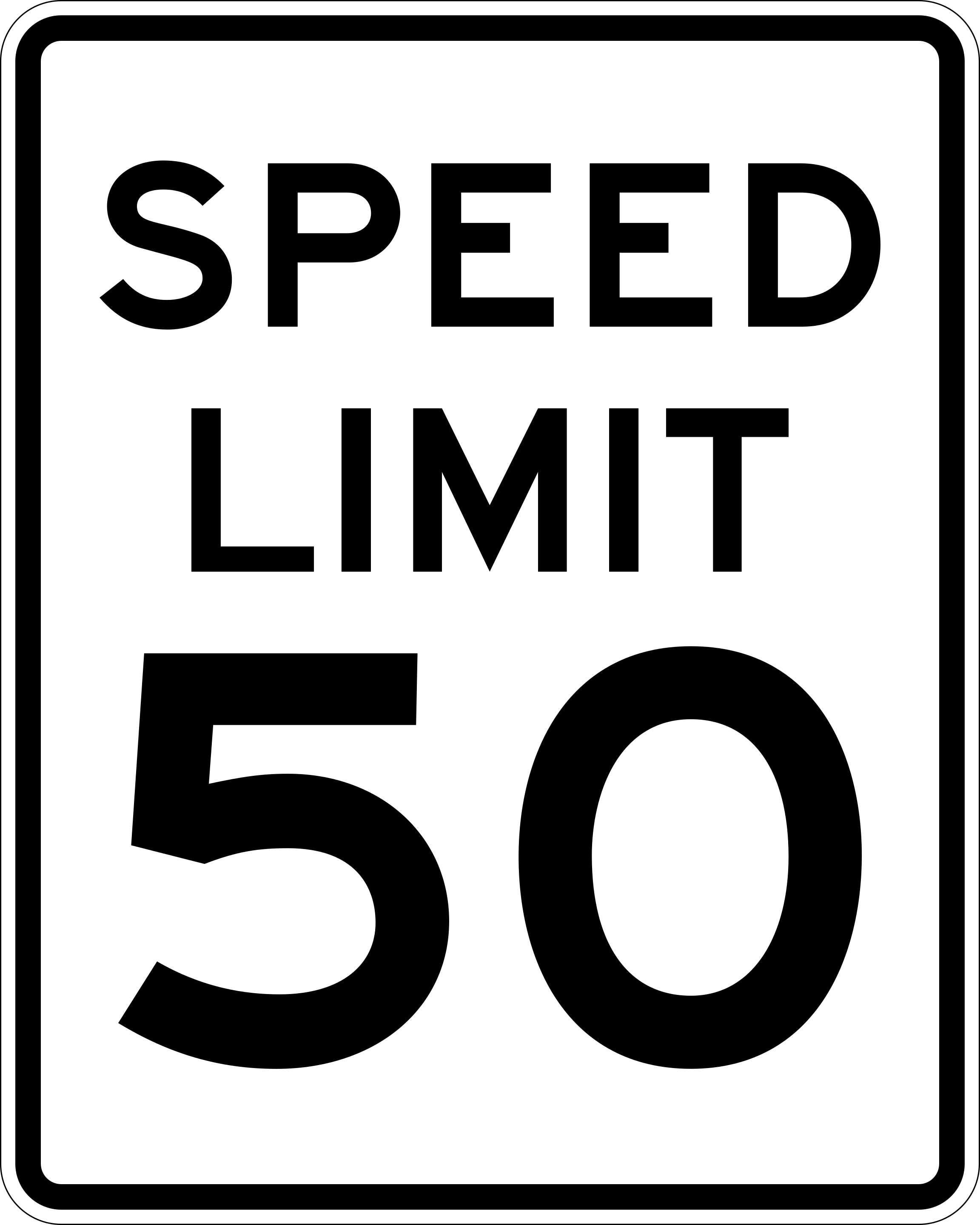
- The speed everyone must drive in any weather
- The maximum legal speed allowed in ideal conditions
- The lowest speed allowed on that road
- A speed suggested only for dry roads
Show answer
The maximum legal speed allowed in ideal conditions. A black and white speed sign shows the maximum legal speed allowed in ideal conditions. A heavy rainstorm is not ideal, so the number is a ceiling rather than a target. The manual also tells you to use low beams and slow down on rainy, snowy, or foggy days. The number is not a speed you must hold in any weather, a minimum, or a suggestion for dry roads only.
Study this in the handbook: Regulatory and guide signs
13. On dry pavement with good brakes, braking distance alone is about 158 feet at what speed?
- 25 mph
- 35 mph
- 50 mph
- 65 mph
Show answer
50 mph. Braking distance is the time and distance your brakes need to slow and stop the vehicle. The manual's example is about 158 feet at 50 mph on dry pavement with good brakes. That figure does not include perception and reaction time, which each average three quarters of a second to 1 second for an alert driver, so total stopping distance is longer. The faster you travel, the more time and distance you need to stop.
Study this in the handbook: Stopping distance, following distance and signaling
14. A bicyclist is riding along the right edge of the road ahead of you. Which choice matches the manual when you pass?
- Pass quickly to spend less time beside the rider
- Blow your horn first so the rider moves over
- Slow down and give the rider as much space as possible
- Stay close to the rider to avoid the center line
Show answer
Slow down and give the rider as much space as possible. The manual says to slow down when passing a bicyclist, allow as much space as possible between your vehicle and the bicyclist, and consider the bicyclist's speed when you pass. Passing quickly or squeezing close to the rider does not follow any of these three points. The manual's pass is a slow, wide one that also takes the rider's own speed into account.
Study this in the handbook: Turnabouts, parking, lane changes and passing
15. Your car is stuck in snow. Why does the South Carolina manual say not to spin your wheels?
- Spinning overheats the engine within seconds
- Spinning only digs the car in deeper
- Spinning works but wears out the tires quickly
- Spinning helps once you shift into a higher gear
Show answer
Spinning only digs the car in deeper. When a vehicle is stuck in snow, spinning the wheels will only dig it in deeper, so the manual says not to do it. Instead, turn the wheels from side to side a few times to push snow out of the way, use a light touch on the gas to ease the car out, shovel snow from around the wheels and underside, and put sand, cat litter, gravel, or salt in the path of the wheels for traction.
Study this in the handbook: Rural roads, winter driving and trailers
16. The car ahead passes a road sign. You start counting and reach the same sign at "one thousand two." What does that tell you?
- You are following too closely and should drop back
- Your gap is fine because you counted past one
- You should count again only if it is raining
- You are too far back and can close the gap
Show answer
You are following too closely and should drop back. South Carolina's minimum following distance is 4 seconds. To check it, watch the rear of the vehicle ahead pass a fixed point such as a sign or pole, then count one thousand one, one thousand two, and so on until you reach the same point. Reaching it before one thousand four means you are following too closely. Reduce your speed, then count again at another stationary point, repeating until you are following no closer than 4 seconds.
Study this in the handbook: Stopping distance, following distance and signaling
17. A flagger in a work zone holds up a STOP paddle, but you cannot see any traffic coming the other way. What should you do?
- Stop and wait until the flagger directs you to go
- Slow down and roll through if the lane looks clear
- Go around the flagger on the shoulder
- Honk so the flagger switches the paddle to SLOW
Show answer
Stop and wait until the flagger directs you to go. In work zones, traffic may be controlled by a person with a sign or flag who tells you which direction to travel or when to slow down or stop, and the manual says you must follow those instructions. A STOP paddle means stop, even if you see no oncoming traffic; the flagger may be holding you for workers, equipment, or vehicles you cannot see. Wait until you are directed to proceed, then drive slowly through the zone.
Study this in the handbook: Warning, railroad and work zone signs
18. You are in the right lane, traffic is light, and you see this sign. What should you do?

- Speed up and cut in at the last second
- Stop at the end of your lane and wait
- Check your blind spot, signal, and move over in a gap
- Stay in the lane; it will continue past the sign
Show answer
Check your blind spot, signal, and move over in a gap. This yellow sign shows a lane narrowing away, the Lane Ends warning. With light traffic, plan an early, normal lane change: check your mirrors, check your blind spot by turning your head, identify a gap, signal, look again, then adjust speed and steer into the lane. Racing to the last moment or stopping at the end of the lane creates conflicts, and the lane will not continue. In heavy, backed-up traffic the zipper merge is the recommended method.
Study this in the handbook: Turnabouts, parking, lane changes and passing
19. You are coming up on a curve and cannot see where it ends. When and how much should you slow down?
- Before the curve, and more since the end is hidden
- Halfway through, once you can see the road ahead
- Before the curve, but only if a speed plaque is posted
- After the curve, when the road straightens out
Show answer
Before the curve, and more since the end is hidden. The manual says to always reduce speed before entering a curve to a safe speed that allows slight, constant acceleration through it. It adds that you should slow down even more when traction is poor, when following other vehicles, and when you cannot see the end of the curve. Waiting until you are in the curve risks hard braking, which could cause the tires to lose traction. An advisory plaque is helpful but not required for slowing.
Study this in the handbook: Visual search and speed management
20. Why does a truck or bus driver sometimes swing wide to the left before making a right turn?
- To signal drivers behind to pass on the left
- To clear the corner of a curb or other obstruction
- Because trucks must turn from the left lane by law
- To check the mirrors on the passenger side
Show answer
To clear the corner of a curb or other obstruction. Large vehicles need more room to turn. The manual explains that when a truck or bus needs to turn right, the driver will sometimes swing wide to the left to safely turn right and clear the corner of a curb or other obstruction, sometimes using space from other lanes. Do not try to get between the truck and the curb, where you could be squeezed. Wait to turn until the truck or bus has completed its turn.
Study this in the handbook: Motorcycles and commercial vehicles
Every question is written from the official South Carolina Driver's Manual. Need paper? Printable SC practice test with answer key.
Last verified 2026-10-05. How we check every question · Study all 500 as flashcards
Frequently asked questions
How many questions are on this South Carolina practice test?
This fixed set has 20 questions. It is test 18 of 25 from the 500 question South Carolina bank.
How does this fixed test relate to the full South Carolina bank?
Each numbered test is a fixed set of questions in a fixed order, so you can retake the same test later and compare. Every test mixes road signs and the other topics in about the same proportion as the full bank. Tests 1 to 25 together cover every question in the South Carolina bank once. The full practice page mixes the whole bank at random.
Last verified 2026-10-05. See the South Carolina DMV facts page for sourced state details.
Return to the full South Carolina practice test · Study road signs