
Test 23 of 25 · 20 questions · Free 2026
SC Permit Practice Test 23
Jump to the test ↓A fixed 20 question set from the South Carolina bank with answers and plain English explanations.
Question 1 of 20 · 0 right so far
All 20 questions in test 23
Every question below comes from the South Carolina question bank on this page. Open a question to see the correct answer and the explanation. Nothing here is hidden behind a signup.
1. You are turning right at an intersection, and a bicyclist is riding straight through on your right. Who goes first?
- The bicyclist; yield as you would to any vehicle
- You, because cars have priority over bicycles
- Whoever is moving faster at that moment
- You, if you signaled before the bicyclist arrived
Show answer
The bicyclist; yield as you would to any vehicle. Bicycles are vehicles on the roadway, and bicyclists have the same rights and responsibilities as drivers. The manual says to yield to bicyclists in intersections as you would for pedestrians and other vehicles, and to slow down and let a cyclist clear the intersection before you make your turn. Turning sharply in front of a bicyclist is one of the things the manual tells you to avoid. Signaling does not give you priority.
Study this in the handbook: Yielding to pedestrians and bicyclists
2. Your front left tire blows out on the interstate and the car pulls hard to the left. What is your first move?
- Brake hard to stop as quickly as possible
- Let go of the wheel so the car can steady itself
- Grip the wheel firmly and keep the car going straight
- Steer sharply right to correct the pull
Show answer
Grip the wheel firmly and keep the car going straight. A front tire blowout makes the vehicle pull sharply toward the blowout. The manual's first step is to grip the steering wheel firmly and keep the vehicle going straight. Then slow down gradually by taking your foot off the accelerator, do not brake, and let the vehicle slow by itself or brake gently if necessary. A sharp correction can overshoot, and letting go gives up control. Pull off the road in a safe place and turn on your flashers.
Study this in the handbook: Avoiding collisions and vehicle malfunctions
3. The South Carolina manual compares hydroplaning to what?
- Ice skates gliding on a frozen pond
- The action of water skis on water
- A boat pushing through a wave
- A car rolling on loose gravel
Show answer
The action of water skis on water. Hydroplaning occurs when the steering tires ride on a layer of water on top of the road surface, and the manual compares it to the action of water skis. When that happens, the tires lose traction with the road, so steering and braking stop working normally. The manual says the best way to avoid it is to slow down when driving in rain or on roads with pooled water or puddles.
Study this in the handbook: Visual search and speed management
4. A freight train has passed, but the crossing gates are still down and the lights are flashing. The track looks clear to you. What should you do?
- Drive around the gates since the train is gone
- Honk to tell the gate operator to raise them
- Cross slowly while watching for a second train
- Wait until the gates rise and lights stop
Show answer
Wait until the gates rise and lights stop. After a train crosses the highway, the manual says to wait until the train is well down the track or until railroad devices such as lights and gates indicate it is safe to cross. Gates that are still down with lights flashing have not given that signal, and at crossings with more than one track, another train may be coming. Never go around lowered gates. Wait until they rise and the lights stop, then look both ways and cross.
Study this in the handbook: Warning, railroad and work zone signs
5. What is the main safety advantage of a Diverging Diamond Interchange (DDI)?
- Drivers can turn left on red without stopping at the crossover
- Left turns no longer cross oncoming through traffic
- It removes every traffic signal from the interchange
- It lets drivers make U-turns at both ramp terminals
Show answer
Left turns no longer cross oncoming through traffic. In a DDI, cross street traffic shifts to the left side of the road between two signalized crossover intersections. Because of that shift, vehicles turning left onto or off of the interstate ramps do not cross the paths of approaching through vehicles. The manual says this design improves turning movements and significantly reduces vehicle-to-vehicle conflict points compared with a conventional diamond interchange, and it also reduces the severity of conflicts. The crossovers are signalized, so their signals still apply.
Study this in the handbook: Turns, intersections and roundabouts
6. As you enter a multi-lane highway from a ramp, what is the acceleration lane for?
- Stopping to wait until the right lane is completely empty
- Passing slow vehicles that are already on the highway
- Reaching the speed of highway traffic before merging
- Parking briefly if you need to check directions
Show answer
Reaching the speed of highway traffic before merging. The acceleration lane runs alongside the main roadway so you can build speed to match other vehicles before you pull on. Then you identify a gap in traffic, merge with the flow, and cancel your turn signal. Stopping at the end of the lane to wait for an empty highway defeats its purpose, and it is not a passing lane or a place to park. Drivers already on a limited access or interstate highway have the right-of-way, so you fit into a gap rather than forcing one.
Study this in the handbook: Turnabouts, parking, lane changes and passing
7. Bicyclists are required to ride with the flow of traffic. What does the South Carolina manual still tell drivers?
- Look for bicyclists riding anywhere on the roadway
- Watch only the right edge, where riders must be
- Expect riders against traffic only on sidewalks
- Ignore riders going the wrong way; they must yield
Show answer
Look for bicyclists riding anywhere on the roadway. The law expects bicyclists to ride in the direction of traffic, but the manual warns drivers not to count on it: look for bicyclists riding anywhere on the roadway. Riders vary in skill, and an unskillful bicyclist may swerve, ignore signs and signals, or ride without a light at night. Children riding on sidewalks may come onto the road. Scanning one edge of the road, or treating a wrong-way rider as someone else's problem, leaves you unprepared.
8. Head restraints are designed to prevent whiplash. How should you adjust yours?
- So it rests against your neck below your ears
- So it touches the back of your head, not below ear level
- As low as possible so it stays out of your view
- So it sits several inches behind the top of your head
Show answer
So it touches the back of your head, not below ear level. A head restraint helps only when it is positioned correctly. The manual says it should contact the back of your head and not sit below the level of your ears, so it can do its job of preventing whiplash. A restraint against the neck or pushed all the way down sits too low, and one well away from your head does not make the contact the manual calls for. Set it along with your seat and mirrors before you start to drive.
9. Backing out of a perpendicular parking space, when should you start turning the steering wheel sharply?
- When your front bumper clears the car parked beside you
- As soon as your rear bumper leaves the space
- Before you start moving, so the car pivots out
- When your side mirror lines up with the next car's mirror
Show answer
When your front bumper clears the car parked beside you. Leaving a perpendicular or angle space, first check for traffic in all directions. Then, while still checking, move straight back until your front bumper clears the vehicle parked beside you. Only after that do you turn the steering wheel sharply in the direction the rear of your vehicle should move. When the vehicle is clear of the parking space, stop, shift to drive, and accelerate smoothly while steering as needed to straighten the wheels.
Study this in the handbook: Turnabouts, parking, lane changes and passing
10. You stopped for a red light and plan to turn right on red. A pedestrian is stepping into the crosswalk on your right. What must you do?
- Turn now, since right on red is allowed
- Turn quickly before the person reaches your lane
- Inch into the crosswalk so the pedestrian waits
- Wait and let the pedestrian cross before turning
Show answer
Wait and let the pedestrian cross before turning. Turning right on red is allowed unless a sign prohibits it, but it comes with duties. Stop before entering the crosswalk on the near side of the turn, and yield to pedestrians lawfully in or next to the crosswalk and to other traffic using the intersection. The manual repeats that when turning right on red, you must be prepared to yield to pedestrians. Rushing the turn or creeping into the crosswalk ignores that duty.
Study this in the handbook: Pedestrians, school zones and speed
11. On which side of a large truck does the South Carolina manual say the bigger blind spot is?
- The left side, beside the driver's door
- The right side, from behind the cab along the truck
- Directly in front of the cab, by the bumper
- Neither; both sides have equal blind spots
Show answer
The right side, from behind the cab along the truck. Large trucks and buses have big no zones on both sides, much larger than a car's blind spots, but the manual says the right side is larger, starting behind the cab and extending up to the length of the truck. The left side and the front also have blind spots, yet the right is the bigger one. If you cannot see the driver's face in the side mirror, the driver cannot see you, so avoid driving alongside a truck longer than you must.
Study this in the handbook: Motorcycles and commercial vehicles
12. A work zone sign shows a picture of a traffic signal. What does it tell you?
- A permanent signal is being removed ahead
- A temporary traffic signal may be used ahead
- Traffic signals do not apply in the work zone
- A pedestrian signal is ahead of the work zone
Show answer
A temporary traffic signal may be used ahead. The manual says temporary traffic signals may be used in work zones, and you may see a warning sign showing a symbol of a traffic signal. That sign tells you a temporary signal may be ahead. If it shows red, stop at the white line if one is present. The sign does not mean a signal is being removed or that signals are switched off.
Study this in the handbook: Warning, railroad and work zone signs
13. What is the blue sign posted at a South Carolina railroad crossing for?
- Showing the train schedule for that crossing
- Telling you the speed limit for crossing the tracks
- Marking the nearest place to turn around
- Giving the number to call if a vehicle is stuck there
Show answer
Giving the number to call if a vehicle is stuck there. If your vehicle ever gets stuck on a track, the manual says to contact the emergency phone number listed on the blue sign at the crossing and provide the crossing information. The blue sign does not give train schedules, crossing speeds, or turnaround locations. Better still, never stop on the tracks in the first place: if traffic backs up, wait at the stop line before them, and cross only when there is room on the other side.
Study this in the handbook: Warning, railroad and work zone signs
14. South Carolina's move-over law responds to more roadside workers being struck. Which group does the manual name along with police, EMS, and firefighters?
- Garbage truck crews
- Utility line crews
- School crossing guards
- Tow truck operators
Show answer
Tow truck operators. The manual explains that incidents are increasing in which law enforcement officers, emergency medical services, fire department personnel, and tow truck operators are struck while performing duties on the road. Move-over laws in South Carolina and most other states respond to that problem by requiring drivers to slow down and change lanes when approaching emergency vehicles. When a lane change is unsafe, slow down and proceed with caution at a safe speed for traffic conditions.
15. You pass this round yellow sign on a country road. What does the South Carolina manual say it asks you to do?

- Slow down, look and listen, and be ready to stop
- Speed up so you can cross before any train reaches the road
- Stop completely at the sign, then continue
- Turn on your hazard lights until you cross
Show answer
Slow down, look and listen, and be ready to stop. The round yellow sign with an X and RR letters is placed along the road before a highway-railroad grade crossing. It cautions you to slow down, look, and listen for a train or railroad vehicle, and to be prepared to stop if a train is approaching. It is an advance warning, not a stop sign, so no stop at the sign itself is required. At the crossing, look both ways and cross quickly without stopping when no train is coming.
Study this in the handbook: Warning, railroad and work zone signs
16. A driver towing a trailer waits until the car is halfway down a steep hill to slow down. What should the driver have done?
- Slowed down only at the bottom of the hill
- Kept the same speed so the trailer stays steady
- Slowed down before starting down the hill
- Braked hard once the trailer began to sway
Show answer
Slowed down before starting down the hill. The manual says that when going down a grade you should slow down BEFORE starting down the hill. A driver who waits until the car is halfway down, until the bottom, or until the trailer sways has slowed too late. If conditions worsen, the manual also says to reduce speed even more. Slow before the descent begins, not partway through it.
Study this in the handbook: Rural roads, winter driving and trailers
17. A motorcycle is approaching with its right turn signal blinking, and you want to pull out from a side street. What should you do?
- Pull out, since the rider is about to turn
- Wait until you are sure the rider is turning
- Flash your lights so the rider turns sooner
- Pull out halfway to claim your spot
Show answer
Wait until you are sure the rider is turning. Motorcycle turn signals may not cancel by themselves, and the rider may have forgotten to turn the signal off. The manual says not to assume a motorcycle is turning just because its signal is flashing; wait to be sure the rider is going to turn before you proceed. Motorcycles are small and easy to misjudge, so give them the same caution you would give any vehicle with the right-of-way.
Study this in the handbook: Motorcycles and commercial vehicles
18. Why should you walk around behind your car before getting in to back out of the driveway?
- To check that the tires are fully inflated
- Because relying on a backup camera is illegal
- Children and small objects can't be seen from the seat
- To give the engine time to warm up
Show answer
Children and small objects can't be seen from the seat. The manual's first backing step is to check behind the vehicle before you get in, because children and small objects cannot be seen from the driver's seat. Mirrors do not show the area immediately behind the car, and a rearview camera should be checked only occasionally while backing. Tire pressure and engine warm-up are not the reasons given. Then back slowly, looking through the rear window, with your right arm on the passenger seat.
19. Your brake warning light comes on as you get ready to leave. What does the South Carolina manual say?
- Do not drive the vehicle while that light is on
- Drive gently and have the brakes checked within a week
- Pump the brakes a few times until the light goes out
- Ignore it if the pedal feels firm when pressed
Show answer
Do not drive the vehicle while that light is on. Checking your warning lights is part of making sure the vehicle is working correctly. A brake warning light tells you the brakes are not working properly, and the manual's instruction is plain: do not drive if you see it. Driving gently or waiting a week ignores the warning, and pumping the pedal or judging by feel does not fix the problem. If the brakes fail while you are already driving, the manual's backup is the parking brake, applied slowly.
Study this in the handbook: Avoiding collisions and vehicle malfunctions
20. What does this orange diamond sign with a person symbol warn you about?
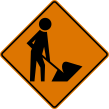
- A pedestrian crosswalk in a school zone
- A hiking trail crossing the highway
- People working on or near the road ahead
- A crossing guard at the next corner
Show answer
People working on or near the road ahead. Orange diamond signs are work zone signs, and this one, with a worker symbol, warns of workers ahead. Work zone signs alert you that people are working on or near the roadway, along with warnings about reduced speed zones, detours, slow-moving construction equipment, and poor or suddenly changing road surfaces. Pedestrian and school crossings use yellow or fluorescent yellow signs instead. Reduce your speed, adjust your lane position to give workers space, and be prepared to stop.
Study this in the handbook: Warning, railroad and work zone signs
Every question is written from the official South Carolina Driver's Manual. Need paper? Printable SC practice test with answer key.
Last verified 2026-10-05. How we check every question · Study all 500 as flashcards
Frequently asked questions
How many questions are on this South Carolina practice test?
This fixed set has 20 questions. It is test 23 of 25 from the 500 question South Carolina bank.
How does this fixed test relate to the full South Carolina bank?
Each numbered test is a fixed set of questions in a fixed order, so you can retake the same test later and compare. Every test mixes road signs and the other topics in about the same proportion as the full bank. Tests 1 to 25 together cover every question in the South Carolina bank once. The full practice page mixes the whole bank at random.
Last verified 2026-10-05. See the South Carolina DMV facts page for sourced state details.
Return to the full South Carolina practice test · Study road signs