
Test 4 of 10 · 20 questions · Free 2026
MD Permit Practice Test 4
Jump to the test ↓A fixed 20 question set from the Maryland bank with answers and plain English explanations. The real MD exam is 25 questions, 88 percent to pass; take the full length version on the main practice page.
Question 1 of 20 · 0 right so far
All 20 questions in test 4
Every question below comes from the Maryland question bank on this page. Open a question to see the correct answer and the explanation. Nothing here is hidden behind a signup.
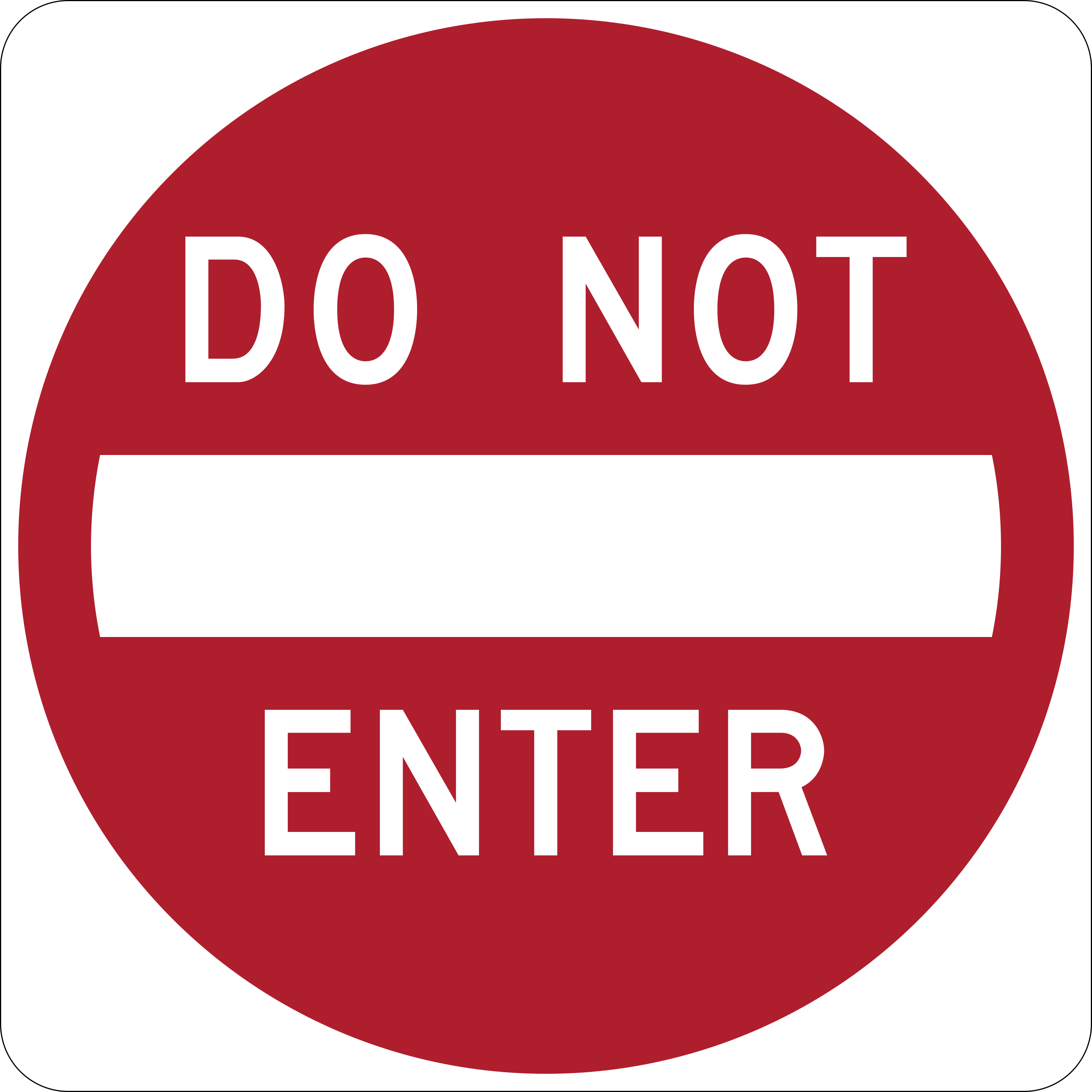
1. What does the pictured red sign communicate?
- The road is one-way in your direction
- Parking is permitted for five minutes
- A railroad crossing is ahead
- Do not enter
Show answer
Do not enter. The manual identifies red as a sign color used for stop, yield, do not enter, or wrong way messages. A Do Not Enter sign therefore prohibits entering the roadway or ramp from that approach. It is not permission to park, a railroad warning, or confirmation that traffic travels toward you in your direction. If the sign is facing your approach, look for a legal route around the restriction rather than crossing past it. Red is the quick color cue, and the words or symbol identify the specific prohibition.
Study this in the handbook: Sign colors and shapes
2. When driving in Maryland, how may you carry your valid insurance identification card?
- Only after a police officer requests it
- Only as a paper card issued within the past 30 days
- Only as a photograph stored on another driver's phone
- In paper or electronic format
Show answer
In paper or electronic format. Maryland requires a driver to have a valid insurance identification card while operating a motor vehicle, and the card may be electronic. A paper card is also acceptable, but it is not limited to a recent 30-day issue or to another person's device. The obligation exists before a traffic stop, so waiting for an officer to ask does not remove the requirement. Keep the card accessible in the vehicle or in a phone you can safely show when stopped, and present it if law enforcement requests proof.
Study this in the handbook: Supervising drivers, insurance, seat belts and child seats
3. What does a posted speed limit represent under ideal road conditions?
- The maximum legal speed you can travel on that road
- The minimum speed allowed on that road
- A recommended speed that may always be exceeded by 10 mph
- A target speed that applies only when traffic is light
Show answer
The maximum legal speed you can travel on that road. A posted speed limit is the maximum legal speed for that road when conditions are ideal. It is not a suggested floor, and a driver cannot treat the number as permission to add extra miles per hour. Poor weather, traffic, curves, pedestrians, or other hazards may require a slower speed. A useful cue is to read the sign as an upper boundary, then ask whether the road and visibility make an even lower speed necessary.
Study this in the handbook: Defensive driving and who goes first
4. What should a driver do when a warning sign identifies a sharp turn?

- Stop in the lane at the sign every time
- Accelerate through without checking the road
- Prepare to slow and take appropriate action
- Ignore the sign if the road is dry
Show answer
Prepare to slow and take appropriate action. Maryland classifies signs for special conditions or hazards as warnings and says a driver may have to slow down and should be ready to take appropriate action. A sharp-turn warning therefore calls for an early speed adjustment and careful lane control. Accelerating, stopping in the travel lane without a reason, or ignoring the sign on a dry road all remove safety margin. Look through the turn, reduce speed before steering demand increases, and follow any advisory speed or additional control that appears.
Study this in the handbook: Sign colors and shapes
5. Your Maryland license is suspended. When does the suspension period begin?
- On the date of the traffic stop
- When you receive the mailed notice
- When the MVA receives your license
- On the first day of the next month
Show answer
When the MVA receives your license. If a Maryland license is suspended, revoked, refused or canceled, the driver must give the license to the MVA, and the suspension or revocation period begins when the MVA receives it. Holding on to the card only delays the start of the clock. The period does not start at the traffic stop or when the notice arrives in the mail, and the manual sets no calendar month rule. Driving is not allowed at any point without a valid license.
6. At a Maryland yield sign, what must you do before proceeding?
- Stop every time, even when the road is empty
- Slow down and yield to pedestrians, bicycles, and vehicles
- Accelerate so other traffic must wait
- Proceed without looking if your lane is open
Show answer
Slow down and yield to pedestrians, bicycles, and vehicles. A yield sign calls for a slower approach and a careful look to both sides. Give way to pedestrians, bicycles, and vehicles, and continue only when doing so is safe. A complete stop may be needed, but stopping every time is not the sign's automatic instruction. Accelerating or skipping the scan would reverse the protective purpose of the sign. Remember the triangle: it signals a conditional stop and right-of-way decision, unlike the octagonal sign that requires a complete stop in every approach situation.
Study this in the handbook: Regulatory, warning and guide signs
7. What should drivers do to reduce the possibility of aggressive driving incidents?
- Ignore traffic laws when another driver is aggressive
- Compete with drivers who are moving too slowly
- Follow an impatient driver closely to discourage passing
- Respect and cooperate with other people using the road
Show answer
Respect and cooperate with other people using the road. Maryland advises drivers to respect and cooperate with everyone using the road as one way to reduce aggressive-driving incidents. That means keeping your own conduct calm, lawful, and predictable instead of turning delays or disagreements into a contest. Competing with slower drivers raises conflict, and following closely removes the space needed to respond safely. Ignoring traffic laws creates additional danger rather than resolving it. Allow extra travel time, stay patient, signal intentions, and leave room when another driver behaves aggressively.
Study this in the handbook: Aggressive, distracted and drowsy driving
8. After each moving violation conviction or PBJ, what must a Maryland provisional driver start over before getting a full license?
- A new 45-day permit period
- A new 18-month conviction-free period
- A new 60-hour practice log
- A new knowledge test
Show answer
A new 18-month conviction-free period. The manual says that after each conviction or probation before judgment for a moving violation, the provisional driver must begin a new 18-month conviction-free period before the license can be restored or upgraded. This matches the rule that a full license requires 18 months with no moving violation convictions. A 45-day permit period and the 60-hour practice log belong to the learner stage. Passing all licensing tests again is tied to a minor's fourth offense revocation, not to this rule.
Study this in the handbook: Provisional license restrictions, implied consent and penalties
9. What is the purpose of Maryland's Provisional Driver's License?
- To permit unsupervised driving with restrictions for new drivers
- To replace the learner's permit for commercial drivers only
- To allow unrestricted driving before any testing
- To authorize driving only when a parent is in the vehicle
Show answer
To permit unsupervised driving with restrictions for new drivers. The provisional credential is the graduated licensing step for a new driver who has never held a license. It allows driving without supervision, but restrictions control situations such as passengers, nighttime travel, and wireless device use. It is not an unrestricted license and is not limited to commercial applicants. Think of it as supervised experience carried forward into a restricted independent stage.
Study this in the handbook: From provisional license to full driver's license
10. In a Maryland work zone, what do flashing blue lights mean?
- Workers have gone home
- The work zone speed limit no longer applies
- Highway maintenance vehicles are merging
- Speed cameras are active
Show answer
Speed cameras are active. Maryland's table of work zone lights gives each color a meaning. Flashing amber or yellow lights mean an active work zone with workers present. Flashing blue lights mean the speed cameras are active, and speeding fines may be much higher in work zones. Flashing green lights mark highway maintenance vehicles. Blue does not signal that work has ended, and it never lifts the posted work zone limit, so slow down and obey the posted limit.
Study this in the handbook: Railroads, work zones, roundabouts, highways and processions
11. When may a Maryland driver be required to take a drug or alcohol test?
- Only after a crash involving property damage
- Only if the driver volunteers the request
- Only after a judge issues a written warrant
- Whenever a law enforcement officer asks after driving or attempting to drive on a covered road or public-use property
Show answer
Whenever a law enforcement officer asks after driving or attempting to drive on a covered road or public-use property. Maryland's implied-consent rule means that driving or attempting to drive on a road or private property used by the public carries agreement to take a drug or alcohol test when a law enforcement officer asks. A crash, warrant, or voluntary request is not the trigger stated here. The cue is the combination of driving and an officer's request on a covered roadway or public-use property.
Study this in the handbook: Provisional license restrictions, implied consent and penalties
12. Where does the Maryland manual say children under 13 should ride?
- In the front seat with the air bag on
- Anywhere, as long as they are belted
- Buckled up in a rear seat, in a child safety seat or with a seat belt
- In the front seat if over 4 feet 9 inches
Show answer
Buckled up in a rear seat, in a child safety seat or with a seat belt. Children under age 13 should ride buckled up in a rear seat, in a child safety seat or with a seat belt. Children in a rear facing seat must never ride in the front seat of a vehicle with a passenger air bag. Being belted somewhere in the vehicle is not the whole guidance, and a child's height does not move a child under 13 to the front. Follow all instructions from the maker of the child safety seat and of the vehicle.
Study this in the handbook: Supervising drivers, insurance, seat belts and child seats
13. After stopping at a steady red signal, which turn may be permitted unless a sign prohibits it?
- A U-turn from the intersection
- Any left turn across two-way traffic
- A right turn, or a left turn from one one-way street to another
- A straight movement through the red signal
Show answer
A right turn, or a left turn from one one-way street to another. A steady red signal requires a complete stop and normally keeps the driver stopped. After that stop, Maryland permits a right turn, or a left turn from one one-way street to another one-way street, unless a sign prohibits the movement. In either case, yield to pedestrians and all other traffic. A general left turn across two-way traffic, a U-turn, or continuing straight would exceed the listed permission. Check for a stop line first, then the crosswalk, and make the permitted turn only when the path is clear.
Study this in the handbook: Traffic signals, arrows and lane use lights
14. On a wet road, what braking practice helps reduce the risk of a skid?
- Brake hard and turn sharply to regain traction
- Avoid slamming on the brakes; pump them if the vehicle lacks ABS
- Keep braking firmly until the tires begin to slide
- Release the steering wheel and let the vehicle choose its path
Show answer
Avoid slamming on the brakes; pump them if the vehicle lacks ABS. On wet or otherwise inclement roads, Maryland advises avoiding slamming on the brakes because it may cause a skid. A vehicle without anti-lock brakes should have its brakes pumped to help prevent skidding. Braking hard while turning sharply, or braking firmly until the tires slide, invites the skid the manual warns about, and letting go of the wheel gives up control. Avoid jerking the steering wheel or quickly changing speed, and keep a much larger following distance on wet pavement.
Study this in the handbook: Bad weather, skids and hydroplaning
15. How must a Maryland child younger than 2 ride?
- In a rear facing child safety seat meeting federal guidelines, until reaching the seat's height or weight limit
- Forward facing with a harness
- In a booster seat
- In an adult belt in the back seat
Show answer
In a rear facing child safety seat meeting federal guidelines, until reaching the seat's height or weight limit. Children younger than 2 must ride in a rear facing child safety seat that meets federal guidelines until they reach the height or weight specified by the manufacturer. All children under 8 must ride in a child safety seat unless they are 4 feet 9 inches or taller, and a rear facing seat must never go in front of an active passenger air bag. Follow both the seat maker's and the vehicle maker's instructions.
Study this in the handbook: Supervising drivers, insurance, seat belts and child seats
16. What do blue traffic signs identify?
- No-passing zones and passing restrictions
- General warnings about hazards ahead
- Destinations and route distances
- Services such as food, gas, and rest areas
Show answer
Services such as food, gas, and rest areas. Blue signs provide service information, including food, gas, and rest areas. They help a driver locate useful facilities rather than impose a speed rule or warn about a roadway hazard. Yellow is the manual's general warning color, green identifies destinations, distances, and directions, and a no-passing instruction is communicated by a regulatory sign or pennant. The cue is to associate blue with help available along the route, then read the symbol or words for the particular service.
Study this in the handbook: Sign colors and shapes
17. What does Maryland law say about speed when road conditions are adverse?
- You may drive slower than the posted limit, but never faster
- A driver may exceed the limit to match traffic in bad weather
- The posted number becomes a minimum during rain or snow
- Lower speeds are required only on roads without center lines
Show answer
You may drive slower than the posted limit, but never faster. Maryland requires a reasonable speed that accounts for existing and potential hazards. A driver may go slower than the posted limit when road, weather, visibility, or traffic conditions call for it, but may not go faster than the limit. Matching fast traffic is not a defense for speeding in rain or snow. A concrete cue is to treat the posted number as a ceiling and conditions as a reason to lower your speed.
Study this in the handbook: Speed limits and a safe speed
18. How far before an oncoming vehicle must a Maryland driver change from high beams to low beams?
- At least 100 feet
- At least 300 feet
- At least 500 feet
- Only after the vehicles pass
Show answer
At least 500 feet. When an oncoming vehicle is approaching, the driver must switch from high beams to low beams at least 500 feet before reaching that vehicle. Waiting until the vehicles pass can glare the other driver and reduce safety. The 300-foot figure applies to following a vehicle in front of you, so first identify whether the traffic is approaching or traveling in the same direction.
Study this in the handbook: Headlights, night driving and fog
19. Under Maryland's Move Over Law, what should you do when approaching a stopped vehicle with flashing lights?
- Pass close to it at the posted speed limit
- Move to a lane that is not immediately next to it, if safe
- Stop in the lane beside it until the lights turn off
- Use the shoulder without checking traffic
Show answer
Move to a lane that is not immediately next to it, if safe. Maryland requires drivers to move over when approaching a vehicle stopped, standing, or parked on a road with its lights flashing. Choose a lane that is not immediately adjacent to the stopped vehicle whenever conditions make that safe. If moving over is not safe or possible, slow to a safe speed instead. Passing close at the limit leaves no protective space, stopping beside the vehicle creates a hazard, and entering the shoulder without checking can cause another collision. Consider weather, road conditions, traffic, and pedestrians when choosing the response.
Study this in the handbook: Pedestrians, emergency vehicles and school buses
20. Two drivers reach an intersection at the same time. Which driver must yield?
- The driver on the left yields to the driver on the right
- The driver on the right yields to the driver on the left
- The driver going straight yields to the turning driver
- The driver in the smaller vehicle yields
Show answer
The driver on the left yields to the driver on the right. When two vehicles arrive together, the driver on the left yields to the driver on the right. This rule helps resolve a tie without relying on vehicle size, speed, or a guess about who intends to move first. The same right-side principle appears at a four-way intersection with stop signs. Slow down, check both directions, and identify which vehicle is on your right before entering.
Study this in the handbook: Defensive driving and who goes first
QualitySpace is expanding to Maryland
We are a California-based independent insurance brokerage working on licensing in more states. We cannot help with Maryland insurance yet. Leave your email and we will let you know when we can.
Every question is written from the official Maryland Driver's Manual. Need paper? Printable MD practice test with answer key.
Last verified 2026-10-05. How we check every question · Study all 200 as flashcards
Frequently asked questions
How many questions are on this Maryland practice test?
This fixed set has 20 questions. It is test 4 of 10 from the 200 question Maryland bank. The real MD exam asks 25 questions and you need 22 correct.
What is the passing score for the real Maryland test?
88% or higher That figure comes from the official Maryland source cited on the DMV facts page.
How does this fixed test relate to the full Maryland bank?
Each numbered test is a fixed set of questions in a fixed order, so you can retake the same test later and compare. Every test mixes road signs and the other topics in about the same proportion as the full bank. Tests 1 to 10 together cover every question in the Maryland bank once. The full practice page mixes the whole bank at random.
Last verified 2026-10-05. See the Maryland DMV facts page for sourced state details.
Return to the full Maryland practice test · Study road signs