
Test 17 of 25 · 20 questions · Free 2026
MD Permit Practice Test 17
Jump to the test ↓A fixed 20 question set from the Maryland bank with answers and plain English explanations. The real MD exam is 25 questions, 88 percent to pass; take the full length version on the main practice page.
Question 1 of 20 · 0 right so far
All 20 questions in test 17
Every question below comes from the Maryland question bank on this page. Open a question to see the correct answer and the explanation. Nothing here is hidden behind a signup.
1. Passing is barred in Maryland when the view ahead is blocked as a driver comes within how far of a bridge, elevated road, or tunnel?
- Within 50 feet of the bridge or tunnel entrance
- Within 100 feet of the structure
- Within 200 feet of the structure
- Within 500 feet of the structure
Show answer
Within 100 feet of the structure. Bridges, elevated roads, and tunnels squeeze sight lines and escape room, so passing near them carries extra risk when the view is blocked. The barred distance reaches one hundred feet before such a structure. Fifty feet would start the protection too late, while two hundred or five hundred feet stretch it well past the stated boundary. Holding back inside that hundred-foot zone keeps a driver from meeting opposing traffic where the road narrows and neither vehicle has room to move aside.
Study this in the handbook: Passing rules and parking
2. You approach a bicyclist from behind at night on a Maryland road. Which headlight setting should you use?
- High beams so the rider sees you sooner
- Parking lights only until you pass
- Low beam headlights as you approach
- No lights so the rider is not blinded
Show answer
Low beam headlights as you approach. Night riding hides hazards for cyclists, and bright beams from behind can blind the person you are trying to protect. Low beams still announce your approach and help the rider judge when to use the shoulder, while giving the rider usable vision. Parking lights understate your presence, and darkness hides you entirely. Combine low beams with slower speed, since everything takes longer to unfold safely after dark on the road.
Study this in the handbook: Trucks, motorcycles, bicycles and mopeds
3. Which background color do Maryland signs use for school, pedestrian, and bicycle messages?
- Fluorescent pink
- Bright construction orange
- Standard warning yellow
- Fluorescent yellow-green
Show answer
Fluorescent yellow-green. Maryland ties each sign background color to a kind of message. Fluorescent yellow-green marks school, pedestrian, and bicycle signs, so seeing it tells you to watch for children, walkers, and riders. Fluorescent pink is used for emergency traffic incidents. Standard yellow gives a general warning of what to expect ahead, and orange marks construction and maintenance work areas. Knowing the bright yellow-green color lets you start slowing and scanning for people near the road before you can read the symbol on the sign.
Study this in the handbook: Sign colors and shapes
4. You see the pictured orange sign in a Maryland work zone. What should you be ready to do?
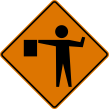
- Watch for a school crossing guard
- Look for a pedestrian crossing signal
- Expect a police checkpoint ahead
- Follow the directions given by a flagger ahead
Show answer
Follow the directions given by a flagger ahead. This orange sign warns that a flagger is working ahead. Flaggers control traffic through work zones, and Maryland's work zone rules tell drivers to obey the flagger's directions, merge carefully, avoid tailgating, and change lanes only when they have to. Slow down when you see the sign so you can stop if the flagger signals you to. A school crossing guard works near schools rather than in road work, and this symbol does not announce a police checkpoint or a pedestrian signal.
Study this in the handbook: Railroads, work zones, roundabouts, highways and processions
5. You are behind a bicyclist in Maryland who holds an arm out to the side. What is the rider doing?
- Telling you to pass on that side
- Asking you to stop and wait
- Showing you what the rider plans to do
- Warning you about a hazard behind you
Show answer
Showing you what the rider plans to do. Bicycles do not have turn signals, so bicyclists use hand and arm signals to tell you what they plan to do. An arm held out is the rider's version of a turn signal. It is not an invitation to pass and it is not a request to stop. Slow down, give the rider room, and be ready for a turn or a change of position before you decide how to proceed.
Study this in the handbook: Trucks, motorcycles, bicycles and mopeds
6. You are on an entrance ramp in Maryland, about to join a highway where traffic is already moving. Who goes first?
- Traffic entering from the next ramp behind you
- Drivers who arrived at the ramp entrance before you
- Vehicles using the shoulder to reach the highway
- Drivers already traveling on the highway itself
Show answer
Drivers already traveling on the highway itself. An entrance ramp joins a road where traffic is already traveling at highway speed. Those highway drivers keep their path and pace, while the entering driver uses the ramp and acceleration space to match speed and select a gap. Entering ahead of highway traffic in a way that forces braking defeats that design. Build speed alongside the flow, check mirrors and blind areas, and merge behind or ahead only where a genuine gap fits the whole vehicle.
Study this in the handbook: Defensive driving and who goes first
7. You stop 10 feet behind a Maryland school bus that has its flashing red lights on. Is that far enough back?
- No, you must stop at least 20 feet behind it
- Yes, any distance works while the bus is stopped
- Yes, 10 feet is the required distance
- No, you must stop at least 100 feet behind it
Show answer
No, you must stop at least 20 feet behind it. When a school bus is stopped on the road with its flashing red lights on, a driver behind it must stop at least 20 feet from the back of the bus, and a driver in front of it must stop at least 20 feet from the front. Ten feet is too close. One hundred feet is not the school bus number; it is the distance from an intersection or railroad crossing within which passing is barred. Stay stopped until the bus moves or turns off its red lights.
Study this in the handbook: Pedestrians, emergency vehicles and school buses
8. You start a new prescription in Maryland. What should you check on the label before driving?
- Only whether the dose is taken with food
- Whether refills remain at the pharmacy
- Check for warnings against driving or using heavy machinery
- Only the expiration date printed on the bottle
Show answer
Check for warnings against driving or using heavy machinery. Prescription and over the counter labels carry driving guidance that deserves a careful read. The key search is for warnings against driving or using heavy machinery while taking the medication. Food instructions, refill counts, and expiration dates matter for other reasons, but none of them answer the driving question. Finding a warning early lets a driver plan rides before impairment becomes an emergency. Pharmacists can also clarify a confusing label. That small reading habit prevents a much larger legal and safety problem.
Study this in the handbook: Alcohol, drugs and driving
9. You are following a motorcycle in Maryland toward a stretch of gravel and uneven pavement. What following gap should you keep?
- One to two seconds in good weather
- Three to four seconds back
- The same gap as behind a large truck
- Half a second more than usual
Show answer
Three to four seconds back. Riders may slow for gravel, wet patches, or tracks without showing brake lights, since they can ease off speed in other ways. Three to four seconds of space lets you notice that slowing and respond smoothly instead of closing in fast. Shorter gaps vanish quickly when speed drops without a light cue. Extra room also protects the rider if a hazard forces a sudden lane adjustment in front of you.
Study this in the handbook: Pedestrians, emergency vehicles and school buses
10. In Maryland, you must follow a slow farm vehicle for a stretch while waiting for a safe place to pass. How can you warn drivers behind you?
- Turn off your headlights until you pass
- Use emergency flashers while you follow
- Wave following drivers around your vehicle
- Tap your brakes every few seconds
Show answer
Use emergency flashers while you follow. A slow line of traffic can surprise drivers approaching at full speed from behind. Flashers announce that your vehicle is moving well below the normal flow and give followers time to slow early. Darkening your lights hides the problem, waving others around invites an unsafe pass, and repeated brake taps send a confusing signal. Keep the flashers on while you wait, then pass only when the way ahead is clearly safe.
Study this in the handbook: Railroads, work zones, roundabouts, highways and processions
11. You are signaling a right turn at a Maryland intersection, and a bicyclist is riding beside you on the right without giving any hand signal. What should you assume?
- The rider is turning right with you
- The rider will stop and let you turn
- The rider will move onto the sidewalk
- The rider is going straight through
Show answer
The rider is going straight through. Maryland says to always assume that bicyclists are going straight through an intersection unless they signal that they are turning. Bicyclists use hand and arm signals, so a rider with no signal is likely to continue straight. Bicyclists have the right-of-way when a motor vehicle is making a turn, so wait for the rider to pass before turning. Before starting a right turn, move as far right as possible and make sure no bicycle is on your right.
Study this in the handbook: Trucks, motorcycles, bicycles and mopeds
12. A large truck ahead of you in Maryland drifts toward the left side of its lane before a corner. What is the truck most likely doing, and what should you do?
- Changing lanes, so pass quickly on its right
- Preparing a wide right turn; wait to pass
- Parking, so pass on whichever side is open
- U-turning, so stop behind it at once
Show answer
Preparing a wide right turn; wait to pass. Trucks make wide turns at intersections and need more space than cars. When making a right turn, a large truck will often move left first, and other drivers may think it is changing lanes and try to pass on its right. Passing any truck on the right can be risky, and you could be caught between the turning truck and the curb. Maryland's advice is to wait to see whether the truck is planning to turn before passing it.
Study this in the handbook: Pedestrians, emergency vehicles and school buses
13. In Maryland, when is passing not allowed because of limited sight distance?
- At a hilltop or bend where you cannot see ahead clearly
- Whenever the road ahead is straight and empty
- Only when a solid line is visible for a full mile
- Whenever another vehicle ahead travels well below the posted limit
Show answer
At a hilltop or bend where you cannot see ahead clearly. A crest or bend can hide an oncoming vehicle until neither driver has room to react. Passing there bets your safety on a gap you cannot verify. Straight empty stretches with clear sight lines are a different setting, and a mile of solid line is not the measure used here. A slow vehicle ahead does not by itself create permission where vision is blocked. Wait for a place where the full passing distance is visible, signal clearly, and leave generous room before returning to your lane.
Study this in the handbook: Passing rules and parking
14. Maryland advises increasing your following distance to four or five seconds, and possibly more, behind certain vehicles. Which vehicle is one of them?
- A sedan in the lane to your left
- A sports car traveling at the speed limit
- A city bus that makes frequent stops
- A pickup truck that just passed you
Show answer
A city bus that makes frequent stops. The MVA recommends a minimum following distance of 3 to 4 seconds under ideal conditions. When following vehicles that stop often, such as buses and delivery vans, Maryland says to increase the gap to four or five seconds, and possibly more if needed. A car simply driving at the limit, a vehicle in another lane, or a truck that just passed you is not named as calling for that increase. Count the seconds against a fixed object to check your gap.
Study this in the handbook: Following distance, stopping distance and turns
15. Traffic on a Maryland highway flows steadily at 55 mph where the limit is 60 mph. Which pace is generally wisest?
- Roll with traffic at about 55 mph
- Push to 60 mph because the sign allows it
- Drop to 40 mph to stay extra cautious
- Weave between lanes to find the fastest one
Show answer
Roll with traffic at about 55 mph. Moving near the pace of surrounding traffic, while staying at or under the limit, keeps closing speeds small and makes a vehicle predictable to others. Forcing the full signed value through slower flow invites tailgating and abrupt lane changes. Crawling far below the flow invites constant passing, which carries its own risk. The calm middle path is to blend with the stream and keep steady gaps. Keep generous gaps ahead so the stream can absorb small surprises without sudden braking.
Study this in the handbook: Defensive driving and who goes first
16. An overhead signal over your lane shows a red X in Maryland. What must you do about that lane?
- Never drive in that lane
- Use it only for left turns
- Use it only at low speed
- Share it with opposing traffic
Show answer
Never drive in that lane. Some Maryland lanes change direction during the day to match heavy traffic flow, and overhead signals assign each lane its current direction. A red X closes the lane below it completely, with no exceptions for speed, turning, or short distances. A green arrow opens a lane for travel, a steady yellow X tells drivers to move out soon, and a flashing yellow X allows left turn use. Entering a red X lane risks a head-on meeting with traffic lawfully using the lane from the other direction.
Study this in the handbook: Traffic signals, arrows and lane use lights
17. Your vehicle must stop on the shoulder of a Maryland interstate. After turning on your emergency flashers, what should you do if you can?
- Stand behind the vehicle and wave traffic past
- Walk along the shoulder to look for help
- Sit on the guardrail away from the lanes
- Stay inside your vehicle
Show answer
Stay inside your vehicle. Maryland allows a stop on the shoulder only when your vehicle is disabled or you have another emergency. If you must stop there, turn on your emergency flashers to warn other drivers and stay inside your vehicle if you can. Standing or walking along an interstate is very dangerous because traffic is traveling at very high speeds. Waving at traffic, walking for help, or sitting near the lanes all put you in reach of passing vehicles.
Study this in the handbook: Railroads, work zones, roundabouts, highways and processions
18. The gates at a Maryland railroad crossing seem to be broken and stay down with no train around. How can you report the safety problem?
- Call the number printed on the crossbuck post
- Note the nearest mile marker and email the MVA later
- Use the information on the blue and white ENS sign
- Tell the next school bus driver who stops there
Show answer
Use the information on the blue and white ENS sign. Maryland asks drivers to report emergencies and safety problems at railroad crossings using the information on the blue and white Emergency Notification System sign, known as the ENS sign. A gate that stays down with no train is a safety problem worth reporting. Until the gates rise and the warning lights stop, treat the crossing as closed and do not drive around the gates. The crossbuck only identifies where a crossing is, and mile markers belong to interstate highways.
Study this in the handbook: Bad weather, skids and hydroplaning
19. The lights at a junction are dark, and there is no marked stopping line or crossing area. Where must you stop in Maryland?
- Just inside the intersection, after rolling
- Before entering the intersection
- Next to cars waiting on the cross street
- At the far side after checking both ways
Show answer
Before entering the intersection. A dark signal removes the usual green permission, so every approach must treat the arrival as a stop. The stopping point moves outward when the usual markers are missing: first the marked line, then the crossing area, and finally the edge of the junction itself. Stopping before entering keeps sight lines open along the cross street. Rolling inside before stopping puts the vehicle where cross traffic expects a clear path. From the earlier stop, each driver can take turns proceeding when the way through is genuinely clear.
Study this in the handbook: Traffic signals, arrows and lane use lights
20. Which conditions does the Maryland manual name as important times to use your headlights?
- Nighttime, foggy conditions, and stormy weather
- Only on interstates after midnight
- Only when driving through tunnels
- Bright sunny days on empty roads
Show answer
Nighttime, foggy conditions, and stormy weather. Maryland lists nighttime, foggy conditions, and stormy weather as important times to use headlights. Headlights help you see when visibility is low and help oncoming traffic see you. The law also requires headlights whenever there is not enough light to clearly see at least 1,000 feet ahead, and whenever you use your windshield wipers in inclement weather. Lights are not limited to interstates or tunnels, and a sunny day on an empty road is not one of the listed times.
Study this in the handbook: Lines and pavement markings
Every question is written from the official Maryland Driver's Manual. Need paper? Printable MD practice test with answer key.
Last verified 2026-10-05. How we check every question · Study all 500 as flashcards
Frequently asked questions
How many questions are on this Maryland practice test?
This fixed set has 20 questions. It is test 17 of 25 from the 500 question Maryland bank. The real MD exam asks 25 questions and you need 22 correct.
What is the passing score for the real Maryland test?
88% or higher That figure comes from the official Maryland source cited on the DMV facts page.
How does this fixed test relate to the full Maryland bank?
Each numbered test is a fixed set of questions in a fixed order, so you can retake the same test later and compare. Every test mixes road signs and the other topics in about the same proportion as the full bank. Tests 1 to 25 together cover every question in the Maryland bank once. The full practice page mixes the whole bank at random.
Last verified 2026-10-05. See the Maryland DMV facts page for sourced state details.
Return to the full Maryland practice test · Study road signs