
Test 3 of 10 · 20 questions · Free 2026
MD Permit Practice Test 3
Jump to the test ↓A fixed 20 question set from the Maryland bank with answers and plain English explanations. The real MD exam is 25 questions, 88 percent to pass; take the full length version on the main practice page.
Question 1 of 20 · 0 right so far
All 20 questions in test 3
Every question below comes from the Maryland question bank on this page. Open a question to see the correct answer and the explanation. Nothing here is hidden behind a signup.
1. What is a safe speed choice when a road has pedestrians or animals nearby?
- Increase speed to pass the area quickly
- Reduce speed so you have more time to respond
- Maintain the posted limit regardless of visibility
- Match the fastest nearby vehicle
Show answer
Reduce speed so you have more time to respond. Maryland lists roads where pedestrians or animals may be present among the conditions that call for reduced speed. Slowing gives a driver more time to see movement, judge distance, and brake smoothly. Accelerating through the area reduces that time, while holding the posted number can be unsafe if visibility or traffic makes the maximum inappropriate. The fastest nearby vehicle is not a reliable safety measure. Scan the edges of the roadway, cover the brake, and choose a pace that lets you stop before a person or animal enters your path.
Study this in the handbook: Defensive driving and who goes first
2. Where is it illegal to drive with an open alcohol container under Maryland's manual?
- Only in a locked trailer behind the vehicle
- Only in the trunk of a sedan
- In the passenger area of the vehicle
- Only when the container is made of glass
Show answer
In the passenger area of the vehicle. Maryland prohibits driving with an open alcohol container in the passenger area of the vehicle. That area includes the driver and passenger seats and any place the driver or passengers can easily reach from where they are sitting, so the rule targets the cabin rather than a trunk or a trailer. It is not limited to glass: an open can, bottle, other container, or package is covered.
Study this in the handbook: Alcohol, drugs and driving
3. How long must an applicant under 18 hold a Maryland learner's permit without a violation before a provisional license?
- 45 days
- 3 months
- 18 months
- 9 months
Show answer
9 months. An applicant under 18 must complete a nine-month permit period without a violation before becoming eligible for the provisional license. The three-month period applies to certain older applicants, while 45 days is the minimum listed for applicants age 25 and older. The 18-month figure belongs to the later provisional-license stage, so do not move it backward into the permit requirement.
Study this in the handbook: The learner's instructional permit and practice hours
4. What does a steady yellow traffic signal tell a Maryland driver?
- The driver must reverse away from the intersection
- The driver must accelerate through the intersection
- The driver may treat it exactly like a green signal
- The signal is changing from green to red and gives time to stop safely
Show answer
The signal is changing from green to red and gives time to stop safely. A steady yellow warns that the signal is changing to red. The driver should use the interval to stop safely, while recognizing that a vehicle too close to stop safely may continue carefully through. Accelerating is the opposite of the manual's purpose, and treating yellow like green removes the warning. Check the distance and speed immediately, brake smoothly when a stop is safe, and avoid entering late just to beat the red. The signal also allows vehicles already in the intersection time to clear.
Study this in the handbook: Traffic signals, arrows and lane use lights
5. What is the purpose of warning signs in Maryland?
- They notify road users of a situation that may not be readily apparent
- They replace every traffic law with a recommendation
- They identify only restaurants and fuel stations
- They give permission to ignore pavement markings
Show answer
They notify road users of a situation that may not be readily apparent. Warning signs call attention to hazards or changes that a driver might not otherwise notice in time. They do not cancel traffic laws, identify only services, or authorize disregard of lane markings. A warning sign should change the driver's preparation: scan farther ahead, adjust speed, and be ready for a curve, crossing, lane change, or other condition shown by the sign. Think of the sign as advance notice that the normal roadway pattern may soon require a deliberate response.
Study this in the handbook: Regulatory, warning and guide signs
6. After a crash, which situation requires a driver to always call the police?
- Someone has been injured
- The roadway is empty and no vehicle is damaged
- The driver exchanged insurance information without injury
- The vehicle was parked legally before the crash
Show answer
Someone has been injured. Maryland requires a driver to call the police after a crash when someone has been injured. The response should include getting help and reporting the number of people, the type of injury, and the crash location. Exchanging insurance information is important in some crashes, but it does not replace emergency reporting when a person is hurt. An empty roadway, legal parking, or a lack of visible damage does not establish the injury condition. Protect the scene, avoid moving vehicles when an injury is involved, and call promptly so police, fire, or medical services can respond.
Study this in the handbook: Crashes, traffic stops and the Move Over Law
7. If your vehicle begins to skid, which action helps you regain control?
- Turn sharply away from the direction of the skid
- Press the brake pedal harder immediately
- Release the accelerator or brake pedal you are using
- Accelerate rapidly before looking ahead
Show answer
Release the accelerator or brake pedal you are using. A skid means the tires have lost some grip, so removing the current accelerator or brake input helps the vehicle regain control. After releasing that input, steer in the direction of the skid and look where you want the vehicle to go. Braking harder can prolong the slide, and a sharp turn away from the skid can make the loss of control worse. Rapid acceleration is not the general first response. Once the tires grip the road again, braking can resume if needed. The cue is to restore traction before demanding another maneuver.
Study this in the handbook: Bad weather, skids and hydroplaning
8. What is the minimum age to receive a full Maryland Driver's License, the last stage of the graduated system?
- 17
- 18
- 16 and a half
- 21
Show answer
18. A Driver's License is the final stage of Maryland's Graduated Licensing System, and one requirement is being at least 18 years of age. The driver must also have held a Provisional License for at least 18 months with no moving violation convictions or probation before judgment in the past 18 months. Seventeen and sixteen and a half are too young for this stage. Twenty-one is the minimum age for a supervising driver, not for a full license.
Study this in the handbook: From provisional license to full driver's license
9. A Maryland learner's permit holder is convicted of a moving violation. How long must the permit then be held before the applicant can move on?
- No extra time if the driver is 25 or older
- At least 14 days after the conviction
- Until age 21
- At least 9 months after the most recent conviction or PBJ, at any age
Show answer
At least 9 months after the most recent conviction or PBJ, at any age. A moving violation conviction or a Probation Before Judgment resets the clock. At any age, the permit must then be held at least 9 months following the most recent conviction or PBJ, and the same applies after any suspension. Being 25 or older gives no exemption, because the rule says at any age. Fourteen days is the Type 2 permit wait, not a penalty period. Nothing in this rule delays the license until age 21.
Study this in the handbook: The learner's instructional permit and practice hours
10. When entering an interstate from an acceleration lane, how should you handle the solid lines separating the ramp from the highway?
- Cross them immediately to claim a lane
- Stop on the solid lines until traffic opens
- Do not cross them while entering the highway
- Use the shoulder beyond the lines instead of the highway
Show answer
Do not cross them while entering the highway. The entrance ramp and acceleration lane give you space to adjust to the speed of traffic already on the interstate. While entering, do not cross the solid lines that divide the entrance from the highway. Crossing early can disrupt traffic and remove the benefit of the acceleration lane. Build speed safely, observe the lane markings, and merge only where the roadway design permits it.
Study this in the handbook: Railroads, work zones, roundabouts, highways and processions
11. When must a Maryland driver use headlights because visibility is limited?
- Only when visibility is below 100 feet
- When there is not enough light to clearly see at least 1,000 feet ahead
- Only during a snowstorm after stopping
- Only when driving on an interstate
Show answer
When there is not enough light to clearly see at least 1,000 feet ahead. The manual sets the visibility trigger at the point where there is not enough light to clearly see at least 1,000 feet in front of the vehicle. That includes situations such as fog and stormy weather, and it is not limited to interstates or to a 100-foot threshold. Turn on the headlights before visibility becomes dangerously short, not after the road disappears ahead.
Study this in the handbook: Headlights, night driving and fog
12. While making a legal U-turn in Maryland, when may you turn into the lane traveling in the opposite direction?
- Before checking for oncoming traffic
- Immediately after signaling
- Only when the next signal is green
- When the way is clear
Show answer
When the way is clear. Maryland directs a driver completing a U-turn to wait until the way is clear before turning into the outside or right-hand lane traveling in the opposite direction. Signaling and stopping are also required steps, but they do not make the turn safe when traffic is approaching. A green signal alone does not remove the need to check the roadway. Look for vehicles coming toward you, yield as required, and enter the opposite direction lane only after the path is clear.
Study this in the handbook: Following distance, stopping distance and turns
13. At the pictured stop sign, where must you stop if a stop line is present?
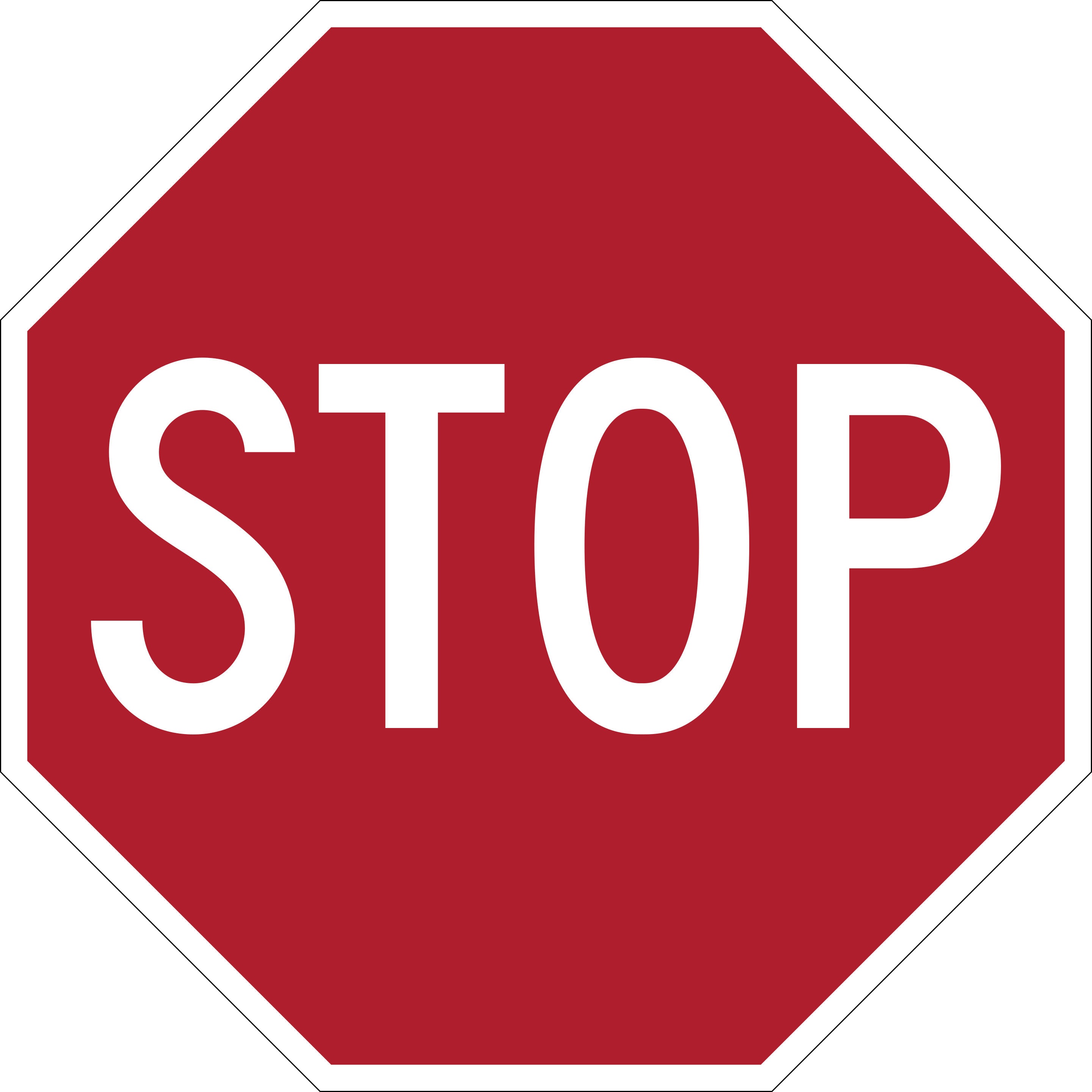
- Only beside the intersection
- After entering the crosswalk
- At the stop line
- At least one car length beyond the line
Show answer
At the stop line. A Maryland stop sign requires a complete stop at the marked stop line. If there is no stop line, stop before the crosswalk; if neither exists, stop before entering the intersection. After stopping, yield to vehicles and pedestrians in the intersection and remain stopped until it is safe to proceed. Rolling through because the road appears empty is still a violation. The visual cue is the wide line painted across your lane, which identifies the first stopping point before the crossing area.
Study this in the handbook: Regulatory, warning and guide signs
14. What traffic pattern does the pictured ONE WAY sign establish?
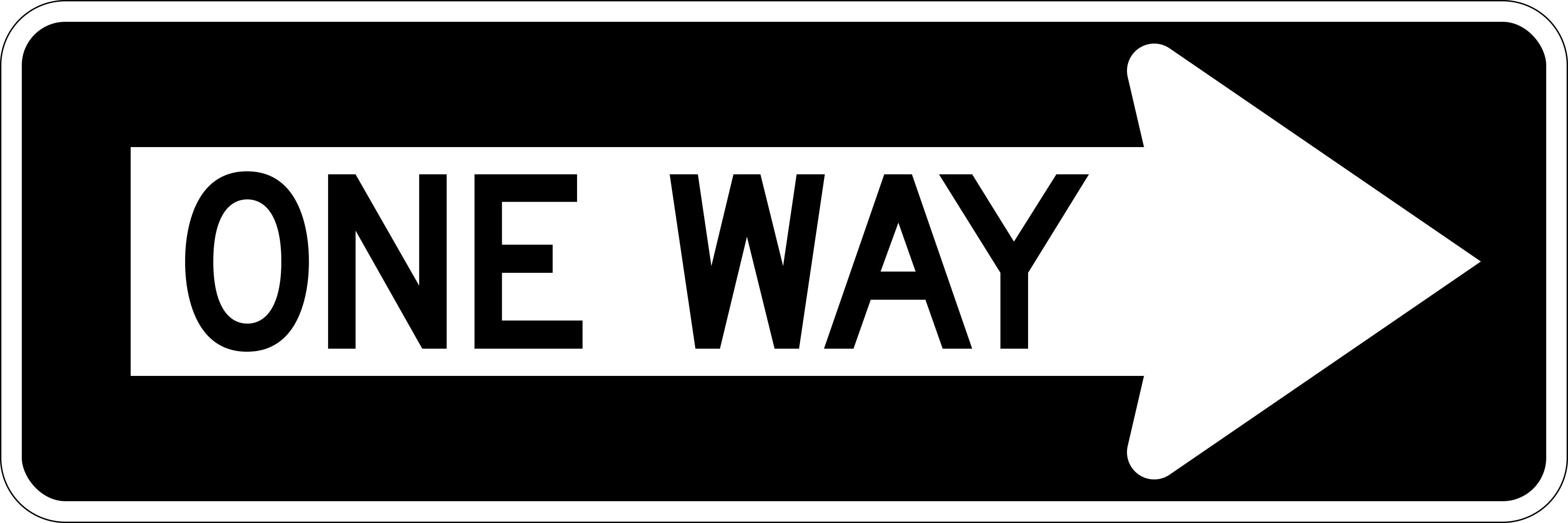
- Traffic may travel only in the arrow's direction
- Traffic may use either direction until sunset
- Only buses may travel in the arrow's direction
- The next turn must be made on red
Show answer
Traffic may travel only in the arrow's direction. A One Way sign directs traffic to travel only in the direction shown by its arrow. It does not allow opposing travel at certain times, reserve the street for buses, or authorize a turn on red. The manual lists black as the color used for One Way signs and signs that change messages. Read the arrow before entering or crossing the roadway, especially after turning from another street. A driver who enters against the arrow risks facing vehicles that have the legal direction of travel.
Study this in the handbook: Regulatory, warning and guide signs
15. At a T intersection, which vehicle has priority?
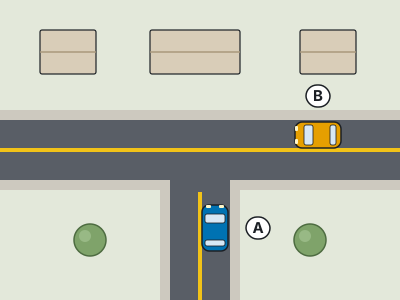
- The vehicle closest to the center of the intersection
- The vehicle leaving the road that ends
- The vehicle that sounds its horn first
- Traffic already on the through road
Show answer
Traffic already on the through road. At a T intersection, drivers already traveling on the through road have priority over a vehicle coming from the road that ends. The ending road must yield before entering the continuing roadway. A horn does not establish right-of-way, and proximity to the center is not the rule given by the manual. The driver approaching from the terminating road should slow, assess traffic, and wait for a safe opening. The cue is to picture the road ending at the stem of the T, where entering traffic yields to the crossbar road.
Study this in the handbook: Defensive driving and who goes first
16. What minimum following distance does the MVA recommend under ideal driving conditions?
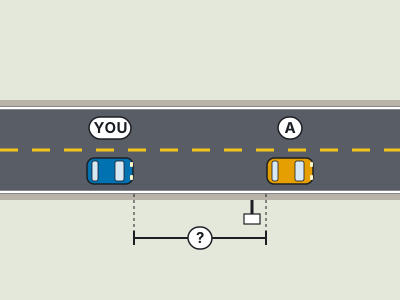
- Three to four seconds
- Two seconds
- One second
- Ten feet at every speed
Show answer
Three to four seconds. The MVA recommends at least three to four seconds behind the vehicle ahead when conditions are ideal. This time-based method remains useful as speed changes because it measures space through a reference point rather than a fixed number of feet. The one-second choice leaves little time to notice and react if traffic brakes. On wet roads, or behind a bus or delivery van that stops often, increase the interval beyond the baseline. Pick a bridge, sign, or mile marker and count after the lead vehicle passes it.
Study this in the handbook: Following distance, stopping distance and turns
17. A Maryland co-signer cancels a minor's license. When can the minor drive again?
- After 30 days
- Immediately, with a new photo
- When they turn 18, unless a co-signer signs a new application
- Never
Show answer
When they turn 18, unless a co-signer signs a new application. A co signer may cancel a minor's license by submitting a written request to the MVA's Administrative Adjudication Division. The license remains canceled until the minor reaches the age of 18, unless a co signer who meets the qualifications co signs a new application. Minors, meaning applicants younger than 18, must have a parent or legal guardian co sign their application, and the co signer must show proof of that relationship.
Study this in the handbook: From provisional license to full driver's license
18. About what share of Maryland drivers and passengers wear seat belts, according to the manual?
- About 50 percent
- About 90 percent, with a goal of 100 percent
- About 25 percent
- Nearly 100 percent already
Show answer
About 90 percent, with a goal of 100 percent. About 90 percent of Maryland drivers and passengers wear their seat belt, but the state's goal is 100 percent. Each year hundreds of unbelted drivers and passengers are seriously injured or killed on Maryland roads, and most of those injuries and deaths could have been prevented. Wear the belt on every trip, in the front seat or the back, and make sure every passenger does the same before you move.
Study this in the handbook: Speed limits and a safe speed
19. What is Maryland's rule on headsets, earphones and earplugs while driving?
- You may not drive with them in both ears, though hearing aids are allowed
- They are allowed at low volume
- They are allowed on highways only
- They are banned entirely, including hearing aids
Show answer
You may not drive with them in both ears, though hearing aids are allowed. You may not drive with earplugs, headsets or earphones in both ears. Hearing aid devices are allowed. The rule is not about volume and is not limited to highways. Maryland also makes it illegal to use a hand held cell phone, including texting, while driving. If you make a hands free call, the manual says to use the phone as little as possible, use it only in emergencies if possible, and have a passenger make the call when you can.
Study this in the handbook: Supervising drivers, insurance, seat belts and child seats
20. In and before a Maryland work zone, what do flashing green lights identify?
- Highway maintenance vehicles or service equipment
- A signal that you may speed up
- Active speed cameras
- The end of the work zone
Show answer
Highway maintenance vehicles or service equipment. Flashing green lights may be found on highway maintenance vehicles or service equipment in and before work zones. Green in this setting is not permission to speed up, so obey the work zone limit. Active speed cameras are marked by flashing blue lights, and an active work zone with workers present is shown by flashing amber or yellow lights. Green lights also do not announce the end of the work zone.
Study this in the handbook: Railroads, work zones, roundabouts, highways and processions
QualitySpace is expanding to Maryland
We are a California-based independent insurance brokerage working on licensing in more states. We cannot help with Maryland insurance yet. Leave your email and we will let you know when we can.
Every question is written from the official Maryland Driver's Manual. Need paper? Printable MD practice test with answer key.
Last verified 2026-10-05. How we check every question · Study all 200 as flashcards
Frequently asked questions
How many questions are on this Maryland practice test?
This fixed set has 20 questions. It is test 3 of 10 from the 200 question Maryland bank. The real MD exam asks 25 questions and you need 22 correct.
What is the passing score for the real Maryland test?
88% or higher That figure comes from the official Maryland source cited on the DMV facts page.
How does this fixed test relate to the full Maryland bank?
Each numbered test is a fixed set of questions in a fixed order, so you can retake the same test later and compare. Every test mixes road signs and the other topics in about the same proportion as the full bank. Tests 1 to 10 together cover every question in the Maryland bank once. The full practice page mixes the whole bank at random.
Last verified 2026-10-05. See the Maryland DMV facts page for sourced state details.
Return to the full Maryland practice test · Study road signs