
Test 9 of 10 · 20 questions · Free 2026
MD Permit Practice Test 9
Jump to the test ↓A fixed 20 question set from the Maryland bank with answers and plain English explanations. The real MD exam is 25 questions, 88 percent to pass; take the full length version on the main practice page.
Question 1 of 20 · 0 right so far
All 20 questions in test 9
Every question below comes from the Maryland question bank on this page. Open a question to see the correct answer and the explanation. Nothing here is hidden behind a signup.
1. By Maryland law, what must a bicycle's brakes be able to do?
- Stop the bicycle within 50 feet at 20 mph
- Stop the bicycle within 3 feet at any speed
- Stop the bicycle within 15 feet at 10 mph on dry, level, clean pavement
- Stop the bicycle within 100 feet on wet pavement
Show answer
Stop the bicycle within 15 feet at 10 mph on dry, level, clean pavement. Maryland lists required bicycle equipment, and the brake standard is exact: the brakes must stop the bicycle within 15 feet when it is going 10 miles per hour on dry, level, clean pavement. The other choices mix up distances and speeds that the law does not use. The same list requires a white headlight seen from 500 feet and a red rear reflector seen from 600 feet when the bicycle is ridden at night.
2. What must a Maryland driver caught drinking and driving install in the vehicle?
- A dashboard camera that records every trip
- A speed governor set at 55 mph
- A GPS tracker monitored by the court
- A breathalyzer car lock that prevents starting the vehicle if alcohol is detected
Show answer
A breathalyzer car lock that prevents starting the vehicle if alcohol is detected. Maryland warns that a driver caught drinking and driving will have to install a breathalyzer car lock, which stops the vehicle from starting if it detects alcohol. This device is often called an ignition interlock. A dashboard camera, a speed governor, and a court GPS tracker are not the device the manual describes for alcohol offenses. The lock goes with a vehicle, so drinking first and then trying to drive leaves the car unable to start.
Study this in the handbook: Provisional license restrictions, implied consent and penalties
3. A 17 year old Maryland Provisional License holder wants to drive alone at 12:30 a.m. For which trip is that allowed?
- Driving a friend home from a movie
- Driving home from a job
- Driving to a late restaurant with family members
- Driving to a party that ends at 1:00 a.m.
Show answer
Driving home from a job. Provisional License holders under 18 may drive unsupervised between 12:00 midnight and 5:00 a.m. only for listed purposes: going to, from or during a job, to or from an organized volunteer program, to or from an official school activity, or to or from an athletic event or training session they take part in. A trip home from work fits. Movies, restaurants and parties are social trips that are not on the list, so they need a qualified supervising driver in that window.
Study this in the handbook: Provisional license restrictions, implied consent and penalties
4. What can leaving the scene of a fatal crash bring in Maryland?
- A felony with up to 10 years in prison and a fine up to $10,000
- Up to 5 years and $5,000
- A misdemeanor with a $500 fine
- License suspension only
Show answer
A felony with up to 10 years in prison and a fine up to $10,000. Leaving the scene of a crash where someone dies is a felony in Maryland, and you could go to prison for up to 10 years and be fined up to $10,000. A serious injury crash carries up to 5 years and $5,000 plus revocation. Even when no one is hurt and the vehicle cannot move, call 911 with the location and wait for police assistance.
Study this in the handbook: Crashes, traffic stops and the Move Over Law
5. What should a driver constantly check while driving?
- Where vehicles are in front, behind, and next to the vehicle
- Only the vehicle directly ahead
- Only the speedometer and fuel gauge
- Only the lane to the left
Show answer
Where vehicles are in front, behind, and next to the vehicle. The manual tells drivers to remain alert and constantly check where other vehicles are in front, behind, and next to them. That broad scan helps reveal a vehicle entering a blind spot, a queue forming ahead, or a driver approaching too quickly from behind. Looking only forward leaves important information out of the driving picture. The dashboard cannot show surrounding traffic, and checking one side alone misses risks on the other side. Make the mirror checks part of the normal visual cycle, while continuing to watch the roadway ahead.
Study this in the handbook: Alcohol, drugs and driving
6. What do orange traffic signs warn drivers about in Maryland?
- One-way street directions
- Hospital and medical services
- Recreation and cultural sites
- Construction and maintenance work areas
Show answer
Construction and maintenance work areas. Orange is the color assigned to construction and maintenance work area warnings. It tells a driver to expect temporary conditions, such as lane shifts, closures, workers, equipment, or changed traffic patterns. Blue identifies services, brown identifies recreation and cultural interest areas, and black is used for one-way signs and changeable messages. Treat an orange sign as an early warning to reduce distractions, obey temporary controls, and prepare for conditions that may change as you approach rather than assuming the normal roadway layout continues.
Study this in the handbook: Sign colors and shapes
7. What do Maryland warning signs tell drivers to expect?
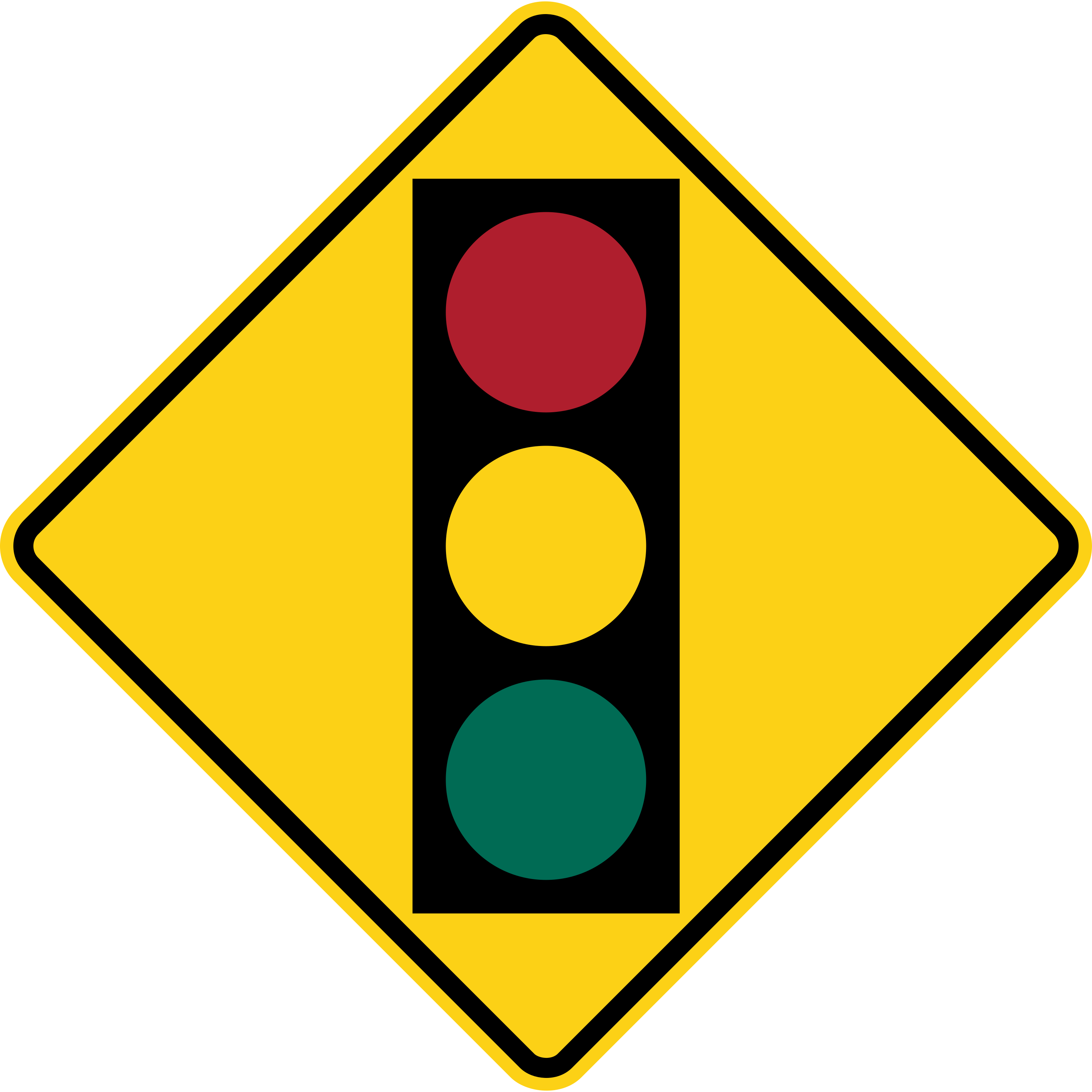
- The end of all intersection controls
- A guaranteed clear roadway
- A mandatory vehicle inspection
- Special conditions or hazards ahead
Show answer
Special conditions or hazards ahead. Maryland says warning signs provide notice of a situation that might not be readily apparent, and that they warn of special conditions or hazards ahead. They do not guarantee a clear roadway, announce a mandatory vehicle inspection, or cancel other traffic controls. Treat a warning sign as advance information: check the road farther ahead, reduce speed when needed, and prepare for the condition before reaching it. The sign gives time to respond smoothly, which is safer than waiting until the hazard is directly in front of the vehicle.
Study this in the handbook: Sign colors and shapes
8. How long does a Maryland Type 1 Learner's Instructional Permit last?
- Up to 180 days
- Up to 2 years
- Up to 45 days
- Up to 18 months
Show answer
Up to 2 years. A first-time Maryland applicant gets a Type 1 Learner's Instructional Permit, and it lasts up to 2 years after the vision screening and knowledge test are passed. The 180 day limit belongs to the Type 2 permit, which is for someone who already holds a license and wants a different class. Forty-five days is the minimum holding time for an applicant 25 or older, not the length of the permit. Eighteen months is how long the later Provisional License must be held.
Study this in the handbook: The learner's instructional permit and practice hours
9. What does the pictured crossbuck identify?
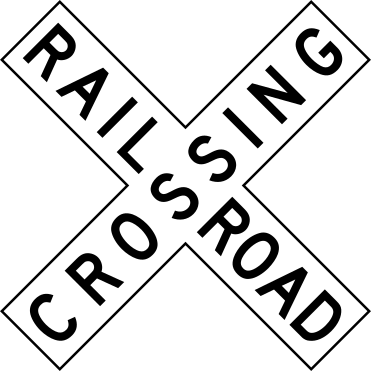
- The end of a no-passing zone
- The start of a school zone
- A lane reserved for buses
- The location of a railroad crossing
Show answer
The location of a railroad crossing. The crossbuck identifies the location of a highway rail grade crossing. It is not a school-zone marker, bus-lane sign, or no-passing marker. As you reach the tracks, scan for trains and obey any additional signals, gates, or pavement markings. The manual distinguishes the crossbuck from the round railroad warning sign: the round sign warns that a crossing is ahead, while the crossbuck marks where the crossing is located. That shape distinction helps determine whether to prepare or to cross the tracks.
Study this in the handbook: Sign colors and shapes
10. What fine does Maryland list for failing to keep insurance on a vehicle?
- $100 per vehicle
- $50 per month
- No fine, only registration cancellation
- Up to $3,500 per vehicle each year
Show answer
Up to $3,500 per vehicle each year. All motor vehicles registered in Maryland must be insured, and it is against the law to drive without vehicle insurance. If coverage lapses, the MVA can charge the owner $200 for 1 to 30 days without insurance, plus $7 per day starting on the 31st day. Maryland Transportation Article section 17-106 caps that penalty at $3,500 for each violation in a 12 month period, and the Maryland Insurance Administration guide gives the same maximum. The printed driver manual sidebar still says up to $2,500, but that figure is outdated.
11. Which movement is permitted across double solid yellow center lines?
- Only traffic next to the lines may pass without checking
- Passing is permitted for traffic on both sides when clear
- Passing is prohibited in both directions, but a permitted left turn may cross
- The roadway is one way and the lines may be ignored
Show answer
Passing is prohibited in both directions, but a permitted left turn may cross. Double solid yellow lines separate opposing traffic where passing is not allowed in either direction. They do not create an absolute barrier, because a driver may cross them for a left turn, such as turning into a driveway. The two passing choices incorrectly treat the markings as permission, and the one-way choice misunderstands yellow center lines, which divide opposing directions. The cue is double solid yellow means no passing, with the narrow exception of a lawful left-turn movement across the lines.
Study this in the handbook: Lines and pavement markings
12. What wireless-device exception applies to a Maryland driver under 18 while driving?
- GPS navigation when the phone is mounted
- A hands-free call to a family member
- A 911 emergency call
- A text message from an employer
Show answer
A 911 emergency call. Maryland drivers under 18 may not use wireless communication devices while driving, including hands-free phones. The only exception described is a 911 emergency call. Navigation, family calls, and employer messages do not create additional exceptions. A useful memory cue is that the restriction covers the device itself and hands-free use, while the emergency exception is limited to contacting 911. Keep this distinction in mind.
Study this in the handbook: Provisional license restrictions, implied consent and penalties
13. If an emergency vehicle approaches with its siren and flashing lights operating, what must you do?
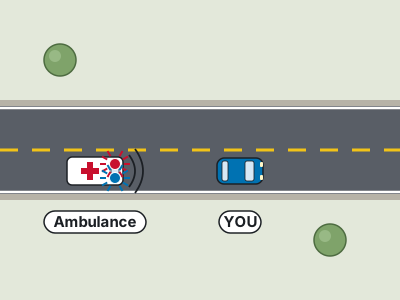
- Follow it through the intersection to use its clear path
- Move toward the road edge, stay out of intersections, and stop
- Stop in the nearest intersection so it can go around you
- Continue at the same speed until it passes on your left
Show answer
Move toward the road edge, stay out of intersections, and stop. An emergency vehicle using its signals needs a predictable, open path. Move as close as possible to the edge, keep out of the intersection, and remain stopped until the vehicle has passed. Following behind it is not a permitted shortcut, and stopping inside the intersection blocks the very route emergency responders may need. Maintaining speed also leaves too little room for the response vehicle to maneuver. As soon as you hear or see the signals, check mirrors, clear the intersection if possible, then stop at the edge.
Study this in the handbook: Pedestrians, emergency vehicles and school buses
14. When may you begin moving after stopping for a school bus with flashing red lights?
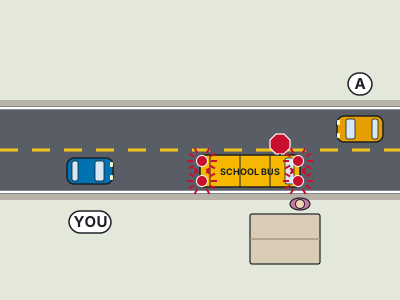
- As soon as no child is visible near the roadway
- After the bus starts moving or turns off its flashing red lights
- After waiting exactly 10 seconds
- When the vehicle behind you honks
Show answer
After the bus starts moving or turns off its flashing red lights. The stop continues until the school bus starts moving or turns off its flashing red lights. A driver cannot replace that signal with a personal guess that children are clear, a timed pause, or pressure from following traffic. The bus may still be loading or preparing to release children, so the visible red lights control the waiting period. Keep the vehicle stopped at least 20 feet away when approaching from behind, watch the bus, and move only after one of the two stated release conditions occurs.
Study this in the handbook: Pedestrians, emergency vehicles and school buses
15. When may you change lanes according to Maryland's basic lane-driving guidance?
- After determining it is safe, but not while in an intersection
- Whenever the vehicle ahead slows, including in an intersection
- Only after crossing the center line
- Without checking if the lane appears empty
Show answer
After determining it is safe, but not while in an intersection. Maryland expects a driver to remain in a single lane until a safe lane change has been confirmed. The manual specifically warns against drifting across lane lines or changing lanes in an intersection. A slowing vehicle may require patience, not an unchecked move, and an empty-looking lane still needs a proper search of mirrors and blind areas. Crossing the center line is not a general lane-change method. Signal, scan the surrounding traffic, and complete the move where the roadway gives you enough space and time to control it.
Study this in the handbook: Passing rules and parking
16. When may a Maryland minor register as an organ donor?
- At any age without consent
- At least 16 years old with a parent or guardian's written consent
- Never until 21
- Only at 18
Show answer
At least 16 years old with a parent or guardian's written consent. Anyone 18 years old or older may be an organ donor, and minors at least 16 years old may be organ donors if a parent or guardian consents in writing. Checking yes on the license application or renewal notice authorizes the MVA to forward your information to the Maryland Department of Health for the Maryland Organ Donor Registry, and you can choose to have the license show that you are a donor.
Study this in the handbook: Supervising drivers, insurance, seat belts and child seats
17. Which applicants must hold a learner permit for at least three months without a violation before a provisional license?
- All applicants age 25 or older
- All applicants younger than 18
- Applicants age 18 with a high school diploma or GED, or ages 19 to 24
- Applicants with no driver education requirement
Show answer
Applicants age 18 with a high school diploma or GED, or ages 19 to 24. Maryland requires an applicant age 18 with a high school diploma or GED, or an applicant age 19 to 24, to hold the learner permit for at least three months without a violation before becoming eligible for a provisional license. This is different from the nine-month rule for applicants under 18 and the 45-day minimum for applicants age 25 or older. Match the waiting period to both age and the stated qualification. A violation can change the timeline, so the permit period is not merely a calendar exercise.
Study this in the handbook: The learner's instructional permit and practice hours
18. What can excessive speed increase in a crash?
- The force and impact
- The driver’s available reaction time
- The accuracy of distance judgments
- The ability to handle curves
Show answer
The force and impact. Maryland says speeding increases the force and impact in a crash, making serious injuries and deaths more likely. It does not increase reaction time, improve distance judgments, or make curves easier to handle. In fact, the manual says excessive speed decreases the ability to recognize and react to hazards and reduces control around curves and obstacles. Use the posted limit as a maximum under ideal conditions, then slow further when traffic, weather, or road design creates risk. The cue is simple: more speed means more force when something goes wrong.
Study this in the handbook: Speed limits and a safe speed
19. How many questions are on Maryland's knowledge test, and how much time is provided?
- 25 questions in 20 minutes
- 20 questions in 15 minutes
- 15 questions in 10 minutes
- 30 questions in 30 minutes
Show answer
25 questions in 20 minutes. The Maryland knowledge test contains 25 questions and gives the applicant 20 minutes. The other pairs change either the question count, the time limit, or both. A useful study cue is to remember this as a compact timed test, not an open-ended examination. The manual also directs applicants to study all of its information because the test covers the material presented there. Budget the available minutes across the entire test instead of lingering on one item.
Study this in the handbook: The vision screening, knowledge test and skills test
20. Before entering a Maryland traffic circle, what should you do?
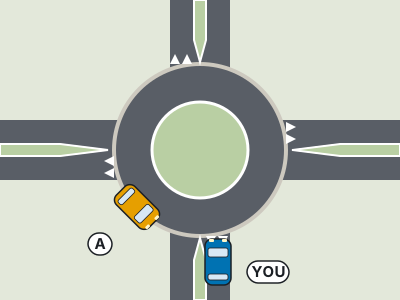
- Enter immediately because circulating traffic must yield
- Stop in the circle and wait for every approaching vehicle
- Yield to traffic already in the circle and wait for a safe gap
- Drive left of the island to shorten the route
Show answer
Yield to traffic already in the circle and wait for a safe gap. Traffic entering a circle must yield to vehicles already circulating. The driver should approach cautiously, reduce speed, watch for pedestrians in the crosswalk, and wait at the yield line for a gap. A full stop in the middle disrupts traffic and is not the prescribed location. Entering immediately reverses the priority rule, while driving left of the island violates the instruction to keep right. The cue is to read the yield line before entry, then join the circle only after the circulating path is clear.
Study this in the handbook: Railroads, work zones, roundabouts, highways and processions
QualitySpace is expanding to Maryland
We are a California-based independent insurance brokerage working on licensing in more states. We cannot help with Maryland insurance yet. Leave your email and we will let you know when we can.
Every question is written from the official Maryland Driver's Manual. Need paper? Printable MD practice test with answer key.
Last verified 2026-10-05. How we check every question · Study all 200 as flashcards
Frequently asked questions
How many questions are on this Maryland practice test?
This fixed set has 20 questions. It is test 9 of 10 from the 200 question Maryland bank. The real MD exam asks 25 questions and you need 22 correct.
What is the passing score for the real Maryland test?
88% or higher That figure comes from the official Maryland source cited on the DMV facts page.
How does this fixed test relate to the full Maryland bank?
Each numbered test is a fixed set of questions in a fixed order, so you can retake the same test later and compare. Every test mixes road signs and the other topics in about the same proportion as the full bank. Tests 1 to 10 together cover every question in the Maryland bank once. The full practice page mixes the whole bank at random.
Last verified 2026-10-05. See the Maryland DMV facts page for sourced state details.
Return to the full Maryland practice test · Study road signs