
Test 8 of 10 · 20 questions · Free 2026
MD Permit Practice Test 8
Jump to the test ↓A fixed 20 question set from the Maryland bank with answers and plain English explanations. The real MD exam is 25 questions, 88 percent to pass; take the full length version on the main practice page.
Question 1 of 20 · 0 right so far

All 20 questions in test 8
Every question below comes from the Maryland question bank on this page. Open a question to see the correct answer and the explanation. Nothing here is hidden behind a signup.
1. What does the round railroad warning sign tell a driver?
- A railroad crossing is ahead
- The vehicle must enter a roundabout
- A railroad crossing has just ended
- Trains have priority only at night
Show answer
A railroad crossing is ahead. The round sign is a railroad warning sign used before a crossing. It tells the driver that tracks are ahead, so the driver should reduce speed, search for a train, and be ready to stop. It does not direct a vehicle into a roundabout, mark the end of tracks, or limit train priority to nighttime. The round shape is the recognition cue for advance railroad information. The crossbuck is different because it identifies the crossing itself, so do not confuse the two locations.
Study this in the handbook: Sign colors and shapes
2. Why can alcohol create driving impairment concerns before a driver reaches 0.08 BAC?
- A lower BAC improves reaction time but increases fines
- The legal limit changes to 0.10 when traffic is light
- Only experienced drivers are affected below 0.08 BAC
- Judgment and coordination can be impaired at a much lower BAC
Show answer
Judgment and coordination can be impaired at a much lower BAC. The manual identifies 0.08 as Maryland’s threshold for driving under the influence, but it also warns that alcohol can impair judgment and physical coordination at a much lower BAC. One drink may affect vision, simple movements, and reaction time. The number of drinks is not a reliable personal gauge because food, body composition, tiredness, mood, and medication change how alcohol affects someone. The safest plan after drinking is not to drive.
Study this in the handbook: Alcohol, drugs and driving
3. On which public roads may Maryland mopeds and scooters be ridden?
- Only roads with a posted maximum of 25 mph
- Roads with a posted maximum speed limit of 50 mph or less
- Any road, including one posted above 50 mph
- Only roads without painted lane markings
Show answer
Roads with a posted maximum speed limit of 50 mph or less. Maryland permits mopeds and scooters on roads whose posted maximum speed limit is 50 mph or less. The limit is tied to the posted maximum, not to whether lane markings are present or to a lower 25 mph threshold. A road posted above 50 mph falls outside the manual's stated permission, so check the sign before entering it on a moped or scooter.
Study this in the handbook: Trucks, motorcycles, bicycles and mopeds
4. A police officer directs you to stop while your traffic signal is green. Which instruction controls?
- A flashing red arrow
- The green signal
- A school crossing guard’s direction
- The officer’s direction
Show answer
The officer’s direction. Everyone must obey traffic control devices, and the manual lists the only exceptions: a police officer or other emergency personnel, or a uniformed school crossing guard directing traffic near a school. An officer directing you to stop therefore controls even while the signal displays green. Continuing because the light is green would disregard the person managing the intersection, and a flashing red arrow is just another device the officer may override. Watch the officer's hand signals and proceed only when released.
Study this in the handbook: Traffic signals, arrows and lane use lights
5. When an emergency vehicle approaches using its siren and flashing lights, what is the Maryland driver's immediate duty?
- Continue at the same speed if your lane is clear
- Speed up to reach the next intersection first
- Move near the road edge and remain stopped until it passes
- Pass the emergency vehicle before pulling over
Show answer
Move near the road edge and remain stopped until it passes. A police car, ambulance, or fire engine using its signals has the right-of-way. Move as close as possible to the road edge, stay out of intersections, and remain stopped until the emergency vehicle passes. Speeding toward an intersection can trap the vehicle where responders need a clear path. A clear lane does not cancel the duty to yield, and passing the emergency vehicle is prohibited when traveling in the same direction unless it stops or an officer directs you to pass. Treat the siren and flashing lights as an immediate instruction to yield.
Study this in the handbook: Pedestrians, emergency vehicles and school buses
6. Where does the Maryland driving skills test take place?
- Only on a closed course with no public-road driving
- Inside an MVA office using a simulator
- Only in the applicant's neighborhood
- On public roads and a special course at the testing location
Show answer
On public roads and a special course at the testing location. Maryland's skills test checks practical driving in two settings: public roads and a special course at the testing location. It is not limited to a simulator, an applicant's neighborhood, or a closed course that excludes traffic-road skills. Prepare for both ordinary roadway decisions and the controlled exercises required at the test site. This combination tests both everyday traffic judgment and precise vehicle control.
Study this in the handbook: The vision screening, knowledge test and skills test
7. What should you do when approaching the pictured yield sign?
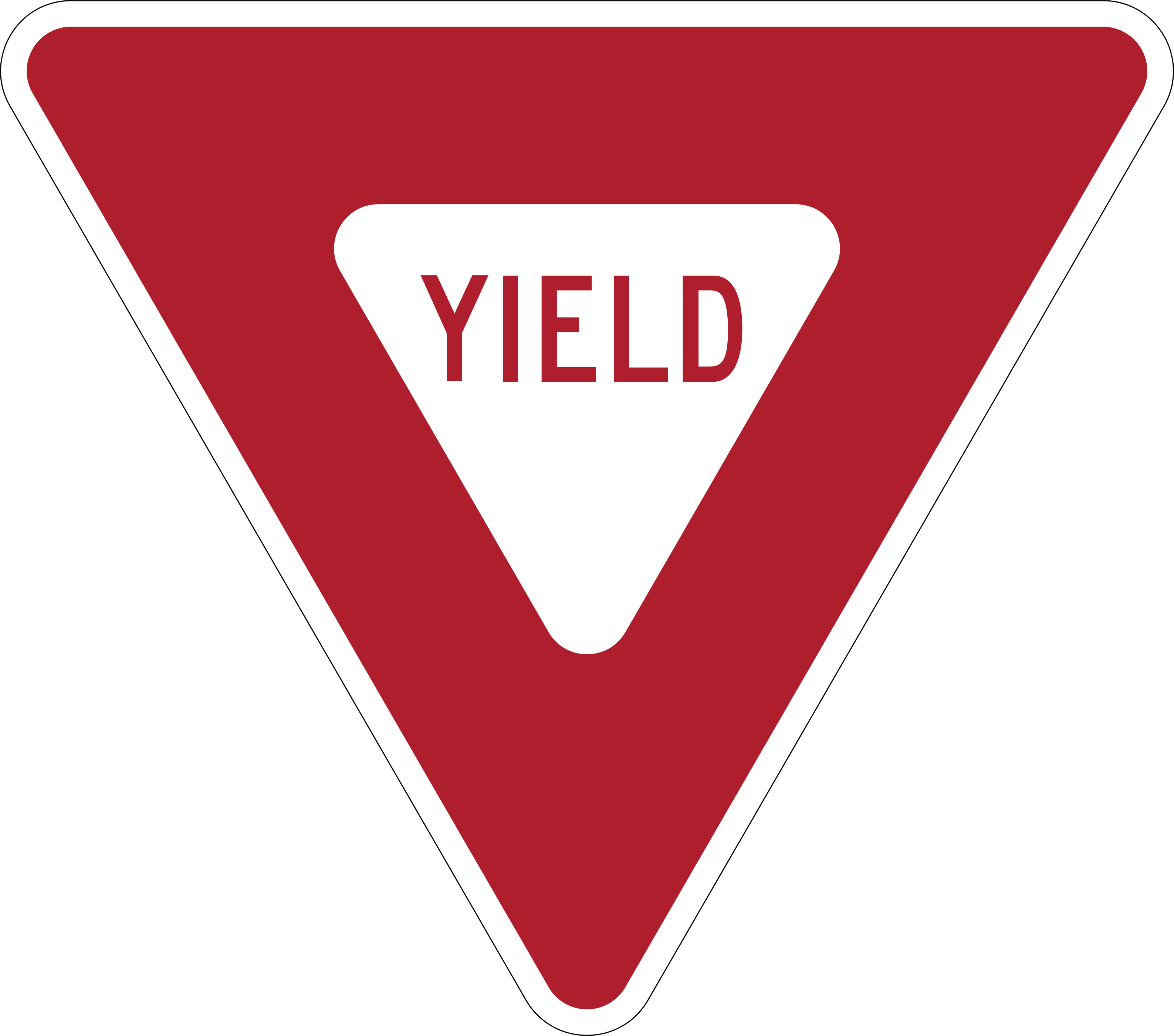
- Slow down, look both ways, and yield; stop if needed
- Accelerate to claim the intersection
- Stop every time, even when no one is present
- Proceed without checking for bicycles
Show answer
Slow down, look both ways, and yield; stop if needed. At a yield sign, slow down and look to the left and right. Yield to pedestrians, bicycles, and vehicles, then proceed only when doing so is safe. A complete stop may be necessary, but the sign does not require stopping in every circumstance when the way is clear. Accelerating to assert priority reverses the intended behavior, and ignoring bicycles leaves out a protected road user. Use the triangular shape as a cue to reduce speed, scan both directions, and be ready to stop.
Study this in the handbook: Regulatory, warning and guide signs
8. For a driver age 21 or older operating a noncommercial vehicle in Maryland, what is the lowest BAC covered by the general alcohol per se threshold?
- .04 or higher
- .08 or higher
- .06 or higher
- .10 or higher
Show answer
.08 or higher. Maryland considers a driver to be under the influence of alcohol at a blood alcohol concentration of .08 or higher. The lower numbers in the choices are not the threshold stated for this classification, and .10 is above the listed threshold rather than the point at which it begins. Remember that the threshold does not make lower alcohol levels safe or free from other consequences.
Study this in the handbook: Alcohol, drugs and driving
9. A school bus stops on the other side of a physical barrier on a multiple-lane road. What should you do?
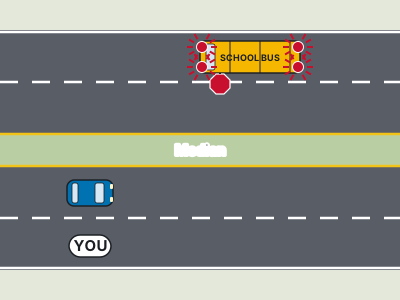
- Stop only if a child is visible near the barrier
- Stop at least 20 feet from the median barrier
- Continue without stopping for the bus on the other side
- Reverse until the bus driver waves you through
Show answer
Continue without stopping for the bus on the other side. On a multiple-lane road divided by a physical barrier, traffic does not stop when the school bus is on the opposite side of that barrier. Without such a barrier, the manual's stopping rule applies to drivers behind the bus and to drivers in front of it, at least 20 feet away. Do not use the absence of visible children as a test. Identify whether a real physical divider separates the directions, then follow the matching rule.
Study this in the handbook: Pedestrians, emergency vehicles and school buses
10. What is the youngest age at which a Maryland applicant under 25 can get a Learner's Instructional Permit?
- 15 years exactly
- 16 years and 6 months
- 16 years exactly
- 15 years and 9 months
Show answer
15 years and 9 months. Maryland lets an applicant younger than 25 apply for the learner's permit once the applicant is at least 15 years and 9 months old. A 15 year old who has not reached that extra nine months is too young. Sixteen years and 6 months is the minimum age for a Type 2 permit, which is a different permit for people who already hold a license. An applicant under 18 also needs a parent or legal guardian to co-sign, and one under 16 needs a school attendance form.
Study this in the handbook: The learner's instructional permit and practice hours
11. What must a driver do before crossing a Maryland railroad track?
- Make sure there is room to get completely over the tracks before the train comes
- Enter the crossing first and look for space afterward
- Stop on the tracks if traffic is backed up beyond them
- Cross whenever the warning lights are flashing if no train is visible
Show answer
Make sure there is room to get completely over the tracks before the train comes. A driver must not begin crossing unless the vehicle can clear the entire track area before a train arrives. The rule protects against stopping on the rails when traffic, a signal, or a queue blocks the far side. Entering first and checking later reverses the required order, and a flashing warning signal means the crossing is closed even when a train is not yet visible. Look both ways, verify the exit space, and wait until the vehicle can reach the other side without stopping.
Study this in the handbook: Bad weather, skids and hydroplaning
12. What happens after a second moving violation for a Maryland provisional driver under 18?
- A warning
- License revocation until age 21
- A 180 day suspension
- A 30 day suspension followed by a 90 day restriction to employment and educational driving
Show answer
A 30 day suspension followed by a 90 day restriction to employment and educational driving. For a provisional license holder under 18, the first moving violation conviction requires a driver improvement program. A second offense brings a 30 day suspension followed by a 90 day restriction that limits driving to employment and educational purposes. A third offense brings a 180 day suspension, the young driver improvement program, and a 180 day employment and education restriction.
Study this in the handbook: Provisional license restrictions, implied consent and penalties
13. Which Maryland administrative action ends the driving privilege without reinstatement?
- Cancellation
- Suspension
- Restriction
- Revocation
Show answer
Cancellation. Cancellation is the most severe action the manual describes. It is more severe than a suspension or a revocation, and it means the driving privilege is terminated and not reinstated. The MVA may cancel a license if you should not have been given one, gave wrong or missing information on the application, or committed fraud. A suspension is a temporary loss. A revocation can end in reinstatement after a waiting period. A restriction only limits when or why you may drive.
14. How fast does the Maryland manual say experienced bicyclists may ride?
- No more than 10 mph
- As fast as 35 mph, so they may be closer than you think
- Bicycles cannot exceed 5 mph
- About 15 mph at most
Show answer
As fast as 35 mph, so they may be closer than you think. Experienced bicyclists often ride very fast, as fast as 35 mph, and may be closer than you think. A bicycle may also come from an unexpected direction, including a sidewalk or trail. Never make a right turn from a through lane immediately after passing a bike on the shoulder or in a bike lane, and check that no bicycles are beside you before turning.
Study this in the handbook: Trucks, motorcycles, bicycles and mopeds
15. What happens when a vehicle hydroplanes?
- The vehicle skids because the driver brakes after traction is lost
- The tires keep normal contact but the steering becomes heavier
- The tires lose contact with the road after the vehicle rides on a sheet of water
- The tires grip the wet surface more firmly as speed rises
Show answer
The tires lose contact with the road after the vehicle rides on a sheet of water. Hydroplaning occurs when increasing speed and road water leave a vehicle riding on a sheet of water, causing the tires to lose contact with the road. That loss can remove some or all steering and braking control. The tires do not keep normal contact, and they do not grip more firmly as speed rises; more speed makes the problem worse. A skid caused by braking after traction is lost is a result the driver can trigger, not the definition of hydroplaning. In wet conditions, lower speed and sound tires reduce the risk.
Study this in the handbook: Bad weather, skids and hydroplaning
16. Which Maryland children must ride in a child safety seat?
- All children under age 4 only
- All children under age 8, unless the child is 4 feet 9 inches or taller
- Only children who weigh under 40 pounds
- All children under age 12 regardless of height
Show answer
All children under age 8, unless the child is 4 feet 9 inches or taller. All children under age 8 must ride in a child safety seat unless the child is 4 feet 9 inches or taller, and children younger than 2 must ride rear facing until they reach the seat's height or weight limit. Follow the instructions from both the seat maker and the vehicle maker. Families who cannot afford a seat can contact the Kids In Safety Seats program at the Maryland Department of Health.
Study this in the handbook: Supervising drivers, insurance, seat belts and child seats
17. At a stop sign with no stop line or crosswalk, where must the driver stop?
- At the stop sign, even if it blocks the crosswalk
- In the crosswalk to see around traffic
- Before entering the intersection
- After entering the intersection to check for vehicles
Show answer
Before entering the intersection. A stop sign demands a complete stop. Maryland's stopping sequence uses the stop line first, the crosswalk next, and the intersection itself when neither is marked. Stopping after entering the intersection places the vehicle where cross traffic may need to travel. The practical cue is to scan for a line and crosswalk as the sign approaches, then stop before the intersection if both are absent. Yield to vehicles and pedestrians already there before continuing.
Study this in the handbook: Regulatory, warning and guide signs
18. Under Maryland right-of-way rules, which vehicle at an intersection should you yield to?
- The vehicle already at or arriving before you
- The vehicle that is traveling fastest
- The vehicle with the newest license plate
- The vehicle approaching from behind you
Show answer
The vehicle already at or arriving before you. Maryland's right-of-way guidance gives priority to the driver who is at or arrives before you at an intersection. Yield means let that vehicle move ahead or cross before you proceed. Speed, plate age, and a vehicle behind you do not determine this particular priority. Even with a rule in your favor, keep checking the whole intersection because another road user may act unexpectedly. A simple arrival-order cue helps: if the other vehicle got there first, wait and let it clear.
Study this in the handbook: Defensive driving and who goes first
19. When a crosswalk signal is telling pedestrians to cross, what should drivers do?
- Stop beyond the crosswalk so pedestrians can pass behind you
- Yield only after the pedestrian reaches the middle of the road
- Stop and allow pedestrians to cross safely
- Proceed if the driver has already slowed without stopping
Show answer
Stop and allow pedestrians to cross safely. The manual describes the crosswalk signal as a device that stops traffic so pedestrians can cross the road safely. A driver must yield to people in the crossing and may not pass any vehicle that is stopped at a crosswalk. Stopping beyond the crosswalk leaves your vehicle in the crossing, and slowing without stopping does not give pedestrians a safe path. Hold the vehicle back, keep the crossing unobstructed, and wait for a safe opportunity to continue.
Study this in the handbook: Pedestrians, emergency vehicles and school buses
20. When should a driver activate a turn signal?
- Only after beginning to turn
- Before reaching the turn
- Only when another vehicle is directly behind
- After completing the turn
Show answer
Before reaching the turn. Maryland instructs drivers to switch on the turn signal before getting to the turn so other drivers know what is planned. Waiting until the vehicle is already turning gives surrounding road users less time to react, and waiting for a visible follower overlooks pedestrians or vehicles outside the mirror's immediate view. The cue is early communication: signal before the turning point, check around the vehicle, then make the turn at a suitable speed.
Study this in the handbook: Passing rules and parking
QualitySpace is expanding to Maryland
We are a California-based independent insurance brokerage working on licensing in more states. We cannot help with Maryland insurance yet. Leave your email and we will let you know when we can.
Every question is written from the official Maryland Driver's Manual. Need paper? Printable MD practice test with answer key.
Last verified 2026-10-05. How we check every question · Study all 200 as flashcards
Frequently asked questions
How many questions are on this Maryland practice test?
This fixed set has 20 questions. It is test 8 of 10 from the 200 question Maryland bank. The real MD exam asks 25 questions and you need 22 correct.
What is the passing score for the real Maryland test?
88% or higher That figure comes from the official Maryland source cited on the DMV facts page.
How does this fixed test relate to the full Maryland bank?
Each numbered test is a fixed set of questions in a fixed order, so you can retake the same test later and compare. Every test mixes road signs and the other topics in about the same proportion as the full bank. Tests 1 to 10 together cover every question in the Maryland bank once. The full practice page mixes the whole bank at random.
Last verified 2026-10-05. See the Maryland DMV facts page for sourced state details.
Return to the full Maryland practice test · Study road signs