
Test 2 of 10 · 20 questions · Free 2026
MD Permit Practice Test 2
Jump to the test ↓A fixed 20 question set from the Maryland bank with answers and plain English explanations. The real MD exam is 25 questions, 88 percent to pass; take the full length version on the main practice page.
Question 1 of 20 · 0 right so far
All 20 questions in test 2
Every question below comes from the Maryland question bank on this page. Open a question to see the correct answer and the explanation. Nothing here is hidden behind a signup.
1. Under Maryland's seat belt restriction for Provisional License holders under 18, who must be buckled up?
- Only the driver
- Only passengers in the front seat
- Only passengers under 16
- The driver and every passenger, with children in child safety seats
Show answer
The driver and every passenger, with children in child safety seats. A Provisional License carries a seat belt restriction that covers everyone in the vehicle. The driver must always use a safety belt, and all passengers must use safety belts or child safety seats. Limiting the rule to the driver, the front seat, or young passengers leaves out people the restriction plainly covers. Breaking a license restriction is a serious offense in Maryland, and the manual warns that it can cost a new driver the driving privilege.
Study this in the handbook: Provisional license restrictions, implied consent and penalties
2. A Maryland officer believes a driver is impaired by drugs. Who may request that the driver submit to a blood test?
- Only a judge after a hearing
- Only the MVA after a written notice
- A tow truck operator at the scene
- A drug recognition expert
Show answer
A drug recognition expert. When an officer has reason to believe a driver is impaired by drugs, alcohol or a controlled substance, the officer may have a drug recognition expert request that the driver submit to a blood test. No court hearing or MVA notice is needed first, because implied consent already applies to anyone driving on a public road. A tow operator has no role in testing. The license is suspended at a BAC of .08 or higher or if drugs impair the driver.
Study this in the handbook: Provisional license restrictions, implied consent and penalties
3. You are stopped at a T intersection and want to enter the road that continues across. Who must receive the right of way?
- The vehicle that signals first
- Traffic already on the road you are entering
- The driver stopped at the end of the T
- Traffic approaching from the less busy direction only
Show answer
Traffic already on the road you are entering. A driver entering from the stem of a T intersection must yield to drivers already traveling on the through road. Being stopped does not create priority, and a turn signal from either driver does not change the basic rule. Before moving, scan for traffic in both directions and wait until the through road is clear. Treat the road you are joining as having priority over your entry.
Study this in the handbook: Defensive driving and who goes first
4. What can make wet roads more dangerous?

- A guarantee of better braking
- Reduced traction
- A requirement to drive faster
- Removal of all stopping risks
Show answer
Reduced traction. Maryland notes that wet roads can be slippery, reducing traction and making it harder to stop. Reduced grip means the driver should lower speed, increase following distance, and use smooth steering and braking. Wet pavement does not improve braking, require faster travel, or remove stopping risks. The sign or condition is a cue to create more time and space before reaching the slick area. Avoid abrupt inputs, watch for standing water, and remember that traction can change quickly even when rain appears light.
Study this in the handbook: Headlights, night driving and fog
5. What do warning signs provide notice of?

- A situation that might not be readily apparent
- A guarantee that no hazard is present
- A vehicle registration requirement
- A direction to ignore traffic controls
Show answer
A situation that might not be readily apparent. Maryland states that warning signs provide notice to road users of a situation that might not be readily apparent. Their purpose is to reveal a condition or hazard early enough for a driver to look ahead, adjust speed, and choose a safe response. A warning does not guarantee that the road is clear, replace registration rules, or authorize ignoring other controls. Treat the sign as advance information, then obey the signal, marking, or regulatory sign that governs the actual location.
Study this in the handbook: Regulatory, warning and guide signs
6. What eye problem must be reported to the Maryland MVA?
- Mild nearsightedness
- Any need for reading glasses
- Color blindness
- One that prevents corrected acuity of 20/70 in at least one eye or a binocular field of at least 110 degrees
Show answer
One that prevents corrected acuity of 20/70 in at least one eye or a binocular field of at least 110 degrees. An eye problem that prevents a corrected minimum visual acuity of 20/70 in at least one eye or a binocular field of vision of at least 110 degrees must be reported to the MVA, along with alcohol or drug use problems, dementia, and other conditions that may affect driving. The licensing standard is stricter, 20/40 in each eye and 140 degrees, so a decline below the reporting line triggers review.
Study this in the handbook: Supervising drivers, insurance, seat belts and child seats
7. How should you adjust following distance on a wet road compared with a dry road?
- Leave much more space
- Keep the same gap because tires stop normally
- Reduce the gap to prevent another vehicle from entering
- Use exactly one car length
Show answer
Leave much more space. Wet pavement increases the room needed to react and stop, so the following gap should be much greater than on a dry road. Snow or ice requires even more space. Keeping the ordinary dry-road gap assumes traction and stopping performance that may not exist. Reducing the gap invites a rear-end crash, and one car length is not a dependable measure at changing speeds. Pair the larger gap with a lower speed, good tire tread, and smooth controls so the vehicle has time to respond if traffic slows unexpectedly.
Study this in the handbook: Headlights, night driving and fog
8. What penalty does Maryland list for leaving the scene of a crash that causes serious injury?
- Three points
- A $100 fine
- License revocation, up to 5 years in prison and a fine up to $5,000
- A 30 day suspension
Show answer
License revocation, up to 5 years in prison and a fine up to $5,000. If you leave the scene of a crash that results in serious injury, your license will be revoked and you could go to prison for up to 5 years and be fined up to $5,000. Leaving a crash where someone dies is a felony punishable by up to 10 years and $10,000. Stay, call 911, give the location, and exchange information with the other drivers.
Study this in the handbook: Crashes, traffic stops and the Move Over Law
9. For a learner under age 25, how many supervised practice hours are required, and how many must be at night?
- 14 total hours, including at least 3 at night
- 60 total hours, including at least 10 at night
- 45 total hours, including at least 5 at night
- 20 total hours, with no nighttime requirement
Show answer
60 total hours, including at least 10 at night. Applicants younger than 25 must complete at least 60 supervised practice hours, with at least 10 of those hours during the period beginning 30 minutes before sunset and ending 30 minutes after sunrise. The 14-hour and 3-night-hour figures apply to applicants age 25 and older. Keep the Practice and Skills Log as the running record, and count nighttime practice within the required total rather than adding it separately.
Study this in the handbook: The learner's instructional permit and practice hours
10. When must Maryland drivers turn on headlights because of windshield wipers?
- Only when visibility falls below 500 feet
- Only after sunset, regardless of weather
- Whenever wipers are being used in inclement weather
- Only when another driver flashes headlights
Show answer
Whenever wipers are being used in inclement weather. Maryland requires headlights whenever the windshield wipers are in use because of inclement weather. The rule is not limited to nighttime, a 500-foot visibility measurement, or another driver's warning. The practical cue is simple: if bad weather requires the wipers, turn on the headlights as well so you can see and be seen. This habit also makes the vehicle easier for other road users to notice.
Study this in the handbook: Lines and pavement markings
11. What must everyone obey while driving in Maryland?
- Only pavement markings
- Only traffic signals
- Traffic control devices
- The direction of the driver ahead
Show answer
Traffic control devices. Maryland states that everyone must obey traffic control devices. The manual defines these devices as traffic signals, signs, and pavement markings that regulate, warn, and guide traffic. Limiting the rule to signals leaves out signs and road lines, while following another driver is not a substitute for obeying a device. A useful driving cue is to scan all three forms of control as you approach an intersection, lane change, or restricted area. Only a police officer, emergency personnel, or a uniformed school crossing guard directing traffic can tell you to do something different.
Study this in the handbook: Traffic signals, arrows and lane use lights
12. What does yielding the right of way require a driver to do?
- Use the horn to make another road user wait
- Claim priority whenever the driver reaches the intersection first
- Stop permanently until every nearby road is empty
- Let another vehicle, bicyclist, or pedestrian move ahead or cross first
Show answer
Let another vehicle, bicyclist, or pedestrian move ahead or cross first. Yielding means allowing another vehicle, bicyclist, or pedestrian to move ahead of you or cross the road in front of you. It is an active safety decision, not a permanent stop and not a claim based on the loudest horn. The manual also warns drivers not to assume automatic priority. Scan the whole conflict area, identify who needs to go first, and let that road user clear your path.
Study this in the handbook: Defensive driving and who goes first
13. What do two-way left-turn arrows allow a driver to use a lane for?
- Passing traffic at any speed
- A left turn
- Parking while waiting
- Driving straight through the center lane
Show answer
A left turn. Maryland explains that a flashing yellow X signal or two-way left-turn arrows allow use of the lane for a left turn. The lane may be shared with left-turning vehicles coming from the opposite direction, so it is not a passing lane, a parking space, or a through lane. Check for opposing traffic, signal your intention, and use the center lane only to position for the turn. Keep the maneuver brief and return to the proper travel lane once the turn is complete.
Study this in the handbook: Traffic signals, arrows and lane use lights
14. What kind of instruction does the pictured sign provide?
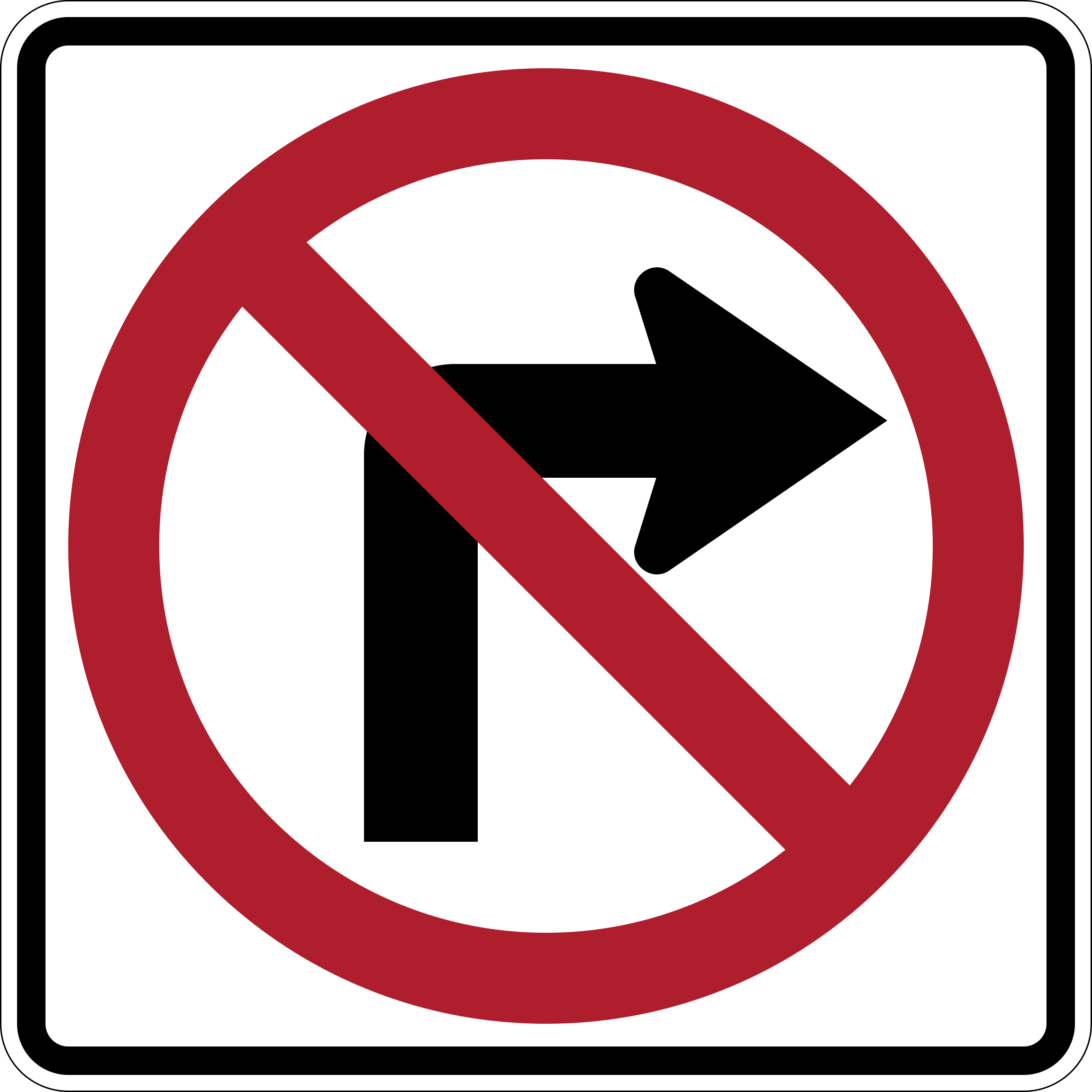
- An optional suggestion for busy intersections
- A traffic-law regulation that must be obeyed
- A warning about changing weather
- A guide to nearby services
Show answer
A traffic-law regulation that must be obeyed. The pictured sign provides a traffic-law regulation, so it must be obeyed at the signed location. It is not optional advice for busy intersections, a weather warning, or a guide to food, fuel, or other services. Maryland explains that regulatory signs concern traffic laws and must be followed. Read the arrow and words carefully, then apply the restriction while continuing to watch for signals, markings, and other controls. A useful habit is to classify the sign before acting: regulatory means an immediate rule for your lane, not a suggestion to reconsider later.
Study this in the handbook: Regulatory, warning and guide signs
15. During the first 151 days, when may an under-18 Maryland provisional licensee carry a non-family passenger under 18?
- Whenever the passenger has written permission from a parent
- Only during daylight hours without any exception
- When a qualified supervising driver is also present
- After the licensee has driven 500 miles
Show answer
When a qualified supervising driver is also present. For the first 151 days, an under-18 provisional licensee cannot drive unsupervised with an under-18 passenger who is not immediate family. A qualified supervising driver in the vehicle creates the stated exception. A parent note, daylight, or a mileage total does not replace that condition. The practical check is to identify both ages, the family relationship, and whether supervision is actually present.
Study this in the handbook: Provisional license restrictions, implied consent and penalties
16. Which locations are specifically listed as reasons to reduce speed for safety?
- Sharp curves or hills where it is hard to see
- Only straight roads with wide shoulders
- Only roads with a posted limit below 25 mph
- A clear road with no traffic or pedestrians
Show answer
Sharp curves or hills where it is hard to see. Sharp curves and hills belong on the manual’s list of conditions requiring a lower speed because they can restrict what the driver sees. Other listed situations include slippery roads, heavy traffic, narrow bridges and tunnels, schools, residential streets, and railroad crossings. A wide shoulder or a low posted number is not the test. Use the visual cue of limited sight distance and slow before entering the hidden portion of the roadway.
Study this in the handbook: Speed limits and a safe speed
17. What speed should a driver generally use when moving with traffic?
- The same speed as most traffic, up to the maximum limit
- Any speed above the posted limit if traffic is moving quickly
- A speed lower than all other traffic in every situation
- The speed shown on the sign plus five miles per hour
Show answer
The same speed as most traffic, up to the maximum limit. Maryland says it is safest to travel at the same speed as most traffic, but never above the posted maximum. This guidance helps reduce repeated passing by faster vehicles while preserving the legal ceiling. It does not authorize speeding when surrounding drivers are moving too quickly, and it does not require a driver to copy traffic when conditions make that unsafe. Watch the road, weather, visibility, and traffic flow together. If most traffic is at the limit, stay near that pace when appropriate; if hazards require slower travel, safety controls the choice.
Study this in the handbook: Defensive driving and who goes first
18. After a crash with no injuries, what should you do if your vehicle cannot move?
- Wait silently until another driver offers transportation
- Leave the vehicle and walk into traffic to direct cars
- Call 911, give the crash location, and request police assistance
- Move the disabled vehicle by pushing it into the nearest lane
Show answer
Call 911, give the crash location, and request police assistance. When a crash causes no injuries but leaves the vehicle unable to move, Maryland directs the driver to call 911, provide the location, and report the need for police assistance. Do not try to cross the roadway or stop traffic yourself. Walking into moving lanes creates a second danger, and waiting without reporting the disabled vehicle can leave other drivers unaware of the obstruction. Turn on emergency flashers if possible, stay away from traffic, and wait patiently for help. The vehicle's inability to move triggers the call even when nobody is hurt.
Study this in the handbook: Crashes, traffic stops and the Move Over Law
19. What does the triangular yield sign require a driver to do?
- Come to a stop even when the road is empty
- Change lanes before reaching the intersection
- Continue without checking because the triangle grants priority
- Slow down and give way to other vehicles and pedestrians when necessary
Show answer
Slow down and give way to other vehicles and pedestrians when necessary. The triangle communicates yield, which means the driver must reduce speed and be ready to stop for traffic or pedestrians. It does not impose a fixed stop every time, and it certainly does not grant priority to the approaching vehicle. The strongest habit is to enter the decision point slowly enough to see the left, right, and crossing path. If another road user is present or close enough to create a conflict, wait and let that road user go first.
Study this in the handbook: Regulatory, warning and guide signs
20. A Maryland learner age 25 or older must log 14 practice hours. How many of those hours must be in the dark period around sunset and sunrise?
- At least 3
- At least 10
- At least 1
- At least 7
Show answer
At least 3. Applicants 25 and older complete at least 14 supervised practice hours, and at least 3 of those hours must fall between 30 minutes before sunset and 30 minutes after sunrise. Ten night hours is the rule for learners under 25, who log 60 hours in total. One hour is too few, and seven is not the figure the manual sets for this group. The hours are recorded in the Practice and Skills Log, which is turned in before the Provisional License.
Study this in the handbook: The learner's instructional permit and practice hours
QualitySpace is expanding to Maryland
We are a California-based independent insurance brokerage working on licensing in more states. We cannot help with Maryland insurance yet. Leave your email and we will let you know when we can.
Every question is written from the official Maryland Driver's Manual. Need paper? Printable MD practice test with answer key.
Last verified 2026-10-05. How we check every question · Study all 200 as flashcards
Frequently asked questions
How many questions are on this Maryland practice test?
This fixed set has 20 questions. It is test 2 of 10 from the 200 question Maryland bank. The real MD exam asks 25 questions and you need 22 correct.
What is the passing score for the real Maryland test?
88% or higher That figure comes from the official Maryland source cited on the DMV facts page.
How does this fixed test relate to the full Maryland bank?
Each numbered test is a fixed set of questions in a fixed order, so you can retake the same test later and compare. Every test mixes road signs and the other topics in about the same proportion as the full bank. Tests 1 to 10 together cover every question in the Maryland bank once. The full practice page mixes the whole bank at random.
Last verified 2026-10-05. See the Maryland DMV facts page for sourced state details.
Return to the full Maryland practice test · Study road signs