
Test 25 of 25 · 20 questions · Free 2026
MD Permit Practice Test 25
Jump to the test ↓A fixed 20 question set from the Maryland bank with answers and plain English explanations. The real MD exam is 25 questions, 88 percent to pass; take the full length version on the main practice page.
Question 1 of 20 · 0 right so far
All 20 questions in test 25
Every question below comes from the Maryland question bank on this page. Open a question to see the correct answer and the explanation. Nothing here is hidden behind a signup.
1. You approach a crossing in Maryland where a person using a white cane is stepping off the curb slowly. How should you drive?
- Be especially alert and allow extra crossing time
- Proceed normally since signals control the crossing
- Honk gently to hurry the person along
- Pass behind the person as soon as space opens
Show answer
Be especially alert and allow extra crossing time. Some people crossing the street cannot see or hear traffic well, or need more time to move across. Extra attention and patience near the curb let you spot slow or uncertain movements before they become an emergency. Treating the crossing as routine, urging the person faster, or slipping behind them can all create a conflict. Slowing early and waiting until the person is fully clear keeps the crossing safe for everyone.
Study this in the handbook: Pedestrians, emergency vehicles and school buses
2. At dusk you are driving on a rural Maryland road where deer often cross. How should you adjust your speed?
- Keep the posted speed and use high beams
- Speed up to get through the area sooner
- Slow down only after you see a deer
- Reduce your speed to stay safe
Show answer
Reduce your speed to stay safe. Maryland lists roads where there may be pedestrians or animals among the conditions that call for reducing your speed to stay safe. A rural road where deer often cross fits that description, so slow down before you see an animal, not after. A lower speed gives you more time to react if a deer steps out. The posted limit is the maximum for ideal conditions, and high beams, where allowed, help you see but do not replace slowing down.
Study this in the handbook: Defensive driving and who goes first
3. Your baby rides in a rear-facing car seat, and your Maryland car has a passenger air bag in front. Where should the seat go?
- In front, if the air bag is turned on
- In the back seat, never in the front
- In front, so you can watch the baby
- Either seat, as long as it is buckled in
Show answer
In the back seat, never in the front. Maryland's air bag guidance says children in a rear-facing car seat should never ride in the front seat of a vehicle with a passenger air bag. Children younger than 2 must ride in a rear-facing child safety seat that meets federal guidelines until they reach the height or weight the manufacturer specifies, and children under 13 should ride buckled up in a rear seat. Being able to watch the baby or having the seat buckled in does not make the front seat acceptable.
Study this in the handbook: Supervising drivers, insurance, seat belts and child seats
4. Before starting a right turn in Maryland where a bike lane runs beside you, how should you position your vehicle?
- Move far right within the lane area
- Stay centered so riders can pass on your right
- Stop in the bike lane and wait for a green arrow
- Angle across two lanes to block the corner
Show answer
Move far right within the lane area. Shifting right before the turn closes the gap a rider might enter beside you and makes your path predictable. Use the bike lane, shoulder, or right-turn lane space as the road provides, after checking that no rider occupies it. Staying centered leaves an inviting opening on your right, and angling across lanes confuses everyone. Position early, signal, and confirm the right side is completely clear before turning the wheel at the corner.
Study this in the handbook: Trucks, motorcycles, bicycles and mopeds
5. At dusk in Maryland the wording on a sign ahead is hard to read, but its main background color is clear. What can that color tell you first?
- How fast traffic is moving beyond the sign
- How far the next exit is from here
- What kind of information the sign carries
- Whether the road ahead is wet or dry
Show answer
What kind of information the sign carries. Color works as a first sorting tool before a driver can read fine print. Each main background color is tied to a category, so seeing the color early helps a driver expect a warning, a rule, a direction, or a service clue and prepare for that kind of message. It does not report traffic speed, distance to an exit, or pavement wetness. Using the color to predict the category gives extra time to slow down, change position, or look for the fuller message as the sign gets closer.
Study this in the handbook: Sign colors and shapes
6. You are stopped at a red light on a Maryland one-way street and want to turn left onto another one-way street whose traffic flows left. No sign prohibits the turn. What may you do?
- Turn left only when a green arrow appears
- Wait for green, since left turns on red are never allowed here
- Turn left without stopping if the street is empty
- Turn left after stopping and yielding to walkers and traffic
Show answer
Turn left after stopping and yielding to walkers and traffic. Unless a sign prohibits turning on red, a Maryland driver who has come to a complete stop at a red signal may turn right, or may turn left from a one-way street onto another one-way street. While making any turn on red, you must yield the right-of-way to pedestrians and all other traffic. The full stop is still required when the street looks empty, and no green arrow is needed for this turn. A No Turn on Red sign would cancel the permission.
Study this in the handbook: Traffic signals, arrows and lane use lights
7. Sleepiness sets in during a long Maryland trip and alertness fades. What should you do?
- Open a window and keep going
- Rest or change drivers
- Speed up to finish sooner
- Turn the music up loud
Show answer
Rest or change drivers. A tired mind reacts slowly and notices less, much like an impaired one. Fresh air and loud music can mask sleepiness for minutes without restoring judgment. Higher speed shortens the little reaction time you have left. Real rest or a fresh driver restores the alertness safe travel requires. Plan stops before fatigue builds, share driving on long trips when possible, and treat heavy eyelids, drifting, or missed landmarks as a command to stop rather than a challenge to endure.
Study this in the handbook: Aggressive, distracted and drowsy driving
8. At dusk in Maryland you can no longer see clearly far ahead. When must your lights be on?
- After full darkness has completely fallen
- Only when other drivers switch theirs on
- Only while traveling on unlit rural roads
- When you cannot clearly see 1,000 feet ahead
Show answer
When you cannot clearly see 1,000 feet ahead. Light fades gradually, so waiting for full darkness or copying other drivers leaves a stretch where you are hard to see and hazards stay dim. Rural roads are not the only place this duty applies. Turning lights on early helps you read the road and helps others spot you sooner. Judge the light by how clearly you can see well ahead, not by the clock or the street name. On dull evenings, in shade, and in poor weather, switch on before visibility becomes a struggle.
Study this in the handbook: Lines and pavement markings
9. Your signal is steady green in Maryland. What should you check before entering the intersection?
- Only the speed of traffic behind you
- Only whether your lane has arrows
- That your headlights are on high beam
- That no other vehicles are in the intersection
Show answer
That no other vehicles are in the intersection. A steady green signal allows entry, but it never promises an empty intersection. A driver first looks for vehicles still inside, including anyone finishing a turn or clearing late, and also yields to pedestrians in the crossing area. When the space is safe, the driver may go straight or turn unless a sign or another signal forbids that turn. Traffic speed behind and headlight settings matter elsewhere in driving, yet neither answers the immediate question of whether the intersection ahead is already occupied by someone else.
Study this in the handbook: Traffic signals, arrows and lane use lights
10. Traffic ahead of you is backed up just beyond tracks in Maryland. When should you start across?
- As soon as the vehicle ahead starts moving forward
- Once the warning lights stop flashing
- Only when there is room to clear the tracks completely
- After inching onto the tracks to see past the car ahead
Show answer
Only when there is room to clear the tracks completely. Stopping on tracks leaves a vehicle with no escape if a train arrives, and trains need a long distance to stop. Before entering a crossing, a driver should check that traffic on the far side leaves enough space for the whole vehicle to clear the rails. A green light, moving traffic ahead, or a pause in warning signals does not create that space. Waiting before the crossing until the far side is open keeps the vehicle off the tracks while traffic is backed up.
Study this in the handbook: Bad weather, skids and hydroplaning
11. You have parked at a Maryland curb and are about to get out. What should you do around opening the door?
- Open it quickly so traffic has less time to approach
- Leave it open while you gather your belongings
- Crack it slightly as a signal and swing it wide
- Check mirrors and traffic first, then close it promptly
Show answer
Check mirrors and traffic first, then close it promptly. A door swung into traffic or a bike lane can strike a passing rider or force a driver into a swerve. A mirror check and a look at approaching traffic time the opening for a clear moment. Closing the door promptly shrinks the window where it blocks the lane beside you. These few seconds of care protect people who have almost no time to react to a sudden door. Teach passengers the same habit, since a rear door can endanger a rider too.
Study this in the handbook: Passing rules and parking
12. A bicyclist ahead of you rides through a red light at an empty Maryland intersection. Is that allowed?
- Yes, bicycles may treat red lights as stop signs
- Yes, if no cars are coming at all
- No, bicyclists must obey all traffic signals
- Only if the rider was on a sidewalk first
Show answer
No, bicyclists must obey all traffic signals. Bicycles are vehicles under Maryland law. Bicyclists are allowed to use the road, and they must obey all traffic signals, so riding through a red light is not allowed even when the intersection looks empty. Maryland's rules for bicyclists also tell riders to yield to pedestrians and obey all traffic signals and signs. As a driver, still expect the unexpected around riders, since a bicycle may come from an unexpected direction.
Study this in the handbook: Pedestrians, emergency vehicles and school buses
13. You reach a Maryland railroad crossing marked only by the pictured sign, with no lights or gates. What should you do?
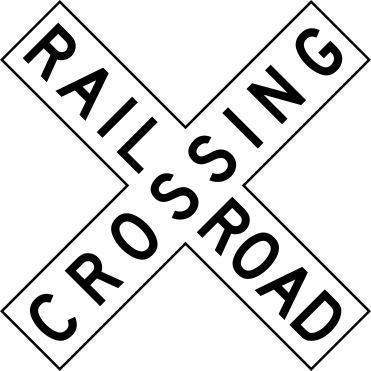
- Cross without slowing, since no signals are active
- Stop only if you hear a train horn
- Look both ways and cross only if no train is near
- Wait for a flagger to wave you across
Show answer
Look both ways and cross only if no train is near. The crossbuck identifies the location of a railroad crossing, so it is your cue to check for trains even when no lights or gates are there. Trains can come from either direction and may be closer and traveling faster than they appear, and they cannot stop quickly. Slow down, look both ways, and start across only when you can get completely over the tracks with room for your vehicle on the other side.
Study this in the handbook: Sign colors and shapes
14. Why does a fast-moving vehicle create extra danger for people on foot or on bikes nearby?
- Its engine sound makes distance easier to judge
- Others may struggle to judge how far away it is
- People nearby can always tell its exact speed
- A faster vehicle is larger and easier to see
Show answer
Others may struggle to judge how far away it is. People crossing or pulling out judge gaps by how fast a vehicle seems to be closing. A vehicle traveling well above expectations can arrive much sooner than its distance suggests, so a gap that looked generous turns out to be short. That misjudgment is a recurring path to crashes involving walkers and riders. Keeping speed predictable gives everyone sharing the road a fair chance to judge safely. Slowing near crossings and driveways gives those judges the extra moment they need.
Study this in the handbook: Defensive driving and who goes first
15. Which habit helps a Maryland driver notice problems that may require a change of speed or lane?
- Constantly observing the front, sides, and rear of your vehicle
- Watching the vehicle directly ahead of you
- Checking the mirrors only just before each turn
- Scanning only the pavement a few feet past your hood
Show answer
Constantly observing the front, sides, and rear of your vehicle. Maryland says constantly observing your surroundings helps you see problems that may cause you to change speed or lanes, and that this includes watching the front, sides, and rear of your vehicle. Looking only at the car ahead or only at the pavement near your hood leaves problems to the sides and rear unseen. Checking mirrors only before turns is too late to prepare. Searching ahead and staying ready to adjust is what the manual calls defensive driving.
Study this in the handbook: Defensive driving and who goes first
16. A police officer in the junction waves you through while your light is red. Which direction controls in Maryland?
- What the person directing traffic tells you
- The red light, because signals always outrank people
- The instruction from the nearest road sign
- The movement chosen by the driver beside you
Show answer
What the person directing traffic tells you. Ordinarily every signal, sign, and marking must be obeyed. The single exception arises when a police officer or other emergency personnel directs traffic differently at the scene. An officer can see blockages, crashes, or hazards that a fixed signal cannot account for. Following that direction keeps all approaches moving under one coordinated plan. Ignoring it in favor of the light creates conflicting movements inside the junction. Once past the directed area, ordinary signals and signs resume their control for the road ahead.
Study this in the handbook: Traffic signals, arrows and lane use lights
17. You need to reach an exit, but a large group of motorcyclists is riding in the next lane in Maryland. What should you do?
- Merge between two riders as soon as a gap appears
- Signal early and wait for the riders to make room for you
- Speed up and cut across the front of the whole group
- Tap the horn so the group opens a space for you
Show answer
Signal early and wait for the riders to make room for you. Around a group of motorcyclists, Maryland says to use your turn signal early and wait for the riders in the group to make room for you. Pushing into the first gap or cutting across the front of the group takes space the riders did not give you. A horn tap can startle riders in close formation. Patience and good communication with the group are the safe way to change lanes or reach an exit.
Study this in the handbook: Pedestrians, emergency vehicles and school buses
18. In Maryland, you reach a crossing where the signal is completely dark, and there is a marked stop line. After stopping there, when may you continue?
- As soon as you have stopped for three seconds
- As soon as your own lane looks clear
- Only when the intersection is clear and safe to enter
- Whenever the vehicle beside you starts moving
Show answer
Only when the intersection is clear and safe to enter. A dark signal removes the usual color instructions, so the crossing works on stop and wait principles. Come to a full stop at the marked line, then study the crossing itself for vehicles and people already inside it. Those road users finish clearing first, and entry follows only when the space is genuinely safe. Counting seconds or copying a neighboring vehicle can both move you into a hidden conflict, so judge the scene directly.
Study this in the handbook: Traffic signals, arrows and lane use lights
19. Which sign is the only one in Maryland with a three-sided shape?
- The yield sign
- The stop sign
- The one way sign
- The do not enter sign
Show answer
The yield sign. No other Maryland sign shares the three-sided outline, so that outline alone can identify the sign from a distance or in poor light. A driver who learns this one-to-one link does not need to read the letters before starting the right response. The stop sign uses eight sides, and the one way and do not enter signs use rectangular or square forms. Recognizing the unique triangle early gives a driver more time to slow down, scan both directions, and prepare to give the right-of-way.
Study this in the handbook: Regulatory, warning and guide signs
20. Why do some Maryland lanes carry traffic in opposite directions at different times of day?
- The lanes are closed for parking at night
- Traffic is heavier one way at certain hours
- The road has no center line painted
- Drivers choose the direction each morning
Show answer
Traffic is heavier one way at certain hours. Some roads move more traffic one way in the morning and the other way later, so certain lanes reverse direction by hour. Signs, signals, and markings show which way a reversible lane flows at a given time. Because the same pavement can face you later in the day, always confirm the lane is open for your direction before entering. Assuming a lane keeps one direction all day can put you head on with opposing traffic.
Study this in the handbook: Traffic signals, arrows and lane use lights
Every question is written from the official Maryland Driver's Manual. Need paper? Printable MD practice test with answer key.
Last verified 2026-10-05. How we check every question · Study all 500 as flashcards
Frequently asked questions
How many questions are on this Maryland practice test?
This fixed set has 20 questions. It is test 25 of 25 from the 500 question Maryland bank. The real MD exam asks 25 questions and you need 22 correct.
What is the passing score for the real Maryland test?
88% or higher That figure comes from the official Maryland source cited on the DMV facts page.
How does this fixed test relate to the full Maryland bank?
Each numbered test is a fixed set of questions in a fixed order, so you can retake the same test later and compare. Every test mixes road signs and the other topics in about the same proportion as the full bank. Tests 1 to 25 together cover every question in the Maryland bank once. The full practice page mixes the whole bank at random.
Last verified 2026-10-05. See the Maryland DMV facts page for sourced state details.
Return to the full Maryland practice test · Study road signs