
Key points
Buses, school buses and hazardous materials trucks must stop before every railroad crossing, so be ready for them to stop.
Source: Handbook p. 30
“Buses, school buses, and trucks carrying hazardous materials must stop before every railroad crossing.”
Maryland Driver's Manual, Handbook p. 30Never start across the tracks unless you can get completely over before the train comes.
Source: Handbook p. 30
“Never start to cross the tracks unless you can get completely over before the train comes.”
Maryland Driver's Manual, Handbook p. 30Speeding fines may be much higher in work zones, and flashing blue lights mean speed cameras are active.
Source: Handbook p. 31
“Speeding fines may be much higher in work zones and even higher if workers are present. Flashing blue lights mean the speed cameras are active.”
Maryland Driver's Manual, Handbook p. 31At a traffic circle, always yield to traffic already in the circle.
Source: Handbook p. 31
“When you come to a traffic circle, you must always yield to traffic already in the circle.”
Maryland Driver's Manual, Handbook p. 31To exit a multi lane circle, signal right and move to the outside lane after passing the exit before yours.
Source: Handbook p. 31
“When preparing to exit, turn on your right turn signal and move to the outside lane after you pass the exit before the one you plan to take.”
Maryland Driver's Manual, Handbook p. 31When entering an interstate, do not cross the solid lines between the entrance and the highway.
Source: Handbook p. 32
“you should not cross the solid lines that divide the entrance and the highway.”
Maryland Driver's Manual, Handbook p. 32Never stop and back up on any part of the highway.
Source: Handbook p. 32
“Never stop and back up on any part of the highway.”
Maryland Driver's Manual, Handbook p. 32Even on a green signal, you must yield the right of way to vehicles in a funeral procession.
Source: Handbook p. 32
“Even if they have a green signal, other vehicles must yield the right-of-way to vehicles in a funeral procession.”
Maryland Driver's Manual, Handbook p. 32The slow moving vehicle sign warns that the vehicle goes 25 mph or less.
Source: Handbook p. 32
“slow-moving sign (shown) on the back of their vehicle to warn you they are only going 25 miles per hour or less.”
Maryland Driver's Manual, Handbook p. 32
Numbers to know
| Number | What it means | Manual |
|---|---|---|
| 25 mph | top speed of vehicles showing the slow moving vehicle sign | Handbook p. 32 |
Recognize these signs

Traffic circle ahead 
Slow moving vehicle emblem 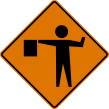
Flagger ahead
3 questions from the Maryland practice test
1. Before entering a Maryland traffic circle, what should you do?
- Enter immediately because circulating traffic must yield
- Stop in the circle and wait for every approaching vehicle
- Yield to traffic already in the circle and wait for a safe gap
- Drive left of the island to shorten the route
Show answer
Yield to traffic already in the circle and wait for a safe gap. Traffic entering a circle must yield to vehicles already circulating. The driver should approach cautiously, reduce speed, watch for pedestrians in the crosswalk, and wait at the yield line for a gap. A full stop in the middle disrupts traffic and is not the prescribed location. Entering immediately reverses the priority rule, while driving left of the island violates the instruction to keep right. The cue is to read the yield line before entry, then join the circle only after the circulating path is clear.
2. When entering an interstate from an acceleration lane, how should you handle the solid lines separating the ramp from the highway?
- Cross them immediately to claim a lane
- Stop on the solid lines until traffic opens
- Do not cross them while entering the highway
- Use the shoulder beyond the lines instead of the highway
Show answer
Do not cross them while entering the highway. The entrance ramp and acceleration lane give you space to adjust to the speed of traffic already on the interstate. While entering, do not cross the solid lines that divide the entrance from the highway. Crossing early can disrupt traffic and remove the benefit of the acceleration lane. Build speed safely, observe the lane markings, and merge only where the roadway design permits it.
3. What must other vehicles do when a funeral procession is crossing their path?
- Yield until the procession has passed
- Cut between vehicles if the signal is green
- Honk so the procession stops
- Pass through the procession before its last vehicle arrives
Show answer
Yield until the procession has passed. Other vehicles must yield the right-of-way to a funeral procession even when they have a green signal, continuing to yield until all vehicles have passed unless they can proceed without crossing the procession's path. Cutting into the line or using a horn creates a conflict with a protected group. The cue is to identify the procession as one moving unit, slow down, and wait until the route no longer intersects it.
Practice this topic
Lock it in with right of way questions from the free Maryland practice test. Every answer comes with a plain English explanation.
Source: the Maryland Driver's Manual, Section 5: Driving Situations and Conditions. This lesson is a plain English summary, not the law itself; where it differs, the manual and the statute govern. Last checked 2026-09-27.