
Key points
Where there is no signal, you must stop for pedestrians in a marked or unmarked crosswalk.
Source: Handbook p. 37
“When there is no traffic signal, you must stop for pedestrians in a marked or unmarked crosswalk.”
Maryland Driver's Manual, Handbook p. 37You may not pass any vehicle stopped at a crosswalk.
Source: Handbook p. 37
“You may not pass any vehicle that is stopped at a crosswalk.”
Maryland Driver's Manual, Handbook p. 37For an emergency vehicle using signals, move to the edge, stay out of intersections and stay stopped until it passes.
Source: Handbook p. 37
“Move as close as possible to the edge of the road. Stay out of intersections, and Remain stopped until the emergency vehicle has passed.”
Maryland Driver's Manual, Handbook p. 37Do not pass an emergency vehicle using its signals in your direction unless it stops or an officer tells you to.
Source: Handbook p. 37
“you may not pass it unless it stops or a police officer tells you to pass it.”
Maryland Driver's Manual, Handbook p. 37Behind a school bus stopped with flashing red lights, stop at least 20 feet from its back.
Source: Handbook p. 38
“Stop at least 20 feet from the back of the school bus, if you are behind it.”
Maryland Driver's Manual, Handbook p. 38Wait until the bus moves or turns off its flashing red lights before you go.
Source: Handbook p. 39
“You may not start moving again until the school bus starts moving or turns off its flashing red lights.”
Maryland Driver's Manual, Handbook p. 39On a multi lane road divided by a physical barrier, you do not stop for a bus on the other side.
Source: Handbook p. 39
“If you are on a multiple lane road divided by a physical barrier, do not stop if the bus is on the other side of the barrier.”
Maryland Driver's Manual, Handbook p. 39
Numbers to know
| Number | What it means | Manual |
|---|---|---|
| 20 feet | minimum stopping distance from a school bus with flashing red lights, front or back | Handbook p. 38 |
Recognize these signs
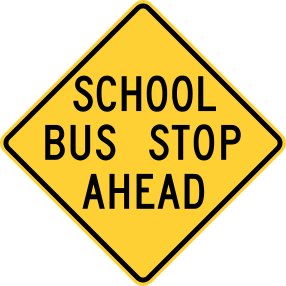
School bus stop ahead
3 questions from the Maryland practice test
1. If an emergency vehicle approaches with its siren and flashing lights operating, what must you do?
- Follow it through the intersection to use its clear path
- Move toward the road edge, stay out of intersections, and stop
- Stop in the nearest intersection so it can go around you
- Continue at the same speed until it passes on your left
Show answer
Move toward the road edge, stay out of intersections, and stop. An emergency vehicle using its signals needs a predictable, open path. Move as close as possible to the edge, keep out of the intersection, and remain stopped until the vehicle has passed. Following behind it is not a permitted shortcut, and stopping inside the intersection blocks the very route emergency responders may need. Maintaining speed also leaves too little room for the response vehicle to maneuver. As soon as you hear or see the signals, check mirrors, clear the intersection if possible, then stop at the edge.
2. A school bus is stopped with flashing red lights on the other side of a divided road. When may you continue?
- Only after the bus driver waves you through
- Whenever the bus is more than 20 feet away
- Whenever no children are visible
- When a physical barrier divides the roadways
Show answer
When a physical barrier divides the roadways. Maryland makes an exception when the road is divided by a physical barrier and the bus is on the opposite side. A painted line alone is not the same protection. Distance from the bus, the absence of visible children, or a missing wave from the driver does not create the exception. On other approaches, stop at least 20 feet from the bus and wait until it moves or turns off its flashing red lights. The deciding cue is the actual barrier separating the two roadways, not the number of lanes by itself.
3. You are in an intersection when an emergency vehicle approaches using its siren and flashing lights. What should you do?
- Turn around and drive against traffic to clear a path
- Stop where you are in the intersection immediately
- Follow the emergency vehicle through the intersection
- Move toward the edge, stay out of intersections, and remain stopped until it passes
Show answer
Move toward the edge, stay out of intersections, and remain stopped until it passes. Emergency vehicles using their signals have priority, but a driver should not create a blockage by stopping in the intersection. Move as close as possible to the road edge, keep out of the intersection, and remain stopped until the emergency vehicle has passed. Stopping in the middle would obstruct its route. Following it could place you in danger, and driving against traffic introduces a separate collision risk. If you are already committed to the intersection, clear it safely first, then take the required position at the edge and wait.
Practice this topic
Lock it in with emergencies questions from the free Maryland practice test. Every answer comes with a plain English explanation.
Source: the Maryland Driver's Manual, Section 7: Sharing the Road. This lesson is a plain English summary, not the law itself; where it differs, the manual and the statute govern. Last checked 2026-09-27.