
Test 10 of 10 · 20 questions · Free 2026
MD Permit Practice Test 10
Jump to the test ↓A fixed 20 question set from the Maryland bank with answers and plain English explanations. The real MD exam is 25 questions, 88 percent to pass; take the full length version on the main practice page.
Question 1 of 20 · 0 right so far
All 20 questions in test 10
Every question below comes from the Maryland question bank on this page. Open a question to see the correct answer and the explanation. Nothing here is hidden behind a signup.
1. What do Maryland traffic signs use to communicate information?
- Only flashing lights
- Engine sounds and tire size
- Symbols and words
- Vehicle registration numbers
Show answer
Symbols and words. Maryland states that traffic signs use symbols and words to communicate information. Drivers should quickly identify signs by their shapes, colors, words, numbers, and symbols. A sign is not interpreted from engine noise, tire size, or a vehicle registration number, and not every sign uses a flashing light. Slow enough to recognize the sign before acting, then combine the visual elements to understand whether it warns, regulates, guides, or identifies a service. This habit helps prevent a driver from reacting to only one part of the sign.
Study this in the handbook: Sign colors and shapes
2. What is the first required action at a flashing red signal?
- Slow down and continue without stopping
- Make a complete stop before the stop line or crosswalk
- Proceed if no vehicle is visible, then stop in the intersection
- Stop only when a pedestrian is waiting
Show answer
Make a complete stop before the stop line or crosswalk. A flashing red signal is treated as a stop requirement. Stop completely at the stop line; if there is no line, stop before the crosswalk and before entering the intersection. After stopping, yield to traffic and pedestrians, then proceed only when the way is clear. Slowing without stopping is the rule for a flashing yellow signal, not a flashing red one. An empty-looking roadway does not remove the stop duty, and the requirement does not depend on seeing a pedestrian. The cue is red means full stop first.
Study this in the handbook: Traffic signals, arrows and lane use lights
3. A school bus is stopped with flashing red lights on the other side of a divided road. When may you continue?
- Only after the bus driver waves you through
- Whenever the bus is more than 20 feet away
- Whenever no children are visible
- When a physical barrier divides the roadways
Show answer
When a physical barrier divides the roadways. Maryland makes an exception when the road is divided by a physical barrier and the bus is on the opposite side. A painted line alone is not the same protection. Distance from the bus, the absence of visible children, or a missing wave from the driver does not create the exception. On other approaches, stop at least 20 feet from the bus and wait until it moves or turns off its flashing red lights. The deciding cue is the actual barrier separating the two roadways, not the number of lanes by itself.
Study this in the handbook: Pedestrians, emergency vehicles and school buses
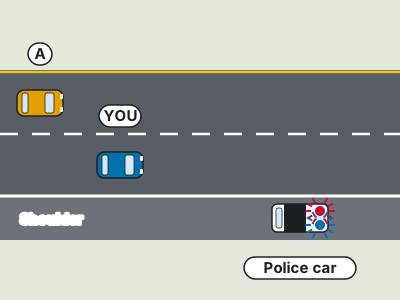
4. What must a driver do when approaching a stopped emergency vehicle with flashing lights on a Maryland roadway?
- Stop in the adjacent lane regardless of traffic
- Maintain speed because the emergency vehicle is off the roadway
- Move over one lane if safe, or slow down if moving over is not safe
- Pass on the shoulder without reducing speed
Show answer
Move over one lane if safe, or slow down if moving over is not safe. Maryland's Move Over rule protects people working beside traffic. If a lane change can be made safely, leave an open lane between your vehicle and the stopped emergency vehicle. If traffic or road design prevents that move, slow down to a safe speed instead. Maintaining speed ignores the roadside risk, while an unconditional stop in a live lane can cause a new collision. Look well ahead for flashing lights, check the next lane early, and make the protective adjustment before reaching the vehicle.
Study this in the handbook: Pedestrians, emergency vehicles and school buses
5. Who must wear a helmet on a bicycle in Maryland?
- No one, helmets are optional
- Everyone regardless of age
- Only riders on state highways
- Anyone under 16, including passengers who are not steering
Show answer
Anyone under 16, including passengers who are not steering. Helmets are required for anyone under age 16 riding on a bike, including passengers who are not steering, and they are strongly recommended for people of all ages. By law all bicycles must have brakes that can stop within a short distance, and at night a white headlight and red rear reflector visible from 600 feet. The manual says bicycles are generally allowed on sidewalks, but local jurisdictions can prohibit sidewalk riding, so riders should check the local code.
6. What does a red background on a Maryland traffic sign generally warn or require?
- Food, fuel, or another roadside service
- Construction or maintenance work ahead
- A destination, distance, or direction
- Stop, yield, do not enter, or wrong way
Show answer
Stop, yield, do not enter, or wrong way. Red is used for several high-priority traffic messages in Maryland: stop, yield, do not enter, and wrong way. It is not the color used to identify a work zone, a destination guide, or a service area. The exact words and shape still matter, because a red octagon gives a stop command while a red triangle gives a yield command. When red appears on a sign, slow your visual search, read the instruction, and follow the restriction before continuing.
Study this in the handbook: Sign colors and shapes
7. What is the minimum practice driving requirement for an applicant younger than 25 with a learner's permit?
- At least 60 hours with a supervising driver
- At least 14 hours, all during daylight
- At least 45 hours with no supervising driver
- At least 18 hours after receiving a provisional license
Show answer
At least 60 hours with a supervising driver. Applicants younger than 25 must practice driving at least 60 hours with a supervising driver while holding the Learner's Instructional Permit. The 14-hour figure applies to applicants who are 25 or older, and the manual also requires nighttime or early morning practice within the applicable total. A permit holder does not satisfy the rule by practicing alone, and hours after a provisional license do not replace the permit requirement. The cue is to pair the applicant's age group with its own total: under 25 means 60 supervised hours.
Study this in the handbook: The learner's instructional permit and practice hours
8. What should a Maryland driver do when road conditions are adverse?
- Keep the same speed in every condition
- Drive faster than the posted limit
- Recognize the conditions and adjust speed
- Ignore potential hazards until they appear
Show answer
Recognize the conditions and adjust speed. Maryland requires drivers to recognize and adjust speed to adverse conditions. The posted speed is a maximum for ideal conditions, not a promise that the same speed is safe during rain, heavy traffic, poor visibility, or a difficult roadway. Driving faster than the limit is illegal, and holding one speed regardless of conditions ignores the manual’s risk guidance. Waiting until a hazard appears leaves less time to respond. Scan the road early, identify what has changed, and reduce speed before traction, sight distance, or stopping room becomes a problem.
Study this in the handbook: Defensive driving and who goes first
9. What practice record must a Maryland applicant submit before moving from a permit to a provisional license?
- A school transcript showing 30 classroom hours only
- A signed Practice and Skills Log showing at least 60 practice hours, or 14 for an applicant age 25 or older
- A receipt proving 45 days of vehicle ownership
- A driving diary with exactly 100 daytime hours
Show answer
A signed Practice and Skills Log showing at least 60 practice hours, or 14 for an applicant age 25 or older. The applicant must submit a completed and signed Practice and Skills Log. It must show at least 60 practice hours with a supervising driver, or 14 hours when the applicant is 25 or older. Classroom time and vehicle ownership do not substitute for logged driving practice. Before testing, check that the log is complete, signed, and records the age-appropriate total.
Study this in the handbook: The learner's instructional permit and practice hours
10. Within what distance of an intersection or railroad grade crossing is passing prohibited in Maryland?
- 100 feet
- 50 feet
- 300 feet
- 500 feet
Show answer
100 feet. Maryland prohibits passing when crossing or within 100 feet of an intersection or a railroad grade crossing. The same 100 foot distance applies when your view is blocked as you come within 100 feet of a bridge, elevated road or tunnel. Fifty feet is too short. Three hundred and five hundred feet are the manual's distances for dimming high beams when following or meeting another vehicle, not passing limits.
Study this in the handbook: Passing rules and parking
11. A Maryland driver has a valid disability placard. Which parking act is still a violation?
- Parking in a disability space when the qualified person is the driver
- Parking on the access aisle next to a disability space
- Parking in a regular space
- Parking in a disability space with the qualified person as a passenger
Show answer
Parking on the access aisle next to a disability space. A placard does not cover every spot. Maryland lists parking on any part of the access aisle next to a disability parking space as a violation even with a disability plate or placard, because people in wheelchairs use that aisle to get in and out. Blocking a curb cut is also illegal with a placard. Using the disability space itself is allowed when the qualified person is the driver or a passenger. A regular space is always allowed.
Study this in the handbook: Provisional license restrictions, implied consent and penalties
12. A Maryland permit applicant is 15 and a half years old. Which extra form must the applicant provide?
- A completed Learner's Permit School Attendance Certification form (DL-300)
- A signed Practice and Skills Log showing 60 hours
- A certificate from the three-hour roadway safety program
- A letter from an employer approving night driving
Show answer
A completed Learner's Permit School Attendance Certification form (DL-300). An applicant under age 16 must hand in a completed Learner's Permit School Attendance Certification form, numbered DL-300, along with a parent or guardian co-signature. The Practice and Skills Log is turned in later, when the permit holder moves up to a Provisional License, so it cannot be required at the permit stage. The three-hour roadway safety program is for drivers who hold a license from another country. No employer letter is part of the permit application.
Study this in the handbook: The learner's instructional permit and practice hours
13. A Maryland driver who already has a license gets a Type 2 Learner's Instructional Permit for a new class. How soon can the driving test be taken?
- After holding the permit at least 45 days
- After holding the permit at least 9 months
- After holding the permit at least 14 days
- On the same day the permit is issued
Show answer
After holding the permit at least 14 days. The Type 2 permit is for someone who already holds a driver's license and wants a different class, so the waiting time is short. The manual lets that driver take the skills test for a full license once the permit has been held at least 14 days. Forty-five days is the minimum permit period for a new applicant 25 or older under the Type 1 route. Nine months applies to new applicants under 18. There is no same day test.
Study this in the handbook: The learner's instructional permit and practice hours
14. How much can a fully loaded truck weigh, and how far does it take to stop, according to the Maryland manual?
- About 10,000 pounds, stopping in 50 feet
- About 20,000 pounds, stopping like a car
- About 40,000 pounds, stopping in 100 feet
- More than 80,000 pounds, taking the length of a football field to stop
Show answer
More than 80,000 pounds, taking the length of a football field to stop. Fully loaded trucks can weigh more than 80,000 pounds and take the length of a football field to stop, while most cars weigh only about 2,000 pounds. Never cut in front of a truck, and never squeeze along a truck's right side as it begins a turn, because it swings wide and you can be caught between the truck and the curb. Stay out of the four no zones.
Study this in the handbook: Trucks, motorcycles, bicycles and mopeds
15. In Maryland, how does the revocation of a driver's license compare with a suspension?
- Revocation is milder and ends automatically after 30 days
- They are the same action with different names
- Revocation is more severe, and there is a minimum waiting period before you can ask to be reinstated
- Revocation only restricts driving to work and school
Show answer
Revocation is more severe, and there is a minimum waiting period before you can ask to be reinstated. Maryland describes revocation as more severe than a suspension. After a revocation you may not drive until the MVA decides you can drive safely again, and there is a minimum waiting period before you can even request reinstatement, which the MVA can deny. It does not end automatically after 30 days, and it is not the same as a suspension. A license limited to work and school is a restricted license, which the MVA may grant in some suspension cases.
16. A Maryland teen lies about age to buy alcohol. Besides criminal fines or prison, what can happen to the driver's license?
- It may be suspended
- Nothing, because the offense did not involve driving
- It is automatically canceled forever
- It is converted to a Type 2 permit
Show answer
It may be suspended. The manual says it is against the law to lie about your age to purchase, possess or acquire alcohol, and that in addition to the fines or prison allowed under federal and state law, your driver's license may be suspended. The license can be affected even though no vehicle was involved. Permanent cancellation is not the listed outcome here, and the Type 2 permit is a licensing product for adding a vehicle class, not a penalty.
17. How much litter do Maryland highway workers remove from state roads each year, according to the manual?
- About 500 pounds
- Over two million pounds
- About 10,000 pounds
- About 100 tons
Show answer
Over two million pounds. The manual's Did You Know note says highway workers remove over two million pounds of litter from Maryland state roads each year. The same note warns that fines for littering can reach $1,500 or 30 days in prison. Five hundred pounds, ten thousand pounds and one hundred tons all fall far short of that figure. Keep a trash bag in the car instead of tossing anything out the window, and secure any load so nothing blows out.
Study this in the handbook: The vision screening, knowledge test and skills test
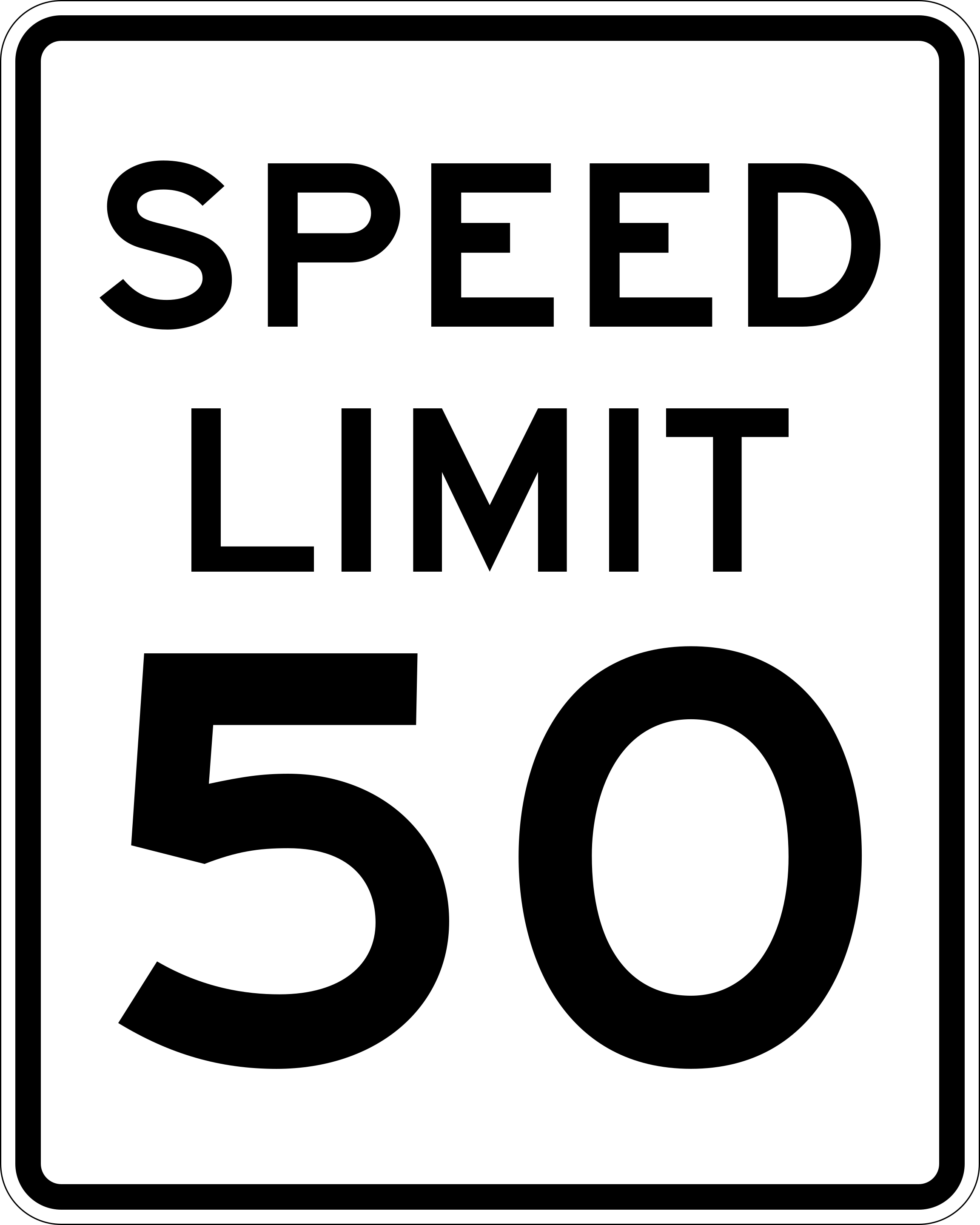
18. What do vertical rectangular signs usually provide?
- Warnings about every railroad crossing
- Instructions or rules of the road
- Only recreation information
- A guarantee that no traffic is present
Show answer
Instructions or rules of the road. Maryland explains that vertical rectangular signs usually give instructions or tell drivers the rules of the road. They are not limited to railroad warnings, recreation information, or assurances about traffic. A driver should read the sign and obey the instruction at the location where it is posted. The shape helps classify the message, but the words and symbols provide the specific rule. Slow enough to identify the sign before acting, especially where a regulatory instruction changes lane use, turns, parking, or speed.
Study this in the handbook: Sign colors and shapes
19. If the broken yellow line is on your side of a solid yellow line, when may you pass?
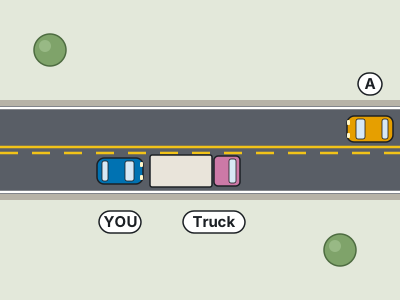
- When passing is careful and the road ahead is clear
- Never, because any solid yellow line forbids both directions
- Only after moving onto the shoulder first
- Whenever the vehicle ahead is traveling below the speed limit
Show answer
When passing is careful and the road ahead is clear. A solid yellow line paired with a broken yellow line permits passing only for traffic on the broken-line side, and the maneuver must still be careful. The solid-line side may not pass. A solid line somewhere in the pair therefore does not forbid both directions, and using the shoulder is not a substitute for a legal passing lane. Being below the speed limit does not by itself make passing safe or lawful. The cue is to identify which side carries the broken line before considering a pass.
Study this in the handbook: Lines and pavement markings
20. At an unsignalized street crossing, when must a driver stop for a pedestrian?
- Only when a crossing guard is present
- Only when the crosswalk has painted stripes
- Only after the pedestrian makes eye contact
- When the pedestrian is in a marked or unmarked crosswalk
Show answer
When the pedestrian is in a marked or unmarked crosswalk. Without a traffic signal, Maryland requires drivers to stop for pedestrians in either a marked or unmarked crosswalk. Paint is not what creates the crossing, and eye contact or a crossing guard is not a prerequisite. Approach crossings attentively, anticipate people who may be difficult to see or hear, and remain stopped long enough for the pedestrian to cross safely. The practical cue is to treat the intersection as a crosswalk even when markings are absent.
Study this in the handbook: Pedestrians, emergency vehicles and school buses
QualitySpace is expanding to Maryland
We are a California-based independent insurance brokerage working on licensing in more states. We cannot help with Maryland insurance yet. Leave your email and we will let you know when we can.
Every question is written from the official Maryland Driver's Manual. Need paper? Printable MD practice test with answer key.
Last verified 2026-10-05. How we check every question · Study all 200 as flashcards
Frequently asked questions
How many questions are on this Maryland practice test?
This fixed set has 20 questions. It is test 10 of 10 from the 200 question Maryland bank. The real MD exam asks 25 questions and you need 22 correct.
What is the passing score for the real Maryland test?
88% or higher That figure comes from the official Maryland source cited on the DMV facts page.
How does this fixed test relate to the full Maryland bank?
Each numbered test is a fixed set of questions in a fixed order, so you can retake the same test later and compare. Every test mixes road signs and the other topics in about the same proportion as the full bank. Tests 1 to 10 together cover every question in the Maryland bank once. The full practice page mixes the whole bank at random.
Last verified 2026-10-05. See the Maryland DMV facts page for sourced state details.
Return to the full Maryland practice test · Study road signs