
Test 14 of 25 · 20 questions · Free 2026
MD Permit Practice Test 14
Jump to the test ↓A fixed 20 question set from the Maryland bank with answers and plain English explanations. The real MD exam is 25 questions, 88 percent to pass; take the full length version on the main practice page.
Question 1 of 20 · 0 right so far
All 20 questions in test 14
Every question below comes from the Maryland question bank on this page. Open a question to see the correct answer and the explanation. Nothing here is hidden behind a signup.
1. Darkness, fog, or heavy rain cuts your view of the road in Maryland. What does that situation demand from you?
- The same casual attention used on a clear day
- More concentration and preparation than normal driving
- Faster reactions instead of advance preparation
- Reliance on other drivers to light your way
Show answer
More concentration and preparation than normal driving. When vehicles, pedestrians, signs, and markings grow hard to see, the driving task itself grows harder. Extra concentration and preparation compensate by slowing decisions down before they become emergencies. Casual clear day attention leaves too little reserve, and quick reactions cannot replace looking and planning ahead. Other drivers cannot light your path or judge your lane position. Slow down, widen gaps, keep lights and windows clear, and scan with more care until normal visibility returns on Maryland roads.
Study this in the handbook: Lines and pavement markings
2. A flashing yellow X is lit over the center lane of a Maryland road, and you want to turn left into a store. Who else should you expect in that lane?
- Through traffic using it to pass slower vehicles
- Delivery trucks parked there while loading
- Left-turning drivers coming from the opposite direction
- Only buses and emergency vehicles on duty
Show answer
Left-turning drivers coming from the opposite direction. A flashing yellow X or two-way left-turn arrows over a lane mean you may use that lane to make a left turn. Maryland warns that you will likely be sharing the lane with left-turning vehicles coming from the opposite direction, so enter it only to prepare your turn and watch for a driver facing you who is doing the same. The lane is not for passing, parking, or reserved vehicles. A red X over the same lane would close it completely.
Study this in the handbook: Traffic signals, arrows and lane use lights
3. A single broken white line separates lanes going the same way in Maryland. What does it allow?
- Passing traffic from the opposite direction
- Parking along the right edge of the road
- Crossing from one lane to the other
- Stopping across both lanes at once
Show answer
Crossing from one lane to the other. White lines manage traffic moving in one direction, and the broken pattern is the permissive form. Gaps in the line tell a driver that moving across into the neighboring lane is allowed after checking mirrors, signaling, and judging a safe gap. A solid white line sends a stricter message by discouraging lane changes or marking the right edge. Yellow lines, not white ones, separate opposing traffic. Parking and stopping across lanes follow separate rules and gain no permission from a broken white line.
Study this in the handbook: Lines and pavement markings
4. You are driving at night on a Maryland road with no streetlights. Which beam choice fits that setting?
- Use low beams only, even when no other traffic is near
- Turn off headlights when the road ahead looks empty
- Alternate between high and low beams every few seconds
- Use high beams so you can see other vehicles and people
Show answer
Use high beams so you can see other vehicles and people. On a road without streetlights, brighter beams extend the distance a driver can see, which helps reveal vehicles, people, and hazards sooner. That extra view matters at night because drivers can see only as far as their lights allow. Brighter beams still need to be dimmed for traffic ahead: at least 500 feet before meeting an oncoming vehicle and when following within 300 feet. On lit roads, in fog, rain, or snow, and when entering tunnels or work areas, lower beams are the better choice.
Study this in the handbook: Lines and pavement markings
5. You are in the inside lane of a two-lane Maryland traffic circle. While circling, what should you do with your lane?
- Change lanes freely to pass slower cars
- Drift between lanes to follow the curve
- Move outside right after entering the circle
- Stay in your lane until you prepare to exit
Show answer
Stay in your lane until you prepare to exit. In a Maryland traffic circle with more than one lane, stay in your lane while circling. When preparing to exit, turn on your right turn signal and move to the outside lane after you pass the exit before the one you plan to take. Changing lanes to pass or drifting across the lane line goes against the stay-in-lane rule, and moving outside right after you enter does not match the timing the manual describes. Watch for people crossing near the exit as you leave.
Study this in the handbook: Railroads, work zones, roundabouts, highways and processions
6. An unsealed bottle sits on the back seat while you drive in Maryland. What is the problem?
- An open container in the passenger area is against the law
- It is a problem only if the driver drinks from it while moving
- Back seat items are exempt from the rule
- It matters only when minors are riding along
Show answer
An open container in the passenger area is against the law. Maryland bans driving with an open alcohol container in the passenger area, and the back seat falls inside that area. Nobody needs to take a sip before the violation exists. The rule targets the presence of accessible alcohol where people sit, not just the act of drinking while moving. Minors in the vehicle are not what triggers it either. Keeping alcohol sealed and outside the passenger area, or leaving it behind entirely, keeps a routine drive from becoming a stop.
Study this in the handbook: Alcohol, drugs and driving
7. On an icy Maryland road, the rear of your car starts sliding to the right. Which way should you steer?
- To the right, the way the car is skidding
- Hard to the left, away from the skid
- Straight ahead, holding the wheel perfectly still
- Back and forth quickly to find grip
Show answer
To the right, the way the car is skidding. To regain control in a skid, Maryland's basic rules are to release the pedal you are using, steer in the direction you are skidding, and look where you want the vehicle to go. When the rear slides to the right, the skid is to the right, so steer right. Turning hard the other way or sawing the wheel works against recovery. Press the brake only after the tires grip the road again, and if the back wheels lose traction, slowly accelerating may help.
Study this in the handbook: Bad weather, skids and hydroplaning
8. You are driving on an ordinary two-way Maryland road. Where should you generally keep your vehicle?
- Directly on top of the center line
- To the right of the center of the road
- Wherever the pavement is smoothest
- Left of center whenever no one is coming
Show answer
To the right of the center of the road. Maryland's lane driving rule is to keep your vehicle to the right of the center of the road, unless you are passing another vehicle going in the same direction, a traffic sign or signal says it is okay to do otherwise, or something in the way makes it necessary to change your position safely. Riding on the center line or drifting left when the road looks empty puts you in the space opposing traffic needs. Stay in a single lane and do not drift across lane lines.
Study this in the handbook: Following distance, stopping distance and turns
9. Your car is disabled but still rolling slowly on a flat. A parking lot is just ahead in Maryland. What should you consider?
- Reach the lot even if driving on the flat damages the rim
- Stop right away in the travel lane to protect the rim
- Speed up to reach help before the tire gets worse
- Park in the painted ramp area to save the wheel
Show answer
Reach the lot even if driving on the flat damages the rim. If your vehicle becomes disabled, Maryland says to do your best to move it to the shoulder, and if you can reach an off-ramp or parking lot, to consider doing that even if it means driving on a flat tire or damaging a rim. The further you can be from traffic, the safer you will be. Stopping in a travel lane to protect the rim leaves you in the path of traffic, and you should never stop or park in the triangular painted zone where a ramp exits the road.
10. You take a Maryland interstate exit signed at 25 mph. When should your slowing begin?
- Only after the ramp curves, to keep highway traffic moving
- While still in the through lane, well before the exit
- Right when you enter the deceleration lane
- At the very end of the ramp, just before the stop
Show answer
Right when you enter the deceleration lane. The deceleration lane exists so slowing happens off the through lanes, protecting faster traffic behind. Entering that lane is the cue to lift off and begin shedding speed, then keep easing down toward the ramp value. Braking hard in a through lane surprises followers, and waiting until the ramp ends invites a rushed stop. Plan the lane change early and let the extra space do the work. A calm exit also leaves room to recover if the first ramp choice turns out wrong.
Study this in the handbook: Railroads, work zones, roundabouts, highways and processions
11. You see the pictured warning sign on a Maryland road. What should you expect ahead?
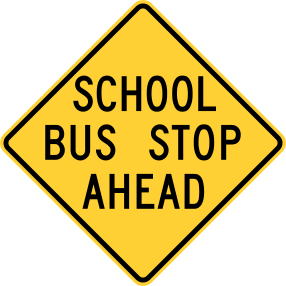
- A school bus stop
- A lane only for buses
- A school parking lot exit
- A transit station entrance
Show answer
A school bus stop. The School Bus Stop Ahead sign warns that a school bus may be stopped ahead, possibly where you cannot see it yet. If the bus has its flashing red lights on, you must stop at least 20 feet from it, whether you are behind it or in front of it, and wait until it moves or turns off the red lights. Slowing early when you see this sign gives you room to make that stop smoothly. The sign does not mark a bus lane or a station entrance.
Study this in the handbook: Regulatory, warning and guide signs
12. Fog hides the words on a sign in Maryland, but you can clearly see its eight-sided outline. What must you do?
- Slow down and proceed with caution
- Come to a complete stop
- Yield only if traffic is near
- Speed up to clear the intersection
Show answer
Come to a complete stop. Maryland drivers can identify signs by shape even when words or symbols are hard to read. The eight-sided outline has only one meaning on the road, so a driver who sees that outline should treat the sign as a stop requirement without waiting to read its letters. Slowing down alone is not enough, and giving way only when traffic is near also falls short. A full stop lets the driver check for vehicles and pedestrians before entering the intersection area.
Study this in the handbook: Sign colors and shapes
13. You see the pictured regulatory sign on a median island in Maryland. What does it tell you to do?

- Turn right at the next intersection
- Merge right because your lane ends
- Pass slower traffic on the right
- Stay to the right of the median
Show answer
Stay to the right of the median. Regulatory signs are about traffic laws, and you must obey them. This sign means stay to the right of the median, which keeps you on the correct side of the island or obstruction it marks. Drive past on the right side without crossing over the island. The sign does not order a turn or permit passing on the right, and a warning that a lane is ending would come on a yellow diamond sign rather than this one.
Study this in the handbook: Regulatory, warning and guide signs
14. Snow covers Maryland roads and you must drive. Which speed claim is correct?
- Normal speeds are safe if your vehicle has four-wheel drive
- Posted limits stay safe on snow if traffic keeps moving
- There is no completely safe speed on ice and snow
- Any speed is safe once the road has been plowed once
Show answer
There is no completely safe speed on ice and snow. Every winter road differs with sun, shade, salt, and surface history, so a driver cannot treat any pace as fully safe on snow or ice. Even four-wheel drive vehicles can slide, and a plowed road may hide refrozen patches where meltwater turned back to ice. Slowing down is the central habit: nothing makes normal speeds safe on covered roads. Drivers should also clear windows and lights fully, start slowly, test braking gently, and begin slowing long before intersections or turns.
Study this in the handbook: Bad weather, skids and hydroplaning
15. On a narrow Maryland street, a bicyclist rides in the center of your lane at about 12 mph, well below the 30 mph limit. What should you do?
- Honk until the rider moves to the edge
- Follow patiently until you can pass safely
- Pass closely, since the rider must move right
- Pass on the right side of the rider
Show answer
Follow patiently until you can pass safely. In Maryland, a bicyclist may use the full lane even while traveling well below the speed of traffic when the lane is too narrow for a motor vehicle to safely pass the bicycle in the lane. A rider in the center of a narrow lane is riding lawfully. Stay back, do not honk, and pass only when you can leave at least 3 feet, which may mean waiting for oncoming traffic to clear. See the bicycle in your mirror before moving back.
Study this in the handbook: Trucks, motorcycles, bicycles and mopeds
16. You are in a Maryland acceleration lane. A gap opens in highway traffic while solid lines still separate your lane from the highway. What should you do?
- Cut across the solid lines into the gap
- Stop at the end of the acceleration lane
- Stay off the solid lines and merge after they end
- Drive on the shoulder to get past the solid lines
Show answer
Stay off the solid lines and merge after they end. When entering an interstate or other limited access highway, Maryland says you should not cross the solid lines that divide the entrance from the highway. Use the acceleration lane to adjust your speed to the flow of traffic already on the interstate, and move over where the lines allow it. Drivers already on the highway have the right-of-way, so pick a gap that fits after the solid lines end. Stopping in the acceleration lane or using the shoulder works against a smooth merge.
Study this in the handbook: Railroads, work zones, roundabouts, highways and processions
17. A bicyclist is riding through a marked crossing ahead of you in Maryland. How must you treat the rider?
- As a pedestrian, because bikes share pedestrian rules there
- Give the rider the same right of way as a person on foot
- Pass quickly before the rider reaches your lane
- Honk so the rider leaves the crossing for cars
Show answer
Give the rider the same right of way as a person on foot. In a crosswalk, a bicycle carries the same right of way as a pedestrian, so a driver must yield rather than press through. That protection reflects how exposed a rider is while crossing at walking pace among turning vehicles. Slowing early and waiting until the rider clears gives space if the rider wobbles or stops. Treating the crossing as shared space, instead of a gap to beat, prevents the most common conflict there.
Study this in the handbook: Trucks, motorcycles, bicycles and mopeds
18. Gates are down at tracks ahead and warning lights are flashing. How is the road treated in Maryland?
- Open to one vehicle at a time between gates
- Open after ten seconds if no train is heard
- Closed only to trucks and school buses
- Temporarily closed until the warnings end
Show answer
Temporarily closed until the warnings end. Maryland says the road is temporarily closed if gates are down or warning lights are flashing. Stop and wait until the gates go up and the warning lights stop flashing. The closure applies to every vehicle, and going around or between gates enters a closed crossing. Listening for a train or waiting a fixed number of seconds is not the test; the position of the gates and lights is. After a train passes, look both ways before starting over the tracks, because another train may be coming on another track.
Study this in the handbook: Bad weather, skids and hydroplaning
19. You are approaching a green light at a Maryland intersection when you hear a siren and see flashing lights behind you. What should you do?
- Move to the road edge and stop short of the intersection
- Speed through the green before the vehicle arrives
- Stop in the middle of the intersection
- Keep going at the limit, since your light is green
Show answer
Move to the road edge and stop short of the intersection. Emergency vehicles have the right-of-way when using their sirens and flashing lights. Immediately after you see or hear one approaching, Maryland says to move as close as possible to the edge of the road, stay out of intersections, and remain stopped until the emergency vehicle has passed. A green light does not change that duty. Stopping in the middle of the intersection or rushing through it can put you in the emergency vehicle's path.
Study this in the handbook: Pedestrians, emergency vehicles and school buses
20. You are on an unfamiliar Maryland road and need to turn around. Before making a U-turn, what should you do first?
- Flash your headlights to warn oncoming drivers
- Turn on hazard lights and start the turn slowly
- Pull onto the shoulder and back across the lanes
- Check whether U-turns are allowed at that spot
Show answer
Check whether U-turns are allowed at that spot. U-turns can be extremely dangerous and are not legal everywhere, so the first step is to check that a U-turn is allowed where you are. If it is, turn on your left signal, stop and yield to traffic coming toward you, and turn into the outside or right-hand lane when the way is clear. Flashing headlights or using hazard lights does not make an illegal U-turn legal, and backing across travel lanes is not part of the maneuver at all.
Study this in the handbook: Following distance, stopping distance and turns
Every question is written from the official Maryland Driver's Manual. Need paper? Printable MD practice test with answer key.
Last verified 2026-10-05. How we check every question · Study all 500 as flashcards
Frequently asked questions
How many questions are on this Maryland practice test?
This fixed set has 20 questions. It is test 14 of 25 from the 500 question Maryland bank. The real MD exam asks 25 questions and you need 22 correct.
What is the passing score for the real Maryland test?
88% or higher That figure comes from the official Maryland source cited on the DMV facts page.
How does this fixed test relate to the full Maryland bank?
Each numbered test is a fixed set of questions in a fixed order, so you can retake the same test later and compare. Every test mixes road signs and the other topics in about the same proportion as the full bank. Tests 1 to 25 together cover every question in the Maryland bank once. The full practice page mixes the whole bank at random.
Last verified 2026-10-05. See the Maryland DMV facts page for sourced state details.
Return to the full Maryland practice test · Study road signs