
Test 7 of 10 · 20 questions · Free 2026
MD Permit Practice Test 7
Jump to the test ↓A fixed 20 question set from the Maryland bank with answers and plain English explanations. The real MD exam is 25 questions, 88 percent to pass; take the full length version on the main practice page.
Question 1 of 20 · 0 right so far
All 20 questions in test 7
Every question below comes from the Maryland question bank on this page. Open a question to see the correct answer and the explanation. Nothing here is hidden behind a signup.
1. What vision does Maryland require to qualify for a driver's license?
- 20/20 in one eye
- Binocular vision, at least 20/40 in each eye, and a continuous field of vision of at least 140 degrees
- 20/70 in either eye with 90 degrees
- Any vision with corrective lenses
Show answer
Binocular vision, at least 20/40 in each eye, and a continuous field of vision of at least 140 degrees. To qualify for a Maryland driver's license the applicant must have binocular vision, visual acuity of at least 20/40 in each eye, and a continuous field of vision of at least 140 degrees. The MVA or your eye doctor can do the screening and explain the standard. If glasses or contact lenses are needed to meet it, you must always wear them when you drive, and the license carries that restriction.
Study this in the handbook: The vision screening, knowledge test and skills test
2. What share of crashes does the Maryland manual say advanced driver assistance systems prevent when used properly?
- 5 percent
- 40 percent
- 100 percent
- None, they are only for comfort
Show answer
40 percent. Advanced driver assistance systems, or ADAS, are vehicle technologies that make driving safer, and when used properly they prevent 40 percent of crashes. They have limits and may not work in rain, snow, fog, on hills or around curves, and they respond differently from one vehicle to another. Keep the software up to date and follow the manufacturer's recommendations. The driver remains responsible.
3. What does a third moving violation bring for a Maryland provisional driver under 18?
- A 180 day suspension, a young driver improvement program, and a 180 day employment and education restriction
- A written warning
- A 30 day suspension
- A $110 fine only
Show answer
A 180 day suspension, a young driver improvement program, and a 180 day employment and education restriction. A third offense for an under 18 provisional driver results in a 180 day suspension of the license, required attendance at a driver improvement program for young drivers, and an employment and education only restriction for 180 days. A fourth or later offense can bring revocation. The first offense requires the improvement program and the second a 30 day suspension with a 90 day restriction.
Study this in the handbook: Provisional license restrictions, implied consent and penalties
4. What is the main purpose of defensive driving in Maryland?
- To make other drivers yield whenever you signal
- To keep the vehicle at the posted speed in every condition
- To avoid crashes by controlling the vehicle and responding to risks
- To watch only the road directly in front of the vehicle
Show answer
To avoid crashes by controlling the vehicle and responding to risks. Defensive driving means controlling the vehicle so risks are identified early and a crash can be avoided. The manual connects this approach with searching ahead, watching the front, sides, and rear, and being ready to change speed or lane. The speed-only choice ignores changing road conditions, while signaling does not give you automatic priority over another driver. Watching only the front leaves important hazards outside your view. A useful cue is to scan continuously and leave yourself time to respond before a problem becomes urgent.
Study this in the handbook: Following distance, stopping distance and turns
5. What must a driver do at a flashing yellow signal in Maryland?
- Stop and remain stopped until the signal turns green
- Treat the signal as permission to accelerate
- Turn around before entering the intersection
- Slow down and proceed with caution
Show answer
Slow down and proceed with caution. A flashing yellow signal permits movement but requires a slower, attentive approach. The manual does not require the complete stop used for a flashing red signal, and it does not authorize extra speed. The choice that says to wait for green adds a stop requirement that is not part of this signal. As you approach, reduce speed, scan for vehicles and pedestrians, and enter only when the path is safe. The yellow flash should prompt caution, not automatic priority.
Study this in the handbook: Traffic signals, arrows and lane use lights
6. What is the purpose of a crosswalk signal?
- It replaces every stop sign at nearby intersections
- It gives vehicles priority over pedestrians who have started crossing
- It stops vehicle traffic so pedestrians can cross safely
- It permits drivers to pass a vehicle stopped at the crosswalk
Show answer
It stops vehicle traffic so pedestrians can cross safely. A crosswalk signal is designed to stop traffic so pedestrians can cross the road safely. Drivers must follow the signal and watch for people using the crossing. It does not give vehicles priority over pedestrians who have started crossing, it does not allow passing a vehicle stopped at the crosswalk, and it does not replace every other traffic control device nearby. The cue is the pedestrian crossing itself: stop as directed, keep the crossing clear, and resume only when the signal and roadway permit.
7. At what speed does a Class 3 electric bicycle stop providing assistance in Maryland?
- 20 miles per hour
- 15 miles per hour
- 28 miles per hour
- 35 miles per hour
Show answer
28 miles per hour. A Class 3 electric bicycle has a motor that provides assistance only when the rider is pedaling and stops assisting when the bicycle reaches 28 miles per hour. Class 1 bikes also assist only while pedaling but stop at 20 mph, and Class 2 bikes assist whether or not the rider pedals, stopping at 20 mph. All classes are limited to a 750 watt motor.
8. What should a driver do after seeing a warning sign?

- Be ready to take appropriate action, including slowing if needed
- Ignore it unless another vehicle is present
- Accelerate before reaching the condition
- Stop in every case at the sign
Show answer
Be ready to take appropriate action, including slowing if needed. Maryland explains that warning signs identify special conditions or hazards ahead and that a driver may have to slow down, so the driver should be ready to take appropriate action. The sign does not require ignoring the road, accelerating, or stopping in every situation. Look beyond the sign to find the actual curve, merge, crossing, or other condition, then choose a speed and lane position that leave room to respond. The key cue is preparation: a warning is advance notice, not permission to continue without checking.
Study this in the handbook: Sign colors and shapes
9. Which of these heart related conditions must be reported to the Maryland MVA?
- Any heart condition ever diagnosed
- High blood pressure controlled by medication
- A heart murmur diagnosed in childhood
- A heart condition that caused a loss of consciousness in the past 6 months
Show answer
A heart condition that caused a loss of consciousness in the past 6 months. Maryland requires drivers to report conditions that may affect safe driving, including a heart condition that has caused a loss of consciousness in the past 6 months, epilepsy or seizures, stroke, dizzy spells or blackouts, sleep apnea or narcolepsy, traumatic brain injury, and a low blood sugar episode needing help in the past 6 months. The Medical Advisory Board then reviews whether and how you may drive.
Study this in the handbook: Supervising drivers, insurance, seat belts and child seats
10. Which steering response is recommended if a vehicle begins to skid?
- Steer hard in the opposite direction
- Steer in the direction of the skid
- Close your eyes and hold the wheel rigidly
- Turn toward the nearest lane without releasing the pedals
Show answer
Steer in the direction of the skid. When a vehicle starts sliding, steering in the direction of the skid helps the driver work with the vehicle's movement and regain control. Also release the accelerator or brake pedal being used, look where the vehicle should go, and wait to brake until the tires have traction again. A hard turn in the opposite direction can produce another slide or a spin. Keeping pedal pressure while changing direction ignores the loss of grip. Smooth inputs give the tires a chance to reconnect with the road surface.
Study this in the handbook: Bad weather, skids and hydroplaning
11. If moving over is unsafe or impossible near a stopped vehicle with flashing lights, what must a Maryland driver do?
- Slow down to a safe speed while considering conditions and people nearby
- Maintain the posted limit and pass closely
- Stop in the travel lane until the vehicle leaves
- Use high beams and accelerate past the scene
Show answer
Slow down to a safe speed while considering conditions and people nearby. Maryland's Move Over Law requires a driver to slow to a safe speed when moving over is not safe or possible. The driver should consider weather, road conditions, traffic, and pedestrians while choosing that speed. Holding the posted limit or accelerating past the scene ignores the changed hazard. Look for a safe lane change first; if one cannot be made, create safety with space and reduced speed.
Study this in the handbook: Crashes, traffic stops and the Move Over Law
12. What shape warns that a railroad crossing is ahead?
- A round sign
- A pentagon sign
- A diamond sign
- A rectangular sign
Show answer
A round sign. Maryland uses a round sign to warn that a railroad crossing is ahead. The shape is a recognition cue that helps a driver prepare before the tracks become visible or the crossing is reached. A pentagon identifies a school zone or school crossing, a diamond warns of special conditions or hazards, and a rectangle generally provides regulatory or guide information. Shape recognition should prompt attention, not an automatic maneuver. After identifying the round warning, reduce distractions, scan for trains and signals, and follow the crossing controls.
Study this in the handbook: Sign colors and shapes
13. What penalty applies to a Maryland Move Over Law violation that causes a crash?
- A $50 fine with no points
- $110 fine and one point
- $750 fine and three points
- $150 fine and three points
Show answer
$150 fine and three points. A Move Over Law violation that causes a crash carries a $150 fine and three points on the license. The $110 and one point combination applies to the basic violation without that result, and no listed penalty is a small fine with no points. These penalties show why a driver must first change lanes away from the stopped vehicle or slow to a safe speed when that is not possible. Points are tracked by the MVA and can contribute to suspension or revocation, so the consequence extends beyond the dollar amount.
Study this in the handbook: Crashes, traffic stops and the Move Over Law
14. What does implied consent mean for a person driving on a Maryland road or public-use private property?
- The driver agrees to a vehicle search at every traffic stop
- The driver agrees to take a drug or alcohol test if law enforcement requests one
- The driver agrees to renew vehicle registration every year
- The driver agrees to a vision test before every trip
Show answer
The driver agrees to take a drug or alcohol test if law enforcement requests one. Maryland’s implied consent rule connects the act of driving with agreement to take a drug or alcohol test when a law enforcement officer asks. It is not a blanket promise to accept a vehicle search, renew registration on demand, or repeat a vision screening. Remember the trigger: driving or attempting to drive on a public road or public-use private property, followed by an officer’s request for the test.
Study this in the handbook: Provisional license restrictions, implied consent and penalties
15. When may a driver pass where a solid yellow line is on the driver's side?
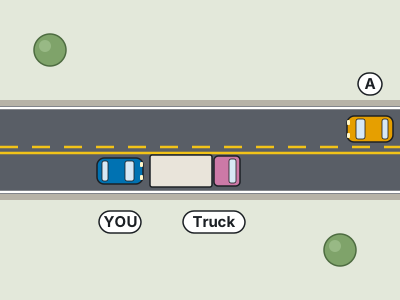
- The driver may not pass in that location
- The driver may pass whenever the road appears empty
- The driver may pass if the vehicle ahead is moving slowly
- The driver may pass after checking only the rear-view mirror
Show answer
The driver may not pass in that location. Where a solid yellow line is paired with a broken one, careful passing is allowed for traffic on the broken line side and not allowed for traffic on the solid line side. An empty-looking road does not cancel the pavement restriction, a slow vehicle ahead does not create an exception, and a mirror check alone does not make the pass lawful. The line separates opposing traffic and marks a no-passing condition for that side. Read the center marking before considering an overtake.
Study this in the handbook: Passing rules and parking
16. What action is always associated with an octagonal traffic sign?
- Yield only when pedestrians are present
- Come to a complete stop
- Reduce speed without stopping
- Move into the right lane
Show answer
Come to a complete stop. The octagonal, or eight-sided, shape always means stop, and Maryland identifies the stop sign as the road's only eight-sided sign. The required action is a complete stop, followed by yielding as needed before entering or continuing through the intersection. A yield-only response misses the sign's stronger instruction. Shape recognition is the useful cue: even before reading the words, eight sides should prompt the driver to prepare for a full stop.
Study this in the handbook: Regulatory, warning and guide signs
17. What does Maryland's manual say about alcohol below the .08 drunk-driving limit?
- It has no possible effect on driving
- It matters only when two drinks are consumed
- It affects only drivers under age 21
- Any amount can affect the ability to drive safely
Show answer
Any amount can affect the ability to drive safely. The .08 limit is not a guarantee that lower concentrations leave driving ability unchanged. Maryland's manual says any amount of alcohol can affect safe driving, and it identifies judgment, coordination, vision, simple movements, and reaction time as abilities that may suffer. The mistake in treating a lower BAC as harmless is that impairment can begin before the classification threshold. A driver should not use the legal threshold as a personal safety target.
Study this in the handbook: Alcohol, drugs and driving
18. If Maryland offers the knowledge test in an applicant's language, what must happen before using an interpreter?
- The applicant must pass the English test twice
- The applicant must first obtain a court order
- The applicant must use an interpreter on the first attempt
- The applicant must take that language version at least five times
Show answer
The applicant must take that language version at least five times. When the MVA offers the knowledge test in the language the applicant speaks, the applicant must take that version at least five times before using an interpreter. The rule does not require an English pass, a court order, or an interpreter on the first attempt. This is a testing-language sequence, so identify whether the requested language is already offered before choosing the accommodation path.
19. When passing a bicyclist in Maryland, how much space must you leave between your vehicle and the bicycle?
- At least 1 foot
- At least 20 feet
- At least 3 feet
- At least 6 inches, if you slow down
Show answer
At least 3 feet. Maryland's rule is to give bikes at least 3 feet when passing. Treat a bicyclist like any slow-moving vehicle: slow down, wait until oncoming traffic is clear, then leave at least 3 feet. The rule applies whether the bicycle is in a bike lane, on the shoulder, or in the same lane as your car, and you should see the bicycle in your rear-view mirror before moving back. One foot or six inches is far too close. Twenty feet is the school bus stopping distance.
Study this in the handbook: Trucks, motorcycles, bicycles and mopeds
20. What information does a white traffic sign background commonly identify?
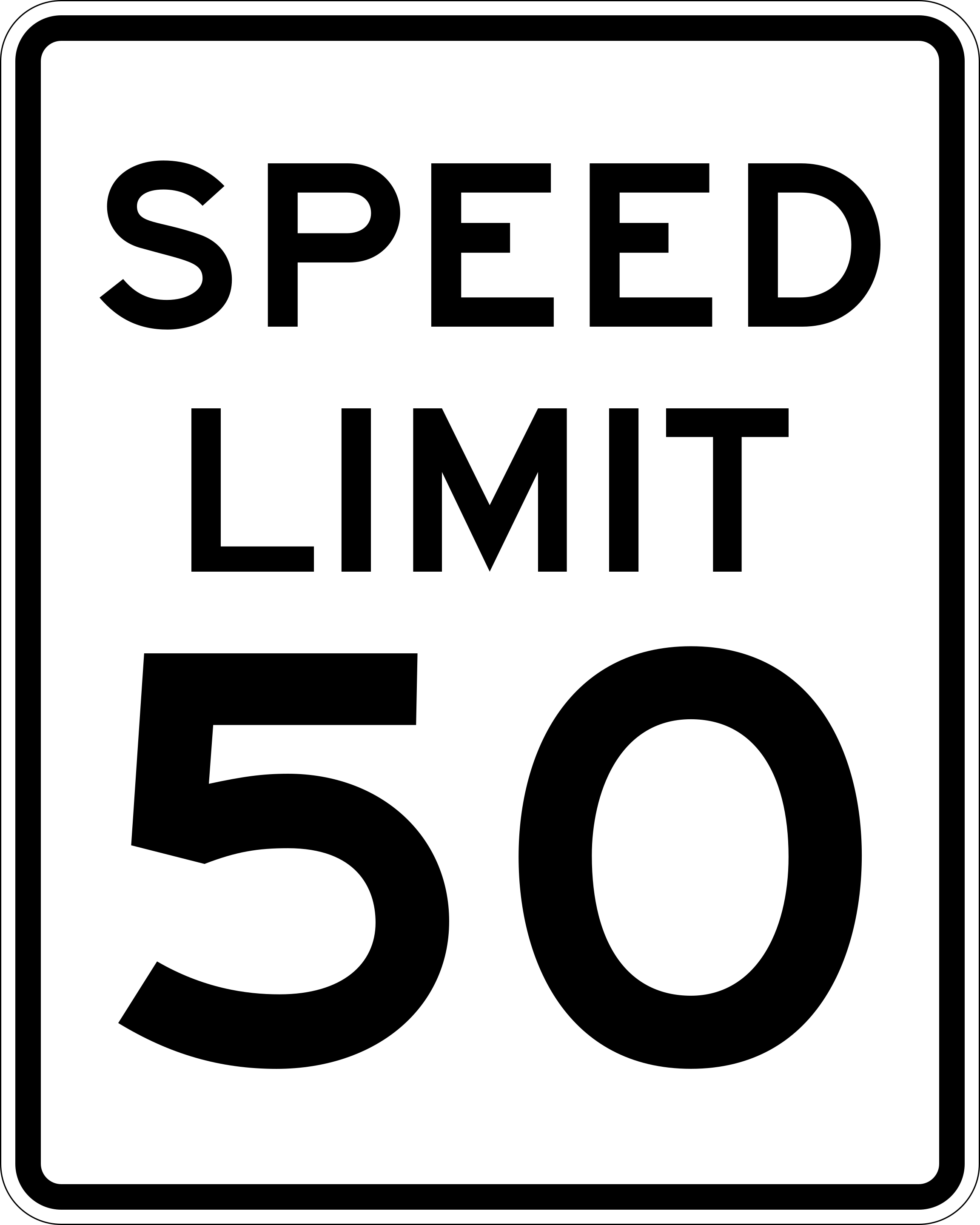
- Speed limits, keep-right instructions, and some guide information
- Construction and maintenance work areas
- Food, fuel, and rest area services
- Recreation and cultural interest areas
Show answer
Speed limits, keep-right instructions, and some guide information. Maryland uses white backgrounds for speed limits, keep-right instructions, and some guide signs. The pictured sign is therefore part of a category that communicates a rule or roadway information, rather than a work-zone warning or a service listing. Orange identifies construction and maintenance areas, blue identifies services, and brown identifies recreation or cultural sites. When reading a white sign, inspect its words, numbers, or arrows for the particular instruction. The background narrows the sign's function, but the complete message controls what you do next.
Study this in the handbook: Sign colors and shapes
QualitySpace is expanding to Maryland
We are a California-based independent insurance brokerage working on licensing in more states. We cannot help with Maryland insurance yet. Leave your email and we will let you know when we can.
Every question is written from the official Maryland Driver's Manual. Need paper? Printable MD practice test with answer key.
Last verified 2026-10-05. How we check every question · Study all 200 as flashcards
Frequently asked questions
How many questions are on this Maryland practice test?
This fixed set has 20 questions. It is test 7 of 10 from the 200 question Maryland bank. The real MD exam asks 25 questions and you need 22 correct.
What is the passing score for the real Maryland test?
88% or higher That figure comes from the official Maryland source cited on the DMV facts page.
How does this fixed test relate to the full Maryland bank?
Each numbered test is a fixed set of questions in a fixed order, so you can retake the same test later and compare. Every test mixes road signs and the other topics in about the same proportion as the full bank. Tests 1 to 10 together cover every question in the Maryland bank once. The full practice page mixes the whole bank at random.
Last verified 2026-10-05. See the Maryland DMV facts page for sourced state details.
Return to the full Maryland practice test · Study road signs