
Test 6 of 10 · 20 questions · Free 2026
MD Permit Practice Test 6
Jump to the test ↓A fixed 20 question set from the Maryland bank with answers and plain English explanations. The real MD exam is 25 questions, 88 percent to pass; take the full length version on the main practice page.
Question 1 of 20 · 0 right so far

All 20 questions in test 6
Every question below comes from the Maryland question bank on this page. Open a question to see the correct answer and the explanation. Nothing here is hidden behind a signup.
1. What does the five-sided sign in the image warn you about?
- A railroad crossing ahead
- A recreational area entrance
- A school zone or school crossing
- A mandatory truck route
Show answer
A school zone or school crossing. The pentagon is the shape used for school zones and school crossings. Seeing this sign means slow down, watch carefully for children, and follow any school-area traffic control devices or posted speed restrictions. It does not identify recreation, rail crossings, or truck routes. The manual assigns other shapes to those messages, including a round sign for railroad warnings and a trapezoid for recreation and cultural areas. The five-sided outline is therefore a strong visual cue to increase attention around students.
Study this in the handbook: Sign colors and shapes
2. What color is used for school, pedestrian, and bicycle signs?
- Brown
- Fluorescent yellow-green
- Blue
- Black
Show answer
Fluorescent yellow-green. Maryland identifies fluorescent yellow-green as the color used for school, pedestrian, and bicycle signs. Blue is used for services such as food, gas, and rest areas, brown marks recreation and cultural interest areas, and black is used for one-way signs and signs that change messages. The color cue helps a driver recognize that a sign concerns vulnerable road users or a school area. When this bright color appears, scan for people walking, riding, or entering the roadway and be prepared to adjust speed.
Study this in the handbook: Sign colors and shapes
3. What can affect how alcohol affects a driver's body, according to Maryland's manual?
- Only the number printed on the beverage container
- Weight, food, fatigue, mood, and medications, among other factors
- Only whether the vehicle has an automatic transmission
- Nothing once the driver has consumed water
Show answer
Weight, food, fatigue, mood, and medications, among other factors. A driver's BAC and impairment cannot be predicted simply by counting drinks. The manual names weight, body fat, how recently and how much the person ate, tiredness, mood, and medications as factors that can change alcohol's effects. Water or a vehicle's transmission does not erase those variables. Because personal estimates are unreliable, the safe decision is not to drive after drinking.
Study this in the handbook: Alcohol, drugs and driving
4. What type of information does a yellow diamond sign provide?

- A warning about a condition or hazard ahead
- A parking permit requirement
- A route distance only
- A fuel service location
Show answer
A warning about a condition or hazard ahead. Maryland classifies diamond-shaped traffic signs as warnings. They alert drivers to special conditions or hazards ahead, so the driver may need to slow down and take appropriate action. A yellow diamond is not a parking permit, a distance-only guide, or a service sign. Read the symbol on the diamond, look ahead for the roadway change, and adjust before reaching it. This early response gives the driver more time to steer, merge, stop, or yield if the warned condition requires it.
Study this in the handbook: Sign colors and shapes
5. A driver with a license from another country wants a Maryland license. Besides the vision, knowledge and skills tests, what else is required?
- 60 hours of logged supervised practice
- A 9 month learner's permit period
- A three-hour roadway safety driving education program approved by the MVA
- A 30 day wait after moving to Maryland
Show answer
A three-hour roadway safety driving education program approved by the MVA. Maryland asks holders of a license from another country to pass a vision screening, the knowledge test and the driving skills test, and also to complete a three-hour roadway safety driving education program approved by the MVA. The 60 hour practice log and the 9 month permit period belong to new drivers under the graduated system. The manual lists no 30 day waiting period. A license not in English must also be translated or backed by an International License.
Study this in the handbook: From provisional license to full driver's license
6. A Maryland provisional driver under 18 is convicted of a fourth moving violation. What happens?
- The license is revoked and all licensing tests must be passed again
- A 30-day suspension
- A driver improvement program only
- A 90-day restriction to school driving
Show answer
The license is revoked and all licensing tests must be passed again. Maryland's ladder for provisional drivers under 18 ends in revocation. A fourth or later offense results in the license being revoked, and the driver must pass all licensing tests to get it back. A 30-day suspension belongs to the second offense, the improvement program alone to the first offense, and a limited work and school restriction is part of the second and third offense penalties. Each step counts a conviction or probation before judgment for a moving violation.
Study this in the handbook: Provisional license restrictions, implied consent and penalties
7. How does a crash on a Maryland road with a speed limit of 65 mph or higher compare with one on a road posted at 40 mph or lower?
- About the same
- Half as likely to be fatal
- Twice as likely to be fatal
- Nearly five times as likely to result in death
Show answer
Nearly five times as likely to result in death. Citing the National Highway Traffic Safety Administration, the manual says a crash on a road with a speed limit of 65 mph or higher is more than twice as likely to result in death than one on a road posted at 45 or 50 mph, and nearly five times as likely as a crash on a road with a speed limit of 40 mph or lower. Its Be the Slow Down Driver message urges drivers to obey speed limits.
Study this in the handbook: Speed limits and a safe speed
8. What is the maximum motor rating for an electric bicycle in Maryland?
- 250 watts
- 750 watts or less
- 1,500 watts
- 5,000 watts
Show answer
750 watts or less. Electric bicycles in Maryland are operated by human power with the assistance of an electric motor, have fully operable pedals, and have an electric motor with a rating of 750 watts or less. Class 1 and Class 2 bikes stop assisting at 20 mph, and Class 3 bikes assist only while pedaling and stop at 28 mph. The 250, 1,500 and 5,000 watt figures do not match the 750 watt rating in the manual's definition.
9. From how far away must the red rear reflector on a bicycle ridden at night be visible in Maryland?
- At least 100 feet
- At least one mile
- At least 50 feet
- At least 600 feet
Show answer
At least 600 feet. When riding at night, Maryland law requires a white headlight on the front of the bicycle and a red reflector on the back, and the manual says the reflector must be visible from at least 600 feet away. The bicycle equipment list repeats that the red rear reflector must be seen from 600 feet, and it sets the white headlight at 500 feet. Bright clothing by day and reflective clothing at night are also recommended.
10. Why should a driver leave extra space when passing a motorcycle?
- A motorcycle may be passed only at an intersection
- A motorcycle must remain at the far edge of its lane when passed
- Wind gusts and drafts from a passing vehicle can affect the motorcycle
- A motorcycle rider must signal the passing vehicle to continue
Show answer
Wind gusts and drafts from a passing vehicle can affect the motorcycle. The manual warns that wind gusts and drafts from a passing vehicle can affect a motorcycle. Leave plenty of space between your vehicle and the motorcycle when passing. Motorcyclists are allowed to use the whole lane, so they are not required to keep to the far edge, and nothing limits passing to intersections or requires the rider to wave you on. After passing, make sure you can see the motorcycle's headlight in your rear-view mirror before moving back into the lane.
Study this in the handbook: Pedestrians, emergency vehicles and school buses
11. What should a Maryland driver do when an emergency vehicle approaches with lights and siren operating?
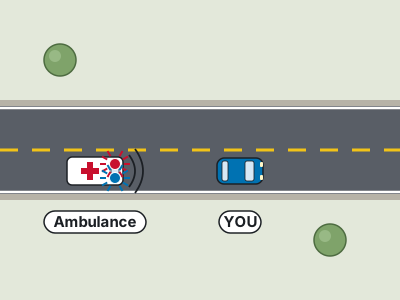
- Race ahead so the emergency vehicle can use the same lane
- Follow the emergency vehicle closely through the intersection
- Move as close as possible to the edge of the road and stop
- Stop in the center of the nearest intersection
Show answer
Move as close as possible to the edge of the road and stop. Maryland gives emergency vehicles a clear path by requiring ordinary traffic to move as close as possible to the edge of the road, stay out of intersections, and remain stopped until the emergency vehicle has passed. Staying in the travel lane can block the response vehicle, and following it closely creates a new hazard. Stopping in an intersection is also unsafe because it can obstruct the emergency route. Check mirrors, move to the edge as soon as you see or hear the signals, and wait until the vehicle has passed and it is safe to continue.
Study this in the handbook: Pedestrians, emergency vehicles and school buses
12. You are turning while a bicyclist continues straight. What is your duty?
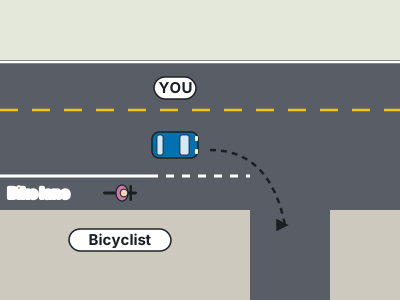
- Yield to the bicyclist
- Turn first because motor vehicles have priority
- Sound the horn and make the bicyclist stop
- Pass the bicyclist inside the intersection
Show answer
Yield to the bicyclist. A bicyclist going straight has priority when a motor vehicle is turning across the bicycle’s path. The manual treats the bicycle as a road user entitled to proceed, not as an obstacle that must clear for the turning car. Check the right side and blind spot before turning, yield fully, and turn only after the bicyclist has passed. A horn does not replace yielding.
Study this in the handbook: Trucks, motorcycles, bicycles and mopeds
13. What do double solid yellow lines mean on a Maryland two-way road?
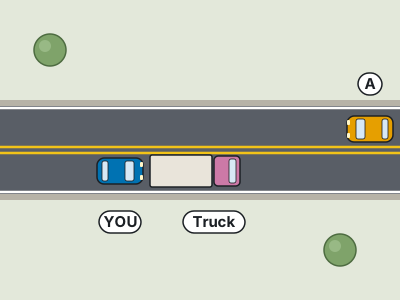
- Passing is permitted for traffic traveling in either direction
- Passing is prohibited in both directions
- Only trucks may cross to pass
- The lane is reserved for bicycles
Show answer
Passing is prohibited in both directions. Double solid yellow lines separate opposing traffic where passing is not allowed in either direction. They do not mean the roadway is closed, and they do not create a special truck or bicycle lane. A left turn across the lines can still be allowed, such as turning into a driveway, but crossing to overtake another vehicle is barred. Treat the paired solid lines as a no-passing message and wait for a lawful opening rather than entering opposing traffic.
Study this in the handbook: Lines and pavement markings
14. Which statement describes the vehicle used for a Maryland driving skills test?
- It must have current plates and registration and proof of insurance
- It may be unregistered if it has a full tank of gas
- It must be supplied by the MVA testing location
- It needs insurance only when the test is on public roads
Show answer
It must have current plates and registration and proof of insurance. The applicant brings the vehicle to the driving skills test. The manual requires up-to-date license plates and registration, plus proof that the vehicle is insured. Those are separate requirements, so a full tank cannot replace registration or insurance, and the testing location does not provide the vehicle. The test vehicle must also be safe to drive, have a clear windshield, and contain at least a half tank of gas. Before leaving for the appointment, check the documents and the vehicle condition together.
Study this in the handbook: The vision screening, knowledge test and skills test
15. Which person qualifies as a Maryland supervising driver for a learner's permit holder?
- A driver age 18 with one year of licensing
- A driver age 21 or older licensed for the same class for at least three years
- Any passenger who has completed driver education
- A parent of any age seated in another vehicle
Show answer
A driver age 21 or older licensed for the same class for at least three years. A supervising driver must be at least 21 and must have held a Maryland or other-state license for the same class of vehicle for at least three years. The person must be beside the learner unless the vehicle is a motorcycle. Age alone, driver education, or a parent traveling separately is insufficient. Verify age, licensing duration, vehicle class, and seating position together.
Study this in the handbook: Supervising drivers, insurance, seat belts and child seats
16. During some Maryland suspensions the MVA may issue a restricted license. What does it allow?
- Driving anywhere during daylight hours
- Driving with any licensed passenger
- Driving only on interstate highways
- Driving only for a specific purpose, like getting to and from work and school
Show answer
Driving only for a specific purpose, like getting to and from work and school. A suspension is a temporary loss of the privilege to drive, but in some cases the MVA may provide a restricted license. That license lets the driver operate a vehicle only for a specific purpose, and the manual gives getting to and from work and school as the example. It is not a general daylight license, it does not depend on having a licensed passenger along, and it has nothing to do with the type of road. Driving outside the stated purpose breaks the restriction.
17. What is the usual purpose of a green highway sign?
- To show destinations, distances, and directions
- To warn of a construction work area
- To identify food, gas, and rest services
- To mark a school crossing
Show answer
To show destinations, distances, and directions. Green is the guide-sign color for destinations, distances, and directions. These signs help the driver navigate toward an exit or route rather than announce a hazard or a facility. Orange warns about construction and maintenance, blue identifies services, and fluorescent yellow-green is used for school, pedestrian, and bicycle signs. The cue is to read green as navigation information: it tells you where the road leads and how far away a destination may be.
Study this in the handbook: Sign colors and shapes
18. How much space does the Maryland manual recommend between the steering wheel and your chest?
- 2 to 3 inches
- At least 24 inches
- As little as possible
- 10 to 12 inches
Show answer
10 to 12 inches. Maryland's manual says air bags give the best protection when used with the vehicle's lap and shoulder belt. Sit as far back from the steering wheel as possible and try to keep 10 to 12 inches between the steering wheel and your chest. Pregnant women should place the lap part of the belt under the abdomen, as low as possible on the hips, and the shoulder belt over the rounding of the belly. Children in a rear facing seat never ride in front of a passenger air bag.
Study this in the handbook: Supervising drivers, insurance, seat belts and child seats
19. What does a steady yellow X signal mean?
- Stop in the lane and wait for opposing traffic
- Remain in the lane until the signal turns green
- Use the lane for through traffic at any time
- Move out of the lane as soon as safely possible
Show answer
Move out of the lane as soon as safely possible. A steady yellow X means the driver should move out of that lane as soon as it can be done safely. It is a lane-use instruction, not permission to continue indefinitely or a command to stop in the lane. The driver should check mirrors and neighboring traffic before changing position. The useful cue is the yellow X above the lane: plan an orderly exit from that lane while maintaining control and watching for other vehicles.
Study this in the handbook: Traffic signals, arrows and lane use lights
20. You approach a stopped service vehicle with warning lights, but traffic prevents a safe lane change. What must you do?
- Maintain your current speed and lane
- Stop in the travel lane immediately
- Slow down to a safe speed and be ready to stop
- Pass on the shoulder without reducing speed
Show answer
Slow down to a safe speed and be ready to stop. Maryland requires a driver approaching a stopped, standing, or parked vehicle with flashing lights to move into a lane that is not immediately next to it when that can be done safely. If traffic, weather, road conditions, or pedestrians make that maneuver unsafe or impossible, the fallback is to slow to a safe speed and prepare to stop. Maintaining speed ignores the hazard, while using the shoulder can create another conflict. A useful roadside cue is simple: move away when you can; otherwise reduce speed early and leave room to stop.
Study this in the handbook: Crashes, traffic stops and the Move Over Law
QualitySpace is expanding to Maryland
We are a California-based independent insurance brokerage working on licensing in more states. We cannot help with Maryland insurance yet. Leave your email and we will let you know when we can.
Every question is written from the official Maryland Driver's Manual. Need paper? Printable MD practice test with answer key.
Last verified 2026-10-05. How we check every question · Study all 200 as flashcards
Frequently asked questions
How many questions are on this Maryland practice test?
This fixed set has 20 questions. It is test 6 of 10 from the 200 question Maryland bank. The real MD exam asks 25 questions and you need 22 correct.
What is the passing score for the real Maryland test?
88% or higher That figure comes from the official Maryland source cited on the DMV facts page.
How does this fixed test relate to the full Maryland bank?
Each numbered test is a fixed set of questions in a fixed order, so you can retake the same test later and compare. Every test mixes road signs and the other topics in about the same proportion as the full bank. Tests 1 to 10 together cover every question in the Maryland bank once. The full practice page mixes the whole bank at random.
Last verified 2026-10-05. See the Maryland DMV facts page for sourced state details.
Return to the full Maryland practice test · Study road signs