Every question below comes from the Washington question bank on this page. Open a question to see the correct answer and the explanation. Nothing here is hidden behind a signup.
1. You are approaching a steady red arrow traffic light in Washington. What must you do first?
- Slow down and turn without stopping
- Come to a complete stop
- Go ahead once pedestrians have cleared the crosswalk
- Proceed if the lane beside you is empty
Show answer
Come to a complete stop. The Washington guide lists the first step for a red arrow in one word: stop. Full explanation in Test 1
Study this in the handbook: Traffic signals and rules of the road
2. How long do alcohol and drug related offenses stay on a Washington driving record?
- Three years
- Five years
- For life
- Until age 21
Show answer
For life. Washington keeps alcohol and drug related offenses on the driving record for life. Full explanation in Test 2
Study this in the handbook: License exams, renewal and losing your license
3. How are bicycle lanes typically marked in Washington?
- Painted blue with double yellow lines
- Marked with orange cones only
- Painted green with solid white lines and a bicycle symbol
- Painted red with a dashed yellow line
Show answer
Painted green with solid white lines and a bicycle symbol. The Washington guide tells drivers to watch for bicycle lanes, which are typically painted green, use solid white lines and are marked with Full explanation in Test 3
Study this in the handbook: Large vehicles, motorcycles, bicycles and farm vehicles
4. When are Washington intermediate driver license restrictions automatically lifted?
- After the first six months
- When the driver turns 18
- After one month of safe driving
- When the driver receives a new permit
Show answer
When the driver turns 18. Washington says intermediate license restrictions are automatically lifted when the driver turns 18. Full explanation in Test 4
Study this in the handbook: Instruction permits and the intermediate license
5. A motorcyclist is riding far to one side of a wide lane. May you move into that lane beside the motorcycle?
- Yes, if the motorcyclist is near the edge
- Yes, during heavy traffic only
- Yes, if you signal first
- No, motorcyclists are entitled to the full lane width
Show answer
No, motorcyclists are entitled to the full lane width. Motorcyclists change position within their lane to see, be seen and avoid objects, and they are entitled to the same lane width as any other Full explanation in Test 5
Study this in the handbook: Large vehicles, motorcycles, bicycles and farm vehicles
6. How close to a railroad crossing may you park in Washington?
- No closer than 15 feet
- No closer than 20 feet
- No closer than 50 feet
- No closer than 100 feet
Show answer
No closer than 50 feet. Washington bans parking on railroad tracks and within 50 feet of a railroad crossing. Full explanation in Test 6
Study this in the handbook: Parking rules and hills
7. What does the guide say drivers are responsible for knowing about Washington signs?
- Only signs pictured in the guide
- Only signs on interstate highways
- All signs, including city and county signs
- Only signs with a speed number
Show answer
All signs, including city and county signs. The guide lists some Washington State signs but makes clear that the list is not complete. Full explanation in Test 7
Study this in the handbook: Traffic signs
8. A red circle and slash over a U-turn symbol indicates what?
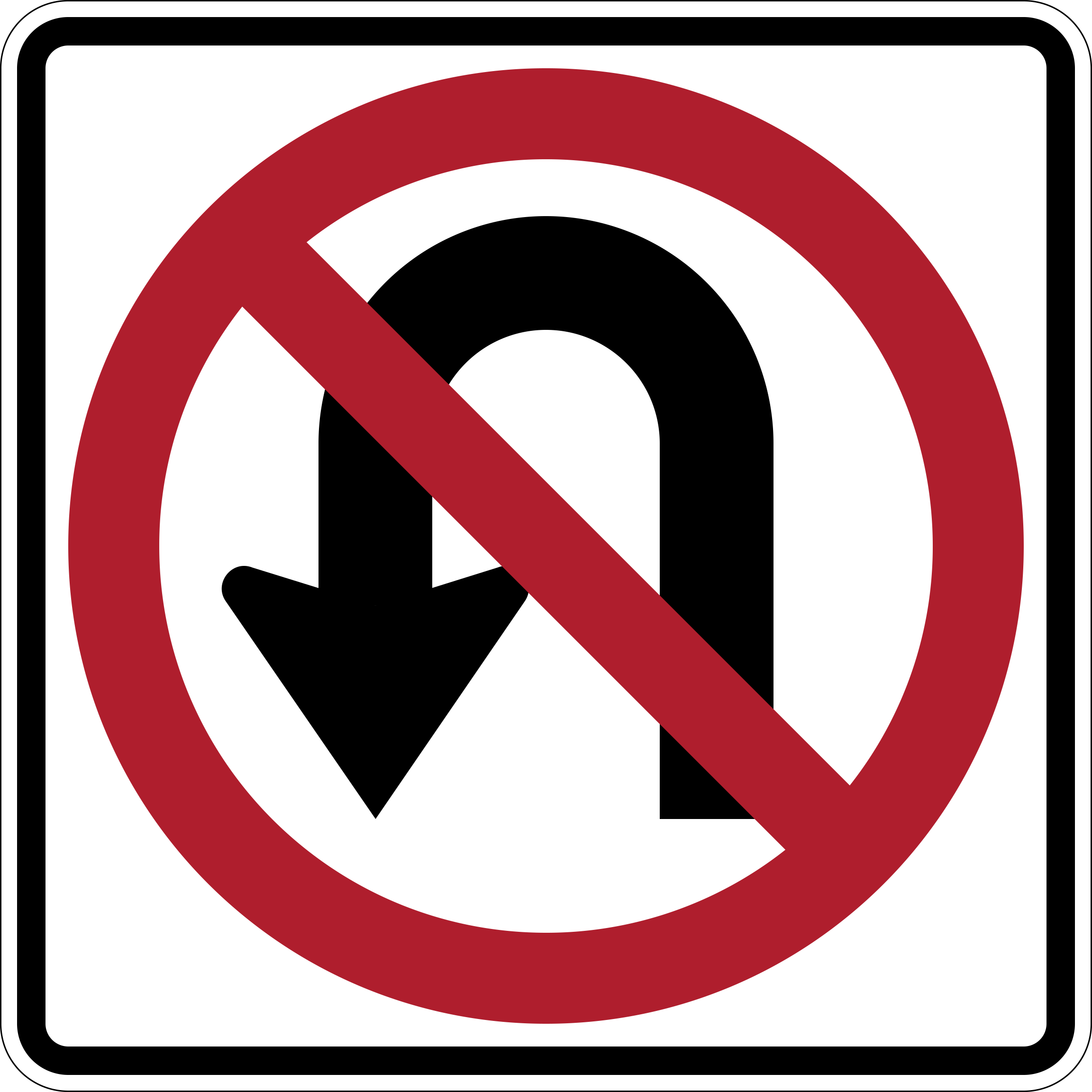
- U-turns are required
- Left turns are the only prohibited movement
- U-turns are not allowed
- The lane is reserved for passing
Show answer
U-turns are not allowed. Washington uses a red circle with a red slash over a symbol to prohibit the pictured action. Full explanation in Test 8
Study this in the handbook: Traffic signs
9. What additional signs can a Washington roundabout have?
- Only signs assigning parking spaces
- Only signs setting freeway ramp speeds
- Only signs marking county boundaries
- Yield, pedestrian warning, and directional arrow signs
Show answer
Yield, pedestrian warning, and directional arrow signs. Washington notes that roundabouts can have yield signs, pedestrian warning signs, and directional arrow signs. Full explanation in Test 9
Study this in the handbook: Traffic signs
10. How early may a Washington driver renew a license before it expires?
- Up to 30 days before
- Up to 90 days before
- Only after it expires
- Up to one year before
Show answer
Up to one year before. Washington drivers can renew up to one year before the license expires, online through License Express or at a licensing office. Full explanation in Test 10
Study this in the handbook: License exams, renewal and losing your license
11. What does the pictured Washington sign prepare a driver for?

- A steep hill ahead
- A speed bump in a parking lot
- A drawbridge that opens for boats
- A tunnel with height limits
Show answer
A steep hill ahead. This sign warns of a hill ahead. The image presents a yellow diamond sign with a truck on a slope. Full explanation in Test 11
Study this in the handbook: Traffic signs
12. Besides the registered and legal owners, what vehicle details does a Washington Certificate of Ownership show?
- The Vehicle Identification Number and bank information when a loan exists
- The yearly tab fee and inspection grade
- The owner insurance agent and policy limits
- The odometer reading from the last sale only
Show answer
The Vehicle Identification Number and bank information when a loan exists. The Certificate of Ownership shows the registered and legal owners, the VIN, and bank information if there is a loan. Full explanation in Test 12
Study this in the handbook: License exams, renewal and losing your license
13. On long, steep grades in Washington, where should you expect slow large vehicles?
- Only behind snow removal equipment
- In the left lane moving with fast traffic
- In the right lane traveling slowly
- Stopped on every shoulder pullout
Show answer
In the right lane traveling slowly. Large vehicles travel slowly when going up or down steep roads. Be prepared to encounter slow vehicles in the right lane. Full explanation in Test 13
Study this in the handbook: Pedestrians, school buses and transit buses
14. A steady yellow X glows over a Washington reversible lane. What does it ask?
- Speed up to exit the lane system early
- Treat the lane as open for one more mile
- Stop in the lane until it turns green
- Move out of the lane as soon as it is safe
Show answer
Move out of the lane as soon as it is safe. A steady yellow X means a reversible lane is changing direction. Move out as soon as it is safe. Full explanation in Test 14
Study this in the handbook: Pedestrians, school buses and transit buses
15. Which roadside conditions can keep vehicle detection technology from working properly?
- The color of the seat upholstery
- A full tank of fuel
- New windshield wiper blades
- Dirty sensors or faded road markings
Show answer
Dirty sensors or faded road markings. Dirty sensors or faded road markings can make vehicle detection technology work poorly. Full explanation in Test 15
16. Your tires start hydroplaning on standing water in Washington. How should you handle the steering wheel?
- Keep the wheel steady and avoid jerking or overcorrecting while grip returns
- Saw the wheel left and right to find dry pavement
- Turn hard toward the shoulder to leave the water
- Spin the wheel quickly to splash water aside
Show answer
Keep the wheel steady and avoid jerking or overcorrecting while grip returns. Keep the steering wheel steady and avoid overcorrecting or jerking it. Full explanation in Test 16
Study this in the handbook: Night driving, slippery roads, skids and hydroplaning
17. The pictured Washington sign tells drivers that the road ahead does what?

- Ends at a ferry terminal
- Becomes one way to the left
- Winds through a series of curves
- Narrows to a single lane
Show answer
Winds through a series of curves. This sign warns of a winding road. Its image is a yellow diamond sign with a winding arrow. Full explanation in Test 17
18. A Washington teen finishes licensing online and prints the receipt. What is that printed page for identification?
- It fully replaces the photo license for identification
- It serves as identification for thirty days
- It counts as identification once signed by a parent
- It works as the temporary license but is not valid for identification
Show answer
It works as the temporary license but is not valid for identification. The printed online receipt serves as the temporary license. It has no photo and is not valid for identification. Full explanation in Test 18
Study this in the handbook: Instruction permits and the intermediate license
19. Where should the lap belt rest on a Washington rider for proper seat belt fit?
- Snugly across the hips, below the stomach
- Loosely across the middle of the stomach
- Over the top of the thighs near the knees
- Behind the back for comfort on long trips
Show answer
Snugly across the hips, below the stomach. The lap belt should fit securely and snugly across the hips below the stomach. Full explanation in Test 19
Study this in the handbook: Seat belts, child seats, steering and braking
20. You back into a parked car in Washington and the owner cannot be found. What must you leave?
- A note with only your first name under the wiper
- Nothing, if your own car shows no damage
- A call to your insurer without any note at the scene
- A visible note with the collision date and time plus your contact information
Show answer
A visible note with the collision date and time plus your contact information. If the collision involves a parked vehicle, you must try to locate the owner. Full explanation in Test 20
Study this in the handbook: Breakdowns, collisions and power lines
21. How is a Washington reversible lane usually marked on the pavement, and what must a driver check first?
- Double solid yellow lines, with curb paint checked first
- Double-dashed white lines, with overhead signs checked before entering
- A single red stripe, with mirror signals checked first
- Green pavement, with toll signs checked first
Show answer
Double-dashed white lines, with overhead signs checked before entering. Reversible lanes borrow pavement in whichever direction the commute needs, and the pavement advertises that flexibility with double-dashed w Full explanation in Test 21
Study this in the handbook: Pedestrians, school buses and transit buses
22. What is REAL ID itself?
- A separate ID card sold at licensing offices
- A sticker added to a standard license
- A law, not an actual piece of ID
- A passport card issued by Washington
Show answer
A law, not an actual piece of ID. REAL ID names a law, not a card you can hold. Full explanation in Test 22
23. Which registration alone makes a person a Washington resident for licensing purposes?
- Being registered to vote in Washington
- Holding a driver license from any other state
- Spending one summer working in Washington
- Registering a boat that is docked in Washington
Show answer
Being registered to vote in Washington. Being registered to vote in Washington is one of the guide’s listed conditions for Washington residency. Full explanation in Test 23
Study this in the handbook: License exams, renewal and losing your license
24. Power lines fall across your car after a Washington crash. How far should bystanders stay back?
- About 10 feet, beyond the fallen wires
- At least 35 feet away, since the ground nearby may be energized
- Just outside the car doors, ready to help you out
- Distance does not matter if nobody touches the wires
Show answer
At least 35 feet away, since the ground nearby may be energized. If power lines fall on your vehicle, stay inside and call 911. The ground around your vehicle could be energized. Full explanation in Test 24
Study this in the handbook: Breakdowns, collisions and power lines
25. At a Washington roundabout, when must drivers stop for pedestrians and bicyclists in crosswalks?
- Only when entering the roundabout
- Only when exiting the roundabout
- Both when entering and when exiting the roundabout
- Only during school hours near campus
Show answer
Both when entering and when exiting the roundabout. Stop for pedestrians and bicyclists in crosswalks both when entering and when exiting a roundabout. Full explanation in Test 25
Study this in the handbook: Intersections, turns and roundabouts
26. In Washington, how far from a traffic signal, stop sign, or yield sign may you not park?
- Within 5 feet
- Within 15 feet
- Within 30 feet
- Within 75 feet
Show answer
Within 30 feet. Washington's do not park list includes parking within 30 feet of a traffic signal, stop sign, or yield sign. Full explanation in Test 1
Study this in the handbook: Parking rules and hills
27. A Washington license has been expired for 8 years. What must the driver do?
- Pay only the regular renewal fee
- Retake the skills and knowledge tests
- Take only a vision screening
- Wait one year before renewing
Show answer
Retake the skills and knowledge tests. If a license is 8 or more years expired, the driver must retake the skills and knowledge tests. Full explanation in Test 2
Study this in the handbook: License exams, renewal and losing your license
28. You want to pass a bicyclist on a road with two lanes in your direction. How far should you move over?
- Just enough to clear the handlebars
- One full lane
- Half a lane
- No move is needed if you slow down
Show answer
One full lane. Washington tells drivers not to pass a bicyclist until it is safe for both of you. Full explanation in Test 3
Study this in the handbook: Large vehicles, motorcycles, bicycles and farm vehicles
29. A solid white line separates your lane from another lane. What does the marking generally mean?
- Stay in your lane unless a special situation requires a change
- Cross whenever you want to pass
- Traffic is traveling in opposite directions
- The lane is reserved for school buses
Show answer
Stay in your lane unless a special situation requires a change. A solid white line means the driver should stay in the current lane unless a special situation requires changing lanes. Full explanation in Test 4
Study this in the handbook: Road markings, lanes and school zones
30. When does the Washington guide recommend placing one hand at the 12 o'clock position on the wheel?
- When driving straight on the freeway
- Whenever making a sharp left turn
- Only when backing the vehicle
- When recovering from a skid
Show answer
Only when backing the vehicle. Washington describes one hand steering for backing up and for reaching vehicle controls such as wipers or lights. Full explanation in Test 5
Study this in the handbook: Seat belts, child seats, steering and braking
31. When driving at night, how should you adjust your following distance?
- Reduce it because headlights improve visibility
- Keep exactly one vehicle length in every condition
- Increase it
- Follow more closely so you can use the vehicle ahead as a guide
Show answer
Increase it. Night driving limits what you can see and how quickly you can identify a hazard, so the guide advises increasing following distance. Full explanation in Test 6
Study this in the handbook: Night driving, slippery roads, skids and hydroplaning
32. What should you do immediately after seeing a Wrong Way sign facing you?
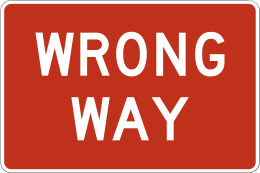
- Continue until the next exit
- Move to the left lane and speed up
- Stop and turn around immediately
- Stop only if another car appears
Show answer
Stop and turn around immediately. A Wrong Way sign warns that the vehicle is traveling against the intended direction and that a head on collision is possible. Full explanation in Test 7
Study this in the handbook: Traffic signs
33. What lane does a Washington Keep Right sign tell you to use when you are not passing?
- The far left lane
- The shoulder
- The right lane
- Any lane closed by a merge sign
Show answer
The right lane. The Keep Right sign reminds drivers to stay in the right lane unless they are passing another vehicle. Full explanation in Test 8
Study this in the handbook: Traffic signs
34. A Washington intermediate license holder gets a second traffic violation. What happens?
- The license is suspended for 6 months or until age 18, whichever comes first
- The current restrictions simply continue until 18
- The license is suspended until age 21
- Nothing happens until a third violation
Show answer
The license is suspended for 6 months or until age 18, whichever comes first. The intermediate license penalty ladder has three steps. A first violation keeps the current restrictions in place until 18. Full explanation in Test 9
Study this in the handbook: Instruction permits and the intermediate license
35. What does a One Way sign identify?
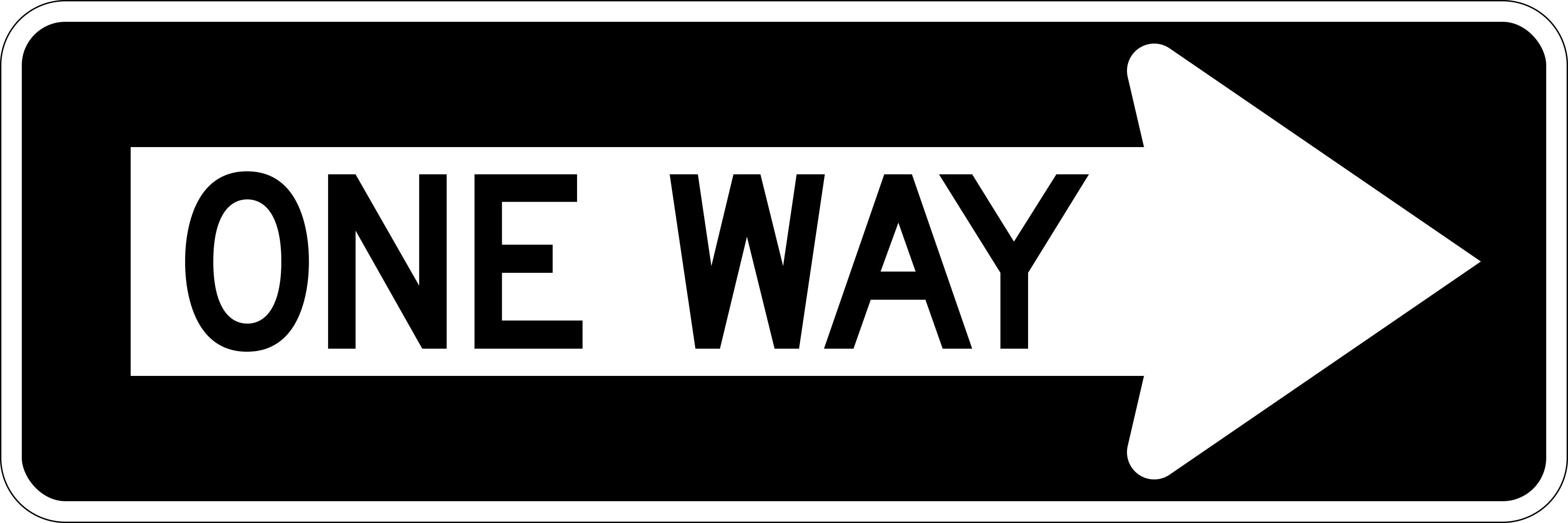
- Only buses may use the road
- Passing is required in the arrow's direction
- The road has two opposing travel lanes
- Traffic flows only in the direction of the arrow
Show answer
Traffic flows only in the direction of the arrow. A One Way sign identifies the permitted flow of traffic, which is only the direction shown by its arrow. Full explanation in Test 10
Study this in the handbook: Traffic signs
36. How should your turn signals and brake lights be used with a motorcyclist following you in Washington?
- Flash brake lights only at the last second
- Skip signaling when the road looks empty
- Signal early enough to give the rider plenty of notice time
- Use hazard lights instead of turn signals
Show answer
Signal early enough to give the rider plenty of notice time. Give motorcyclists plenty of time to notice your turn signals and brake lights. Full explanation in Test 11
Study this in the handbook: Large vehicles, motorcycles, bicycles and farm vehicles
37. Where does Washington forbid making a U-turn for visibility reasons?
- Only inside marked parking lots
- At any intersection with a stop sign
- On a curve or approaching the crest of a hill
- On straight roads with clear views both ways
Show answer
On a curve or approaching the crest of a hill. You must have clear visibility in all directions before making a U-turn. Full explanation in Test 12
Study this in the handbook: Intersections, turns and roundabouts
38. You need to stop on a busy Washington road. What should you do?
- Keep moving until you can safely pull over
- Block one lane while checking your phone
- Reverse to the last side street you passed
- Stop in the travel lane with flashers on
Show answer
Keep moving until you can safely pull over. Avoid blocking travel lanes. If you need to stop, keep moving until you can safely pull over. Full explanation in Test 13
Study this in the handbook: Large vehicles, motorcycles, bicycles and farm vehicles
39. You are taken into custody in Washington while an animal is in your vehicle. What happens to the animal?
- The animal stays alone in the vehicle until you return
- An officer can take charge of the animal, and you pay a fee to collect it from police custody
- The animal is released at the roadside for safety
- A passenger must drive the animal home at once
Show answer
An officer can take charge of the animal, and you pay a fee to collect it from police custody. If you’re taken into custody for any reason, an officer can take charge of any animal(s) in the vehicle. Full explanation in Test 14
40. Where on a Washington driver license can the holder find the expiration date?
- Across the top beside the photograph
- Inside the organ donor heart symbol
- On the back magnetic stripe only
- Near the bottom of the license
Show answer
Near the bottom of the license. The expiration date is near the bottom of the license. Full explanation in Test 15
Study this in the handbook: License exams, renewal and losing your license
