Every question below comes from the Indiana question bank on this page. Open a question to see the correct answer and the explanation. Nothing here is hidden behind a signup.
1. What must a driver do when approaching an intersection with a non-operating traffic signal?
- Continue because a dark signal grants priority
- Stop before entering and yield as required
- Yield only to vehicles approaching from the left
- Wait for a police officer before moving under any circumstance
Show answer
Stop before entering and yield as required. A non-operating signal requires the driver to stop before entering the intersection. Full explanation in Test 1
Study this in the handbook: Turns, all way stops, roundabouts and interstates
2. Where may a speed advisory sign appear?
- With a warning sign, showing an advisory speed for the condition ahead
- Only on a blue service sign at an upcoming exit
- Only below a red STOP sign
- On a brown sign marking a state park entrance
Show answer
With a warning sign, showing an advisory speed for the condition ahead. Speed advisory signs may accompany warning signs and give drivers a recommended speed for the condition ahead, such as an exit, roundabout, Full explanation in Test 2
Study this in the handbook: Warning, regulation and guidance signs
3. Two drivers stop at an all-way stop at the same time. Which driver must yield under Indiana's rule?
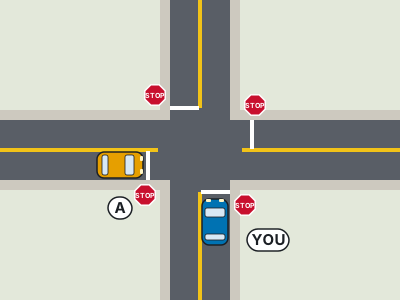
- The driver on the right yields to the driver on the left
- The driver on the left yields to the driver on the right
- The driver going straight always yields to a turning driver
- The larger vehicle automatically proceeds first
Show answer
The driver on the left yields to the driver on the right. At an all-way stop, Indiana first gives priority to the vehicle that stopped first. Full explanation in Test 3
Study this in the handbook: Turns, all way stops, roundabouts and interstates
4. For which of these reasons must the Indiana BMV suspend a juvenile's driving privileges after notice from the school?
- A single failed test
- One tardy arrival
- A second suspension from school in one school year
- Missing an after-school club
Show answer
A second suspension from school in one school year. The BMV must suspend a juvenile's driving privileges when the principal or administrator reports an expulsion or exclusion, a second or late Full explanation in Test 4
Study this in the handbook: The probationary license for drivers under 21
5. On a two-way road, what does the yellow pennant-shaped sign pictured warn drivers not to do?
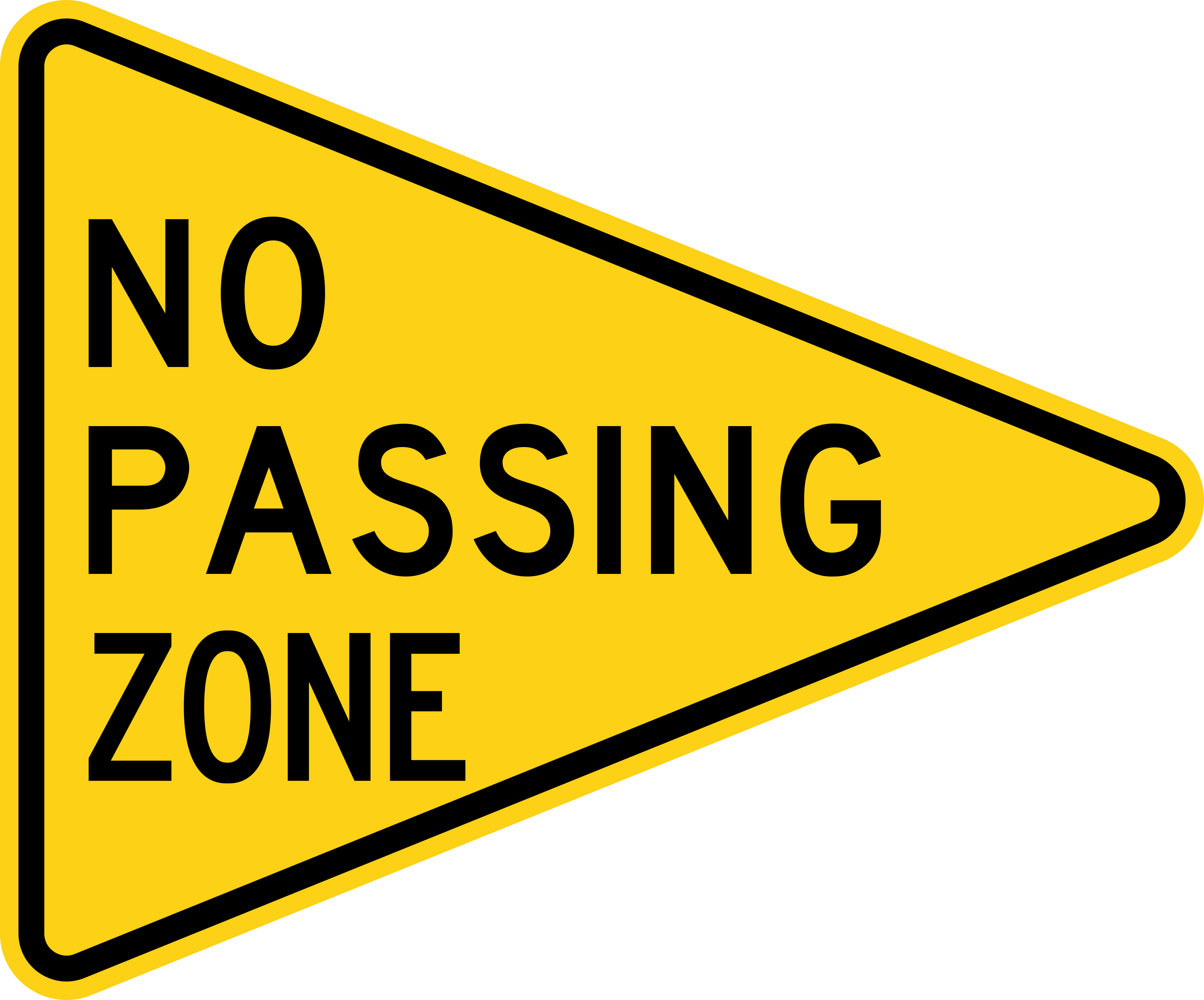
- Turn right at the next intersection
- Pass another vehicle on the left
- Stop for a school bus on the shoulder
- Enter a highway from an acceleration lane
Show answer
Pass another vehicle on the left. Indiana uses the pennant shape for a No Passing Zone warning. Full explanation in Test 5
Study this in the handbook: Traffic sign colors and shapes
6. Which vehicle is required to make a stop at a railroad crossing under Indiana's listed special-stop rule?
- A private sedan carrying only its driver
- A vehicle carrying explosives or flammable liquids
- A bicycle approaching a marked crossing
- A passenger car following a school bus at a safe distance
Show answer
A vehicle carrying explosives or flammable liquids. Indiana identifies vehicles carrying explosives or flammable liquids as one class that must always stop at railroad crossings. Full explanation in Test 6
Study this in the handbook: Railroad crossings, work zones and vehicle size limits
7. What does a steady yellow traffic light indicate?
- The green light has ended and the signal is about to turn red
- The driver has a new protected turn
- Cross traffic must stop for the next full minute
- The driver may enter regardless of the intersection's condition
Show answer
The green light has ended and the signal is about to turn red. A steady yellow light means the green phase has ended and the signal is about to turn red. Full explanation in Test 7
Study this in the handbook: Traffic signals and turning on red
8. What is the Indiana speed limit for trucks with a declared gross vehicle weight above 26,000 pounds on a rural interstate?
- 65 mph
- 55 mph
- 60 mph
- 70 mph
Show answer
65 mph. On rural interstates, trucks with a declared gross vehicle weight greater than 26,000 pounds may not exceed 65 mph or the posted limit, whil Full explanation in Test 8
Study this in the handbook: Turns, all way stops, roundabouts and interstates
9. What do blue traffic signs display?

- Warnings about a series of curves
- Rules prohibiting turns and parking
- Directions to recreational and cultural sites
- Road services and information
Show answer
Road services and information. Blue signs provide road service information, such as amenities available at an upcoming exit. Full explanation in Test 9
Study this in the handbook: Traffic sign colors and shapes
10. Unless posted otherwise, what is the speed limit in an Indiana alley?
- 10 mph
- 15 mph
- 20 mph
- 30 mph
Show answer
15 mph. In alleys, vehicles may not exceed 15 mph or the posted limit. Thirty mph is the limit in most urban residential areas. Full explanation in Test 10
Study this in the handbook: Speed limits, following distance and stopping
11. How can a driver tell whether an Indiana work site speed limit currently applies?
- Work limits apply only during daylight hours
- Work limits never apply on weekends
- Work limits apply only when workers are visible
- Some work site limits apply only when flashing and others apply at all times, so obey the posted signing
Show answer
Some work site limits apply only when flashing and others apply at all times, so obey the posted signing. Work site speed limits are at least 10 mph below the maximum established speed limit for the area. Full explanation in Test 11
Study this in the handbook: Speed limits, following distance and stopping
12. A crash happened in a rental car and the BMV asks for proof of coverage. Who files the affidavit form?
- The rental company, on the employer or rental vehicle affidavit form
- The driver, on a Certificate of Compliance
- The rental company, with no form at all
- The BMV, after a branch interview
Show answer
The rental company, on the employer or rental vehicle affidavit form. If you were operating a rental vehicle, the rental company must fill out the Affidavit - Proof of Financial Responsibility for Employer or R Full explanation in Test 12
Study this in the handbook: Points, driver safety program and insurance
13. How often does the manual say to brush snow off your headlights and taillights in winter weather?
- Once at the start of winter
- Frequently
- Only after a storm ends
- Only at night
Show answer
Frequently. The manual says to brush the snow off your headlights and taillights frequently. Full explanation in Test 13
14. An applicant brings a doctor letter after failing the branch vision screening. What may still happen?
- The letter ends all further review
- The BMV must issue the license
- Driver Ability may still require more testing
- Only an eye chart retest is allowed
Show answer
Driver Ability may still require more testing. Even with a doctor’s letter after a failed vision screening, Driver Ability may require further testing. Full explanation in Test 14
Study this in the handbook: Learner's permits, knowledge exam and skills exam
15. In a skid with conventional brakes, which way should the steering wheel turn?
- Sharply away from the slide at once
- Hard to the opposite lock and hold it
- In a controlled manner toward the direction the rear of the car is sliding
- Straight ahead with no steering at all
Show answer
In a controlled manner toward the direction the rear of the car is sliding. If traction is lost or the rear wheels slide sideways, ease off the gas. Full explanation in Test 15
Study this in the handbook: Speed limits, following distance and stopping
16. A driver is about to reach a freeway exit but a tractor-trailer travels ahead in the same lane. What should the driver avoid doing?
- Slowing down and exiting behind the tractor-trailer
- Signaling before the exit ramp
- Checking mirrors before changing lanes
- Cutting into the open space in front of the tractor-trailer
Show answer
Cutting into the open space in front of the tractor-trailer. Do not cut off a tractor-trailer to reach an exit or turn. Cutting into the space in front removes the truck driver’s safety cushion. Full explanation in Test 16
Study this in the handbook: Speed limits, following distance and stopping
17. A car is stuck on railroad tracks as a train approaches and everyone gets out. Which direction should people run?
- Straight along the tracks away from the train
- Directly across to the far side of the tracks
- At a 45-degree angle away from the tracks toward the oncoming train
- Back toward the car once the train passes
Show answer
At a 45-degree angle away from the tracks toward the oncoming train. If people are stuck at a railroad crossing with a train approaching, evacuate, tell others to evacuate, and run at a 45-degree angle away fr Full explanation in Test 17
Study this in the handbook: Railroad crossings, work zones and vehicle size limits
18. On a multi-lane highway, where do tractor-trailers usually travel to ease local traffic flow?
- The far left lane
- The shoulder
- Any lane without pattern
- The center lane
Show answer
The center lane. The manual says tractor-trailers stay in the center lane on multi-lane highways to help local traffic enter and exit. Full explanation in Test 18
Study this in the handbook: Speed limits, following distance and stopping
19. What must an Indiana resident hold and pass to obtain a motorcycle learner permit?
- A valid Indiana driver license and a knowledge exam from the Motorcycle Operator Manual
- A CDL and a road skills exam
- Only an identification card and a vision screening
- A for-hire endorsement and a medical report
Show answer
A valid Indiana driver license and a knowledge exam from the Motorcycle Operator Manual. To obtain a motorcycle learner’s permit, hold a valid Indiana driver’s license and pass a knowledge exam based on the Motorcycle Operator’s Full explanation in Test 19
20. What mark shows organ donor choice on an Indiana credential?
- A star in the upper right corner
- A red border around the photo
- A heart on the back only
- A small heart on the front
Show answer
A small heart on the front. If you choose to be an organ donor, a small heart is printed on the front of your credential. Full explanation in Test 20
21. A disabled car sits flashing hazard lights ahead. What does Indiana require of approaching drivers?
- Change lanes away; if unable to move over, slow to 10 mph below the posted limit and proceed cautiously
- Pass at full speed close by
- Stop behind it and wait
- Honk continuously while passing
Show answer
Change lanes away; if unable to move over, slow to 10 mph below the posted limit and proceed cautiously. When approaching a disabled stationary vehicle with flashing hazard signals, change lanes away from it. Full explanation in Test 21
Study this in the handbook: Move Over law, school buses and pedestrians
22. Is parking on a highway generally allowed in Indiana?
- Yes, anywhere on the shoulder
- No, unless indicated otherwise
- Yes, if you leave the hazard lights on
- Yes, but only for under an hour
Show answer
No, unless indicated otherwise. Parking on highways is prohibited unless indicated otherwise. Full explanation in Test 22
Study this in the handbook: Turns, all way stops, roundabouts and interstates
23. After parking at the curb, what must a motorist do before opening a vehicle door?
- Check first for bicyclists approaching alongside
- Open the door wide to warn traffic
- Sound the horn before opening
- Open the door only halfway each time
Show answer
Check first for bicyclists approaching alongside. After parking and before opening vehicle doors, a motorist should first check for bicyclists. Full explanation in Test 23
Study this in the handbook: Trucks, motorcycles, bicycles and horse drawn vehicles
24. An Indiana CDL holder wants to drive a cab for pay. What else is required?
- Passing the for-hire knowledge exam and getting that endorsement
- Only a new medical card
- A motorcycle endorsement
- One year of taxi experience first
Show answer
Passing the for-hire knowledge exam and getting that endorsement. An Indiana CDL holder who wants to operate for hire, such as driving a cab, must pass the for-hire knowledge exam and apply for the for-hire Full explanation in Test 24
25. How many points follow an Indiana conviction for having no brake or signal lights?
- No points, warning only
- Five points
- Two points
- Eight points
Show answer
Two points. The manual assigns two points for no brake or signal lights. Full explanation in Test 25
Study this in the handbook: Points, driver safety program and insurance
26. How far behind a disabled vehicle should a red emergency reflective triangle normally be placed on the roadside?
- Exactly 1,000 feet regardless of the road
- 50 feet in every location
- 100 feet unless the vehicle is on a divided highway
- 200 feet, or 500 feet on a hill or curve
Show answer
200 feet, or 500 feet on a hill or curve. Indiana's roadside emergency guidance places a red emergency reflective triangle 200 feet behind the disabled vehicle under ordinary conditi Full explanation in Test 1
Study this in the handbook: Accidents, collisions and roadside emergencies
27. Which category includes the Winding Road sign in Indiana's examples?

- Railroad-crossing shape signs
- Traffic regulation signs
- Traffic guidance signs
- Warning signs
Show answer
Warning signs. Winding Road is included in Indiana's group of warning-sign examples. Full explanation in Test 2
Study this in the handbook: Warning, regulation and guidance signs
28. What must an Indiana driver do when approaching an emergency vehicle with alternately flashing red or red and blue lights?
- Pass in the emergency vehicle's lane
- Stop beside the emergency vehicle
- Change lanes away from the authorized vehicle
- Turn off the headlights and continue
Show answer
Change lanes away from the authorized vehicle. Indiana requires motorists approaching an authorized emergency vehicle with the specified flashing lights to change lanes away from it. Full explanation in Test 3
Study this in the handbook: Move Over law, school buses and pedestrians
29. At what blood alcohol concentration does Indiana identify operation of a vehicle as exceeding the legal limit?
- .08
- .10
- .12
- .05
Show answer
.08. The manual identifies a BAC in excess of .08 as exceeding Indiana's legal limit for operating a vehicle while intoxicated. The .05, . Full explanation in Test 4
Study this in the handbook: Operating while intoxicated and habitual traffic violators
30. What does a red flashing traffic light at an Indiana intersection require a driver to do?
- Slow without stopping if the cross street is empty
- Treat it as a yellow signal and continue carefully
- Wait for a green arrow before moving in any direction
- Treat it as a stop sign and stop completely before proceeding with caution
Show answer
Treat it as a stop sign and stop completely before proceeding with caution. A red flashing light is equivalent to a stop sign. Full explanation in Test 5
Study this in the handbook: Traffic signals and turning on red
31. What kind of information does a green traffic sign provide?
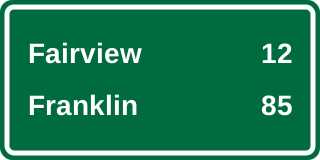
- A warning about a temporary work zone
- A warning that the pavement is slippery
- A legal requirement to stop immediately
- Permitted movements, directions, or guidance
Show answer
Permitted movements, directions, or guidance. Green signs guide a driver through permitted movements and directions, including highway entrances, exits, and distances to destinations. Full explanation in Test 6
Study this in the handbook: Traffic sign colors and shapes
32. What does a flashing arrow board that shows no direction mean in an Indiana work zone?
- Stop immediately
- Use caution, but no lane change is required
- The work zone is closed
- Move to the left lane
Show answer
Use caution, but no lane change is required. Flashing arrow boards are often used to indicate a lane closure or crossover, with lane markings, cones, barrels or barricades outlining the Full explanation in Test 7
Study this in the handbook: Railroad crossings, work zones and vehicle size limits
33. An Indiana driver has nine speeding tickets and one reckless driving conviction within 10 years. What happens?
- Nothing, speeding tickets do not count
- A five-year HTV suspension
- A 10-year HTV suspension
- A lifetime suspension
Show answer
A five-year HTV suspension. Section C of the Habitual Traffic Violator law covers 10 or more traffic violations in 10 years when one is a major offense, and it brings a Full explanation in Test 8
Study this in the handbook: Operating while intoxicated and habitual traffic violators
34. A driver who receives an Indiana license before turning 21 keeps what license status until reaching that age?
- Probationary
- Commercial
- Learner's permit
- Unrestricted adult
Show answer
Probationary. An Indiana license issued to someone younger than 21 remains probationary until the holder turns 21. Full explanation in Test 9
Study this in the handbook: The probationary license for drivers under 21
35. How many points does Indiana assess for a hand-held device violation?
- 1 point
- 2 points
- 4 points
- 8 points
Show answer
4 points. A violation for a hand-held device carries 4 points in Indiana, the same as unsafe lane movement and disregarding a stop or yield sign. Full explanation in Test 10
Study this in the handbook: Points, driver safety program and insurance
36. Which of these may serve as evidence of Indiana residency when you apply for a credential?
- Owning a car titled in Indiana
- Holding a job with an Indiana employer
- Renting a mailbox in Indiana
- Being a registered voter in Indiana
Show answer
Being a registered voter in Indiana. Being a registered voter in Indiana is listed as evidence of Indiana residency. Full explanation in Test 11
Study this in the handbook: Learner's permits, knowledge exam and skills exam
37. If a crash cannot be avoided, what sort of object should a driver aim for?
- A concrete barrier head on
- A stopped truck from behind
- A tree at full speed
- Something that gives way, like brush or shrubs, rather than something hard
Show answer
Something that gives way, like brush or shrubs, rather than something hard. Choose to hit something that will give way, such as brush or shrubs, rather than something hard. Full explanation in Test 12
Study this in the handbook: Accidents, collisions and roadside emergencies
38. Facing a green light with no arrow, how many vehicles at a time may move into an intersection to turn left?
- Two vehicles at a time
- Three vehicles at a time
- Only one vehicle at a time
- As many as fit inside the intersection
Show answer
Only one vehicle at a time. At a green light without an arrow, you may turn when the intersection is clear and must yield to oncoming traffic. Full explanation in Test 13
Study this in the handbook: Traffic signals and turning on red
39. Why does the BMV process every credential application through intensive security checks?
- To shorten the knowledge exam
- To raise the renewal fee
- To help prevent identity theft and fraud
- To limit applicants to one branch visit
Show answer
To help prevent identity theft and fraud. The manual says all credential applications are processed through intensive security checks to help prevent identity theft and fraud. Full explanation in Test 14
40. Restriction 7 appears on an Indiana credential. What does that code mark?
- A medical condition notation
- Lawful temporary resident status
- Seat Belt Exempt status
- HTV Conditional status
Show answer
Seat Belt Exempt status. Restriction 7 marks Seat Belt Exempt status on the credential. Full explanation in Test 15
