
Test 9 of 25 · 20 questions · Free 2026
NY Permit Practice Test 9
Jump to the test ↓A fixed 20 question set from the New York bank with answers and plain English explanations. The real NY exam is 20 questions, 70 percent to pass; take the full length version on the main practice page.
Question 1 of 20 · 0 right so far
All 20 questions in test 9
Every question below comes from the New York question bank on this page. Open a question to see the correct answer and the explanation. Nothing here is hidden behind a signup.
1. Is a New York driver at a YIELD sign ever required to come to a full stop?
- No, a YIELD sign only requires slowing down
- Only when a police officer is present
- Yes, when traffic conditions require it
- Only between sunset and sunrise
Show answer
Yes, when traffic conditions require it. A YIELD sign tells you to decrease speed and prepare to stop, but the New York manual adds that you must come to a full stop at a YIELD sign if traffic conditions require it. If vehicles or pedestrians in or heading toward the intersection leave you no safe gap, you stop and wait until they pass. As you approach, check carefully for traffic and be ready to stop, rather than assuming the sign lets you roll through.
Study this in the handbook: Sign shapes and colors
2. What technology may New York school districts and municipalities use on school buses to identify passing vehicles?
- Automatic speed governors
- License-plate stickers
- Interior passenger cameras
- Stop-arm cameras
Show answer
Stop-arm cameras. New York law authorizes school districts and municipalities to use stop-arm cameras on school buses. These cameras document vehicles that pass while the bus is stopped to load or unload passengers and its red lights are flashing. A speed governor changes how fast a vehicle can travel, while a sticker does not record a violation. An interior passenger camera would monitor the bus cabin rather than the roadway beside the stop arm. Keep the equipment and purpose connected: stop-arm cameras observe passing traffic near a stopped school bus.
Study this in the handbook: Points, suspensions and probation
3. A New York driver under 21 is found at a DMV hearing to have violated the Zero Tolerance law. What must be paid to get the license back after the six-month suspension?
- A $100 suspension termination fee and a $125 civil penalty
- A $50 termination fee only
- A $500 civil penalty
- Nothing; the license returns automatically
Show answer
A $100 suspension termination fee and a $125 civil penalty. Under New York's Zero Tolerance law, a driver under 21 with a measurable BAC of .02 to .07 loses the license for six months after a DMV hearing finding. To be relicensed, the driver pays a $100 suspension termination fee plus a $125 civil penalty. The ordinary $50 termination fee is for other fixed-period suspensions. The $500 civil penalty goes with a chemical test refusal revocation. Nothing about Zero Tolerance reinstatement is automatic.
Study this in the handbook: Alcohol, drugs and DWI
4. How does motorcycle size affect perception?
- Closer and slower than reality
- Farther away with hard-to-judge speed and distance
- Exactly as they appear
- Invisible always
Show answer
Farther away with hard-to-judge speed and distance. Small size deceives distance: motorcycles seem much farther away than reality, making speed and distance hard to judge. Closer-slower, exact, and invisible readings each misjudge the perceptual trap. Small profiles also move within lanes and blend at intersections. Look twice and measure gaps generously. Look twice for bikes and measure gaps very generously. Small profiles blend at intersections and move within lanes.
Study this in the handbook: Pedestrians, bicycles, motorcycles and trucks
5. What does a green arrow over a lane mean?
- You may use that lane
- The lane is closed
- Left turns only
- Stop immediately
Show answer
You may use that lane. Lane-use green arrows open lanes: the arrow means drivers can use that lane. Closed, left-only, and stop readings each belong to red X, flashing yellow X, and emergency commands. Lane controls adapt highways to rush directions and incidents. Follow the signal above each lane, not habit. Follow the signal above each lane, not habit or memory. Lane controls adapt highways to rush directions and incidents.
Study this in the handbook: Sign shapes and colors
6. May you drive on the shoulder to pass?
- Use it freely
- Use it when traffic is slow
- Never drive on shoulders or edge lines unless signed or officer-directed
- Use it to pass
Show answer
Never drive on shoulders or edge lines unless signed or officer-directed. Shoulders are not lanes: drivers cannot travel on or across the shoulder or edge line unless a sign allows it or a traffic officer indicates it. Freely, slow-traffic, and passing readings each claim pavement reserved for emergencies and directed use. Shoulders hide debris, pedestrians, and stopped vehicles. Stay inside the edge line until authority moves you out. Stay inside the edge line until a sign or officer moves you out.
Study this in the handbook: Passing on the left and the right
7. What lights do volunteer responders display?
- Red lights for all
- Green for firefighters, blue for ambulance
- Blue for volunteer firefighters, green for volunteer ambulance or rescue
- Amber for all
Show answer
Blue for volunteer firefighters, green for volunteer ambulance or rescue. Volunteer colors split by service: responding volunteer firefighters may display blue lights while volunteer ambulance or rescue members display green. Red-all, swapped, and amber-all readings each scramble the code other drivers read. Neither color makes an authorized emergency vehicle; courtesy yielding stays optional but wise. Learn the colors and give volunteers room. Learn the colors well and always give volunteers plenty of room.
Study this in the handbook: Right of way, turns and U-turns
8. What information does a yellow diamond-shaped New York traffic sign normally provide?
- A warning about conditions or hazards ahead
- A destination name and distance
- A motorist service location
- A mandatory parking restriction
Show answer
A warning about conditions or hazards ahead. Yellow diamond-shaped signs are warning signs that alert drivers to special hazards or changing road conditions ahead. A parking restriction is normally regulatory, a destination sign is green, and a service sign is blue. The warning does not by itself set a new speed limit, but it tells the driver to become more attentive and adjust speed for the condition shown. Use the diamond as an early cue to look farther ahead and prepare for the roadway feature.
Study this in the handbook: Sign shapes and colors
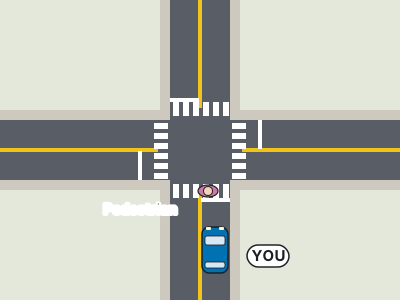
9. At a New York crosswalk without a traffic signal, what must an approaching driver do when a pedestrian is crossing?
- Sound the horn so the pedestrian clears the lane
- Continue because vehicles always have priority without a signal
- Yield and stop when necessary for the pedestrian
- Pass another stopped vehicle before reaching the crossing
Show answer
Yield and stop when necessary for the pedestrian. New York requires every driver approaching an intersection or crosswalk to yield to a pedestrian in the crosswalk or when danger to the pedestrian is present. A missing signal does not cancel that protection. Honking is not a substitute for yielding, and passing a stopped vehicle can conceal someone crossing. The concrete cue is the crosswalk boundary: slow early, stop well back, and leave sight lines open for other drivers.
Study this in the handbook: Pedestrians, bicycles, motorcycles and trucks
10. What causes four of every ten crashes?
- Head-on collisions
- Rollovers
- Side impacts
- Rear-end collisions from tailgating
Show answer
Rear-end collisions from tailgating. The most common crash has the simplest cause: four of every ten crashes are rear-end collisions, normally because someone follows too closely. Head-ons, rollovers, and side impacts each trail the tailgating crash in frequency. The two-second space cushion exists precisely to break this pattern, giving the follower room to stop when the leader brakes suddenly. Leave the gap, brake early and gently, and the commonest crash becomes the most avoidable.
Study this in the handbook: Speed limits, space cushion and work zones
11. Which form applies for disability plates or permits?
- MV-104
- MV-664.1 Instructions and Application
- No form exists
- A phone call
Show answer
MV-664.1 Instructions and Application. One form serves both credentials: use the Instructions and Application for a Parking Permit or License Plates for People with Severe Disabilities, form MV-664.1. Crash-report, no-form, and phone-call readings each misroute applicants away from the official channel. Complete it truthfully, with proper medical certification where required. False statements on it trigger the fraud penalties described nearby, whether criminal or civil in nature.
Study this in the handbook: Parallel parking and where you cannot park
12. What should you do on an expressway exit ramp?
- Decrease speed for the often-lower ramp limit
- Maintain expressway speed
- Accelerate through the ramp
- Stop on the ramp
Show answer
Decrease speed for the often-lower ramp limit. Exits reverse the entrance bargain: on the exit ramp, decrease speed, because ramps often carry lower limits than the expressway. Maintaining, accelerating, and ramp-stopping each misread geometry built for thirty where you ran sixty-five. Signal the exit early, glide into the deceleration lane, and bleed speed before the curve tightens. The ramp limit, not the expressway limit, governs the moment tires leave the mainline.
Study this in the handbook: Railroad crossings, expressways, night and bad weather
13. After a New York crash, what should occupants do if downed wires touch the vehicle or lie nearby?
- Exit on the side closest to the wires
- Move the wires away before leaving
- Remain inside and wait for help
- Push the vehicle clear of the wires
Show answer
Remain inside and wait for help. Downed electrical wires create a danger that can extend beyond the visible cable. If wires touch the vehicle or are lying near it, occupants should stay inside and warn one another not to approach until responders arrive. Exiting can expose a person to energized metal or ground current. The choice to move the wires is especially unsafe because a driver cannot know whether the line is live. Treat the vehicle as a shelter, call for assistance, and wait for trained personnel.
Study this in the handbook: What to do after a crash
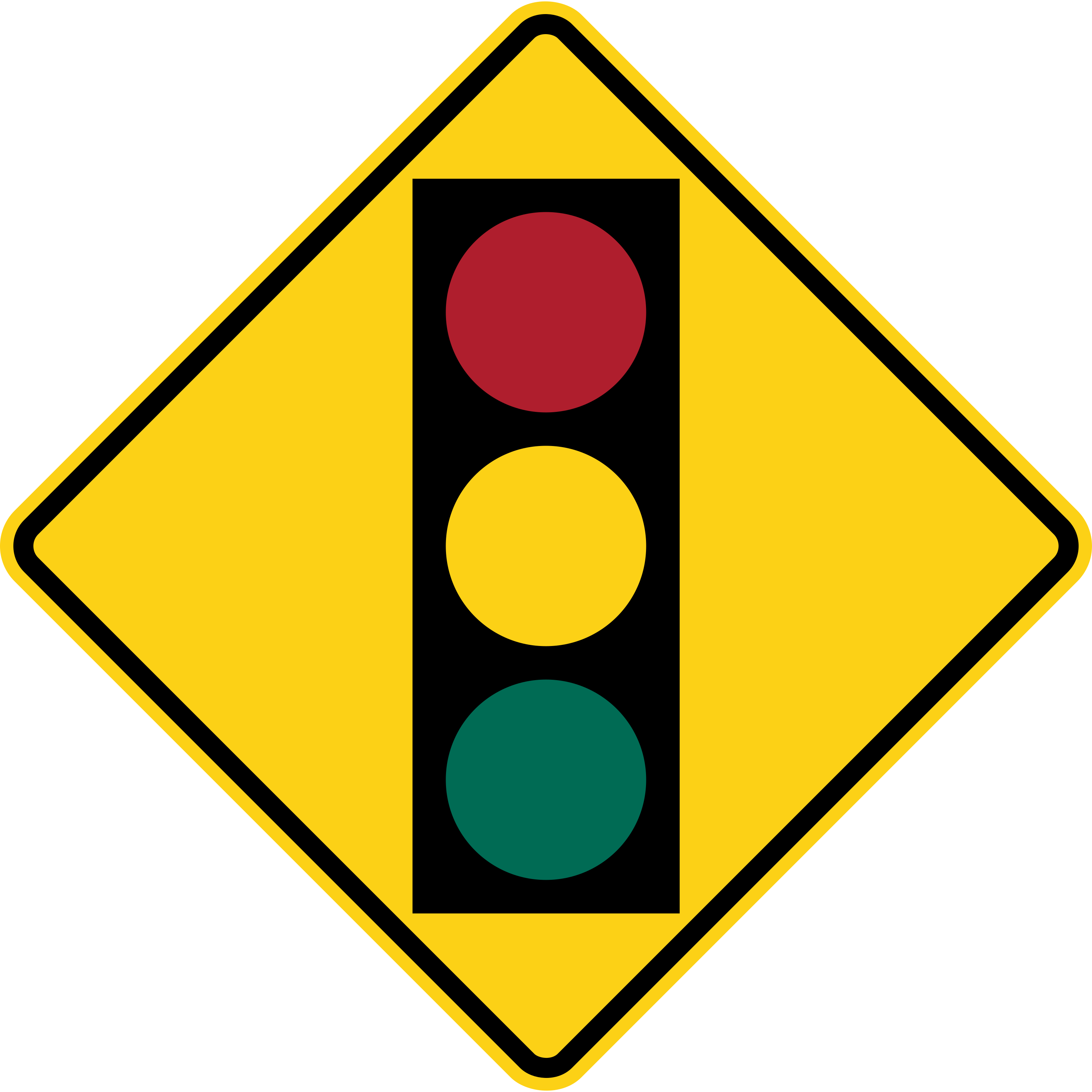
14. What should a driver anticipate after seeing the yellow traffic-signal symbol?
- A traffic signal ahead
- A streetlight outage
- A police checkpoint
- A railroad gate inspection
Show answer
A traffic signal ahead. The yellow diamond with a traffic-light symbol warns that a signalized intersection is ahead. A driver should ease off the accelerator, check lane position, and be ready for a red, yellow, or green indication. The sign does not report broken streetlights, announce a police checkpoint, or identify railroad equipment. Advance warning is especially useful when the signal is difficult to see from a distance or lies beyond a curve. The miniature signal on the yellow diamond is the recognition cue.
Study this in the handbook: Road signs you must know
15. How often must registration be renewed?
- Every ten years
- Every two years with a mailed reminder 45-60 days prior
- Never expires
- Every month
Show answer
Every two years with a mailed reminder 45-60 days prior. Registrations renew biennially: most expire every two years, with renewal reminders mailed forty-five to sixty days beforehand. Decennial, never, and monthly readings each misstate the cycle. Address changes filed late forfeit the reminder. Renew on time and keep the sticker fresh. Address changes filed late forfeit the mailed reminder notice. Renew registration on time and keep the sticker fresh. Late renewals risk tickets and tow.
16. Should you dim for pedestrians?
- Blind them with high beams
- Dim your lights for approaching pedestrians
- Speed past
- Honk continuously
Show answer
Dim your lights for approaching pedestrians. Walkers deserve dimmed lights too: drivers should dim for pedestrians who approach. High-beam, speed-past, and honk readings each blast vulnerable road users with glare and noise. Headlights that reveal the road can blind the walker beside it. Dip for feet as for wheels. Headlights that reveal roads can blind walkers beside them. Dip headlights for feet on the roadside as for wheels.
Study this in the handbook: Railroad crossings, expressways, night and bad weather
17. How should offset intersections affect stopping?
- Watch offset streets to avoid blocking them
- Block freely
- Ignore side streets
- Speed through gaps
Show answer
Watch offset streets to avoid blocking them. Gridlock has cousins: stay alert to cross-streets and offset intersections so the car never blocks another street. Block-freely, ignore, and speed readings each spread one intersection's jam into its neighbors. Offset geometry hides the second street until the car sits across it. Stop short, confirm clear passage fully through, then proceed. Stop short and confirm clear passage fully through before proceeding.
Study this in the handbook: Right of way, turns and U-turns
18. Does alcohol affect self-awareness of impairment?
- Sharpens self-awareness
- Dulls awareness of declining abilities
- Improves judgment
- Has no mental effect
Show answer
Dulls awareness of declining abilities. Alcohol hides its own damage: while physically limiting driving ability, it also makes drivers less aware of what is happening to their skills. Sharpens, improves, and no-effect readings each trust a self-monitor the drug disables. Judging one's own condition grows difficult exactly when it matters most. The drunker the driver, the better they feel about driving. The drunker the driver feels, the better they feel about driving.
Study this in the handbook: Alcohol, drugs and DWI
19. Outside New York City, when may a New York driver turn left on red?
- From any street onto a one-way street after slowing
- From a two-way street onto a one-way street when no cars approach
- Only outside New York City during nighttime hours
- From one one-way street onto another one-way street, after stopping and yielding
Show answer
From one one-way street onto another one-way street, after stopping and yielding. Outside New York City, a driver may turn left on red only from a one-way road onto another one-way road. The driver must first come to a full stop and yield to oncoming traffic and pedestrians, and a sign or marking can still prohibit the movement. New York City has a stricter rule: a red turn is not allowed unless a sign specifically permits it. The useful memory cue is one-way to one-way, with the city exception checked before applying the statewide rule.
Study this in the handbook: Sign shapes and colors
20. Are parallel-parking instructions one-size-fits-all?
- Yes, identical everywhere
- They are general and must be adjusted to each situation
- Only for small cars
- Only for tests
Show answer
They are general and must be adjusted to each situation. Printed steps are starting points, not scripts: the instructions are general, and drivers must adjust parallel-parking procedures to the particular situation. Identical-everywhere, small-only, and test-only readings each deny the adaptation that slopes, tight spaces, and traffic demand. Angles, gaps, and reference points all shift with context. Learn the pattern, then fit it to the street at hand every single time.
Study this in the handbook: Parallel parking and where you cannot park
QualitySpace is expanding to New York
We are a California-based independent insurance brokerage working on licensing in more states. We cannot help with New York insurance yet. Leave your email and we will let you know when we can.
Every question is written from the official New York State Driver's Manual. Need paper? Printable NY practice test with answer key.
Last verified 2026-10-05. How we check every question · Study all 500 as flashcards
Frequently asked questions
How many questions are on this New York practice test?
This fixed set has 20 questions. It is test 9 of 25 from the 500 question New York bank. The real NY exam asks 20 questions and you need 14 correct.
What is the passing score for the real New York test?
You must correctly answer at least 14 of the 20 questions asked, including two of the four questions about road signs That figure comes from the official New York source cited on the DMV facts page.
How does this fixed test relate to the full New York bank?
Each numbered test is a fixed set of questions in a fixed order, so you can retake the same test later and compare. Every test mixes road signs and the other topics in about the same proportion as the full bank. Tests 1 to 25 together cover every question in the New York bank once. The full practice page mixes the whole bank at random.
Last verified 2026-10-05. See the New York DMV facts page for sourced state details.
Return to the full New York practice test · Study road signs