
Test 4 of 25 · 20 questions · Free 2026
NY Permit Practice Test 4
Jump to the test ↓A fixed 20 question set from the New York bank with answers and plain English explanations. The real NY exam is 20 questions, 70 percent to pass; take the full length version on the main practice page.
Question 1 of 20 · 0 right so far
All 20 questions in test 4
Every question below comes from the New York question bank on this page. Open a question to see the correct answer and the explanation. Nothing here is hidden behind a signup.
1. What happens when you drive below a minimum speed limit?
- It improves traffic flow
- It is always safest
- It can halt traffic flow and create danger
- It saves fuel for all
Show answer
It can halt traffic flow and create danger. Minimum limits exist to keep traffic moving: driving slower than the posted minimum can halt the traffic flow and create a dangerous condition. Improvement, always-safest, and fuel-saving readings miss the hazard that slow outliers inject into fast streams. Speed differences, not speed alone, cause many conflicts, which is why some highways post floors as well as ceilings. Match the minimum at least, keep right when slower, and never crawl where traffic runs.
Study this in the handbook: Speed limits, space cushion and work zones
2. How many points for over 40 above the limit?
- 11 points
- 8 points
- 6 points
- 5 points
Show answer
11 points. Extreme speeding maxes the table: more than forty over the posted limit draws eleven license points, alone enough to suspend within eighteen months. Eight, six, and five readings belong to lower bands (thirty-one-to-forty, twenty-one-to-thirty, and reckless driving). Work-zone speeding also draws eight, and most alcohol convictions eleven. Forty-plus over is license-ending speed, often paired with reckless-driving charges and major fines on top of the suspension.
Study this in the handbook: Points, suspensions and probation
3. What may responding emergency vehicles legally do?
- They must obey every traffic law
- They may legally exceed limits, pass reds, and go wrong-way
- They may ignore pedestrians
- They may drive blindfolded
Show answer
They may legally exceed limits, pass reds, and go wrong-way. Working responders hold legal exemptions: with lights and siren or air-horn, they may exceed speed limits, pass red lights and STOP or YIELD signs, go wrong-way on one-ways, and turn abnormally. Obey-everything readings deny the exemptions; ignore-pedestrians and blindfolded readings invent ones no law grants, since careful driving is still required. Expect the unpredictable and give them the whole road.
Study this in the handbook: Right of way, turns and U-turns
4. How dangerous is combining alcohol with other drugs?
- Improves driving
- Has mild effects
- Severely impairs driving and can kill
- Is perfectly safe
Show answer
Severely impairs driving and can kill. Combinations can be lethal: alcohol plus other drugs severely reduces driving ability and can cause serious health problems including death. Improves, mild, and safe readings each trivialize chemistry that kills drivers outright. Impairment multiplies beyond either substance alone. Never combine, never drive combined. Never combine substances, and never drive after combining them. Impairment multiplies far beyond either substance taken all alone.
Study this in the handbook: Alcohol, drugs and DWI
5. From which part of the road may a New York driver make a U-turn?
- Only from the left portion of the lane nearest the centerline, never from the right lane
- From the shoulder
- From any lane after signaling
- From the right lane when it is clear
Show answer
Only from the left portion of the lane nearest the centerline, never from the right lane. The manual allows a U-turn only from the left portion of the lane nearest to the centerline of the roadway, never from the right lane. Starting from the right lane or the shoulder would cut across other traffic during the turn. Where turning around is necessary, the manual prefers using a parking lot or driveway and re-entering the road moving forward. Signs, school zones, curves and hills add further U-turn restrictions.
Study this in the handbook: Right of way, turns and U-turns
6. Why are some stop lines set back from intersections?
- To decorate intersections
- To hold room for large turning vehicles
- To mark parking
- To time lights
Show answer
To hold room for large turning vehicles. Lone stop lines shelter big rigs: single lines placed back from intersections leave room for tractor-trailers, buses, and trucks to turn without forcing others to back up. Decorate, parking, and timing readings each miss the turning-room purpose. Stopping past them blocks the swing. Honor the setback and let giants turn. Honor the setback line and let turning giants pass safely.
Study this in the handbook: Sign shapes and colors
7. For how long must a New York junior driver's permit remain valid before the road test?
- At least 30 days
- At least three months
- At least one year
- At least six months
Show answer
At least six months. A junior driver's permit must be held in valid status for a minimum of six months before the applicant can take the road test. Thirty days and three months fall short of the stated holding period. One year is longer than the manual's minimum and therefore is not required merely to become eligible for the test. This is a permit-stage requirement, separate from the supervised practice hours that must also be documented. Keep the timeline cue simple: six valid months before the junior road test.
Study this in the handbook: Learner permits, junior licenses and the written test
8. Where should you look while backing up?
- Through the rear window, not the mirrors
- Only in the mirrors
- With eyes closed
- Through the sunroof
Show answer
Through the rear window, not the mirrors. Backing vision goes direct: look through the rear window, not the mirrors, while reversing into the space. Mirrors-only, closed-eyes, and sunroof readings each surrender the wide true view the glass provides. Mirrors compress and crop, hiding low obstacles and close bumpers. Turn the body, look through the glass, and supplement with side and front glances for the nose. Direct glass beats glass reflections for judging tight clearances.
Study this in the handbook: Parallel parking and where you cannot park
9. What should you do if you stall on railroad tracks?
- Stay belted and wait
- Get everyone out and away from the tracks
- Push the car alone
- Call a friend first
Show answer
Get everyone out and away from the tracks. Stalled on tracks means evacuate: get out, including everyone in the car from babies to elderly passengers, and get away from the tracks even with no train in sight. Stay-belted, solo-push, and call-first readings each waste the seconds that save lives. Then find the Emergency Notification System sign and call its number. People first, phone second, vehicle last. People first, phone second, and the vehicle always last of all.
Study this in the handbook: Railroad crossings, expressways, night and bad weather
10. Do traffic laws apply in public parking lots?
- No, lots are lawless
- Only on weekdays
- Yes, public-road laws also apply there
- Only with police present
Show answer
Yes, public-road laws also apply there. Lots open to the public carry the road's rulebook: traffic laws obeyed on public highways, roads, and streets also apply in parking lots open to the public. Lawless, weekdays-only, and police-only readings each invent enforcement gaps the rule closes. Signs, signals, and right-of-way all bind between the painted lines. Drive the lot like the street it legally is, signs and all.
Study this in the handbook: Points, suspensions and probation
11. What should you do in a front-wheel skid?
- Steer hard immediately
- Ease off gas, shift to neutral or clutch in, and delay steering
- Brake hard
- Accelerate through
Show answer
Ease off gas, shift to neutral or clutch in, and delay steering. Front skids need unloading first: take the foot off the gas, shift to neutral or push in the clutch, and do not immediately try to steer. Hard-steer, hard-brake, and accelerate readings each demand grip the sliding front tires lack. As sideways wheels slow the car, traction returns for gentle steering. Wait for grip, then guide the recovery. Wait for grip to return, then guide the recovery with gentle steering.
Study this in the handbook: Railroad crossings, expressways, night and bad weather
12. Two vehicles enter an uncontrolled New York intersection at the same time. Which driver must yield?
- The driver on the right yields to the driver on the left
- The vehicle with more passengers yields
- Both drivers proceed together after sounding their horns
- The driver on the left yields to the driver on the right
Show answer
The driver on the left yields to the driver on the right. At an intersection not controlled by signs or signals, or where two drivers at right angles stop at stop signs at the same time, New York gives priority to the vehicle on the right. The driver on the left must wait and let that vehicle go first. The number of passengers does not matter, and sounding a horn does not create any right of way. The practical cue is to compare positions before moving: if the other vehicle is on your right, yield and let it clear the intersection first.
Study this in the handbook: Right of way, turns and U-turns
13. A New York driver carries a 12-year-old passenger who is not buckled. What penalty can the driver receive?
- A fine up to $50 with no points
- No penalty, since the passenger is responsible
- A 60-day suspension
- A fine of $25 to $100 and three points
Show answer
A fine of $25 to $100 and three points. In New York the driver is responsible for making sure every passenger under 16 is restrained by a seat belt or an appropriate child restraint. Each violation can cost the driver $25 to $100 plus three points on the license. The up to $50 fine applies to a driver who fails to buckle up, or to a passenger 16 or older who does not, which is why it is a tempting answer. A 12-year-old is not the one ticketed, and the penalty is not a suspension.
Study this in the handbook: Speed limits, space cushion and work zones
14. What is the minimum license revocation for aggravated DWI in New York, which involves a .18 BAC?
- One year
- 90 days
- Six months
- Two years
Show answer
One year. Aggravated driving while intoxicated, Agg-DWI, is charged at .18 of one percent blood alcohol content and carries a minimum one-year revocation. Ordinary DWI at .08 BAC carries a minimum six-month revocation, and driving while ability impaired by alcohol carries a 90 day suspension for a first offense. Two years is not the Agg-DWI minimum. Courts must also order an ignition interlock for DWI and Agg-DWI convictions under Leandra's Law.
Study this in the handbook: Points, suspensions and probation
15. When may a driver pass another vehicle on the right?
- Only in certain circumstances, when necessary and safe
- Whenever the shoulder is wider than the travel lane
- Whenever the driver wants to avoid a solid yellow line
- Whenever traffic behind the vehicle is moving faster
Show answer
Only in certain circumstances, when necessary and safe. New York allows passing on the right only in certain circumstances, and the maneuver must be necessary and safe. A wide shoulder does not automatically become a passing lane, and avoiding a solid yellow line is not a free pass to use the right side. Faster traffic behind you also creates no permission to overtake there. Check the roadway, the vehicle being passed, pedestrians, and vehicles entering from the right before considering the maneuver. If necessity or safety is uncertain, remain behind the vehicle.
Study this in the handbook: Passing on the left and the right
16. What does a diamond symbol painted in a New York traffic lane indicate?
- A lane where parking is required during rush hour
- A warning that the pavement is slippery
- A reserved lane for buses, high-occupancy vehicles, bicycles, or another special use
- A lane that must be used only by emergency vehicles
Show answer
A reserved lane for buses, high-occupancy vehicles, bicycles, or another special use. The diamond symbol marks a lane reserved for a special category of road user, such as buses, high-occupancy vehicles, or bicycles. It does not announce a slippery surface, a parking requirement, or an emergency-only lane. Before crossing or entering that marked space, check signs and the lane boundaries, then yield to users already traveling there. The visual cue is the diamond painted inside the lane, which signals restricted use rather than a general travel lane.
Study this in the handbook: Sign shapes and colors
17. What colors is a YIELD sign?
- Green and white
- Red and white with red letters
- Blue and white
- Orange and black
Show answer
Red and white with red letters. Yield signs pair red and white: the inverted triangle shows red and white with red letters. Green, blue, and orange readings each borrow destination, service, or work-zone palettes. Shape plus colors announce the yield duty instantly. See the triangle, prepare to give way. See the yield triangle, and prepare to give way there. Shape plus colors announce the yield duty quite instantly.
Study this in the handbook: Sign shapes and colors
18. What counts as a driving distraction?
- Only phones
- Only food
- Only passengers
- Anything taking attention from driving
Show answer
Anything taking attention from driving. Distraction is anything diverting: anything taking attention from driving qualifies, from phones to food to scenery. Phones-only, food-only, and passengers-only readings each narrow a universal definition. Distracted crashes bring injury, death, and property damage. Eyes on road, hands on wheel, mind on traffic. Eyes on road, hands on wheel, mind on traffic always. Distracted crashes bring injury, death, and property damage.
Study this in the handbook: Speed limits, space cushion and work zones
19. What does this yellow New York warning sign, with the right line curving in toward the left line, tell a driver?

- The right lane ends ahead, so stay to the left
- The right lane becomes a parking lane
- The shoulder becomes a separate highway
- A new lane begins on the right
Show answer
The right lane ends ahead, so stay to the left. New York lists this sign as Right Lane Ends, Stay to the Left. It shows one straight line on the left and a right line that curves in toward it, picturing the right lane closing. If you are in the right lane, check your mirrors, signal, and merge left when it is safe rather than waiting for the lane to run out. The sign does not create a parking lane, turn the shoulder into a highway, or announce a new lane. The curving right line is the cue that space is shrinking.
Study this in the handbook: Road signs you must know
20. This red octagonal sign is ahead. What must the driver do?
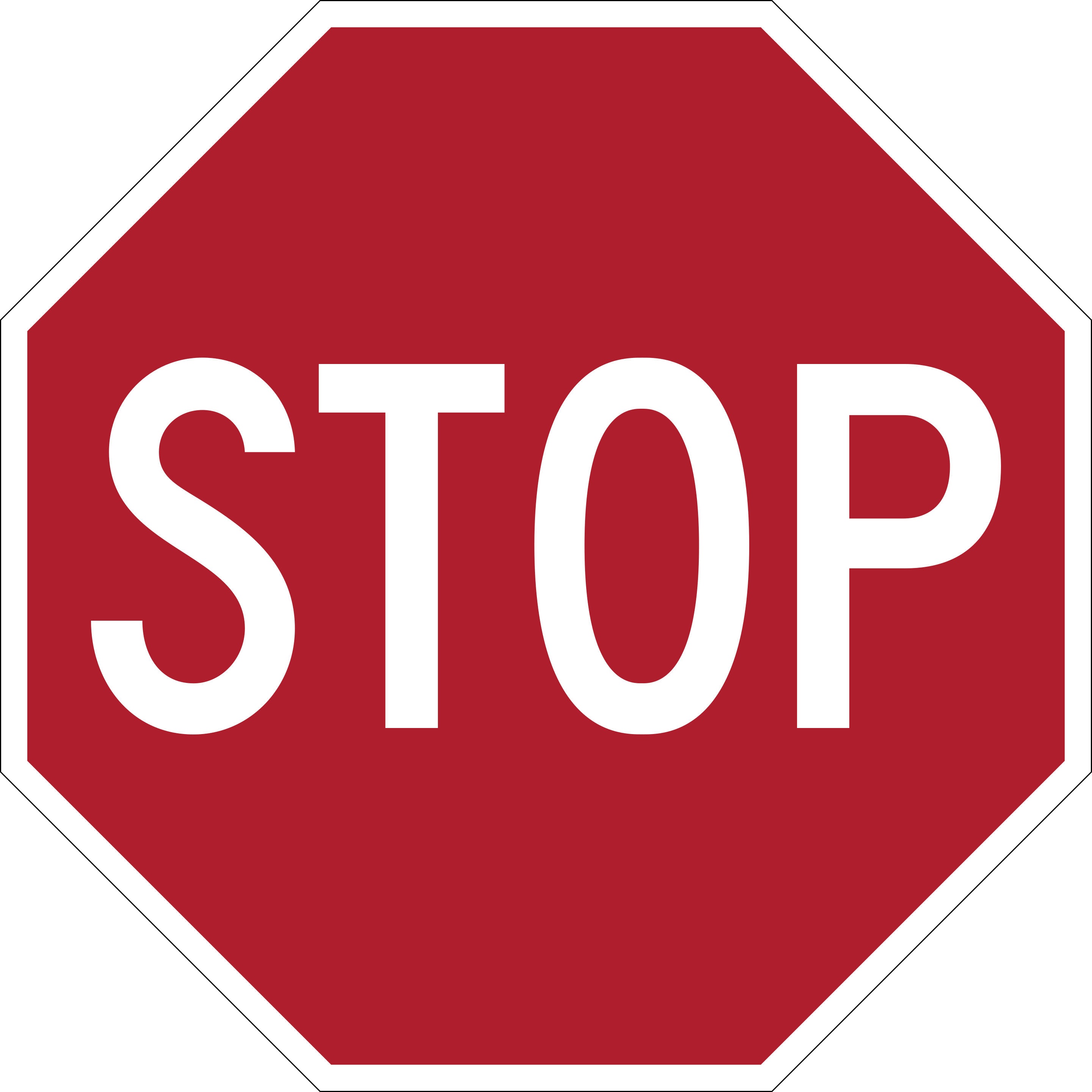
- Slow down and continue if the lane looks empty
- Stop only if a pedestrian is visible
- Come to a complete stop, yield, and go when safe
- Yield without stopping unless cross traffic is close
Show answer
Come to a complete stop, yield, and go when safe. A red octagon is the STOP sign, which requires a full stop before the stop line, crosswalk, or intersection as applicable. An empty-looking lane does not remove the stopping requirement. The pedestrian-only choice is too narrow because the driver must also yield to vehicles in or approaching the intersection. After stopping, scan for traffic and pedestrians, yield as required, and proceed only when the movement is safe. The octagonal shape is the immediate visual cue that a complete stop comes first.
Study this in the handbook: Sign shapes and colors
QualitySpace is expanding to New York
We are a California-based independent insurance brokerage working on licensing in more states. We cannot help with New York insurance yet. Leave your email and we will let you know when we can.
Every question is written from the official New York State Driver's Manual. Need paper? Printable NY practice test with answer key.
Last verified 2026-10-05. How we check every question · Study all 500 as flashcards
Frequently asked questions
How many questions are on this New York practice test?
This fixed set has 20 questions. It is test 4 of 25 from the 500 question New York bank. The real NY exam asks 20 questions and you need 14 correct.
What is the passing score for the real New York test?
You must correctly answer at least 14 of the 20 questions asked, including two of the four questions about road signs That figure comes from the official New York source cited on the DMV facts page.
How does this fixed test relate to the full New York bank?
Each numbered test is a fixed set of questions in a fixed order, so you can retake the same test later and compare. Every test mixes road signs and the other topics in about the same proportion as the full bank. Tests 1 to 25 together cover every question in the New York bank once. The full practice page mixes the whole bank at random.
Last verified 2026-10-05. See the New York DMV facts page for sourced state details.
Return to the full New York practice test · Study road signs