
Test 15 of 25 · 20 questions · Free 2026
NY Permit Practice Test 15
Jump to the test ↓A fixed 20 question set from the New York bank with answers and plain English explanations. The real NY exam is 20 questions, 70 percent to pass; take the full length version on the main practice page.
Question 1 of 20 · 0 right so far
All 20 questions in test 15
Every question below comes from the New York question bank on this page. Open a question to see the correct answer and the explanation. Nothing here is hidden behind a signup.
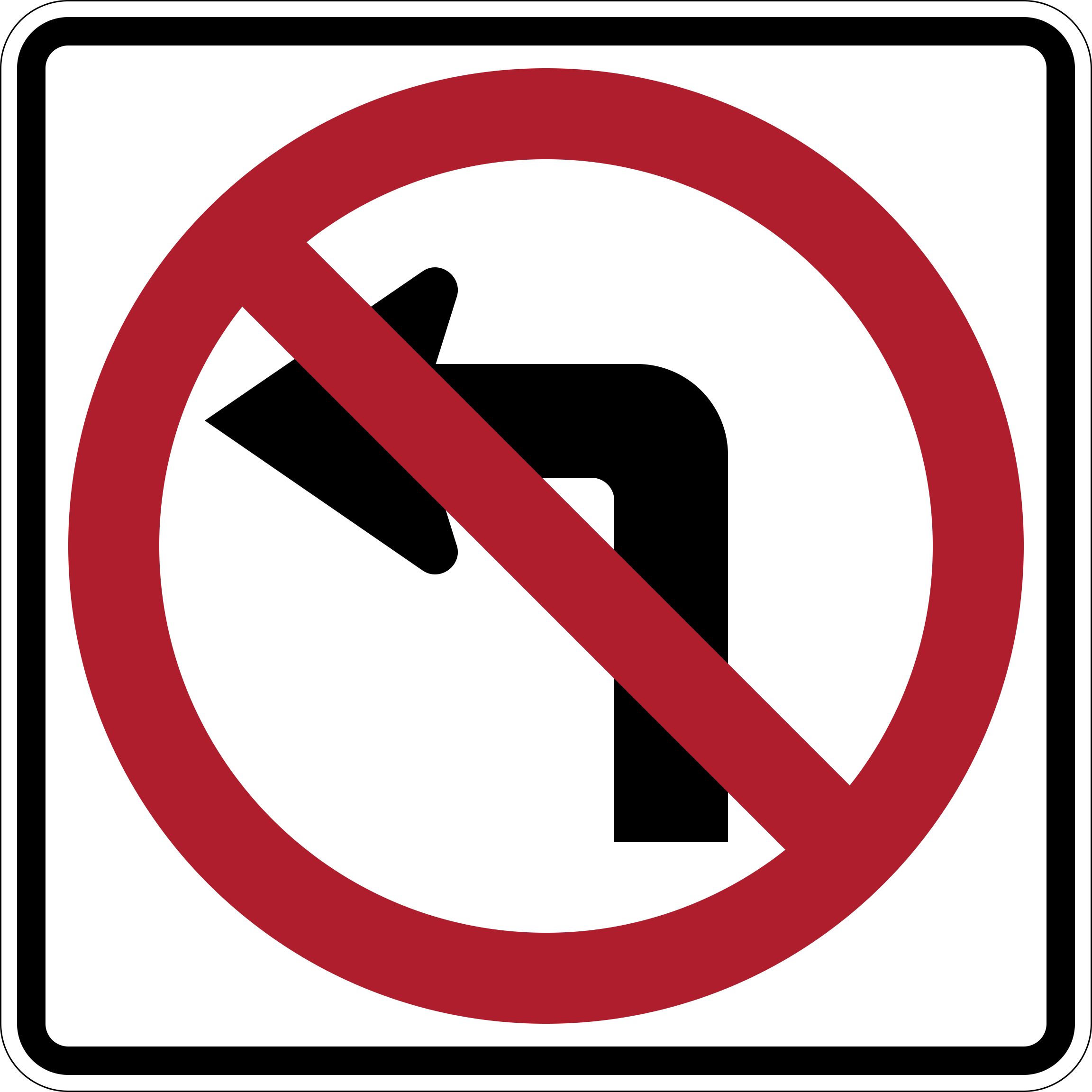
1. What movement is forbidden by the red-slash sign showing a left-turn arrow?
- Turning left where the sign is posted
- Driving straight through the intersection
- Changing lanes before the intersection
- Turning right after stopping at a red light
Show answer
Turning left where the sign is posted. The sign depicts a left turn with a red slash, so that particular movement is prohibited at the posted location. It does not automatically ban a right turn, straight travel, or a lane change unless another sign, signal, or marking imposes those restrictions. The shape of the arrow matters more than the general presence of red. Read the pictured direction first, then apply the slash to that movement. A driver should choose a permitted route rather than turning left and hoping cross traffic is absent.
2. May you stop on railroad tracks?
- Allowed while waiting
- Never stop on railroad tracks
- Allowed briefly
- Allowed with flashers
Show answer
Never stop on railroad tracks. Tracks forbid every halt: stopping on railroad tracks is illegal regardless of duration, signals, or flashers. Waiting, brief, and flashers readings each gamble against trains that cannot swerve or stop short. Queues that trap cars on the crossing kill; always confirm clear space beyond before crossing. Never let the wheels rest on the rails. Trains cannot stop short, so cars must never rest on rails.
3. How should you brake for stops and turns?
- Brake late and hard
- Brake early and gently to warn followers
- Never brake before turns
- Brake only at stop signs
Show answer
Brake early and gently to warn followers. Braking speaks to the cars behind: brake early and gently when preparing to stop or turn, giving followers plenty of warning that speed is decreasing. Late hard braking, never-braking, and signs-only braking each surprise the tailgater the two-second rule barely contains. Early gentle pressure lights the brake lamps while speed bleeds gradually, letting the follower match the slowdown. Signal the intent, brake the plan, and stop the car in that order.
4. Where may you make a three-point turn?
- Only on expressways
- Only in parking lots
- On narrow two-way streets unless prohibited, possibly on the test
- Never anywhere
Show answer
On narrow two-way streets unless prohibited, possibly on the test. Three-point turns suit tight streets: unless prohibited, they may turn cars around on narrow two-way streets, and the road test may require one. Expressway-only, lot-only, and never readings each misplace a maneuver built for cramped pavement. Signal right, pull over, signal left, cross, reverse, and finish forward. Practice the sequence until it flows. Signal right, pull over, signal left, cross, reverse, then finish forward.
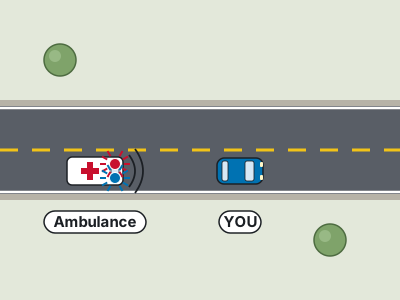
5. An emergency vehicle responding to an emergency approaches from behind in New York. What must you do?
- Stop in the middle of the intersection
- Race ahead until the emergency vehicle changes lanes
- Yield the right-of-way and move safely to the side
- Follow it closely through the next signal
Show answer
Yield the right-of-way and move safely to the side. New York requires drivers to yield to authorized emergency vehicles responding to emergencies. The driver should make room safely, moving toward the side of the road as appropriate, and avoid blocking the vehicle's path. Racing ahead can prolong the conflict, while stopping in an intersection may obstruct both the responder and cross traffic. A siren and emergency lamps are the cue to check mirrors, signal, move aside when safe, and remain stopped or clear until the vehicle has passed.
6. When must a New York driver turn on headlights because the windshield wipers are being used?
- Never, because wipers replace the need for lights
- Only after midnight, regardless of weather
- Only when driving on an expressway with no streetlights
- When using the wipers to clear rain, snow, or sleet
Show answer
When using the wipers to clear rain, snow, or sleet. New York requires headlights when the windshield wipers are being used to clear rain, snow, or sleet. The rule is tied to weather and visibility, not to midnight, expressway status, or the presence of streetlights. Wipers improve the driver's view but do not make the vehicle as visible to other road users, so they are not a substitute for headlights. The simple cue is wipers on for precipitation: turn on the headlights as well and avoid relying on daytime running lights alone.
7. What information does a blue New York service sign provide?
- A warning that a curve or intersection is hazardous
- The location of services such as rest areas, gas stations, or medical facilities
- The direction and distance to a destination
- A command setting the legal speed limit
Show answer
The location of services such as rest areas, gas stations, or medical facilities. Blue service signs show where drivers can find services, including rest areas, gas stations, camping, and medical facilities. They are informational, not warnings about a hazard, legal commands, or destination guidance. Yellow signs prepare drivers for roadway conditions, white signs usually state regulations, and green signs point toward locations. The practical cue is the blue background with white letters or symbols: look for the facility or service named, while continuing to obey the separate speed, lane, and turning rules on the road.
8. When a New York vehicle's rear wheels begin to skid, which way should the driver steer?
- Hard opposite the skid
- Straight while accelerating
- In the direction the vehicle is trying to go
- Toward the nearest shoulder regardless of direction
Show answer
In the direction the vehicle is trying to go. For a rear-wheel skid, New York advises turning the steering wheel in the direction the vehicle is trying to go. If the rear slides left, steer left; if it slides right, steer right. A hard opposite turn can produce a second skid, while acceleration or an automatic shoulder move does not restore the intended path. Ease off the gas, keep movements smooth, and be ready to adjust as the vehicle recovers. The steering direction follows the slide, not the driver's fear of it.
9. Should you signal before braking for a turn?
- Signal after turning
- Signal before braking or turning when possible
- Never signal
- Signal only at night
Show answer
Signal before braking or turning when possible. Signals precede slowdowns: when possible, signal the turn before beginning to brake or make the turn. After, never, and night-only readings each delay the warning followers need. Early signals plus early gentle braking telegraph intentions completely. Blink first, brake second, turn third. Early signals plus gentle braking telegraph intentions completely. Blink the signal first, brake second, and turn third. Never brake first and signal second.
10. How are traffic light colors normally arranged?
- Green on top always
- Sideways only
- Red, yellow, and green top-to-bottom or left-to-right
- Random order
Show answer
Red, yellow, and green top-to-bottom or left-to-right. Signal heads follow a fixed order: red, yellow, and green arranged top to bottom or left to right. Green-top, sideways-only, and random readings each scramble the standard colorblind drivers rely on. Some intersections show lone single-color lights, steady or flashing, round or arrow. Position plus color plus shape announce every command. Position plus color plus shape announce every signal command clearly.
11. How often must vehicles be inspected?
- At least once a year
- Never
- Every ten years
- Only when selling
Show answer
At least once a year. Inspections are annual duties: no one may operate or park on public highways unless the vehicle was inspected at least once a year. Never, decennial, and sale-only readings each stretch an interval the law fixes yearly. Owner's-manual maintenance and prompt repairs supplement but never replace inspection. Keep the sticker current and the equipment sound. Owner-manual maintenance supplements but never replaces yearly inspection.
12. When may you open the roadside door?
- Always fling doors open
- Doors have absolute priority
- Never open roadside doors into bikes or traffic
- Cyclists must always stop
Show answer
Never open roadside doors into bikes or traffic. Dooring kills cyclists: after parking, never open the roadside door if it interferes with bicyclists and other traffic. Fling-open, priority, and cyclists-stop readings each ignore the bike lane running past the driver's door. Check the mirror and shoulder before unlatching, and open narrowly until the lane clears. The Dutch reach, far hand to the latch, forces the lifesaving glance. A mirror glance before unlatching saves a cyclist's life.
13. How should you brake on snow and ice?
- Pump rapidly
- Slam the brakes
- Use the parking brake
- Press brakes in slow, steady strokes
Show answer
Press brakes in slow, steady strokes. Snow and ice reward gentle feet: brake early, carefully, and gently, pressing the brakes in slow, steady strokes rather than stabbing them. Rapid pumping, slamming, and parking-brake grabs each lock wheels that need rolling traction. ABS changes the technique to firm sustained pressure, but the principle holds: smooth inputs preserve grip. Start braking sooner, squeeze progressively, and let the stop stretch long.
14. What should you do if you hear tire thumping?
- Pull safely off and check the tires
- Speed up
- Ignore it
- Turn up the radio
Show answer
Pull safely off and check the tires. Thumping foretells blowouts: a thumping sound can warn that a blowout is coming, so get safely off the road and check the tires. Speed-up, ignore, and radio readings each drive deeper into the failure. Heat and damage announce themselves before rubber lets go. Heed the thump, inspect the rubber, and fix flats before they burst. Heat and damage announce themselves before rubber lets go completely.
15. Whom must turning drivers watch for?
- Only watch for cars
- Watch for pedestrians, bicyclists, and mopeds, especially right turns
- Ignore crosswalks
- Only watch at night
Show answer
Watch for pedestrians, bicyclists, and mopeds, especially right turns. Turns threaten the small and quiet: watch for pedestrians, bicyclists, and moped riders, especially on right turns where they hide in the blind spot. Cars-only, ignore, and night-only readings each miss the daylight walkers and riders the arc crosses. Right turns sweep the curb lane where bikes ride and walkers step. Scan the whole arc before committing the wheel. Scan the whole turning arc before committing the wheel.
16. When must a new resident obtain a New York vehicle registration?
- Within 10 days of buying a vehicle
- Within 30 days of establishing residence
- Only when the current registration expires
- Within 60 days of receiving a license
Show answer
Within 30 days of establishing residence. A new resident must get a New York registration within 30 days of establishing residence. The ten-day period belongs to a vehicle-inspection situation, not the residency deadline. Sixty days is not the stated period, and waiting for an old registration to expire overlooks the new obligation. Count from the date residence is established, rather than from the date a New York license arrives or the next vehicle trip.
17. What do flashing amber lights on a New York school bus warn other drivers about?
- The bus is present and drivers should notice the possible hazard
- The bus is giving every nearby driver a green signal
- The bus may be passed without checking traffic
- The bus is being used as an emergency vehicle
Show answer
The bus is present and drivers should notice the possible hazard. Flashing amber lights on a school bus warn traffic that the bus is present and may create a roadside hazard. They do not grant other drivers permission to pass, turn, or treat the bus as an authorized emergency vehicle. A driver should reduce speed, observe the bus and surrounding children, and be ready for a stop or movement near the roadway. The amber signal is an attention cue, not a replacement for ordinary traffic laws or careful scanning.
18. For a 150-pound man, about how long does the body take to remove the alcohol in one standard drink, such as a 12-ounce beer?
- About one hour
- About 15 minutes
- About three hours
- No time at all after a cup of coffee
Show answer
About one hour. New York treats 1 1/2 ounces of liquor, 5 ounces of wine, 12 ounces of beer, and 12 ounces of wine cooler as roughly equal. For a 150-pound man, each raises BAC by about .02 percent, and the body needs about one hour on average to remove that amount. Women generally take longer. Fifteen minutes is far too fast, and three hours overstates the time for one drink. Coffee, exercise, and cold showers may help a person stay awake but do not lower BAC; only time does.
19. What BAC level can result in an Aggravated DWI charge in New York?
- .15 or higher
- .08 or higher
- .12 or higher
- .18 or higher
Show answer
.18 or higher. Aggravated DWI applies at .18 BAC or higher in New York. The .08 threshold starts ordinary DWI, while .12 and .15 are lower numbers that do not mark the aggravated category in this manual. The important distinction is the gap between the ordinary and aggravated thresholds, not simply whether alcohol is present. Use .18 as the cue for the aggravated tier, and remember that the license consequence and criminal consequences can be more severe at that level.
20. What is the driver's role with ADAS features?
- Assist only; drivers must stay engaged and focused
- Drive the car fully
- Replace attention
- Allow sleeping
Show answer
Assist only; drivers must stay engaged and focused. Assistance never replaces drivers: safety features assist the driving task but do not drive the vehicle, so drivers must remain engaged and focused. Fully-drive, replace-attention, and allow-sleep readings each surrender control the law keeps human. Certain features are even banned during road tests. Supervise every assist, every mile. Supervise every driver assist closely, every single mile. Certain assists are even banned during official road tests.
QualitySpace is expanding to New York
We are a California-based independent insurance brokerage working on licensing in more states. We cannot help with New York insurance yet. Leave your email and we will let you know when we can.
Every question is written from the official New York State Driver's Manual. Need paper? Printable NY practice test with answer key.
Last verified 2026-09-06. How we check every question · Study all 500 as flashcards
Frequently asked questions
How many questions are on this New York practice test?
This fixed set has 20 questions. It is test 15 of 25 from the 500 question New York bank. The real NY exam asks 20 questions and you need 14 correct.
What is the passing score for the real New York test?
You must correctly answer at least 14 of the 20 questions asked, including two of the four questions about road signs That figure comes from the official New York source cited on the DMV facts page.
How does this fixed test relate to the full New York bank?
Each numbered test is a fixed set of 20 questions in a fixed order, so you can retake the same test later and compare. Every test mixes road signs and the other topics in about the same proportion as the full bank. Tests 1 to 25 together cover every question in the New York bank once. The full practice page mixes the whole bank at random.
Last verified 2026-09-06. See the New York DMV facts page for sourced state details.
Return to the full New York practice test · Study road signs