
Test 14 of 25 · 20 questions · Free 2026
NY Permit Practice Test 14
Jump to the test ↓A fixed 20 question set from the New York bank with answers and plain English explanations. The real NY exam is 20 questions, 70 percent to pass; take the full length version on the main practice page.
Question 1 of 20 · 0 right so far
All 20 questions in test 14
Every question below comes from the New York question bank on this page. Open a question to see the correct answer and the explanation. Nothing here is hidden behind a signup.
1. What is the usual speed limit on a New York expressway, and when can it be higher?
- Normally 55 mph, but it can be posted at 65 mph in some rural areas
- Normally 65 mph everywhere
- Normally 45 mph, raised to 55 mph at night
- Normally 70 mph in rural areas
Show answer
Normally 55 mph, but it can be posted at 65 mph in some rural areas. An expressway is a divided highway where traffic moves one way on two or more lanes, entered and exited by ramps. Its speed limit is normally 55 mph, but it can be posted at 65 mph in some rural areas; the Thruway, major interstates and parkways are examples. Sixty five is not the limit everywhere, 70 mph is not a New York posting the manual mentions, and expressway limits do not rise at night. Always slow to the lower limit often posted on exit ramps.
2. What portable-device activity does New York prohibit while driving?
- Listening to a lawfully mounted navigation prompt
- Using a hands-free telephone at any time
- Sending or receiving a text message or email
- Checking the vehicle's outside mirrors
Show answer
Sending or receiving a text message or email. New York prohibits using a portable electronic device, such as a cell phone or smart phone, to send or receive text messages or emails while driving. The manual separately notes that a hands-free telephone, which lets the user communicate without either hand, can be used at any time, so it is not the banned activity here. A mounted navigation prompt and mirror checks are not texting either. Put the device away before moving and set up navigation before entering traffic.
3. What does a steady red light mean?
- Stop and wait for green
- Slow down only
- Speed up
- Turn around
Show answer
Stop and wait for green. Steady red means full stop: halt and do not go until the light turns green. Slow-only, speed-up, and turn-around readings each roll through the hardest stop command. Legal turns on red come only after the complete stop, with yields and without prohibitions. Red means stop; green means go. Legal turns on red come only after the complete stop and yields.
4. Should you check medication labels before driving?
- Skip all labels
- Check medication labels for driving warnings
- Labels never matter
- Only illegal drugs matter
Show answer
Check medication labels for driving warnings. Medicine labels warn drivers: even unprescribed cold or allergy remedies require checking the label for effects warnings. Skip, never-matter, and illegal-only readings each ignore legal drugs that impair like alcohol or worse. When unsure, ask a doctor or pharmacist about driving on the medication. Legal pills can still drive illegally. Legal pills can still drive drivers into illegal impairment charges.
5. How do rear wheels track in turns?
- Rear wheels track wider than the front
- All wheels track identically
- Rear wheels travel inside the front path
- Rear wheels steer the car
Show answer
Rear wheels travel inside the front path. Turns cut corners behind: rear wheels travel inside the front wheels' path, nearer the curb on rights and nearer oncoming traffic on lefts. Wider, identical, and steer readings each deny the off-tracking that clips curbs and mirrors. Swing slightly wider at entry to give the tail its room. Watch the inside mirror through the arc. Swing slightly wider at entry to give the tail room.
6. In New York, what can support a charge for driving while ability impaired besides alcohol?
- Only an illegal street drug found in the vehicle
- Only cannabis, never a prescription or over-the-counter medicine
- A medication only when it causes a visible traffic violation
- A drug that impairs the driver's ability, including some prescription medicines
Show answer
A drug that impairs the driver's ability, including some prescription medicines. New York warns that any drug can affect driving ability, including prescription and over-the-counter medicines. The substance does not need to be an illegal street drug, and the rule is not limited to cannabis. A visible traffic violation is not the only trigger for concern; impairment itself is the safety issue. Read medicine labels, ask a health professional about effects, and never assume a legal prescription makes driving safe.
7. What minimum revocation period can apply after driving an uninsured vehicle?
- No revocation if no crash occurred
- At least 30 days
- At least six months
- At least one year
Show answer
At least one year. A conviction for driving an uninsured vehicle, or allowing another person to drive one, can revoke the license or driving privilege for at least one year. Thirty days and six months understate the minimum. The absence of a crash does not erase the violation because the rule covers driving or permitting the uninsured vehicle to be driven. Keep liability coverage active while registered, or surrender the plates before coverage ends.
8. On a wet New York road, what adjustment does the manual recommend for following distance?
- Increase the gap behind the vehicle ahead
- Follow more closely so spray cannot enter the lane
- Keep the ordinary gap because wet pavement changes nothing
- Use the shoulder to create a second following lane
Show answer
Increase the gap behind the vehicle ahead. New York advises increased following distance when rain, snow, or ice makes the road slippery. More space gives the driver additional time to perceive a slowing vehicle and brake without abrupt control inputs. Keeping the usual gap ignores the reduced traction, and following closely makes spray and sudden stops harder to manage. The shoulder is not a substitute travel lane. A useful cue is to pair lower speed with a visibly larger cushion whenever weather reduces grip or visibility.
9. What should you do if traction fades in heavy rain?
- Decrease speed even more
- Speed up to clear water
- Steer sharply
- Brake hard
Show answer
Decrease speed even more. Heavy rain already demands slower driving, and lost traction demands slower still: if the vehicle begins to lose grip, decrease speed even more. Speeding, sharp steering, and hard braking each deepen a hydroplane instead of curing it. Easing off the accelerator lets the tires reconnect with the pavement, while gentle inputs keep the slide from rotating. Slow at the first drops, slower at the first float, and patience restores the road.
10. Your supervising driver is not your parent, guardian, person acting in place of a parent, driver education teacher, or driving school instructor. On a New York junior permit, how many passengers under 21 may you carry, not counting immediate family?
- No more than two
- No more than three
- As many as the vehicle's seat belts allow
- No more than one
Show answer
No more than one. A New York junior learner permit holder cannot drive with more than one passenger under age 21. The limit does not apply to members of the driver's immediate family, and it is also lifted when the supervising driver is the licensed parent, guardian, person acting in place of a parent, driver education teacher or driving school instructor. Seat belt availability does not expand the limit, because each person must have their own belt. Count the under 21 passengers first, then check whether the family or supervising parent exception applies.
11. After the five-year waiting period for certain repeat alcohol or drug-related offenders, what device must be installed on the vehicle?
- A speed governor
- An interlock device
- A second set of license plates
- A breathalyzer used by passengers
Show answer
An interlock device. For the repeat-offender group described in New York's manual, an interlock device is required on the vehicle for five years from the date the licensing document is issued. The device measures the driver's breath alcohol and prevents the vehicle from starting until an acceptable sample is provided. A speed governor changes vehicle performance but is not the licensing condition described. Passenger testing and extra plates are unrelated. The timing cue is important: the interlock requirement follows approval after the five-year waiting period and then continues for five years from issuance.
12. A New York sign has a red circle and slash over a symbol. What does that design communicate?
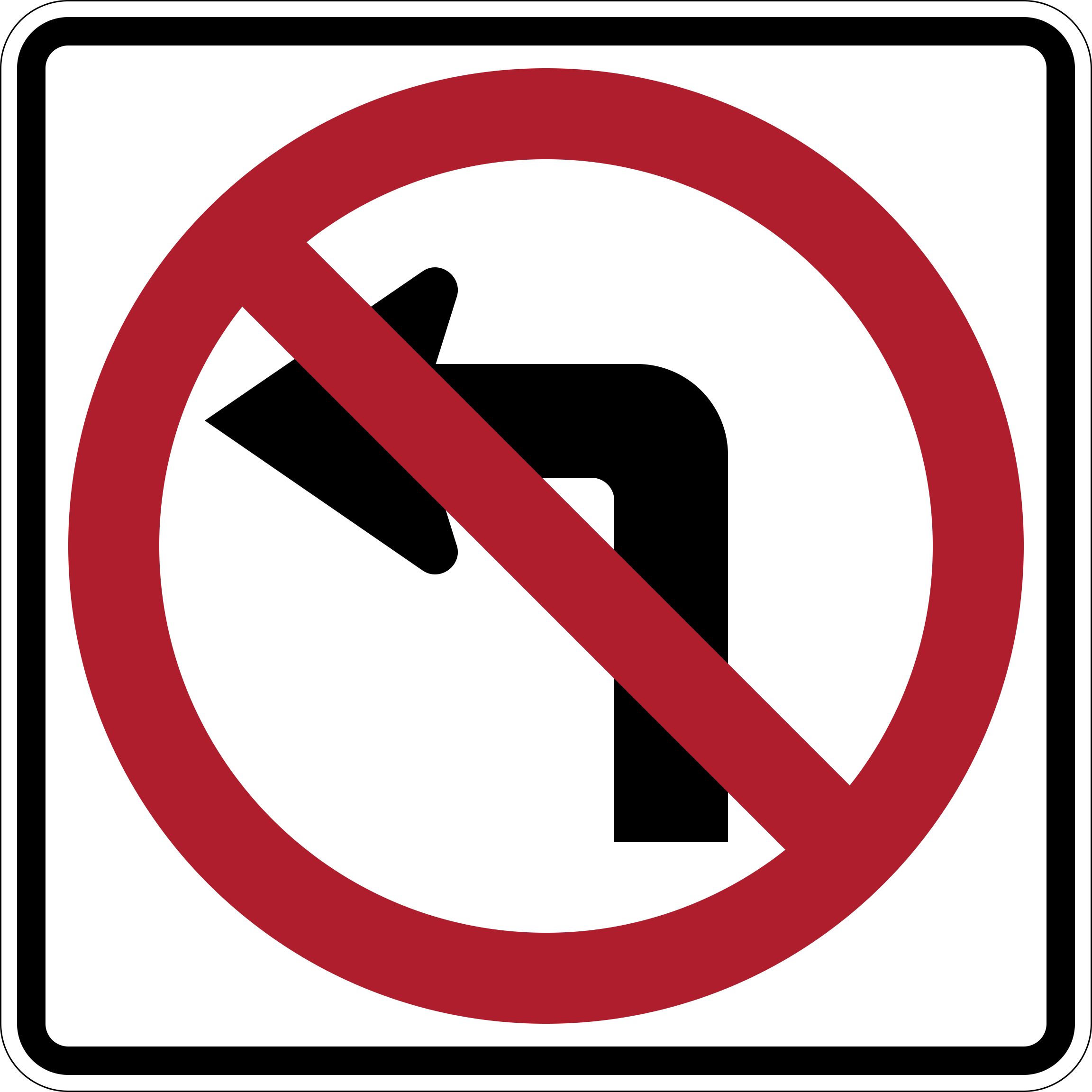
- A service area is available ahead
- A recommended route for the pictured vehicle
- The pictured action is not allowed or the vehicle is restricted
- The road surface is likely to be slippery
Show answer
The pictured action is not allowed or the vehicle is restricted. A red circle with a slash is a regulatory sign design that indicates the pictured action is not allowed or that some vehicles are restricted from the road. A service area uses a different sign category, and a route recommendation or slippery surface is not what the slash communicates. The visual cue is the prohibition mark itself: identify the symbol underneath, then read the sign as forbidding that action or vehicle use. This applies to signs such as a prohibited turn or restricted vehicle entry.
13. What should you check for at a YIELD sign?
- Nothing
- Traffic, carefully, prepared to stop
- Only pedestrians
- Only the sky
Show answer
Traffic, carefully, prepared to stop. Yield approaches stay vigilant: check carefully for traffic and be prepared to stop. Nothing, pedestrians-only, and sky readings each skip the careful scan the sign demands. Full stops become mandatory whenever conditions require them. Slow down, look hard, and yield the priority others own. Slow down, look hard, and yield the priority others own every time. Yield means others own the priority here.
14. Must you always stop at stop lines?
- Always stop at every line
- Stop only on Tuesdays
- Stop only when required by lights, signs, officers, or yielding duties
- Never stop at lines
Show answer
Stop only when required by lights, signs, officers, or yielding duties. Stop lines do not self-trigger: stopping is needed only when lights, signs, officers, or pedestrian and skater yielding duties require it. Always, Tuesdays, and never readings each divorce the line from its trigger. Uncontrolled lines without crossers need no stop. Read the control first, then honor the paint accordingly. Uncontrolled lines without crossers need no stop at all. Read the control first, then honor the paint accordingly.
15. How do you turn left from one-way onto one-way?
- Left lane to left lane
- Right lane to any lane
- Any lane to any lane
- Shoulder to shoulder
Show answer
Left lane to left lane. One-way to one-way lefts stay left: move into the left lane to prepare, and enter the new road's left lane where it has two. Right-start, any-lane, and shoulder readings each cross lanes the turn never needs. Left-to-left keeps the arc tight and predictable for everyone. Follow the lane lines through and hold the left lane after. Follow the lane lines through the turn and hold the left lane after.
16. May you park in front of a driveway?
- Parking or standing in front of driveways is banned
- Driveway parking is always allowed
- Only overnight bans apply
- Driveways are loading zones
Show answer
Parking or standing in front of driveways is banned. Driveways must stay clear: parking or standing in front of a driveway is not allowed, keeping residents and businesses able to enter and exit. Always-allowed, overnight-only, and loading-zone readings each invent permissions the blanket ban refuses. Blocked driveways trap vehicles and force dangerous reversals into traffic. Leave every curb cut fully open at all hours. Leave every curb cut fully open, day and night, without exception.
17. What should you do near downed wires?
- Touch them to test
- Stay away from downed wires
- Move them by hand
- Drive over them
Show answer
Stay away from downed wires. Downed wires kill at a touch: if wires fall, do not go near them. Testing, handling, and driving-over readings each complete the circuit the rule breaks. Warn vehicle occupants to stay inside when wires touch or lie near the car. Electricity needs no invitation; distance is the only insulation. Warn occupants to stay inside when wires touch or lie near the car.
18. What follows failure to report a crash?
- A thank-you
- A discount
- Nothing
- A misdemeanor risking license and registration suspension or revocation
Show answer
A misdemeanor risking license and registration suspension or revocation. Unreported crashes are crimes: failure to report is a misdemeanor that can suspend or revoke driver licenses and registrations, the owner's included. Thank-you, discount, and nothing readings each trivialize a criminal offense with career-level consequences. Injured drivers may have passengers or owners file for them. Report within ten days, without exception. Injured drivers may have passengers or owners file the report for them.
19. Why glance forward while backing in?
- Stare only backward
- Ignore the front
- Glance side and front to avoid touching the car ahead
- Watch the radio
Show answer
Glance side and front to avoid touching the car ahead. The swinging nose needs watching: glance to the side and front occasionally to be sure the vehicle ahead stays untouched. Backward-only, front-ignoring, and radio readings each let the arc's outer end strike the neighbor. As the tail tucks curbward, the nose sweeps streetward past the forward bumper. Split attention between the rear glass and the front fender until straight. The nose arc is the silent half of every parallel park.
20. How much side space should you maintain?
- Tailgate closely
- Keep escape room on both sides
- Drive with no gaps
- Close all gaps
Show answer
Keep escape room on both sides. Hazards need exits: keep escape room to the left and right for sudden lane changes or pull-overs. Tailgate, gapless, and closed readings each seal the exits emergencies require. Space cushions ahead, behind, and beside complete the shield. Room to maneuver is room to survive. Room to maneuver a car is room to survive crashes. Space ahead, behind, and beside completes the full shield.
QualitySpace is expanding to New York
We are a California-based independent insurance brokerage working on licensing in more states. We cannot help with New York insurance yet. Leave your email and we will let you know when we can.
Every question is written from the official New York State Driver's Manual. Need paper? Printable NY practice test with answer key.
Last verified 2026-09-06. How we check every question · Study all 500 as flashcards
Frequently asked questions
How many questions are on this New York practice test?
This fixed set has 20 questions. It is test 14 of 25 from the 500 question New York bank. The real NY exam asks 20 questions and you need 14 correct.
What is the passing score for the real New York test?
You must correctly answer at least 14 of the 20 questions asked, including two of the four questions about road signs That figure comes from the official New York source cited on the DMV facts page.
How does this fixed test relate to the full New York bank?
Each numbered test is a fixed set of 20 questions in a fixed order, so you can retake the same test later and compare. Every test mixes road signs and the other topics in about the same proportion as the full bank. Tests 1 to 25 together cover every question in the New York bank once. The full practice page mixes the whole bank at random.
Last verified 2026-09-06. See the New York DMV facts page for sourced state details.
Return to the full New York practice test · Study road signs