
Test 5 of 25 · 20 questions · Free 2026
NY Permit Practice Test 5
Jump to the test ↓A fixed 20 question set from the New York bank with answers and plain English explanations. The real NY exam is 20 questions, 70 percent to pass; take the full length version on the main practice page.
Question 1 of 20 · 0 right so far
All 20 questions in test 5
Every question below comes from the New York question bank on this page. Open a question to see the correct answer and the explanation. Nothing here is hidden behind a signup.
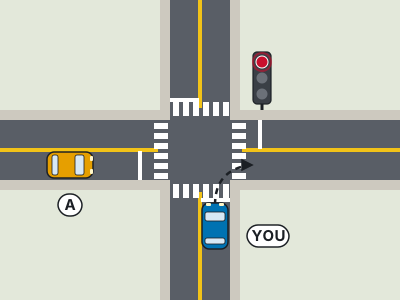
1. Outside New York City, when may you turn right at a steady red light?
- Immediately after slowing if no vehicle is close
- After a full stop, when the way is clear and no sign or marking prohibits the turn
- Only after waiting for a green arrow in every location
- Whenever the driver is turning from a one-way street
Show answer
After a full stop, when the way is clear and no sign or marking prohibits the turn. Outside New York City, you may turn right on a steady red after a complete stop, once you have yielded to oncoming traffic and pedestrians, as long as no sign, signal, or pavement marking forbids it. Inside New York City the default flips: no turn on red unless a sign allows it. Slowing without stopping is not enough. A green arrow is not required for every right turn, and the one way to one way condition belongs to the separate left on red rule. Look for posted turn limits before you move.
Study this in the handbook: Traffic lights, lane lights and road lines
2. What do white lane arrows indicate?
- They show which lanes you must use
- They decorate the road
- They mark speed limits
- They show parking
Show answer
They show which lanes you must use. Lane arrows command lane choice: arrows show which lanes drivers must use for each movement. Decorate, speed, and parking readings each ignore the mandatory direction. Right-only arrows confine turns to the right lane; straight arrows claim the left. Read the arrows early and merge before the solid separators. Right-only arrows confine turns strictly to the right lane. Straight arrows claim the left lane instead.
Study this in the handbook: Sign shapes and colors
3. For a junior permit or license, what suspension follows a serious violation worth three points or more?
- A 30-day suspension
- A six-month revocation
- A 60-day suspension
- A one-year suspension
Show answer
A 60-day suspension. New York imposes a 60-day suspension when a junior permit or license holder is convicted of a serious traffic violation worth three points or more. The 30-day option understates the stated sanction, while six months and one year are not the period given for this junior-driver rule. Keep the trigger attached to the time period: one serious violation or two other violations leads to 60 days. This is a license consequence even if the driver has not accumulated enough points for the adult point system.
Study this in the handbook: Points, suspensions and probation
4. When may you pass a left-turning vehicle on the right?
- Never
- Only on expressways
- When a vehicle ahead makes a left turn and passing is safe
- Only at night
Show answer
When a vehicle ahead makes a left turn and passing is safe. Left-turning leaders open the right: drivers may pass on the right when a vehicle ahead makes a left turn, provided the pass is safe. Never, expressway-only, and night readings each miss the commonest legal right-pass case. Multi-lane roads add more cases, but the turning leader is the classic. Verify room and legality, signal, and pass without using the shoulder. Never cross the edge line to do it.
Study this in the handbook: Passing on the left and the right
5. What speed change may work zones suddenly require?
- Quick slowdowns or even full stops
- Faster driving
- No speed change
- U-turns
Show answer
Quick slowdowns or even full stops. Work zones ambush speed: expect them anywhere, possibly requiring quick slowdowns or even full stops as lanes shift and workers appear. Faster, unchanged, and U-turn readings each miss the sudden-deceleration duty the zone imposes. Fines double for work-zone speeding even with no workers present. Stay alert, cover the brake, shed speed early, and expect shifted lanes around every work zone.
Study this in the handbook: Speed limits, space cushion and work zones
6. A 16-year-old holds a New York junior learner permit in New York City. When is driving not allowed at all?
- Between 9 p.m. and 5 a.m.
- Between midnight and 5 a.m.
- Between 11:01 p.m. and 5 a.m.
- Never, as long as a parent is in the car
Show answer
Between 9 p.m. and 5 a.m.. In New York City, a junior learner permit allows driving only from 5 a.m. to 9 p.m., and only with a parent, guardian, person in loco parentis, driver education teacher, or driving school instructor in a car with dual controls. From 9 p.m. to 5 a.m. the permit holder must not drive at all, even with a parent. Long Island has the same nighttime ban. Neither 11:01 p.m. nor midnight is where the New York City limit begins.
Study this in the handbook: Learner permits, junior licenses and the written test
7. What should you do immediately after a tire blowout?
- Brake hard before the vehicle begins to drift
- Hold the wheel tightly and slowly release the accelerator
- Accelerate to keep the tire rotating
- Turn sharply toward the shoulder
Show answer
Hold the wheel tightly and slowly release the accelerator. After a tire blows out, New York advises holding the steering wheel tightly and slowly taking your foot off the gas pedal. If the vehicle skids, handle it as you would on ice or snow, and do not use the brake until the vehicle is controlled. Hard braking, speeding up, or a sharp turn toward the shoulder all work against regaining control. Leave the road only when it is safe to do so. A thumping sound can warn that a blowout is about to occur, so get off the road and check the tires if you hear it.
Study this in the handbook: Railroad crossings, expressways, night and bad weather
8. You have a green light, but another vehicle is already completing a turn in the intersection. What should you do?
- Wait until that vehicle clears before entering
- Honk so the turning vehicle must reverse
- Enter because green always gives immediate priority
- Pass behind it by crossing into the opposing lane
Show answer
Wait until that vehicle clears before entering. A green light does not erase the obligation to avoid interfering with traffic already in the intersection. New York says an approaching driver must yield to a vehicle that is already there, allowing that vehicle to complete its movement. Entering immediately can create a collision even though the signal favors you. The tempting green-light choice overlooks the vehicle's existing position. Use a simple visual cue: check the intersection before crossing the stop line, and wait if any vehicle is still clearing it.
Study this in the handbook: Right of way, turns and U-turns
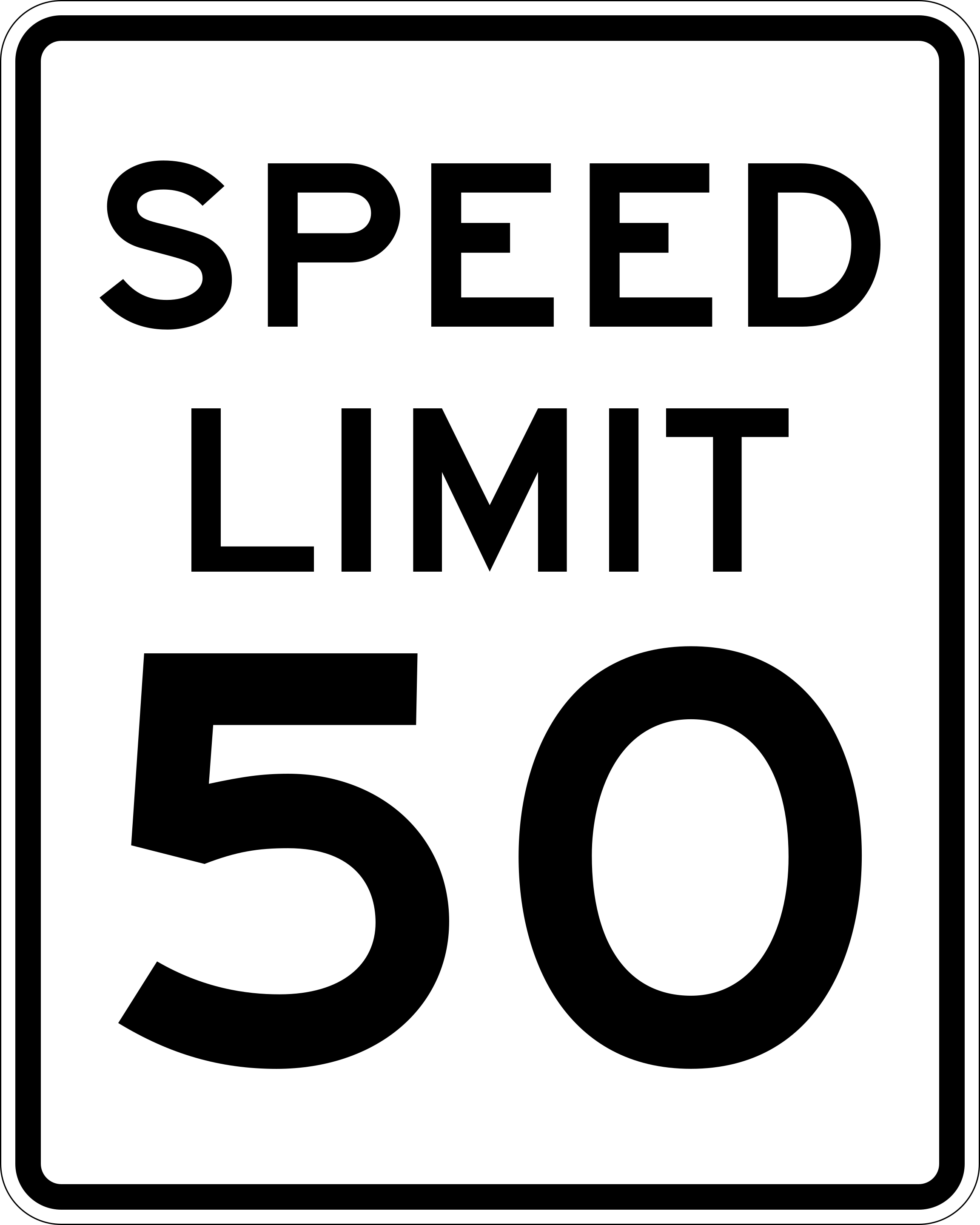
9. What kind of New York sign is the white rectangular speed-limit sign shown?
- A yellow warning sign for a roadway hazard
- A green destination sign giving directions
- A blue service sign for a facility
- A regulatory sign stating a traffic rule
Show answer
A regulatory sign stating a traffic rule. New York classifies the white rectangular speed-limit display as a regulation sign. Regulation signs communicate rules that govern traffic, unlike yellow warning signs, green destination signs, or blue service signs. The posted number sets a legal maximum, but a driver still needs to reduce speed when weather, visibility, traffic, or road surface makes that limit unsafe. The visual cue is the plain white rectangle with dark lettering or symbols. Treat it as an instruction to obey, not merely advice about a possible hazard.
Study this in the handbook: Sign shapes and colors
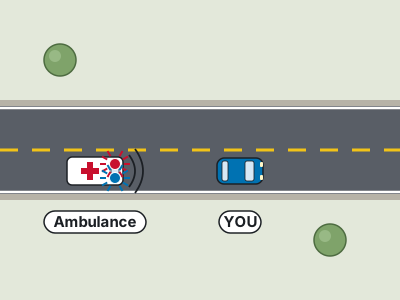
10. An emergency vehicle approaches from behind on a New York two-way road. What should the driver do?
- Pull to the right edge and stop
- Move left into the oncoming lane
- Keep speed and remain centered
- Stop in the middle of the intersection
Show answer
Pull to the right edge and stop. New York drivers must yield to an approaching emergency vehicle by pulling as far right as practical and stopping. Remaining centered can block the emergency vehicle, and moving into the oncoming lane creates a new conflict. Stopping in an intersection may obstruct both the emergency response and cross traffic. Check mirrors, signal the move, clear an intersection if possible, then stop at the right edge until the emergency vehicle has passed and the roadway is safe to reenter.
Study this in the handbook: Emergency vehicles and the Move Over law
11. Where may conditional-license holders drive?
- Unlimited driving
- Only to and from school, work, and medical appointments
- Only for fun trips
- Only out of state
Show answer
Only to and from school, work, and medical appointments. Conditional licenses run essential errands only: use is limited to driving to and from school, work, and medical appointments. Unlimited, fun-only, and out-of-state readings each exceed the narrow permission. Noncompliance with court terms, or any traffic conviction beyond parking and standing, revokes it. Essential means essential. Essential destinations only; fun and habit both violate the condition. Noncompliance with court terms revokes the conditional license fast.
Study this in the handbook: Alcohol, drugs and DWI
12. How does alcohol affect driving skills?
- Improves all skills
- Delays reactions, dulls vision, distorts judgment, lowers inhibitions, invites risk
- Affects nothing
- Only affects parking
Show answer
Delays reactions, dulls vision, distorts judgment, lowers inhibitions, invites risk. Alcohol weakens every driving skill at once: delayed reactions, blurred vision, warped speed and distance judgment, lowered inhibitions, and greater risk-taking. Improves, nothing, and parking-only readings each deny the across-the-board degradation. The important safety skills all fade together. No experience level preserves them against rising blood alcohol. No experience level preserves skills against rising blood alcohol content. Reaction, vision, judgment, and courage all fail together at once.
Study this in the handbook: Alcohol, drugs and DWI
13. How far can a truck's front blind spot reach?
- No front blind spot exists
- 5 feet
- 10 feet
- 20 feet for long-hood tractors
Show answer
20 feet for long-hood tractors. Long hoods hide the road ahead: tractors with long hoods can blind the driver to twenty feet directly in front. None, five, and ten readings each shrink a zone swallowing whole cars. Cutting in close ahead vanishes the cutter. Leave truck fronts generous following room. Leave truck fronts generous following room at all times. Cutting in close ahead makes the cutter simply vanish.
Study this in the handbook: Pedestrians, bicycles, motorcycles and trucks
14. This yellow New York warning sign shows a truck tilted on a slope. What lies ahead?

- A truck weigh station
- A road closed to all trucks
- A hill
- A loading zone for delivery trucks
Show answer
A hill. New York lists Hill Ahead among the road signs you must know, drawn as a truck driving downhill on a yellow diamond. Yellow diamonds are warning signs, so this one describes the road ahead rather than a rule about who may use it. A hill matters for two reasons the manual raises elsewhere: you cannot pass on a two-way road when you cannot see over the top of a hill, and a large vehicle normally loses speed on a grade, so expect slower traffic and keep extra space when you see this sign.
Study this in the handbook: Road signs you must know
15. How should you return after running off the pavement?
- Swerve back instantly
- Brake hard
- Ease off gas, brake gently, check behind, then return carefully
- Speed up
Show answer
Ease off gas, brake gently, check behind, then return carefully. Pavement drops punish jerks: ease off the gas, brake gently, and once slowed, check behind before turning carefully back onto the pavement. Instant-swerve, hard-brake, and speed-up readings each flip or spin cars straddling the edge. The height gap grabs tires that rush it. Slow first, look back, then climb the lip gently. Slow first, look back, then climb the pavement lip back up gently.
Study this in the handbook: Railroad crossings, expressways, night and bad weather
16. What if a pedestrian crosses the lot exit?
- Wait for the pedestrian to cross
- Drive around closely
- Honk and proceed
- Reverse back in
Show answer
Wait for the pedestrian to cross. Lot exits yield to feet too: if a pedestrian crosses the exit, wait for that person to go across. Close-around, honk-through, and reverse readings each rush or dodge a duty that patience satisfies. Exiting drivers focus on car gaps and miss walkers; the rule forces the second look. People first, then the roadway gap. Watch for people first, then take the roadway gap second.
Study this in the handbook: Right of way, turns and U-turns
17. What do orange New York work-area signs tell drivers to expect?
- A medical facility and emergency entrance
- A permanent prohibition on all vehicle travel
- A highway destination and route distance
- People working on or near the roadway and possible traffic control
Show answer
People working on or near the roadway and possible traffic control. Orange signs identify a work area where people may be working on or near the roadway and where traffic can be controlled by a flag person. The driver should reduce speed, watch for changing lanes, and obey the flag person’s directions. Blue signs serve facilities, green signs guide destinations, and an orange sign does not automatically mean the road is closed. Treat the color as an early warning to scan for workers, equipment, and a temporary movement pattern before entering the zone.
Study this in the handbook: Sign shapes and colors
18. What credentials allow disability-space parking?
- Any note on the dash
- DMV plates, state permit, or another state's credential
- A doctor's letter alone
- Verbal assurance
Show answer
DMV plates, state permit, or another state's credential. Reserved-space credentials come in three forms: DMV disability plates, a New York disability parking permit, or a similar out-of-state plate or permit. Dash notes, lone letters, and verbal claims each fail the credential test the ban enforces. Anything less leaves the park illegal. Display the real credential properly and keep it current. Display the real credential properly and keep it current always.
Study this in the handbook: Parallel parking and where you cannot park
19. Should you signal when leaving the space?
- Leave silently
- Honk instead
- Wave out the window
- Signal the move from space to traffic
Show answer
Signal the move from space to traffic. Intentions need announcing: signal the move from the parking space into traffic so approaching drivers can adjust. Silent, honking, and waving readings each fail the communication the blinker performs. The signal claims no right of way, but it warns the stream the parked car is waking. Light it early, scan completely, and enter only when safe. The blinker warns the stream before the wheels ever turn.
Study this in the handbook: Parallel parking and where you cannot park
20. How do you enter from a too-short ramp?
- Enter at any speed
- Stop and wait for a large space
- Speed up on the shoulder
- Merge blindly
Show answer
Stop and wait for a large space. Too-short ramps change the maneuver: when the entrance lane forbids acceleration to expressway speed, the safest method is to stop and wait for a large space in traffic. Any-speed entries, shoulder sprints, and blind merges each gamble against sixty-five-mile traffic from a standstill. Full stops on normal ramps are wrong, but stunted ramps make stopping the only safe entry. Wait for the big gap, then commit decisively.
Study this in the handbook: Railroad crossings, expressways, night and bad weather
QualitySpace is expanding to New York
We are a California-based independent insurance brokerage working on licensing in more states. We cannot help with New York insurance yet. Leave your email and we will let you know when we can.
Every question is written from the official New York State Driver's Manual. Need paper? Printable NY practice test with answer key.
Last verified 2026-10-05. How we check every question · Study all 500 as flashcards
Frequently asked questions
How many questions are on this New York practice test?
This fixed set has 20 questions. It is test 5 of 25 from the 500 question New York bank. The real NY exam asks 20 questions and you need 14 correct.
What is the passing score for the real New York test?
You must correctly answer at least 14 of the 20 questions asked, including two of the four questions about road signs That figure comes from the official New York source cited on the DMV facts page.
How does this fixed test relate to the full New York bank?
Each numbered test is a fixed set of questions in a fixed order, so you can retake the same test later and compare. Every test mixes road signs and the other topics in about the same proportion as the full bank. Tests 1 to 25 together cover every question in the New York bank once. The full practice page mixes the whole bank at random.
Last verified 2026-10-05. See the New York DMV facts page for sourced state details.
Return to the full New York practice test · Study road signs