
Test 2 of 25 · 20 questions · Free 2026
NY Permit Practice Test 2
Jump to the test ↓A fixed 20 question set from the New York bank with answers and plain English explanations. The real NY exam is 20 questions, 70 percent to pass; take the full length version on the main practice page.
Question 1 of 20 · 0 right so far
All 20 questions in test 2
Every question below comes from the New York question bank on this page. Open a question to see the correct answer and the explanation. Nothing here is hidden behind a signup.
1. May you enter to prepare a left turn?
- Enter on green if no one ahead plans a left
- Always wait behind the line
- Enter on red
- Rush through yellow
Show answer
Enter on green if no one ahead plans a left. Left-turn staging is allowed conditionally: on green, enter to prepare when no vehicle ahead plans a left turn. Always-wait, red-entry, and yellow-rush readings each miss the permission that keeps one car staged per cycle. Once inside, hold right of the center line with wheels straight until the gap opens. Stage legally, wait patiently, complete safely. Stage legally, wait patiently, and complete the turn safely.
Study this in the handbook: Right of way, turns and U-turns
2. How should you center in the space?
- Leave wheels cranked
- Block both neighbors
- Park diagonally
- Straighten wheels and pull forward with room both ends
Show answer
Straighten wheels and pull forward with room both ends. Centering completes the park: bring the wheels straight, pull forward, and allow room for the vehicles ahead and behind. Cranked, blocking, and diagonal readings each leave the car crooked, trapped, or trapping others. Equal gaps let everyone exit, and straight wheels prevent curb strikes on departure. Center up, straighten out, and the park is done. Centered straight cars let the whole block breathe and move.
Study this in the handbook: Parallel parking and where you cannot park
3. A New York sign shows a large letter H with an arrow pointing right. What is it telling you?
- A highway entrance is on the right
- Helicopters may land on the road
- Heavy vehicles must keep right
- A hospital is to the right
Show answer
A hospital is to the right. The manual's Road Signs You Must Know page lists Hospital To The Right, drawn as an H with an arrow pointing right. It works like the blue service signs, which show the location of services like rest areas, gas stations, camping and medical facilities. The letter names the service and the arrow gives the direction, so the sign is guidance, not a rule or a hazard warning. Knowing it can save time in an emergency when you need to reach medical care quickly.
Study this in the handbook: Road signs you must know
4. What information must crash drivers exchange?
- Only first names
- Name, address, license, registration, and insurance with policy number and dates
- Only phone numbers
- Nothing in writing
Show answer
Name, address, license, registration, and insurance with policy number and dates. Crash exchanges are fully documented: give name, address, driver license number, vehicle registration, and insurance information including policy number and effective date. First-names, phones-only, and nothing readings each withhold records the claims process requires. Share everything with other drivers and police at the scene. Complete paper trails protect every party later. Share everything with other drivers and police officers at the scene.
Study this in the handbook: What to do after a crash
5. How do you approach a two-way to two-way left turn?
- Approach from the right half closest to the center
- Approach from the left lane
- Approach from the shoulder
- Approach from any lane
Show answer
Approach from the right half closest to the center. Two-way lefts start center-hugging: approach from the right half of the roadway closest to the center. Left-lane, shoulder, and any-lane readings each begin from pavement the turn does not own. Center-hugging lines the car for the crossing while leaving room for oncoming left-turners. Enter the new road right of its center, close as possible. Enter the new road right of its center line, as close as possible.
Study this in the handbook: Right of way, turns and U-turns
6. May non-HOV cars enter city HOV lanes?
- Non-HOV may enter to turn right at the next intersection
- Nobody may ever enter
- Only buses may enter
- Entry requires a permit
Show answer
Non-HOV may enter to turn right at the next intersection. City HOV lanes allow right-turn entry: where broken white replaces the solid separators, non-HOV vehicles may enter to turn right at the next intersection. Nobody, buses-only, and permit readings each miss the turning exception. Through travel stays reserved. Enter late, turn right, and clear the lane. Enter the lane late, turn right promptly, and clear it. Through travel in HOV lanes stays reserved for qualifiers.
Study this in the handbook: Sign shapes and colors
7. What traffic direction does the black-and-white ONE WAY sign with an arrow establish?
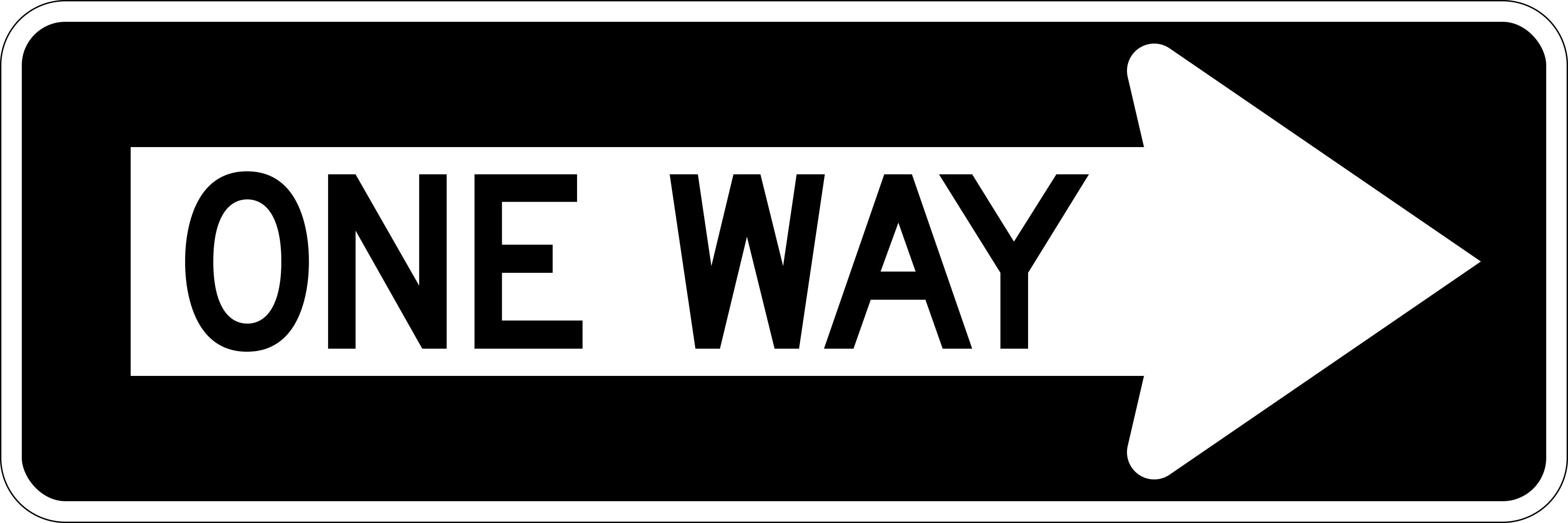
- Traffic must turn around at the next signal
- The lane is reserved for buses and emergency vehicles
- Traffic may travel only in the arrow's direction
- The street carries two-way traffic until a stop sign
Show answer
Traffic may travel only in the arrow's direction. A ONE WAY sign is a regulation sign, and regulation signs give rules for traffic direction, lane use, turns, speed and parking. The arrow shows the only direction in which traffic may travel on that street. The sign does not order a turnaround, reserve the lane for buses, or describe two way traffic continuing to a stop sign. Entering against the arrow puts a vehicle head on into the permitted flow. Before turning onto the street, read the arrow and line the vehicle up with that direction from the start.
Study this in the handbook: Sign shapes and colors
8. What minimum liability insurance must a registered New York vehicle carry for injury to one person and for property damage?
- $15,000 for injury to one person and $5,000 for property damage
- $50,000 for injury to one person and $25,000 for property damage
- $25,000 for injury to one person and $10,000 for property damage
- $100,000 for injury to one person and $50,000 for property damage
Show answer
$25,000 for injury to one person and $10,000 for property damage. New York requires liability coverage for as long as a vehicle is registered, even if it is not driven. The minimums are $25,000 for injury to one person, $50,000 for injury to two or more people, and $10,000 for property damage, along with $50,000 for the death of one person and $100,000 for the death of two or more. The $15,000 and $5,000 figures are too low for New York. The larger pairs mix up the death and multiple injury limits with the one person and property figures.
9. In a New York work zone, what should you do when a flagger directs traffic?
- Maintain the normal highway speed until a police officer arrives
- Slow down and obey the flagger's directions
- Pass the flagger if no workers are in your lane
- Stop only when a construction truck blocks the road
Show answer
Slow down and obey the flagger's directions. A work zone requires heightened attention, and a flagger's directions control the movement of traffic through that area. The absence of a separate work-zone speed sign does not authorize normal highway speed when conditions call for slower travel. Passing a flagger or waiting for police defeats the traffic-control system. The useful roadside cue is the person managing the lane: reduce speed early, watch the signals, and follow the instruction given for your vehicle.
Study this in the handbook: Speed limits, space cushion and work zones
10. What roadway arrangement is represented by arrows separating around a center divider?

- A three-way intersection with no median
- A permission to cross the median for a U-turn
- A divided highway, with traffic moving in separate directions
- A temporary lane reserved for bicycles
Show answer
A divided highway, with traffic moving in separate directions. Arrows that separate around a center area represent a divided highway, where opposing directions travel on distinct roadways. The image does not describe a three-way junction, authorize a median crossing, or create a bicycle lane. On an expressway, traffic normally moves in one direction on two or more lanes, and a driver should remain on the correct side of the divider. Treat the median as a physical separation, not an opening for an improvised turn or shortcut.
Study this in the handbook: Railroad crossings, expressways, night and bad weather
11. How do you set up to leave a parallel space?
- Crank wheels and floor it
- Drive over the curb
- Straighten wheels, back to the rear car, turn away from curb
- Pull out blindly
Show answer
Straighten wheels, back to the rear car, turn away from curb. Exiting reverses the entry: with wheels straight, back toward the vehicle behind, then turn away from the curb to enter traffic. Flooring, curbing, and blind readings each skip the setup that aims the nose streetward. The rearward roll creates the exit angle; the away-turn swings the nose into the lane. Then run the six-step scan before committing to the stream.
Study this in the handbook: Parallel parking and where you cannot park
12. After stopping for a school bus, what must you watch for?
- Nothing, speed away
- Children along the roadside; drive slowly past them
- Only traffic lights
- Only your phone
Show answer
Children along the roadside; drive slowly past them. Bus stops end with a child watch: after stopping, look for children along the side of the road and drive slowly until past them. Speed-away, lights-only, and phone readings each abandon the pedestrians most bus-zone deaths involve. Most fatalities strike children crossing after discharge, not bus collisions. Scan both roadsides, crawl past the stop, and only then resume normal speed.
Study this in the handbook: Passing on the left and the right
13. How many points does reckless driving carry?
- 3 points
- 11 points
- 5 points
- 8 points
Show answer
5 points. Reckless driving sits mid-table: the violation draws five license points, sandwiched between over-height bridge strikes at eight and school-bus passing at eight. Three points cover minor moving violations, eleven points end licenses, and eight points mark the serious-but-survivable tier. Recklessness is judged by willful disregard, not by speed alone, so aggressive weaving and racing behavior qualify. Five points plus the criminal exposure make it a costly thrill.
Study this in the handbook: Points, suspensions and probation
14. When must drivers be most careful about deer?
- Drive carefully at dawn and dusk when visibility is poor and deer are active
- Speed up at dawn
- Ignore deer signs
- Use high beams only
Show answer
Drive carefully at dawn and dusk when visibility is poor and deer are active. Twilight doubles the deer risk: drive carefully at dawn and dusk, when driver visibility is bad and deer are most active. Speed-up, ignore-signs, and beams-only readings each rush the hours of peak collisions. Breeding season from October through December raises the risk further. Slow down, scan roadsides, and expect bolts. Slow down, scan both roadsides, and expect sudden bolts day and night.
Study this in the handbook: Railroad crossings, expressways, night and bad weather
15. Who usually causes fatal car-truck crashes?
- The car driver contributes to the cause
- The truck is always at fault
- Nobody causes them
- Weather causes them
Show answer
The car driver contributes to the cause. Car drivers cause most truck crashes: in over sixty percent of fatal car-truck crashes, the car driver contributes to the cause. Truck-always, nobody, and weather readings each shift blame the statistics pin on car drivers. Four times in five, the killed one is the car driver. Know truck limits and steer clear. Know truck limits well and steer clear of big rigs.
Study this in the handbook: Pedestrians, bicycles, motorcycles and trucks
16. Can test refusal be used against you in court?
- Refusals stay secret
- Refusals can be raised against you at trial
- Refusals help your case
- Refusals void charges
Show answer
Refusals can be raised against you at trial. Refusals follow drivers into court: the fact of refusing a chemical test can be brought up when tried on the alcohol or drug charge. Secret, helpful, and voiding readings each hide a consequence the law makes public. Refusal is also a separate issue from guilt, with its own suspension. Silence at the station speaks loudly to the jury. Silence at the station speaks loudly and badly to the jury.
Study this in the handbook: Alcohol, drugs and DWI
17. Why do tractor-trailers need longer to stop?
- Air-brake delay adds many feet to stopping distance
- Trucks stop faster than cars
- Brakes never matter
- Trucks stop instantly
Show answer
Air-brake delay adds many feet to stopping distance. Air brakes lag: transmitting brake power from tractor to trailer adds many feet to stopping distance. Faster, never-matter, and instant readings each deny physics punishing tailgaters. Leave trucks extra space ahead and behind. Signal lane changes early and never cut abruptly ahead. Leave trucks extra space both ahead and well behind. Never tailgate heavy rigs on any road ever. Give air brakes time and room.
Study this in the handbook: Pedestrians, bicycles, motorcycles and trucks
18. For a driver under 21, what does a first Zero Tolerance violation at BAC .02 through .07 cause?
- A 30-day suspension
- A one-year revocation in every first case
- A warning without license action
- A six-month license suspension
Show answer
A six-month license suspension. New York's Zero Tolerance rule suspends the license for six months when a driver under 21 is found with a BAC from .02 to .07. The 30-day choice is too short, and a one-year revocation applies to a second Zero Tolerance violation or other circumstances, not every first violation. A warning ignores the mandatory license action. The cue is age plus range: under 21 and .02 through .07 means a six-month suspension, even if the BAC could have resulted from only one drink.
Study this in the handbook: Points, suspensions and probation
19. Which person is listed as authorized to direct traffic in a New York highway work area?
- A passenger in a private vehicle
- A roadside advertiser
- A driver waiting at the next intersection
- A highway work area flag person
Show answer
A highway work area flag person. New York recognizes a highway work area flag person as someone who may direct traffic. That person’s instructions control the movement being managed, even when a driver expects the lane to remain open. A passenger, advertiser, or motorist who happens to be waiting has no comparable traffic-control authority. The visual cue is the trained flag person at the work area: slow down, watch the gestures, and follow the direction before proceeding or changing lanes.
Study this in the handbook: Sign shapes and colors
20. What is the minimum age to register a vehicle in New York?
- 15
- 16
- 18
- 21
Show answer
16. A person must be at least 16 years old to register a vehicle in New York. A title certificate is different and may be held at any age, so registration age and ownership age are not interchangeable. Fifteen, 18, and 21 are not the threshold given here. Identify whether the question asks about registration or title. The useful memory cue is registration at 16, while title ownership has no minimum age in this passage.
QualitySpace is expanding to New York
We are a California-based independent insurance brokerage working on licensing in more states. We cannot help with New York insurance yet. Leave your email and we will let you know when we can.
Every question is written from the official New York State Driver's Manual. Need paper? Printable NY practice test with answer key.
Last verified 2026-10-05. How we check every question · Study all 500 as flashcards
Frequently asked questions
How many questions are on this New York practice test?
This fixed set has 20 questions. It is test 2 of 25 from the 500 question New York bank. The real NY exam asks 20 questions and you need 14 correct.
What is the passing score for the real New York test?
You must correctly answer at least 14 of the 20 questions asked, including two of the four questions about road signs That figure comes from the official New York source cited on the DMV facts page.
How does this fixed test relate to the full New York bank?
Each numbered test is a fixed set of questions in a fixed order, so you can retake the same test later and compare. Every test mixes road signs and the other topics in about the same proportion as the full bank. Tests 1 to 25 together cover every question in the New York bank once. The full practice page mixes the whole bank at random.
Last verified 2026-10-05. See the New York DMV facts page for sourced state details.
Return to the full New York practice test · Study road signs