
Test 21 of 25 · 20 questions · Free 2026
NY Permit Practice Test 21
Jump to the test ↓A fixed 20 question set from the New York bank with answers and plain English explanations. The real NY exam is 20 questions, 70 percent to pass; take the full length version on the main practice page.
Question 1 of 20 · 0 right so far
All 20 questions in test 21
Every question below comes from the New York question bank on this page. Open a question to see the correct answer and the explanation. Nothing here is hidden behind a signup.
1. What does one solid line along a New York lane permit?
- Changing lanes freely at any speed
- Passing or changing lanes only when an obstruction or traffic condition makes it necessary
- Crossing into opposing traffic whenever a gap appears
- Parking in the lane until traffic clears
Show answer
Passing or changing lanes only when an obstruction or traffic condition makes it necessary. New York gives a single solid line a limited meaning: passing or changing lanes may be done only when an obstruction in the road or traffic conditions make the movement necessary. It is not an invitation to move across whenever a gap appears, and it does not authorize entering opposing traffic without a safe lawful reason. Parking is unrelated. Before crossing, identify the condition requiring the maneuver, check mirrors and blind spots, signal, and complete the move only when it will not create a conflict.
2. What should you do if a driver tailgates you?
- Speed up to escape
- Brake-check the follower
- Change lanes if possible, or slow and pull off to let them pass
- Stop in your lane
Show answer
Change lanes if possible, or slow and pull off to let them pass. Tailgaters are managed, not fought: move to another lane if possible, or reduce speed and pull off the road to let the driver go by. Speeding, brake-checking, and lane-stopping readings each escalate a rear-end risk into a deliberate crash. Signaling the move keeps intentions clear. Yield the lane, preserve the cushion, signal every move, and let impatience pass harmlessly ahead.
3. What are shopping-center disability parking fines?
- $50-$75 first, $75-$150 second within two years
- $10 flat
- $500 minimum
- No fine applies
Show answer
$50-$75 first, $75-$150 second within two years. Shopping-center disability violations carry set fines where municipalities set no higher penalty: fifty to seventy-five dollars first offense, seventy-five to one-fifty for a second within two years in the same municipality. Ten-flat, five-hundred, and no-fine readings each miss the ladder plus its mandatory thirty-dollar surcharge. Street fines are set locally and vary. Respect the reserved row everywhere. Respect the reserved row in every lot across the state.
4. What do right-of-way rules tell you?
- Who pays for gas
- Who has the faster car
- Who goes first and who must wait
- Who arrived last
Show answer
Who goes first and who must wait. Right-of-way rules answer one question: in each condition, who goes first and who must wait. Gas, speed, and last-arrival readings each substitute trivia for the priority system preventing intersection collisions. From left-turners to driveway exits to emergency vehicles, every rule assigns first and rest. Learn the assignments cold, and intersections choreograph themselves. Learn the priority assignments cold for every intersection type.
5. How must ages 4 to 7 ride in cars?
- Adult seat belts alone
- An approved booster with lap and shoulder belt
- No restraint needed
- Front seat only
Show answer
An approved booster with lap and shoulder belt. Ages four through seven ride boosted: children in that range must use an approved child restraint, commonly a booster seat, with lap and shoulder belt. Belts-alone, none, and front-only readings each skip the sized restraint the law demands. Adult belts are legally excluded as inappropriate for children. Match the seat to the manufacturer's size and weight limits. Match the booster seat to size and weight limits every time.
6. How should you position for a right turn?
- Get far right, avoid wide sweeps, enter the right lane
- Start from the left lane
- Sweep wide into any lane
- Turn from the bike lane
Show answer
Get far right, avoid wide sweeps, enter the right lane. Right turns stay tight and right: get as far right as possible, avoid wide sweeping turns, and enter the right lane unless signs direct otherwise. Left-start, wide-sweep, and bike-lane readings each swing the car across lanes it has no right to. Tight entries keep the tail clear of the curb and the nose out of the next lane. Start right, stay right, finish right.
7. When does New York law require headlights to be on?
- Only after midnight
- From a half hour after sunset to a half hour before sunrise, and when visibility is under 1,000 feet
- Only when visibility drops below 100 feet
- From sunset to sunrise, but never in daylight rain
Show answer
From a half hour after sunset to a half hour before sunrise, and when visibility is under 1,000 feet. New York sets headlight times by the sun and by visibility. Lights must be on from one-half hour after sunset until one-half hour before sunrise, and any time visibility is under 1,000 feet. Using windshield wipers for rain, snow, or sleet also requires headlights, so daylight rain can require them. Waiting until midnight leaves hours of darkness unlit. A 100 foot visibility trigger comes far too late, because fog that limits sight to several hundred feet already calls for lights.
8. What does a green arrow permit at a New York traffic signal?
- Turn without checking the intersection
- Stop until a circular green light appears
- Travel in the arrow's direction while still yielding as required by law
- Yield to every vehicle approaching from any direction
Show answer
Travel in the arrow's direction while still yielding as required by law. A green arrow permits movement in the arrow's direction, but it does not suspend every right-of-way rule. New York still requires yielding to other traffic at the intersection when the law calls for it, including traffic already occupying the intersection. Treating the arrow as permission to ignore surrounding road users is unsafe. The visual cue is directional guidance combined with an active scan: follow the arrow, check the path, and yield where the intersection rules require.
9. At what BAC does a New York driver enter the DWI category?
- .08 or higher
- .10 or higher
- .05 or higher
- .18 or higher only
Show answer
.08 or higher. The New York DWI category begins at a BAC of .08 or higher. The .05 figure is below that threshold and can fall into the alcohol impairment range under the conditions described in the manual. A .10 result is already within the DWI range, but it is not the starting point. The .18 choice identifies aggravated DWI, a more serious tier. On a practice test, read the wording as a threshold question and select the earliest BAC that activates DWI.
10. When should you counter-steer while backing in?
- Keep full lock
- Reverse the wheel while continuing back
- Stop forever
- Drive forward immediately
Show answer
Reverse the wheel while continuing back. The S-turn midpoint arrives at bumper alignment: when the front wheels stand opposite the forward car's rear bumper, turn the wheel the other way while continuing to back. Full-lock, frozen, and forward readings each miss the counter-steer that straightens the car into the slot. The first lock tucked the tail; the reverse lock tucks the nose. Counter-steer smoothly and the car glides parallel.
11. How should night speed compare to daylight?
- Faster than daylight
- Slower than daylight, especially on unknown or curvy roads
- Same as daylight
- At the limit always
Show answer
Slower than daylight, especially on unknown or curvy roads. Darkness shrinks sight distance, so drive slower than in daylight, especially in unknown areas or on narrow roads with many curves. Faster, same, and always-at-limit readings ignore headlights that reach only hundreds of feet. Unfamiliar bends hide beyond the beams, and narrow lanes leave no recovery room. Slow into the unknown, stay within headlight range, and let daylight speeds wait for dawn.
12. What does this NO TURN ON RED sign mean?
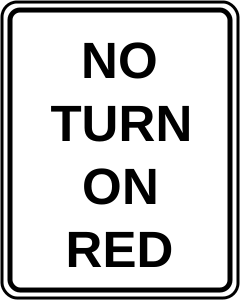
- Turns are always allowed
- Only U-turns are banned
- No turns at red where posted, plus other posted bans
- Honking is banned
Show answer
No turns at red where posted, plus other posted bans. The sign kills red-light turns: where NO TURN ON RED posts, drivers cannot turn at red, and other signs, signals, or markings can also prevent the turn. Always-allowed, U-only, and honk readings each miss the posted prohibition. New York City bans red turns citywide without permitting signs. Read the corner before turning. Read every corner carefully before attempting any red turn.
13. How far from the air bag cover should the center of your chest be, according to the New York manual?
- At least 10 inches
- At least 6 inches
- At least 18 inches
- At least 3 inches
Show answer
At least 10 inches. An opening air bag can injure someone sitting too close, so the New York manual says to sit with at least 10 inches between the center of your chest and the air bag cover. It also advises holding the wheel at the 3 and 9 o'clock positions so your hands stay clear if the bag deploys. Three or six inches is too close to the cover. Eighteen inches is more than the manual requires; the stated minimum is 10 inches.
14. What happens to a speeding ticket fine in a New York work zone when no workers are present?
- It is reduced by half
- It is waived
- It is the normal fine
- It still doubles
Show answer
It still doubles. New York doubles ticket fines for speeding in work zones, and the manual stresses that the doubling applies even when the workers or work vehicles are not there. Expect a work zone anywhere: lanes can shift or close and you may have to slow quickly or stop. Because the zone is defined by its signs rather than by visible workers, the fine is not reduced, waived, or returned to normal when the site looks empty.
15. Is a chemical test required to convict?
- Tests are always required
- Only video convicts
- Only confessions convict
- Officer testimony about driving, appearance, and behavior can convict alone
Show answer
Officer testimony about driving, appearance, and behavior can convict alone. Chemical tests are optional evidence: officer testimony about driving behavior, appearance, and interaction can convict without any chemical test. Always-required, video-only, and confession-only readings each invent prerequisites the law refuses. Weaving, stumbling, and slurring witnessed by police suffice. Refusing the test never guarantees acquittal. Refusing the chemical test never guarantees acquittal at trial. Weaving, stumbling, and slurring witnessed by police fully suffice.
16. How should you treat oncoming traffic at a scene?
- Shield yourself and others from oncoming traffic
- Stand in the lane
- Direct traffic blindly
- Ignore approaching cars
Show answer
Shield yourself and others from oncoming traffic. Live lanes threaten everyone standing in them: protect yourself and others from oncoming traffic at the scene. Lane-standing, blind-directing, and ignoring readings each offer bodies to the next impact. Get people behind barriers, post warnings early, and work from the safe side. No evidence matters more than surviving the roadside. Get people behind barriers, post warnings early, and work from the safe side.
17. After parallel parking in New York, how close must the vehicle's wheels be to the curb?
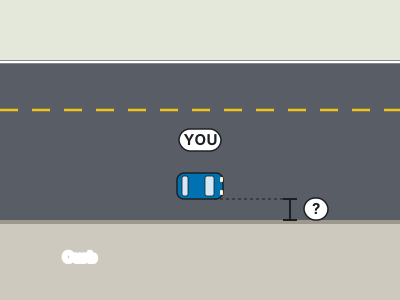
- No more than one foot from the curb
- At least two feet from the curb
- Touching the curb with the front tire
- No more than three feet from the curb
Show answer
No more than one foot from the curb. The final parallel-parking position must leave the wheels no more than one foot, or 30 centimeters, from the curb. This keeps the vehicle from protruding into moving traffic while avoiding contact with the curb. Three feet is too far away, and touching the curb is not the stated target. Use a final alignment check after pulling forward: straighten the wheels, leave room around both vehicles, and estimate the gap at roughly a foot or less.
18. What is required to pass New York's 20-question written test?
- At least 10 total correct and all four sign questions correct
- At least 14 total correct with no sign requirement
- At least 16 total correct, regardless of sign answers
- At least 14 total correct and at least 2 of the 4 road-sign questions correct
Show answer
At least 14 total correct and at least 2 of the 4 road-sign questions correct. New York uses two passing checks for the written test. The applicant must answer at least 14 of 20 questions correctly and must also answer at least two of the four road-sign questions correctly. A strong overall score cannot erase a weak sign result, while getting two signs right is not enough if the total is below 14. Treat the exam as a total-score requirement plus a separate sign checkpoint when reviewing practice results.
19. What kind of information is normally shown by a blue New York service sign?
- A mandatory traffic-control command
- Services available to road users
- A destination route and distance only
- A warning about an upcoming curve
Show answer
Services available to road users. Blue signs identify services available along the roadway, such as facilities that help travelers. They are not the normal color for a mandatory command, a yellow warning about a curve, or a green destination route. A driver can use the color as a quick classification aid, then read the symbol or words for the particular service. Because service signs provide information rather than a stop or yield order, they should not be treated like regulation signs.
20. Which way should you run from a stalled car as a train nears?
- Run down the track away from the train
- Run toward the road
- Run toward the train at a 45-degree angle away from the tracks
- Stand still
Show answer
Run toward the train at a 45-degree angle away from the tracks. Escape direction matters: run toward the general direction the train comes from, angling forty-five degrees away from the tracks. Down-track, roadward, and frozen readings each risk debris that flies forward when the train strikes the car. Running toward the train sounds wrong but keeps the wreck's debris field behind. Angle away, keep moving, and do not look back. Angle away from the rails, keep moving, and do not look back.
QualitySpace is expanding to New York
We are a California-based independent insurance brokerage working on licensing in more states. We cannot help with New York insurance yet. Leave your email and we will let you know when we can.
Every question is written from the official New York State Driver's Manual. Need paper? Printable NY practice test with answer key.
Last verified 2026-09-06. How we check every question · Study all 500 as flashcards
Frequently asked questions
How many questions are on this New York practice test?
This fixed set has 20 questions. It is test 21 of 25 from the 500 question New York bank. The real NY exam asks 20 questions and you need 14 correct.
What is the passing score for the real New York test?
You must correctly answer at least 14 of the 20 questions asked, including two of the four questions about road signs That figure comes from the official New York source cited on the DMV facts page.
How does this fixed test relate to the full New York bank?
Each numbered test is a fixed set of 20 questions in a fixed order, so you can retake the same test later and compare. Every test mixes road signs and the other topics in about the same proportion as the full bank. Tests 1 to 25 together cover every question in the New York bank once. The full practice page mixes the whole bank at random.
Last verified 2026-09-06. See the New York DMV facts page for sourced state details.
Return to the full New York practice test · Study road signs