
Test 1 of 25 · 20 questions · Free 2026
NY Permit Practice Test 1
Jump to the test ↓A fixed 20 question set from the New York bank with answers and plain English explanations. The real NY exam is 20 questions, 70 percent to pass; take the full length version on the main practice page.
Question 1 of 20 · 0 right so far
All 20 questions in test 1
Every question below comes from the New York question bank on this page. Open a question to see the correct answer and the explanation. Nothing here is hidden behind a signup.
1. Flashing red lights and a lowered gate are active at a railroad crossing. How far back must you stop?
- At least 30 feet from the tracks
- At least 3 feet from the tracks
- At least 15 feet from the tracks
- With the front bumper over the first rail
Show answer
At least 15 feet from the tracks. Flashing red lights, a lowered gate, or a bell at a railroad crossing requires stopping at least 15 feet from the tracks. Three feet is too close, while 30 feet is not the minimum stated here. Extending the bumper over a rail puts the vehicle in the crossing area. Stop before the marked line when one exists, keep clear of the rails, and wait until the signals stop and the gates are completely raised before moving.
Study this in the handbook: Railroad crossings, expressways, night and bad weather
2. May you stop beside a parked car?
- Legal briefly
- Illegal double parking
- Allowed at night
- Allowed with flashers
Show answer
Illegal double parking. Roadside-of-parked means double: stopping beside an already-parked vehicle is double parking, banned at all times. Briefly-legal, night, and flashers readings each invent exceptions the blanket ban refuses. Double parks block the travel lane, trap the curbside car, and force cyclists into traffic. Circle the block or wait legally rather than stacking. No flashers, minutes, or darkness legalize a double-parked car.
Study this in the handbook: Parallel parking and where you cannot park
3. At a railroad crossing, what does the X-shaped crossbuck require of a driver?
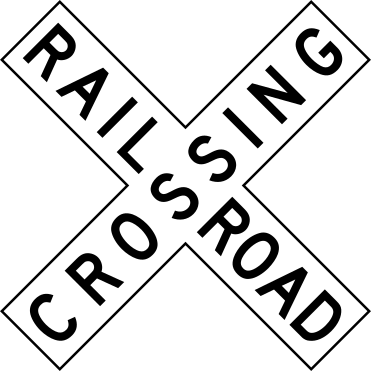
- Speed up so the train cannot reach the crossing
- Yield, look and listen, and cross only when it is safe
- Stop on the tracks until the next signal changes
- Drive around a lowered gate if no train is visible
Show answer
Yield, look and listen, and cross only when it is safe. A crossbuck marks the railroad crossing itself. The driver must yield, look and listen for trains, and proceed only after the tracks and the far side are safe. Speeding toward the rails reduces the time available to react, while stopping on the tracks creates a direct hazard. A lowered gate must never be bypassed, even when the train is not immediately visible. Use the white X and railroad wording as the cue to treat the crossing like a yield point for trains.
Study this in the handbook: Railroad crossings, expressways, night and bad weather
4. Who sets fines for street parking violations?
- Municipalities
- The state legislature
- The DMV commissioner
- Police officers
Show answer
Municipalities. Street parking fines are local: municipalities set the fines for parking violations on a street. State, commissioner, and officer readings each misplace authority the manual assigns to cities, towns, and villages. Shopping-center disability fines follow the state schedule only where municipalities set nothing higher. Expect street penalties to vary across every municipal border crossed in the state. Check local signs for the exact amount.
Study this in the handbook: Parallel parking and where you cannot park
5. When no speed limit is posted in New York, what is the statutory maximum speed?
- 45 mph
- 55 mph
- 35 mph
- 65 mph
Show answer
55 mph. New York's general statutory maximum is 55 miles per hour where no other speed limit is posted. That number is a ceiling, not a guarantee that 55 is safe for rain, congestion, darkness, or a work area. The 45, 65, and 35 mph choices belong to other road classifications or special postings. First check for a sign; if none applies, use 55 as the legal default and still adjust for conditions.
Study this in the handbook: Speed limits, space cushion and work zones
6. A driver facing this inverted red-and-white triangle should:
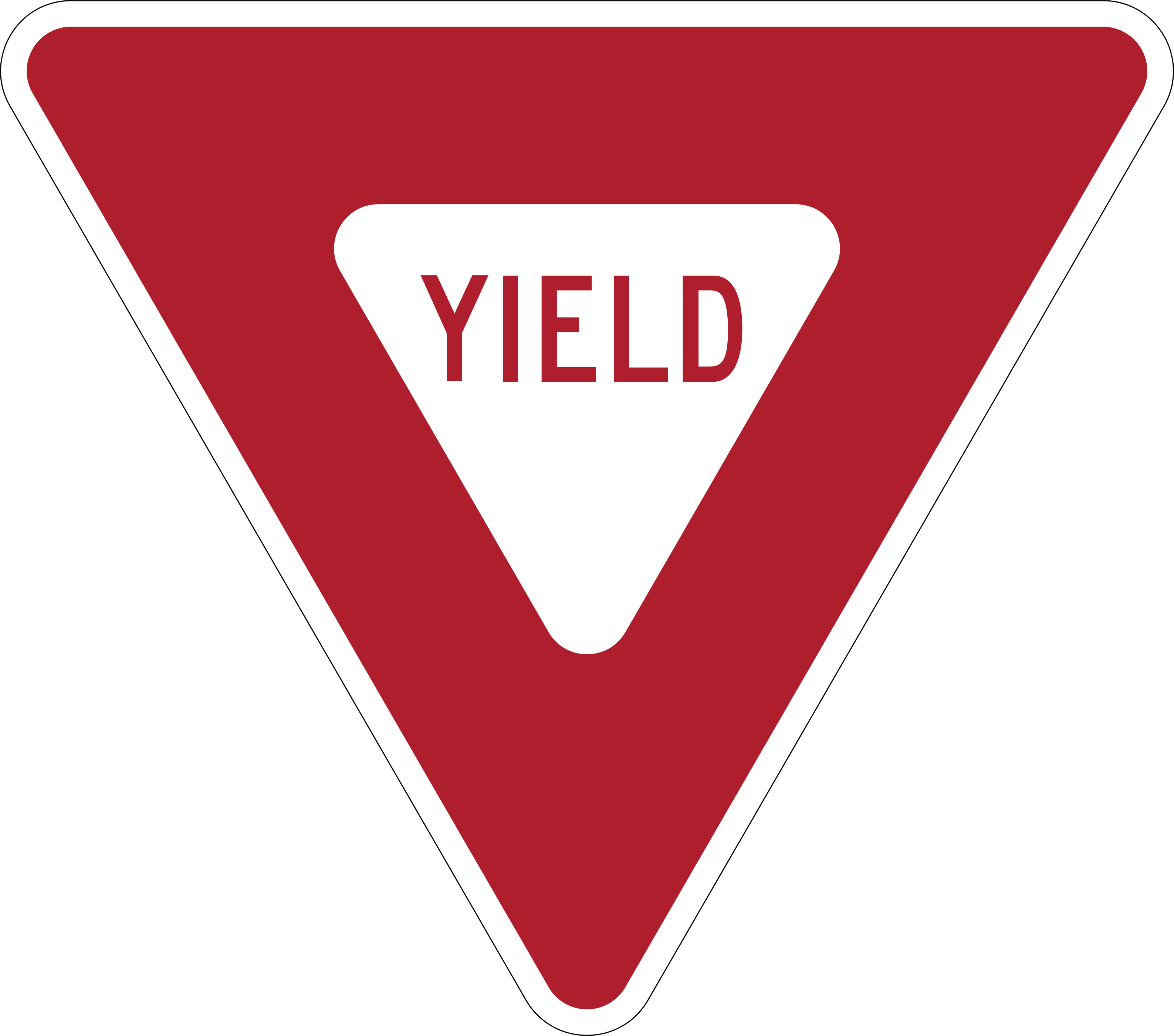
- Stop for five seconds every time, even with no traffic
- Decrease speed, prepare to stop, and yield as required
- Accelerate because the sign grants priority
- Treat the sign as a prohibition on entering the road
Show answer
Decrease speed, prepare to stop, and yield as required. The inverted triangle is a YIELD sign. It directs the driver to decrease speed, look carefully for traffic and pedestrians, and prepare to stop. A full stop is required when traffic conditions make it necessary, but a fixed five-second pause is not part of the rule. The priority and no-entry choices reverse the sign's purpose. Use the shape as a prompt to look toward the intersection, identify who has the right-of-way, and give that road user room to pass first.
Study this in the handbook: Sign shapes and colors
7. How many points for failure to exercise due care?
- 2 points
- 11 points
- 5 points
- 9 points
Show answer
5 points. Careless driving costs five points: failure to exercise due care draws five on the violation table, matching reckless driving and scene-leaving. Two points cover miscellaneous movers, eleven end licenses, and eight mark the severe tier. Due care is the everyday duty behind every maneuver, from lane changes to intersection scans. Negligent inattention that causes harm often lands here even without a more specific charge.
Study this in the handbook: Points, suspensions and probation
8. What do rectangular white signs indicate?
- Decorations
- Parking permits
- Alerts to special rules
- Speed guarantees
Show answer
Alerts to special rules. White rectangles warn of rules: rectangular white signs with black or red letters or symbols signal drivers to be alert for special rules. Decoration, permit, and guarantee readings each miss the regulatory alert. Direction, lane-use, turn, speed, and parking rules all post this way. See white rectangular, think special rule. See white rectangular signs, and think special rule ahead. Direction, lane-use, turn, speed, and parking rules post this way.
Study this in the handbook: Sign shapes and colors
9. Can you drive safely after drinking or drugs?
- Safe driving becomes impossible
- Driving improves
- Only parking suffers
- Nothing changes
Show answer
Safe driving becomes impossible. Alcohol and drugs end safe driving: once consumed, safe driving is simply not possible. Improves, parking-only, and nothing readings each deny the universal degradation of reaction, vision, and judgment. Not every impaired driver crashes, but each one endangers everyone sharing the road. The only safe impaired trip is the one never taken. The only safe impaired trip is the one that is never taken.
Study this in the handbook: Alcohol, drugs and DWI
10. Which crosswalks protect pedestrians?
- Only marked crosswalks
- Only signalized crossings
- Both marked and unmarked legal crosswalks
- No crosswalks
Show answer
Both marked and unmarked legal crosswalks. Legal crossings need no paint: drivers must yield to pedestrians legally using marked or unmarked crosswalks. Marked-only, signal-only, and none readings each erase the unmarked crossings every intersection implies. Slow down or stop as needed, and in all cases avoid colliding with pedestrians and cyclists. Paint helps, but law protects the walker either way. Paint helps visibility, but law protects the walker either way.
Study this in the handbook: Right of way, turns and U-turns
11. How old must you be to title a vehicle?
- Any age
- Only at 16 or older
- Only at 18 or older
- Only at 21 or older
Show answer
Any age. Titling has no age floor: anyone can title a vehicle at any age, unlike registration which requires sixteen. Sixteen-plus, eighteen-plus, and twenty-one-plus readings each import thresholds from licensing and registration. Ownership papers differ from operating permission. Title young, register when eligible, and drive only when licensed. Ownership papers differ from operating permission in every case. Title young, register when eligible, and drive only when fully licensed.
12. How does alcohol affect headlight glare recovery?
- Improves glare recovery
- Has no effect on glare
- Reduces glare recovery from headlights
- Eliminates headlights
Show answer
Reduces glare recovery from headlights. Alcohol blinds longer: it reduces the ability to recover from oncoming headlight glare. Improves, no-effect, and eliminates readings each deny the extended blindness when another vehicle approaches. Night drinkers stare through longer whiteouts. Sober eyes recover in moments; impaired eyes linger blind. Sober eyes recover in moments; impaired eyes linger blind much longer. Night drinkers stare through much longer blinding whiteouts ahead.
Study this in the handbook: Alcohol, drugs and DWI
13. How many points can a New York driver remove by completing a DMV-approved crash prevention course?
- Up to two points
- Up to eleven points
- All points on the record
- Up to four points
Show answer
Up to four points. New York's Motor Vehicle Crash Prevention Course, known as the Point and Insurance Reduction Program, can take up to four points off a driving record and save up to 10 percent on liability and collision premiums. It counts for point reduction once every 18 months. The course cannot prevent a mandatory suspension or revocation, cannot bank a credit against future points, and does not reduce a Driver Responsibility Assessment. Eleven points is the suspension notice threshold, not a course credit, and no course clears the record.
Study this in the handbook: Points, suspensions and probation
14. You hear a nearby siren but cannot tell where the emergency vehicle is. What should you do?
- Pull safely to the right edge and stop until its direction is clear
- Continue at the speed limit while watching the mirrors
- Pull left and stop beside the center line
- Turn around to search for the emergency vehicle
Show answer
Pull safely to the right edge and stop until its direction is clear. When a nearby siren or air-horn cannot be located, New York directs you to pull safely to the right-side edge and stop. Continuing forward may place you in the responder path. Stopping at the center line leaves less room, and turning around creates another conflict. Ease right without cutting across traffic, stop, and remain there until you know the emergency vehicle is not approaching. Sound is the cue to begin.
Study this in the handbook: Right of way, turns and U-turns
15. How early must a New York driver signal a turn or lane change?
- At least 100 feet before the maneuver
- Only after beginning to turn
- At least 500 feet before every maneuver
- At least 25 feet before the maneuver
Show answer
At least 100 feet before the maneuver. New York requires a turn or lane-change signal at least 100 feet before the maneuver. Twenty-five feet provides less warning, and signaling after the movement gives other road users no useful notice. Five hundred feet is not the ordinary distance. Signal before braking when possible so following drivers can read your plan, then check traffic and complete the movement only when safe.
Study this in the handbook: Right of way, turns and U-turns
16. How should you handle a post-blowout skid?
- Steer wildly
- Brake hard
- Close your eyes
- Handle it as you would on ice or snow
Show answer
Handle it as you would on ice or snow. Blowout skids follow winter rules: if the vehicle skids after a blowout, handle it as on ice or snow. Wild-steering, hard-braking, and eye-closing readings each abandon the gentle corrections skids require. Steer toward the slide, ease inputs, and wait for grip to return. The same skid recovery works whatever stole the traction. Steer gently toward the slide and wait for grip to come back.
Study this in the handbook: Railroad crossings, expressways, night and bad weather
17. What protective gear must motorcyclists wear?
- Approved helmets plus goggles or a face shield
- No gear needed
- Only gloves
- Only boots
Show answer
Approved helmets plus goggles or a face shield. Riders gear the head and eyes: motorcyclists must wear approved helmets plus goggles or a face shield. None, gloves-only, and boots-only readings each skip the mandated protection. Even so, bikes offer no frame shielding car drivers enjoy. Gear up fully; the road forgives nothing. Gear up fully for riding; the road forgives nothing ever. Bikes offer no frame shielding like car drivers enjoy.
Study this in the handbook: Pedestrians, bicycles, motorcycles and trucks
18. What is leaving a property-damage scene?
- A reward
- Nothing
- A criminal charge
- A traffic violation
Show answer
A traffic violation. Fleeing property damage is ticket-level crime: leaving the scene of a property-damage incident is a traffic violation. Reward, nothing, and criminal readings each misgrade an offense the law places below injury-flight but above nothing. Penalties still fine, point, and record the runner. Injury or fatal flight escalates the same act into criminal violation territory. Penalties still fine, point, and record every driver who runs away.
Study this in the handbook: What to do after a crash
19. What if passing would interfere with oncoming traffic?
- Pass anyway
- Speed up
- Flash lights
- Do not pass if you would interfere with oncoming traffic
Show answer
Do not pass if you would interfere with oncoming traffic. Interference vetoes every pass: if attempting the pass would interfere with oncoming traffic, it must not begin. Anyway, speed-up, and flash readings each force a maneuver the rule flatly bans. Interference includes forcing oncoming drivers to brake or swerve. The pass can wait for a truly clear stretch; head-ons cannot be undone. The pass can wait for a truly clear stretch; head-on crashes cannot be undone.
Study this in the handbook: Passing on the left and the right
20. Where should you wait inside for a left turn?
- Left of the center line
- Right of the center line
- On the crosswalk
- In the bike lane
Show answer
Right of the center line. Staged left-turners hug the middle correctly: inside the intersection, keep to the right of the center line. Left-of-center, crosswalk, and bike-lane readings each stage the car where oncoming traffic or pedestrians travel. Right-of-center staging leaves room for opposing left-turners and through traffic alike. Pair it with straight wheels against rear-end shoves. Pair center-right staging with straight wheels against rear-end shoves.
Study this in the handbook: Right of way, turns and U-turns
QualitySpace is expanding to New York
We are a California-based independent insurance brokerage working on licensing in more states. We cannot help with New York insurance yet. Leave your email and we will let you know when we can.
Every question is written from the official New York State Driver's Manual. Need paper? Printable NY practice test with answer key.
Last verified 2026-10-05. How we check every question · Study all 500 as flashcards
Frequently asked questions
How many questions are on this New York practice test?
This fixed set has 20 questions. It is test 1 of 25 from the 500 question New York bank. The real NY exam asks 20 questions and you need 14 correct.
What is the passing score for the real New York test?
You must correctly answer at least 14 of the 20 questions asked, including two of the four questions about road signs That figure comes from the official New York source cited on the DMV facts page.
How does this fixed test relate to the full New York bank?
Each numbered test is a fixed set of questions in a fixed order, so you can retake the same test later and compare. Every test mixes road signs and the other topics in about the same proportion as the full bank. Tests 1 to 25 together cover every question in the New York bank once. The full practice page mixes the whole bank at random.
Last verified 2026-10-05. See the New York DMV facts page for sourced state details.
Return to the full New York practice test · Study road signs