
Test 17 of 25 · 20 questions · Free 2026
NY Permit Practice Test 17
Jump to the test ↓A fixed 20 question set from the New York bank with answers and plain English explanations. The real NY exam is 20 questions, 70 percent to pass; take the full length version on the main practice page.
Question 1 of 20 · 0 right so far
All 20 questions in test 17
Every question below comes from the New York question bank on this page. Open a question to see the correct answer and the explanation. Nothing here is hidden behind a signup.
1. What do solid edge lines indicate?
- Lane centers
- Where the travel lane ends and the shoulder begins
- Parking spaces
- Speed limits
Show answer
Where the travel lane ends and the shoulder begins. Edge lines mark pavement limits: solid side lines show where the travel lane ends and the shoulder begins. Centers, parking, and speed readings each misread the boundary keeping traffic on the road. Crossing them is illegal except by officer direction or official sign. Angling centerward, they warn the road narrows ahead. Crossing edge lines is illegal except by officer direction or sign.
2. What license action follows a first New York conviction for driving while ability impaired by alcohol (DWAI) for a driver 21 or older?
- A minimum six-month revocation
- A minimum one-year revocation
- A 90-day suspension
- No license action, only a fine
Show answer
A 90-day suspension. New York's lowest alcohol offense, DWAI, applies when a driver's ability is impaired by alcohol, which includes a BAC above .05 up to .07. A first conviction brings a 90 day suspension and a fine of $300 to $500. The six-month minimum revocation is for DWI at .08 or higher, and the one-year minimum revocation is for aggravated DWI at .18 or higher. DWAI is a traffic infraction, but it still takes the license; a fine alone is not the whole penalty. A driver who was under 21 when arrested faces a minimum one-year revocation instead.
3. What happens to a New York driver under 21 who commits a second Zero Tolerance violation?
- Revocation for at least one year or until age 21, whichever is longer
- Another six-month suspension
- A 90-day suspension
- A $125 fine with no license action
Show answer
Revocation for at least one year or until age 21, whichever is longer. The first Zero Tolerance violation suspends a young New York driver for six months, but a second one leads to revocation. The license is revoked for at least one year or until the driver turns 21, whichever period is longer. A 19-year-old would therefore wait until 21, while someone who is 20 and a half would still serve the full year. Repeating the six-month suspension or a 90 day suspension describes lighter penalties, and a fine alone ignores the license action entirely.
4. A New York vehicle has driver-assistance sensors. Which condition can interfere with those safety features?
- A dry road with clear lane markings
- A clean windshield on a straight road
- A fully charged phone in the cabin
- Fog, snow, or a curve
Show answer
Fog, snow, or a curve. New York treats driver assistance as help for an attentive driver, not as a substitute for observation. Rain, snow, ice, fog, hills, and curves can prevent sensors or related systems from working properly. A clean windshield or a charged phone does not remove those environmental limits. The practical cue is changing conditions: keep scanning with mirrors and head checks, maintain control yourself, and be ready to respond when an alert is late, absent, or inaccurate.
5. What should you do to speed in snow or fog?
- Reduce speed
- Maintain speed
- Increase speed
- Stop in the lane
Show answer
Reduce speed. Precipitation lowers every ceiling: snow, rain, sleet, and fog each demand reduced speed alongside low beams and earlier signals. Maintaining, increasing, and lane-stopping responses each misread conditions the manual treats as universally slowing. Traction falls, visibility shrinks, and other drivers brake unpredictably, so the cushion must grow on both axes. Slow early, signal sooner, and brake gently until the sky clears.
6. How do you snug closer to the curb?
- Alternate forward and back, steering curbward then straight
- Ram the curb once
- Give up and double-park
- Stay far from the curb
Show answer
Alternate forward and back, steering curbward then straight. Closing the last gap uses a shuffle: alternately pull forward and back up, steering first toward the curb then quickly straight again. Ramming, surrendering, and staying-wide readings each fail where the patient shuffle succeeds. Each cycle walks the car sideways inches closer without striking the concrete. Repeat until the wheels rest within a foot, straight and even. Patience with the shuffle beats strength against the curb.
7. Do all intersections use three-color signals?
- Yes, always three colors
- No, some use lone single-color lights
- Only arrows exist
- No signals exist
Show answer
No, some use lone single-color lights. Signal heads vary by intersection: some locations use lone red, yellow, or green lights instead of the standard three-color stack. Always-three, arrows-only, and none readings each deny the variety the manual describes. Some lights run steady while others flash; some are round and some are arrows. Read each head as installed. Read each signal head exactly as it is installed there.
8. How many crashes occur yearly in New York?
- About 30,000
- About 100,000
- More than 300,000
- Almost none
Show answer
More than 300,000. New York crashes number in the hundreds of thousands: more than three hundred thousand traffic crashes occur statewide each year. Thirty-thousand, hundred-thousand, and almost-none readings each shrink a toll that touches every county. Even careful drivers meet others' errors and unplanned events. Obey the law, drive defensively, and stay ready to act responsibly at any scene. Three hundred thousand yearly crashes demand constant readiness.
9. What should you do while being passed on the left?
- Speed up to block
- Slow slightly and stay centered in your lane
- Swerve left
- Brake hard
Show answer
Slow slightly and stay centered in your lane. Being passed calls for steadiness: when another vehicle passes on the left, decrease speed slightly and stay centered in the lane. Blocking, swerving, and hard-braking readings each fight a maneuver that cooperation completes safely. Once the passer clears ahead, resume normal speed. If many pass on the right, move right and let the left pass properly. If many pass you on the right, move right and let the left pass properly.
10. What does this deer warning sign mean?

- A zoo ahead
- An area with frequent deer-vehicle collisions
- A hunting zone
- A farm stand
Show answer
An area with frequent deer-vehicle collisions. Deer signs mark proven crossings: areas with many deer-vehicle collisions get deer-crossing signs. Zoo, hunting, and farm-stand readings each invent attractions the warning never promises. Dawn, dusk, and October-through-December raise the risk most. See the leaping deer, slow down and scan roadsides. See the leaping deer, slow down, scan both roadsides well. Dawn, dusk, and fall months raise deer risk the most.
11. A curb in New York is posted with a NO PARKING sign. What may a driver still do there?
- Leave the car for up to 15 minutes
- Nothing; the vehicle may not stop for any reason
- Make a temporary stop to load or unload merchandise or passengers
- Park overnight if the meter is paid
Show answer
Make a temporary stop to load or unload merchandise or passengers. New York divides what people call parking into three categories: parking, standing and stopping. Of the three posted signs, NO PARKING allows the most. It means you can make a temporary stop to load or discharge merchandise or passengers, such as dropping off a rider or unloading a delivery. Leaving the vehicle there for any other purpose is parking, which the sign forbids. Stricter signs, NO STANDING and NO STOPPING, take away more of these choices.
12. A New York driver facing a steady green light wants to turn left. What is still required?
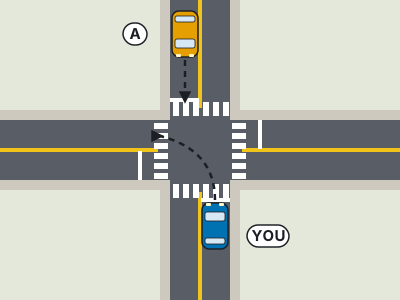
- Turn immediately because green guarantees priority
- Yield to oncoming traffic and pedestrians as required by law
- Yield only to vehicles traveling behind the driver
- Wait for the signal to become red before entering
Show answer
Yield to oncoming traffic and pedestrians as required by law. A steady green light permits movement but does not erase right-of-way duties. A driver turning left must still yield to oncoming traffic and pedestrians when the law requires it. Turning immediately can cut across a vehicle moving straight, and waiting for red reverses the meaning of the signal. Traffic behind the turning driver is not the main conflict. Use the green as permission to prepare, then scan ahead and across the intersection, enter only when appropriate, and complete the turn after the opposing path is clear.
13. How many points does New York assess for driving 15 mph over the posted limit?
- 3
- 6
- 8
- 4
Show answer
4. New York's point table rises with the amount over the limit. Speeding 1 to 10 mph over is 3 points, 11 to 20 mph over is 4 points, 21 to 30 mph over is 6 points, 31 to 40 mph over is 8 points, and more than 40 mph over is 11 points. Fifteen over falls in the 11 to 20 band. Three points is only for the lowest band, and 6 or 8 points require going more than 20 or 30 mph over. Eleven points within 24 months brings a suspension notice.
14. How many points does New York assess for passing a stopped school bus?
- Three
- Five
- Eight
- Eleven
Show answer
Eight. Passing a stopped school bus is an 8 point violation in New York, higher than reckless driving at 5 points. Three passing a stopped school bus violations within three years lead to a revocation of at least six months, and owners of vehicles caught by school bus stop arm cameras also face a $250 penalty for a first violation. Three points is the value for ordinary right of way or signal violations. Eleven points is the value for an alcohol or drug related incident or speeding more than 40 mph over. Drivers must stop at least 20 feet from a bus showing flashing red lights.
15. A New York driver with a full license and no probation talks on a hand-held phone while driving for the first time. What penalty can apply?
- A fine up to $200 and five license points
- A $50 fine and no points
- Two points and no fine
- Nothing, if the call was short
Show answer
A fine up to $200 and five license points. Holding a phone to talk or listen while driving is a traffic infraction in New York. A first offense can bring a fine of up to $200 and five points, and the point table lists the same five points for phone or portable device use. A hands-free phone, which needs neither hand, may be used at any time, and the phone may be held briefly to start or end a call. A $50 fine is the seat belt figure, not the phone penalty. A short call is still a violation.
16. A stopped hazard vehicle occupies the shoulder of a New York interstate. When is changing lanes not required?
- Whenever the driver is running late
- Whenever the stopped vehicle is on the shoulder
- When traffic or another hazard prevents a safe lane change
- Only when a police officer waves traffic through
Show answer
When traffic or another hazard prevents a safe lane change. The lane-change part of New York's Move Over rule is conditioned on safety. A driver must leave the lane beside the stopped emergency or hazard vehicle on a multilane controlled-access road unless traffic or another hazard makes that maneuver unsafe. Being late is not an exception, and the shoulder location is precisely why caution is needed. A police officer need not provide a signal. Reduce speed, assess the opening, and stay put only when moving over would create greater danger.
17. May you stop inside an intersection?
- Only if signs or meters permit
- Always allowed
- Never under any condition
- Only on Sundays
Show answer
Only if signs or meters permit. Intersections generally forbid halts: no parking, stopping, or standing unless signs or parking meters permit it. Always, never, and Sundays readings each miss the conditional ban that meters and signs can lift. Intersection stops block sight lines and turning paths from every direction. Read the curb hardware; silence means keep moving. Intersection hardware speaks; curb silence means keep the wheels rolling.
18. What happens when tires hydroplane in heavy rain?
- Tires riding on road water, risking total loss of traction and steering
- Engine flooding
- Brake failure
- Tire melting
Show answer
Tires riding on road water, risking total loss of traction and steering. Hydroplaning floats tires off the road: in heavy rain, tires can ride on the water film above the pavement, causing complete loss of traction and steering control. Engine-flood, brake-fail, and melt readings each misname a traction failure. Higher speeds invite it, as do worn or underinflated tires. Slow down in downpours before the tires start surfing. Slow down in downpours well before the tires start surfing water.
19. What is a driver prohibited from doing in a New York dedicated bicycle lane or bike box?
- Checking for bicycles before turning across it
- Reducing speed near the marked area
- Yielding to a cyclist using the space
- Operating in the dedicated space
Show answer
Operating in the dedicated space. New York's manual says drivers are prohibited from operating in dedicated bicycle spaces, including bicycle lanes and bike boxes. Checking, yielding, and slowing are safety actions that help a driver cross or turn near the feature without entering it as a travel lane. The green paint increases visibility but does not make the area available for passing or waiting. Use the marking as a boundary: scan for cyclists, yield as needed, and cross only when the maneuver is lawful and safe.
20. How should a New York driver approach an intersection controlled by a flashing yellow signal?
- Stop and wait for a green signal
- Slow down and proceed with caution
- Treat it as a solid red light
- Accelerate before cross traffic arrives
Show answer
Slow down and proceed with caution. A flashing yellow signal tells the driver to slow down and proceed with caution. It does not require the automatic stop associated with a red signal, but it also does not invite acceleration. Waiting for green would misread the signal, while treating it as solid red would apply the wrong control. Scan for cross traffic, pedestrians, and turning vehicles, then enter only when the intersection is clear. The yellow flash is a warning to reduce speed and be ready to yield.
QualitySpace is expanding to New York
We are a California-based independent insurance brokerage working on licensing in more states. We cannot help with New York insurance yet. Leave your email and we will let you know when we can.
Every question is written from the official New York State Driver's Manual. Need paper? Printable NY practice test with answer key.
Last verified 2026-09-06. How we check every question · Study all 500 as flashcards
Frequently asked questions
How many questions are on this New York practice test?
This fixed set has 20 questions. It is test 17 of 25 from the 500 question New York bank. The real NY exam asks 20 questions and you need 14 correct.
What is the passing score for the real New York test?
You must correctly answer at least 14 of the 20 questions asked, including two of the four questions about road signs That figure comes from the official New York source cited on the DMV facts page.
How does this fixed test relate to the full New York bank?
Each numbered test is a fixed set of 20 questions in a fixed order, so you can retake the same test later and compare. Every test mixes road signs and the other topics in about the same proportion as the full bank. Tests 1 to 25 together cover every question in the New York bank once. The full practice page mixes the whole bank at random.
Last verified 2026-09-06. See the New York DMV facts page for sourced state details.
Return to the full New York practice test · Study road signs