
Test 13 of 25 · 20 questions · Free 2026
NY Permit Practice Test 13
Jump to the test ↓A fixed 20 question set from the New York bank with answers and plain English explanations. The real NY exam is 20 questions, 70 percent to pass; take the full length version on the main practice page.
Question 1 of 20 · 0 right so far
All 20 questions in test 13
Every question below comes from the New York question bank on this page. Open a question to see the correct answer and the explanation. Nothing here is hidden behind a signup.
1. What freezes first when snow begins to fall?
- Bridges, ramps, and overpasses
- Tunnels
- Parking garages
- Underpasses
Show answer
Bridges, ramps, and overpasses. Elevated pavement freezes first: when wintry precipitation begins, bridges, ramps, and overpasses ice before ordinary roadways because cold air surrounds them. Tunnels, garages, and underpasses each shelter nearer ground warmth. The first flakes should trigger bridge caution long before the highway glazes. Ease off approaching every span, avoid sudden inputs on the deck, and expect ice where the road leaves the earth.
2. How many points for 31 to 40 over the limit?
- 6 points
- 8 points
- 11 points
- 2 points
Show answer
8 points. High-end speeding nears suspension territory: thirty-one to forty over draws eight license points. Six points cover twenty-one-to-thirty, eleven points need forty-plus, and four points belong to eleven-to-twenty. Paired with any three-point violation, an eight-point ticket crosses the eleven-point suspension line within eighteen months. Triple-digit-adjacent speeds on ordinary roads risk the license itself, not just the wallet, plus steep fines and surcharges.
3. How do you move a victim from fire danger?
- Keep back and neck straight, support under back and neck, pull head-first by clothing
- Drag by the feet
- Lift by the head
- Twist the body
Show answer
Keep back and neck straight, support under back and neck, pull head-first by clothing. Emergency moves protect the spine: keep back and neck straight, arms under the back, neck supported by upper arms, grip clothing, and pull head-first from danger. Feet-dragging, head-lifting, and twisting readings each snap the alignment the technique preserves. Straight-line drags minimize cord damage. Rehearse the method before the fire that demands it. Rehearse the method now, before the fire that demands it ever comes.
4. Should you stop at a crash you were not in?
- Always stop to watch
- Stop only if involved or no help has arrived
- Never stop ever
- Stop to take photos
Show answer
Stop only if involved or no help has arrived. Gawking is banned: do not stop at a crash scene unless involved or emergency help has not arrived. Always-watch, never-ever, and photo readings each clog the road rescuers need. Focus on driving and obey traffic officers' directions instead. Rubbernecking causes the secondary crashes behind the first. Focus on driving and obey traffic officers' directions through the area instead. Rubbernecking causes the secondary crashes behind the first one.
5. A licensed driver moves to New York permanently from another state. How soon must they get a New York license?
- Within 30 days of becoming a permanent resident
- Within 10 days
- Within 90 days
- When the out-of-state license expires
Show answer
Within 30 days of becoming a permanent resident. New York lets licensed visitors drive, but new residents must switch. Drivers who have moved here must turn in their out-of-state driver license and get a New York license within 30 days of becoming a permanent resident, and in most cases it is illegal to hold licenses from two states at once. Waiting until the old license expires, or for 90 days, is too long. Ten days is the deadline for reporting a change of address to DMV, not for switching a license from another state.
6. What forms can traffic lights take?
- Only round green
- Only arrows
- Steady or flashing, round or arrow
- Only hanging
Show answer
Steady or flashing, round or arrow. Traffic lights mix forms freely: some run steady while others flash, and some display round lenses while others show arrows. Round-only, arrow-only, and hanging-only readings each freeze hardware the manual describes as varied. Colors arrange red-yellow-green top-to-bottom or left-to-right. Interpret each combination by color, motion, and shape together. Interpret every combination by color, motion, and shape together always. Never assume a head shows three colors.
7. Near this school crossing sign, when must a New York driver yield to pedestrians?

- Only at crossings with a crossing guard
- Only when a signal shows WALK
- Only when the crosswalk is painted
- At all crosswalks and intersections, whether marked or unmarked, including when turning
Show answer
At all crosswalks and intersections, whether marked or unmarked, including when turning. The School Crossing sign shows two people crossing a road and warns that children may be crossing ahead. The pedestrian rule that applies there is broader than paint: pedestrians have the right of way at all crosswalks, and you must yield to pedestrians when making right or left turns and at all crosswalks and intersections, whether marked or unmarked. A crossing guard's signal must be obeyed, but the duty to yield does not depend on a guard, on painted lines, or on a WALK signal. Slow down near the sign and be ready to stop.
8. Why should a New York driver avoid lingering beside a large truck?
- The truck's side blind spot can hide the car from its driver
- The truck's headlights cannot illuminate a passing car
- The truck is required to stop whenever a car is beside it
- The truck always has priority in every lane
Show answer
The truck's side blind spot can hide the car from its driver. Large vehicles have broad side blind spots, and a car remaining there may be invisible to the truck driver even when the driver knows a vehicle is nearby. That does not give the truck automatic priority or require it to stop. The safer plan is to pass with room, avoid staying alongside the trailer, and make sure the truck driver can see your vehicle before settling into the lane ahead. If you cannot see the truck’s mirrors, assume the driver may not see you.
9. What colors are work-area signs?
- Orange with black letters or symbols
- Yellow with black letters
- Red with white letters
- Blue with white letters
Show answer
Orange with black letters or symbols. Work zones glow orange: work-area signs show orange with black letters or symbols. Yellow, red, and blue readings each borrow warning, regulatory, or service colors. Orange means people at work with possible flagger control. See orange, slow down and stay alert. See orange work signs, slow down, and stay fully alert. Orange means workers present with possible flagger control nearby.
10. How should you secure a car parked on a hill?
- Leave it in neutral
- Set the brake and Park or 1st gear
- Turn wheels uphill only
- Leave the engine running
Show answer
Set the brake and Park or 1st gear. Hills demand triple security: set the parking brake and select Park, or first gear with a manual transmission. Neutral-only, wheels-only, and running-engine readings each skip the brake-and-gear pair that holds the car. The brake grips the wheels while the gear locks the drivetrain, backing each other up. Add curbward wheels, and gravity gets three opponents. Brake plus gear plus curbward wheels triple-locks the hill park.
11. Before a New York driver whose license was revoked for a first chemical test refusal can be relicensed, what civil penalty must be paid?
- $50
- $125
- $500
- $2,500
Show answer
$500. New York attaches a civil penalty to a refusal revocation, and it must be paid before a new license application is accepted. For a chemical test refusal the penalty is $500, or $550 if the driver was operating a commercial motor vehicle. If the refusal came within five years of an earlier alcohol, drug, or refusal revocation, the penalty rises to $750. Fifty dollars is the usual suspension termination fee, and $125 is the Zero Tolerance civil penalty. The refusal also carries a $250 yearly Driver Responsibility Assessment for three years.
12. How do you begin rolling out?
- Floor it left
- Shoulder-check left, roll forward avoiding the car ahead
- Close your eyes
- Reverse into traffic
Show answer
Shoulder-check left, roll forward avoiding the car ahead. The committed roll starts left-checked: look over the left shoulder through the rear window, drive slowly forward, and avoid the parked car ahead. Flooring, blind, and reversing readings each turn the exit into a strike. The left shoulder covers the lane being entered; slow speed preserves the abort. Clear the forward bumper, then complete the lane entry when safe. Slow left-checked rolls keep the exit abortable to the end.
13. May you U-turn on a green left-turn arrow?
- Never on any signal
- On a green-arrow left-turn signal if allowed, yielding to others
- On any red light
- Without yielding
Show answer
On a green-arrow left-turn signal if allowed, yielding to others. Green arrows can authorize U-turns: unless signs forbid, drivers may U-turn on a green-arrow left-turn signal where allowed, yielding to other traffic. Never, red-light, and no-yield readings each misstate the conditional permission. The arrow grants direction, not priority; cross traffic and pedestrians still hold rights. Check the signs, take the arrow, and yield through the arc. Check the signs, take the arrow, and yield to all others through the arc.
14. Whom should you ask about driving on medication?
- Guess and drive
- Ask friends only
- Ask your doctor or pharmacist
- Ignore the question
Show answer
Ask your doctor or pharmacist. Medication doubts go to professionals: when unsure about driving on a drug, ask a doctor or pharmacist. Guess, friends-only, and ignore readings each gamble with chemistry only experts understand. Prescription and over-the-counter drugs alike can match alcohol's impairment. One question prevents one crash. Prescription and over-the-counter drugs alike can match alcohol impairment. Just one professional question can prevent one terrible crash.
15. What is the minimum age for a New York Junior Operator (Class DJ) license?
- 16
- 15
- 17
- 18
Show answer
16. New York's Class DJ, the Junior Operator license, starts at age 16 and comes with limits on where, when, and with whom the holder may drive. A senior Class D license normally requires age 18, or 17 with a driver education Certificate of Completion, so 17 and 18 describe the senior license rather than the junior one. Fifteen is too young for a New York license of any kind. A DJ holder may drive vehicles up to 10,000 pounds GVWR and operate Class B and C mopeds.
16. A New York driver over 21 refuses a chemical test for the first time. What is the minimum license revocation?
- 18 months
- Six months
- 30 days
- One year
Show answer
One year. Refusing a chemical test has its own penalty separate from any DWI conviction. For drivers over 21 a first refusal brings a minimum one-year revocation, and a refusal within five years of a prior refusal revocation or any alcohol or drug related violation brings a minimum 18-month revocation. Drivers under 21 face at least one year for a first refusal. The 18-month figure is the repeat case, not the first offense.
17. May you turn on red in New York City?
- Always allowed
- Allowed after midnight
- Never unless a permitting sign is posted
- Allowed on weekends
Show answer
Never unless a permitting sign is posted. New York City bans red-light turns: turning on red is not allowed there unless a sign permitting it is posted. Always, midnight, and weekend readings each invent permissions the citywide ban refuses. Outside the city, turns follow stop-plus-yield rules. In the five boroughs, wait for green. Outside the city, turns follow stop-plus-yield rules instead. In the five boroughs, drivers must wait for green lights.
18. About how far ahead do New York headlights cover during night driving?
- About 100 feet
- About 350 feet
- About 500 feet
- About 1,000 feet
Show answer
About 350 feet. The manual says headlights cover about 350 feet ahead and advises driving at a speed that allows a stop within that distance. One hundred feet understates the visible range, while 500 and 1,000 feet overstate it. This is driving within the range of the headlights. At night, especially on an unfamiliar or curving road, choose a speed that leaves enough pavement inside the illuminated area for a controlled stop.
19. A New York driver turns across a two-way cycle track beside the roadway. Which cyclist movement must the driver anticipate?
- Only bicycles traveling in the same direction as nearby cars
- No bicycles, because the track is a pedestrian sidewalk
- Bicycles traveling in either direction along the track
- Bicycles only when a painted arrow points toward the turn
Show answer
Bicycles traveling in either direction along the track. A two-way cycle track is a marked bicycle lane that permits travel in both directions, so a turning driver must check for a cyclist approaching from either side of the roadway alignment. The same-direction-only choice overlooks a rider coming against the nearby vehicle flow. It is also not a decorative sidewalk and does not depend on a special arrow being visible. Before crossing the track, slow, signal, look both ways, and yield to a cyclist already using the designated space.
20. You have a green light and want to turn left in New York. What must you do before turning?
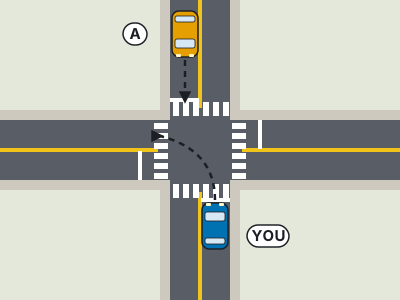
- Turn immediately because green gives absolute priority
- Yield only to vehicles displaying a left-turn signal
- Wait for the vehicle behind you to pass first
- Yield to oncoming vehicles going straight or turning right
Show answer
Yield to oncoming vehicles going straight or turning right. A green signal permits movement but does not give a left-turning driver an unrestricted path across opposing traffic. The turner must yield to oncoming vehicles traveling straight or turning right. A vehicle without a signal may still continue through the intersection, so waiting for a turn indicator is unsafe. The visual cue is the opposing lane: keep the wheels straight while waiting, watch for gaps, and turn only after the conflict is gone.
QualitySpace is expanding to New York
We are a California-based independent insurance brokerage working on licensing in more states. We cannot help with New York insurance yet. Leave your email and we will let you know when we can.
Every question is written from the official New York State Driver's Manual. Need paper? Printable NY practice test with answer key.
Last verified 2026-09-06. How we check every question · Study all 500 as flashcards
Frequently asked questions
How many questions are on this New York practice test?
This fixed set has 20 questions. It is test 13 of 25 from the 500 question New York bank. The real NY exam asks 20 questions and you need 14 correct.
What is the passing score for the real New York test?
You must correctly answer at least 14 of the 20 questions asked, including two of the four questions about road signs That figure comes from the official New York source cited on the DMV facts page.
How does this fixed test relate to the full New York bank?
Each numbered test is a fixed set of 20 questions in a fixed order, so you can retake the same test later and compare. Every test mixes road signs and the other topics in about the same proportion as the full bank. Tests 1 to 25 together cover every question in the New York bank once. The full practice page mixes the whole bank at random.
Last verified 2026-09-06. See the New York DMV facts page for sourced state details.
Return to the full New York practice test · Study road signs