
Test 19 of 25 · 20 questions · Free 2026
NY Permit Practice Test 19
Jump to the test ↓A fixed 20 question set from the New York bank with answers and plain English explanations. The real NY exam is 20 questions, 70 percent to pass; take the full length version on the main practice page.
Question 1 of 20 · 0 right so far
All 20 questions in test 19
Every question below comes from the New York question bank on this page. Open a question to see the correct answer and the explanation. Nothing here is hidden behind a signup.
1. What should you do at a broken traffic light?
- Stop as for a stop sign
- Speed through
- Ignore the intersection
- Turn around
Show answer
Stop as for a stop sign. Dead signals mean stop signs: when lights or controls are out of service or malfunctioning, drivers must stop as for a stop sign. Speed-through, ignore, and turn-around readings each dodge the rule treating dark intersections as all-way stops. Then continue by right-of-way rules unless an officer directs otherwise. No lights, same caution. Then continue by right-of-way unless an officer directs you otherwise.
2. How do bicyclists react to road hazards?
- They never change direction
- They signal every move
- They may swerve suddenly for road hazards
- They always stop
Show answer
They may swerve suddenly for road hazards. Bicyclists dodge like motorcyclists: riders near or ahead can react to hazards with sudden changes of speed, direction, or lane position. Never-change, always-signal, and always-stop readings each expect predictability potholes destroy. Give them maneuvering room and following distance. Expect the swerve before it happens. Give riders maneuvering room plus extra following distance. Potholes destroy the predictability that drivers often expect.
3. What fine can a New York driver face for failing to wear a seat belt?
- Up to $500
- Up to $25
- Up to $50
- There is no fine, only points
Show answer
Up to $50. Under New York's occupant restraint law the driver must be properly restrained by a seat belt, and a driver who fails to buckle up can face a fine of up to $50. A passenger 16 or older who fails to buckle up faces the same maximum. The $25 and $500 figures are not the manual's number for this violation, and it is not a points only matter, although a driver who fails to restrain a passenger under 16 faces a fine of $25 to $100 and three points.
4. What surcharge attaches to disability parking penalties?
- $5
- $30 mandatory on each penalty
- $200
- No surcharge
Show answer
$30 mandatory on each penalty. Every disability-parking penalty grows by thirty: a mandatory thirty-dollar surcharge is added to each penalty. Five-dollar, two-hundred, and none readings each misstate the fixed add-on atop the base fine schedule. First and second shopping-center offenses alike carry it. Municipal street fines add their own local extras beyond this state surcharge, so expect still more on any city street ticket you receive.
5. How many decisions does each driving mile require?
- Hundreds of decisions every mile
- One decision per trip
- No decisions needed
- Decisions only at stops
Show answer
Hundreds of decisions every mile. Driving is decision-dense: every mile demands hundreds of decisions that become the actions keeping the vehicle controlled and crash-free. One-per-trip, none, and stops-only readings each trivialize the continuous judgment driving requires. Alcohol corrupts both the decisions and their execution. Hundreds of chances per mile for impairment to kill. Hundreds of chances per mile for impairment to kill someone. Alcohol corrupts both the decisions and their physical execution badly.
6. How many New York traffic deaths involve impairment?
- Under 10 percent
- About 20 percent
- More than 40 percent
- Zero percent
Show answer
More than 40 percent. Impairment drives New York fatalities: more than forty percent of all motor vehicle deaths in the state involve impaired driving. Ten, twenty, and zero readings each shrink a share approaching half of all road deaths. Behind the number lie shortened lives, disabling injuries, and devastated families. Every impaired trip gambles membership in that statistic. Every impaired trip gambles membership in that deadly statistic.
7. What colors is a STOP sign?
- Red with white letters
- Blue with white letters
- Green with white letters
- Yellow with black letters
Show answer
Red with white letters. Stop signs wear red and white: the octagon shows red with white letters. Blue, green, and yellow readings each dress it in service, destination, or warning colors. Color plus shape plus legend make stops unmistakable day and night. See red octagon, prepare to stop fully. See red octagons ahead, and prepare to stop fully there. Color plus shape plus legend make stops unmistakable always.
8. How many points does a signal, stop-sign, or yield-sign violation carry?
- 2 points
- 5 points
- 4 points
- 3 points
Show answer
3 points. Control-device violations cost three points: running traffic signals, stop signs, or yield signs draws three on the violation table. Two points cover miscellaneous movers, five the mid-tier offenses, and four the eleven-to-twenty speeding band. Failing to yield shares the three-point level with these control offenses. Obey every light and sign at every intersection, stopping fully where required and yielding where posted.
9. When must a New York driver give special right-of-way to a blind pedestrian?
- Only when a police officer waves the person across
- When the person with a guide dog or white or metal cane is crossing at a marked or unmarked crosswalk
- Only at a crosswalk with a pedestrian signal
- Only when the person steps into the lane first
Show answer
When the person with a guide dog or white or metal cane is crossing at a marked or unmarked crosswalk. New York gives a blind pedestrian using a guide dog or a white or metal cane the right-of-way at a marked or unmarked crosswalk. That protection applies even when a traffic signal or another ordinary priority rule would otherwise favor vehicles. Waiting for an officer or a special pedestrian signal is too narrow, and a driver should not wait for the person to enter the lane before reacting. Slow early, scan both sides, and yield completely.
10. Which driver-assistance features may not be used during a New York road test?
- Rear-view mirrors and a seat belt
- A working horn and ordinary headlights
- Turn signals and windshield wipers
- Parking assist and cruise control
Show answer
Parking assist and cruise control. The manual says that during the driving test you will not be allowed to use certain safety features, and it names parking assist and cruise control. It also stresses that safety features are meant to assist you in the driving task and are not there to drive the vehicle, so you must stay engaged and focused. Mirrors, a horn, headlights, turn signals, wipers, and a seat belt are ordinary equipment rather than features that take over a driving task.
11. After a New York crash involving only property damage, what must the drivers do at the scene?
- Leave immediately if both vehicles can still be driven
- Stop and exchange identifying, registration, and insurance information
- Wait for a tow truck before stopping or speaking with the other driver
- Exchange names only and report the rest after repairs
Show answer
Stop and exchange identifying, registration, and insurance information. New York requires drivers involved in a crash to stop, even when no one appears injured and the damage is limited to vehicles. They must exchange names, addresses, driver license numbers, vehicle registration details, and insurance information. The leave-immediately option abandons the legal duty created by the collision, while names alone omit required records. If conditions permit, move the vehicles out of traffic after stopping, protect the scene, and then share the complete information safely.
12. How many points within 24 months lead New York DMV to notify a driver that the license will be suspended?
- 5 or more points
- 11 or more points
- 8 or more points
- 15 or more points
Show answer
11 or more points. New York sends a notice of suspension when a driver receives 11 or more points within 24 months. The five-, eight-, and 15-point thresholds in the choices do not match the point-system trigger stated in the manual. Individual violations can carry different point values, so count the accumulated total over the stated 24-month period rather than looking at one ticket alone. The practical cue is 11 points in two years. A separate hearing may address whether the convictions belong to the driver, but it does not change the threshold itself.
13. What if you are unsure the left-turn gap is safe?
- Turn anyway
- Speed up
- Wait for traffic to pass
- Flash high beams
Show answer
Wait for traffic to pass. Doubt decides left turns: with any concern about closeness, wait for traffic to pass before turning. Anyway, speed-up, and flash readings each gamble against judgment the manual tells drivers to trust. Experience calibrates gap sense, but caution covers its absence. A missed cycle costs seconds; a misjudged gap costs lives. A missed cycle costs seconds while a misjudged gap costs lives.
14. May you park at a lowered access curb?
- Always park there
- Never park along cut or lowered access curbs
- Only residents may park there
- Only at night
Show answer
Never park along cut or lowered access curbs. Access curbs serve wheels, not cars: never park along curbs cut, lowered, or made for sidewalk access. Always, residents, and night readings each steal ramps that wheelchairs, strollers, and walkers depend on. A parked car at a curb cut strands users in the roadway. Treat every lowered curb as a driveway for people. Treat every lowered curb as a driveway reserved for people.
15. Must you stop for disability-equipped buses?
- Stop for them as for other school buses
- Ignore them
- Pass quickly
- Honk
Show answer
Stop for them as for other school buses. Disability transports share bus status: vehicles equipped as school buses that transport people with disabilities demand the same stop as any school bus. Ignore, pass, and honk readings each deny protection to especially vulnerable passengers. Red lights flashing means stop and stay stopped regardless of who rides inside. Treat every bus-equipped vehicle identically. Treat every bus-equipped vehicle identically, with full stop-and-wait discipline.
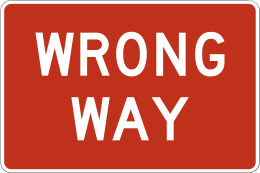
16. What information do regulation signs provide?
- The distance to destinations only
- The names of nearby emergency responders
- Weather forecasts and road temperatures
- Rules for traffic direction, lane use, turns, speed, parking, and other requirements
Show answer
Rules for traffic direction, lane use, turns, speed, parking, and other requirements. Regulation signs communicate roadway rules, including traffic direction, lane use, turns, speed, parking, and other special requirements. They are normally white rectangles with black letters or symbols, although some use other shapes or red letters. A destination sign gives direction and distance to places, so that choice describes a different sign category. Weather information and emergency contacts are not the purpose listed for regulation signs. When reading a sign, first decide whether it controls an action or only guides you to a place, then obey any rule it sets.
17. How many points for 1 to 10 over the limit?
- 2 points
- 4 points
- 6 points
- 3 points
Show answer
3 points. The mildest specified band still costs points: one to ten over the posted limit draws three license points. Two-point, four-point, and six-point readings each belong to other bands (miscellaneous violations, eleven-to-twenty, and twenty-one-to-thirty). The table climbs steeply from here, reaching eleven points past forty over. Small margins still scar the record and the insurance bill, so treat ten-over as expensive.
18. What should a vehicle emergency kit contain?
- Flares and first-aid supplies
- Only snacks
- Only maps
- Nothing
Show answer
Flares and first-aid supplies. Trunks should carry rescue basics: an emergency kit with flares and first-aid supplies prepares drivers for crash scenes. Snacks-only, maps-only, and nothing readings each leave the driver empty-handed when minutes matter. Road kits sell at department and auto-goods stores. Pack the kit before the trip that needs it. Road kits sell at department and auto-goods stores statewide for little money.
19. What is leaving an injury crash scene?
- A criminal violation
- A traffic violation
- Nothing
- A warning
Show answer
A criminal violation. Fleeing injury or death is criminal: leaving a fatality or personal-injury scene is a criminal violation, not a mere ticket. Traffic-level, nothing, and warning readings each downgrade flight the law treats as a crime. Hit-and-run drivers face arrest, prosecution, and license loss. Stop, aid, exchange, and report; flight compounds every consequence. Stop, aid the hurt, exchange details, and report; flight compounds every consequence.
20. What following interval does the New York manual recommend under normal driving conditions?
- At least one second
- A fixed half-car length
- At least two seconds
- Ten seconds in every situation
Show answer
At least two seconds. New York tells drivers to keep a space cushion by using the two second rule. Pick an object near or above the road ahead, such as a sign, tree or overpass, and count slowly as the vehicle ahead passes it. If you reach the object before you finish counting one thousand one, one thousand two, you are following too closely. A one second gap or a fixed half car length is too short, and ten seconds is not the baseline. In bad weather and behind large trucks, increase the count to at least three or four seconds.
QualitySpace is expanding to New York
We are a California-based independent insurance brokerage working on licensing in more states. We cannot help with New York insurance yet. Leave your email and we will let you know when we can.
Every question is written from the official New York State Driver's Manual. Need paper? Printable NY practice test with answer key.
Last verified 2026-09-06. How we check every question · Study all 500 as flashcards
Frequently asked questions
How many questions are on this New York practice test?
This fixed set has 20 questions. It is test 19 of 25 from the 500 question New York bank. The real NY exam asks 20 questions and you need 14 correct.
What is the passing score for the real New York test?
You must correctly answer at least 14 of the 20 questions asked, including two of the four questions about road signs That figure comes from the official New York source cited on the DMV facts page.
How does this fixed test relate to the full New York bank?
Each numbered test is a fixed set of 20 questions in a fixed order, so you can retake the same test later and compare. Every test mixes road signs and the other topics in about the same proportion as the full bank. Tests 1 to 25 together cover every question in the New York bank once. The full practice page mixes the whole bank at random.
Last verified 2026-09-06. See the New York DMV facts page for sourced state details.
Return to the full New York practice test · Study road signs