
Test 11 of 25 · 20 questions · Free 2026
NY Permit Practice Test 11
Jump to the test ↓A fixed 20 question set from the New York bank with answers and plain English explanations. The real NY exam is 20 questions, 70 percent to pass; take the full length version on the main practice page.
Question 1 of 20 · 0 right so far
All 20 questions in test 11
Every question below comes from the New York question bank on this page. Open a question to see the correct answer and the explanation. Nothing here is hidden behind a signup.
1. How many motorcycles may ride side-by-side in one New York lane?
- Two motorcycles
- One motorcycle only
- Any number if they maintain the speed limit
- Three motorcycles
Show answer
Two motorcycles. New York permits two motorcycles to ride side-by-side in a single lane. That allowance does not extend to three motorcycles, an unlimited group, or a motorcycle sharing a lane with an ordinary car or truck. A driver approaching a pair should leave room and avoid treating the formation as a single wide vehicle. The useful cue is the lane count: two motorcycles may share one lane together, but the lane still needs a predictable margin for control.
Study this in the handbook: Pedestrians, bicycles, motorcycles and trucks
2. How do elderly pedestrians use crosswalks?
- They cross faster
- They may need extra crossing time
- They never cross streets
- They always jaywalk
Show answer
They may need extra crossing time. Age and disability slow crossings: elderly and disabled pedestrians can require additional time to complete crossings. Faster, never, and jaywalk readings each deny the patience crosswalks demand. Wait fully until they clear, even if signals change. Every crosser deserves the time they need. Every crosser deserves whatever time they truly need. Wait fully until slow crossers clear, even if signals change.
Study this in the handbook: Pedestrians, bicycles, motorcycles and trucks
3. How should AWD change your winter speed?
- Drive faster than others
- Never exceed what conditions dictate
- Disable traction control
- Follow more closely
Show answer
Never exceed what conditions dictate. Capability is not permission: never let better handling in a front-wheel or four-wheel vehicle tempt driving faster than conditions dictate. Outrunning, disabling aids, and tailgating each spend the traction advantage on risk instead of safety. All-wheel drive helps starting, not stopping, and ice humbles every drivetrain equally. Let conditions set the speed, keep the aids on, and bank the extra grip as margin.
Study this in the handbook: Railroad crossings, expressways, night and bad weather
4. How should you brake in snow or fog traffic?
- Brake late and hard
- Speed up to intersections
- Tailgate in fog
- Brake early behind vehicles and at stops
Show answer
Brake early behind vehicles and at stops. Following in foul weather demands foresight: brake early when decreasing speed behind another vehicle or approaching an intersection stop. Late hard braking, intersection rushing, and fog tailgating each gamble grip that precipitation has already discounted. Early gentle pressure warns followers through lit brake lamps while speed bleeds gradually. Pair it with longer gaps and earlier signals, and the wet chain stays unbroken.
Study this in the handbook: Railroad crossings, expressways, night and bad weather
5. What parking rules must drivers know?
- Only where meters are
- Illegal spots plus the three regulatory signs
- Only garage rules
- Only street cleaning
Show answer
Illegal spots plus the three regulatory signs. Parking knowledge has two halves: drivers must know where parking is illegal and what NO PARKING, NO STANDING, and NO STOPPING signs indicate. Meters-only, garage-only, and cleaning-only readings each shrink a statewide duty covering hydrants, crosswalks, bridges, tracks, and more. The three signs form a strictness ladder from goods-plus-passengers down to nearly-nothing. Learn the places and the signs together, and tickets stay away.
Study this in the handbook: Parallel parking and where you cannot park
6. How many points does improper passing or unsafe lane change carry?
- 2 points
- 5 points
- 3 points
- 8 points
Show answer
3 points. Sloppy lane discipline costs three points: improper passing, unsafe lane changes, driving left of center, and wrong-direction driving each draw three on the violation table. Two points cover miscellaneous movers, five the mid-tier offenses, and eight the severe tier. Signal violations and failures to yield share the three-point level. Keep passes legal, lanes steady, and direction correct at every intersection and lane change.
Study this in the handbook: Points, suspensions and probation
7. May you pass near a bridge with blocked views?
- Always allowed
- Only behind buses
- Never when obstructed near bridges, tunnels, or viaducts
- Only in daylight
Show answer
Never when obstructed near bridges, tunnels, or viaducts. Structures with blocked views ban passes: within one hundred feet of a bridge, tunnel, or viaduct on a two-way road with an obstructed view, passing is prohibited. Always, buses-only, and daylight readings each miss the sight-distance rule that structures impose. Narrow spans hide oncoming lanes completely. Hold position through the structure and pass only where views open fully. Narrow spans hide oncoming lanes completely from view.
Study this in the handbook: Passing on the left and the right
8. What does the yellow sign with two opposing arrows tell a driver?
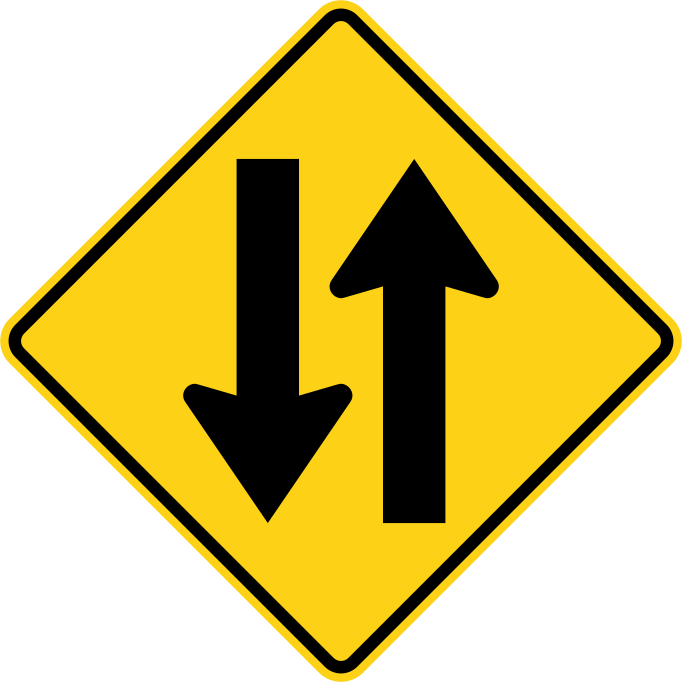
- Passing is automatically allowed in both directions
- Two-way traffic is ahead or begins here
- The roadway is divided by a median
- Only trucks may use the opposite lane
Show answer
Two-way traffic is ahead or begins here. Opposing arrows indicate two-way traffic, so vehicles may be approaching from the other direction. The sign does not grant passing permission, announce a median, or reserve the opposite lane for trucks. Keep to the proper side, watch for oncoming vehicles, and follow any separate pavement markings that govern passing. The paired arrows are the visual cue that the roadway's traffic flow is no longer one-directional. A driver leaving a one-way section should adjust expectations before meeting opposing traffic.
Study this in the handbook: Road signs you must know
9. How does one drink plus cold medicine affect you?
- No effect at all
- As much as several drinks
- It sobers you
- It only helps colds
Show answer
As much as several drinks. Cold remedies multiply drinks: one drink plus a cold remedy can affect drivers as much as several drinks. No-effect, sobering, and cold-only readings each deny the enhancement combining substances produces. Alcohol and drugs amplify each other dangerously. Treat any dosed day as a no-drinking driving day. Treat any dosed day as a strict no-drinking driving day. Alcohol and drugs amplify each other with dangerous deadly force.
Study this in the handbook: Alcohol, drugs and DWI
10. Your car stalls on New York railroad tracks and everyone is out and away. Which sign helps you report it?
- The Emergency Notification System sign, by calling its number
- The yellow advance warning sign, by reading its mile marker
- The crossbuck, by flagging the train with it
- The nearest STOP sign, by waiting there for police
Show answer
The Emergency Notification System sign, by calling its number. If your vehicle stalls or gets stuck on the tracks, the New York manual's first step is to get everyone out and away from the tracks, even if no train is in sight. Then locate the Emergency Notification System sign at the crossing and call the number provided, telling them about the stalled vehicle. Run toward the general direction the train is coming from. If a train is approaching, run toward it but away from the tracks at an angle, because running down the track risks being hit with debris.
Study this in the handbook: Railroad crossings, expressways, night and bad weather
11. What point value does New York assign to following too closely?
- 2 points
- 5 points
- 4 points
- 8 points
Show answer
4 points. New York charges 4 points for following too closely. For a driver on probation, tailgating is also one of the single convictions that suspends a new license for 60 days. Two points is the value for moving violations not listed separately, and 5 points is used for reckless driving and for mobile phone or portable device use. Eight points belongs to work zone speeding and passing a stopped school bus. Keeping at least a two second gap in normal conditions helps avoid the violation.
Study this in the handbook: Points, suspensions and probation
12. How often may a New York driver take the Point and Insurance Reduction Program course to reduce points?
- Once every 18 months
- Once every 12 months
- Once every 3 years
- Only once in a lifetime
Show answer
Once every 18 months. The Point and Insurance Reduction Program can be taken in a classroom or online, and you can complete it every 18 months for point reduction. It can lower your point total by up to four points. It cannot stop a mandatory suspension or revocation, and it cannot be saved as a credit against future points. You may also qualify for at least a 10 percent cut in the base rate of your liability and collision premiums for three years. Twelve months is too soon, and the other choices understate how often it is allowed.
Study this in the handbook: Learner permits, junior licenses and the written test
13. How do you proceed after stopping at a dead signal?
- Go immediately
- Continue by right-of-way rules unless an officer says otherwise
- Wait for green
- Back up
Show answer
Continue by right-of-way rules unless an officer says otherwise. Dark-signal stops end by priority: after stopping, continue according to right-of-way rules unless a traffic officer tells you to continue. Immediate-go, wait-green, and back-up readings each skip the all-way-stop choreography. First-stopped generally goes first, with right-hand tiebreaks. Officers on scene override every rule. First-stopped generally goes first, with right-hand tiebreaks applying. Dark intersections behave exactly like all-way stop crossings. Stop first, then take your lawful turn.
Study this in the handbook: Sign shapes and colors
14. What can lower your blood alcohol content?
- Coffee sobers you
- Cold showers sober you
- Only time without drinking lowers BAC
- Exercise sobers you
Show answer
Only time without drinking lowers BAC. Time is the only cure: abstaining over a period is the sole effective BAC reducer, while coffee, exercise, and cold showers cannot reduce BAC or alcohol effects. Coffee, shower, and exercise readings each trust folk remedies the manual debunks. Stimulants may keep drinkers awake but never make them sober. Wait it out or do not drive. Stimulants may wake drinkers but they never make anyone sober.
Study this in the handbook: Alcohol, drugs and DWI
15. What does an oncoming headlight flash mean?
- Your lights are too bright
- You are speeding
- Your radio is loud
- Your vehicle is hard to see; turn headlights on
Show answer
Your vehicle is hard to see; turn headlights on. Flashes mean go visible: an oncoming driver's headlight flash in low visibility means the vehicle was difficult to see, so turn the headlights on. Too-bright, speeding, and radio readings each misread the courtesy warning. Daytime running lights and parking lights cannot substitute. Heed the flash and light up fully. Daytime running lights and parking lights cannot substitute here. Heed the oncoming flash and light up fully at once.
Study this in the handbook: Railroad crossings, expressways, night and bad weather
16. How close may you stop to a pedestrian safety area?
- Within 30 feet unless otherwise marked
- Anywhere nearby
- Within 5 feet
- On the safety island
Show answer
Within 30 feet unless otherwise marked. Pedestrian refuges get thirty feet: no halts within thirty feet of a pedestrian safety area unless another distance is marked. Anywhere, five-foot, and on-island readings each shrink or ignore the buffer protecting waiting pedestrians. Safety islands strand walkers mid-roadway; nearby parked cars hide them from approaching drivers. Honor the thirty feet or the posted variant. Thirty feet keeps refuge walkers visible to approaching drivers.
Study this in the handbook: Parallel parking and where you cannot park
17. Should you move an injured crash victim?
- Move them immediately
- Roll them over
- Do not move them unless fire or life-threatening danger requires it
- Carry them away
Show answer
Do not move them unless fire or life-threatening danger requires it. Spinal injuries punish helpers: do not move an injured person unless fire or another life-threatening danger makes it necessary. Immediate, rolling, and carrying readings each risk paralyzing a victim help could have saved. Wait for trained responders whenever the scene allows. Move only to outrun flames or imminent peril. Wait for trained responders whenever the scene allows waiting safely. Move victims only to outrun flames or imminent deadly peril.
Study this in the handbook: What to do after a crash
18. Must injury crashes be reported to DMV?
- Report it to the DMV
- Only tell friends
- Report next year
- Ignore it
Show answer
Report it to the DMV. Injury and fatal crashes are DMV-reported: any crash involving fatality or personal injury must be reported to the DMV. Friends-only, next-year, and ignore readings each skip the ten-day legal filing. Thousand-dollar property crashes join the same duty. Insurance notice never substitutes for the state report. Thousand-dollar property crashes join the very same reporting duty. Insurance notice never substitutes for the official state report.
Study this in the handbook: What to do after a crash
19. After a New York DWI conviction, how long must the court-ordered ignition interlock generally stay on vehicles the driver owns or operates?
- At least 30 days
- Exactly 90 days
- Five years in every case
- At least 12 months
Show answer
At least 12 months. New York courts must order anyone convicted of DWI or aggravated DWI to install and maintain an ignition interlock for at least 12 months on any vehicle the driver owns or operates. The device, paid for by the driver, blocks starting until an acceptable breath sample is given. A court may waive the 12 month period if the device was installed for at least six months, but 30 or 90 days is not the rule. Five years applies only to certain repeat offenders who are relicensed after a longer wait.
Study this in the handbook: Alcohol, drugs and DWI
20. How can a New York driver identify a stopped school bus?
- By its SCHOOL BUS sign, red roof lights, and yellow-orange color
- By a blue roof light and a white body
- By a green license plate and a siren
- By a flashing headlight and a black stripe
Show answer
By its SCHOOL BUS sign, red roof lights, and yellow-orange color. A stopped New York school bus can be identified by its SCHOOL BUS sign, the red lights on top, and its distinctive yellow-orange color. These cues matter because traffic approaching from either direction must stop when the bus is stopped and its red lights are flashing. A blue light, green plate, siren, or black stripe is not the identifying combination described in the manual. Scan ahead for the bus shape and its warning lights, then prepare to stop at least 20 feet away. The strongest memory cue is the sign, red lights, and yellow-orange body together.
Study this in the handbook: Stopping for school buses
QualitySpace is expanding to New York
We are a California-based independent insurance brokerage working on licensing in more states. We cannot help with New York insurance yet. Leave your email and we will let you know when we can.
Every question is written from the official New York State Driver's Manual. Need paper? Printable NY practice test with answer key.
Last verified 2026-10-05. How we check every question · Study all 500 as flashcards
Frequently asked questions
How many questions are on this New York practice test?
This fixed set has 20 questions. It is test 11 of 25 from the 500 question New York bank. The real NY exam asks 20 questions and you need 14 correct.
What is the passing score for the real New York test?
You must correctly answer at least 14 of the 20 questions asked, including two of the four questions about road signs That figure comes from the official New York source cited on the DMV facts page.
How does this fixed test relate to the full New York bank?
Each numbered test is a fixed set of questions in a fixed order, so you can retake the same test later and compare. Every test mixes road signs and the other topics in about the same proportion as the full bank. Tests 1 to 25 together cover every question in the New York bank once. The full practice page mixes the whole bank at random.
Last verified 2026-10-05. See the New York DMV facts page for sourced state details.
Return to the full New York practice test · Study road signs