
Test 18 of 25 · 20 questions · Free 2026
NY Permit Practice Test 18
Jump to the test ↓A fixed 20 question set from the New York bank with answers and plain English explanations. The real NY exam is 20 questions, 70 percent to pass; take the full length version on the main practice page.
Question 1 of 20 · 0 right so far
All 20 questions in test 18
Every question below comes from the New York question bank on this page. Open a question to see the correct answer and the explanation. Nothing here is hidden behind a signup.
1. A New York driver who is 18 or older passes the road test. How long is the new license on probation?
- Six months
- One year
- There is no probation for adults
- Thirty days
Show answer
Six months. If you are 18 or older when you pass your road test, or you obtain a license after a revocation, you are on probation for six months. During probation a conviction for DWAI, speeding, reckless driving, following too closely, a speed contest, or any two traffic violations brings a 60 day suspension, and a second such conviction after reinstatement brings a revocation. Probation is not limited to junior drivers, and it lasts six months rather than a month or a year.
2. On a New York multilane controlled-access road, what should a driver do near a stopped vehicle with activated emergency or hazard lights?
- Stop in the adjacent lane until the vehicle leaves
- Maintain speed unless the vehicle is a police car
- Reduce speed and move from the adjacent lane when safe
- Move over only when a tow truck uses amber lights
Show answer
Reduce speed and move from the adjacent lane when safe. New York's Move Over Law requires drivers to reduce speed around authorized emergency or hazard vehicles with activated lights. On parkways, interstates, and other controlled access roads with multiple lanes, the driver must also move from the adjacent lane unless traffic or another hazard makes that unsafe. The rule is broader than police vehicles and does not call for stopping beside the hazard. Slow first, scan for a safe opening, signal, and create separation when the roadway permits the lane change.
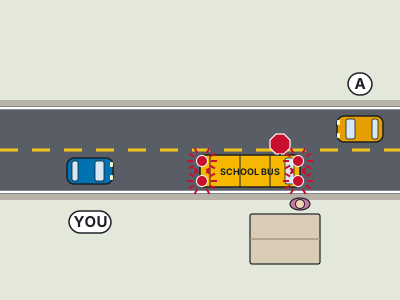
3. A school bus is stopped with flashing red lights on an undivided New York road. How far away should approaching traffic stop?
- At least 20 feet from the bus
- At least 50 feet from the bus
- Only behind the nearest intersection
- At least 5 feet from the bus
Show answer
At least 20 feet from the bus. When a stopped school bus flashes red lights, traffic from either direction must stop at least 20 feet away. Five feet leaves too little space for children and the bus, while 50 feet is not the distance specified by this rule. Waiting behind an intersection is also not a substitute for stopping before reaching the bus. The roadside cue is red lights plus the school bus: stop 20 feet back and remain there until the bus moves or a driver or traffic officer signals you forward.
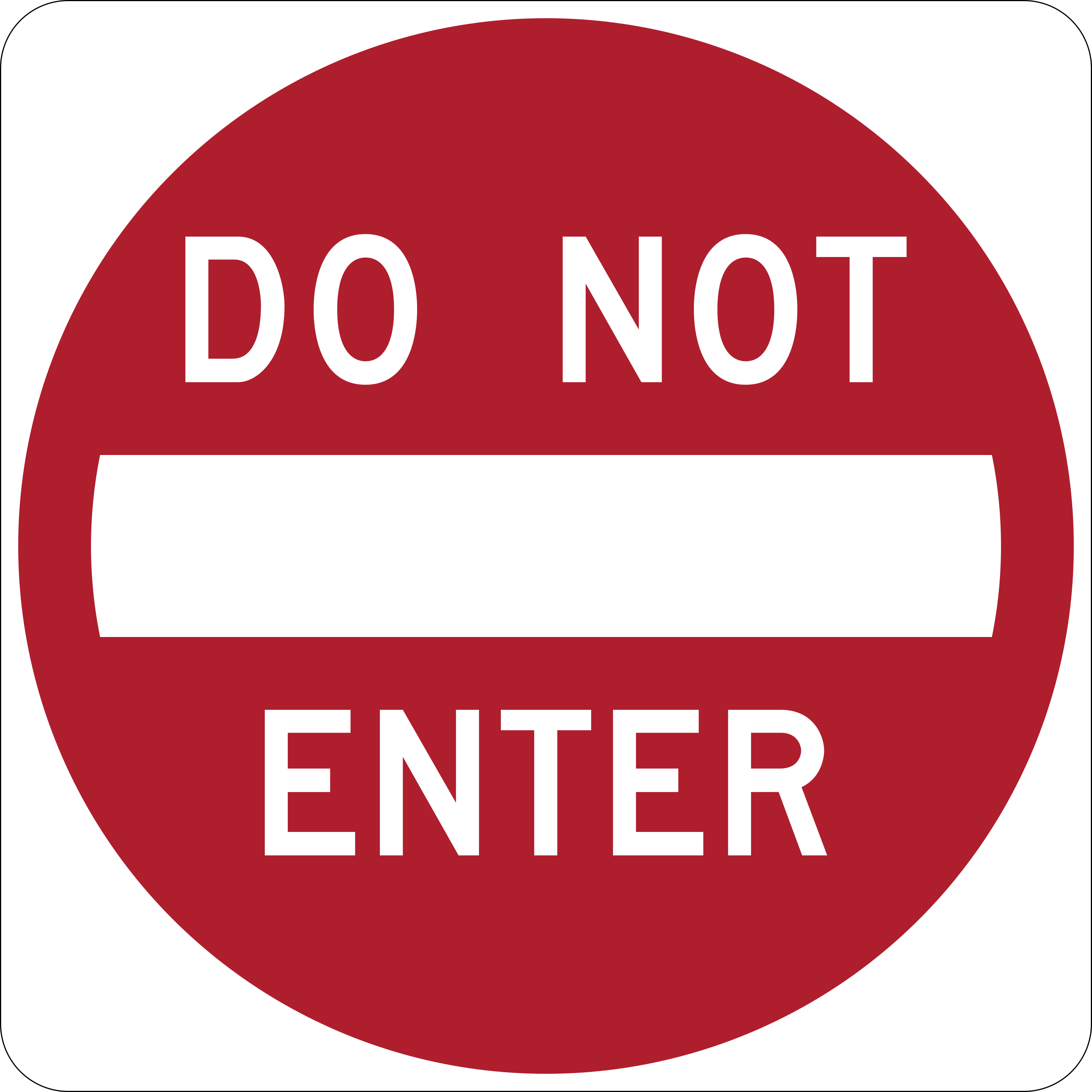
4. In New York, what does the red circle with a white horizontal bar on this sign tell a driver?
- Only trucks may enter from this approach
- Parking is prohibited but travel is allowed
- The road ends ahead after the next block
- Do not enter the roadway or ramp from this direction
Show answer
Do not enter the roadway or ramp from this direction. The red circle and white bar identify a DO NOT ENTER sign. A driver facing it must not proceed into that roadway or ramp from the displayed direction, commonly because the approach leads to opposing traffic or the exit of a one-way facility. The parking choice addresses a different restriction, and a dead end does not prohibit entry by itself. Stop before the sign, reassess the route, and find the lawful direction rather than crossing the sign to save time.
5. How should you protect a crash scene?
- Use gasoline flares
- Ignore leaking fuel
- Smoke at the scene
- Guard with reflectors or flares while watching for fuel leaks
Show answer
Guard with reflectors or flares while watching for fuel leaks. Scene protection respects fire risk: guard the area with reflectors or flares while watching for leaking fuel. Gasoline-flare, ignore-fuel, and smoking readings each invite the fireball the precautions prevent. Fuel plus sparks kills rescuers and victims alike. Set warnings up-road, sniff for gas, and keep ignition sources far away. Fuel plus stray sparks kills rescuers and victims alike. Keep every ignition source far from the guarded scene.
6. How do you measure the two-second following rule?
- Guess the distance
- Count one-thousand-one, one-thousand-two
- Use a stopwatch
- Measure car lengths
Show answer
Use a stopwatch. The two-second rule needs no instruments: as the vehicle ahead passes a roadside object, count slowly one-thousand-one, one-thousand-two. Guessing, stopwatches, and car-length estimates each fail where the spoken count succeeds, because speech paces real seconds at any speed. Reaching the object before finishing proves the gap is short. Lengthen the count in bad weather, darkness, and heavy traffic, and recheck until the cushion holds.
7. Where does disability reserved-parking law apply?
- Only state highways
- Only private garages
- Streets and highways plus qualifying shopping centers
- Nowhere enforced
Show answer
Streets and highways plus qualifying shopping centers. Reserved-space law spans public and commercial ground: it covers spaces on streets and highways by local ordinance plus shopping-center spaces held by state law where five or more stores and twenty or more off-street spaces exist. Highways-only, garages-only, and nowhere readings each shrink jurisdiction the statute states plainly. Mall rows and curb zones alike bind. Honor the reserved sign wherever it is lawfully posted.
8. On a slippery or fogged-in expressway, how should the driver's actual speed compare with the posted limit?
- It should be much lower than the posted limit when conditions make that necessary
- It should always equal the posted limit
- It may exceed the posted limit if traffic is moving quickly
- It should stay at the limit until visibility becomes zero
Show answer
It should be much lower than the posted limit when conditions make that necessary. A posted limit sets a legal maximum, but it may still be unsafe in slippery or fogged-in conditions. The manual gives an expressway example where the legal limit can be 55 or 65 mph while the safe speed is much lower. The choice that keeps speed at the limit ignores the hazard, and exceeding the limit is never justified by fast traffic. Watch the pavement and sight distance, ease off early, and choose a pace that leaves room to react.
9. What does a steady yellow traffic signal mean in New York?
- The signal is broken and may be ignored
- Traffic has priority and should accelerate
- The light is about to turn red; stop if safe
- Stop only if a police officer is present
Show answer
The light is about to turn red; stop if safe. A steady yellow signal warns that the light is about to turn red. The driver should stop if a safe stop can be made, rather than accelerate to beat the change. A yellow signal is not permission to ignore the intersection or wait for an officer. If the vehicle is too close to stop safely, proceed through cautiously while watching for people and cross traffic. The cue is timing: yellow means the green phase is ending and a red phase is next.
10. How many hours long is the Pre-Licensing Course that most new New York drivers must complete?
- 2 hours
- 5 hours
- 8 hours
- 50 hours
Show answer
5 hours. Most first-time New York applicants must finish an approved 5-hour Pre-Licensing Course before a road test appointment, unless a high school or college driver education course already meets the safe driving requirement. The in-person completion certificate is valid for one year. Fifty hours is the supervised practice total, a separate requirement. The DMV's Point and Insurance Reduction Program, sometimes called a defensive driving course, does not satisfy this requirement, so taking it instead leaves the applicant unable to schedule.
11. Must you obey officers against the light?
- Ignore the officer
- Obey the officer in both cases
- Obey only at green
- Obey only at red
Show answer
Obey the officer in both cases. Officer orders bind absolutely: stop at a green light when signaled to stop, and drive through red lights or stop signs when signaled through. Ignore, green-only, and red-only readings each cherry-pick commands that brook no selection. Officers manage what hardware cannot see. Obey every gesture, every time. Officers manage emergencies and details hardware cannot see. Obey every officer gesture completely, every single time.
12. How much does one drink raise a 150-pound man's BAC?
- About .02 percent BAC
- About .20 percent
- Nothing measurable
- About 2 percent
Show answer
About .02 percent BAC. Each standard drink adds about two-hundredths: for a one-hundred-fifty-pound male, one drink raises BAC by about point-oh-two percent. Point-twenty, nothing, and two-percent readings each misplace the decimal by tenfold or infinity. Several drinks stack past legal limits quickly. Small numbers accumulate into big crimes. Small per-drink numbers accumulate quickly into very big crimes. Several stacked drinks pass legal limits faster than anyone thinks.
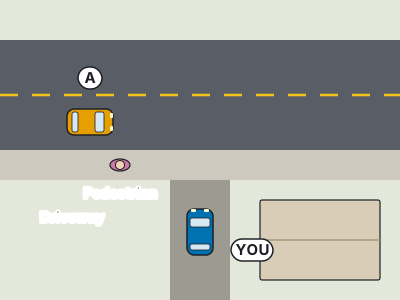
13. A New York driver exits a private driveway onto a public road. What is required?
- Enter immediately if the driver signals a turn
- Treat the driveway like a green traffic signal
- Yield only to traffic approaching from the left
- Stop and yield to roadway traffic and pedestrians
Show answer
Stop and yield to roadway traffic and pedestrians. A vehicle leaving a driveway, alley, or private road must stop and yield to traffic on the public roadway and to pedestrians. Signaling shows your intention but does not create a safe gap or priority. Looking only left can miss a vehicle approaching from the other direction or a person crossing the exit. Stop before entering the sidewalk or roadway, scan both directions, check the pedestrian path, and proceed only after all affected road users can continue safely. The property boundary is the cue to apply this rule.
14. How should you pass a bicyclist?
- Pass quickly and closely
- Give room and slow down; air pressure can topple them
- Honk and speed past
- Tailgate them
Show answer
Give room and slow down; air pressure can topple them. Cyclists need space and calm air: give room, reduce speed when passing, because quick-pass air pressure can throw riders off balance. Quick-close, honk-speed, and tailgate readings each blast or crowd the unprotected. Expect sudden speed, direction, or lane changes around road hazards. Pass wide, pass slow, and pass safe. Pass cyclists wide, pass slow, and pass safe every time. Expect sudden speed, direction, or lane changes from riders.
15. What must courts do to licenses after alcohol convictions?
- The court must revoke or suspend the license at sentencing
- Nothing happens
- Only a warning issues
- Licenses are unaffected
Show answer
The court must revoke or suspend the license at sentencing. Guilty verdicts trigger license action: courts must revoke or suspend the driver license at sentencing for any alcohol or drug-related violation. Nothing, warning, and unaffected readings each deny the mandatory judicial penalty. Even with twenty days to continue driving, the license is taken immediately. Conviction and license loss arrive together. Conviction and license loss always arrive together in court. Even with twenty days to drive, the license is taken at once.
16. You must stop at a New York STOP sign, but the corner has no stop line and no crosswalk. Where do you stop?
- Ten feet before the STOP sign post
- Before entering the intersection, where you can see the cross traffic
- In the middle of the intersection, after checking left
- Anywhere, as long as the wheels stop turning
Show answer
Before entering the intersection, where you can see the cross traffic. The New York manual gives an order of stopping points at a STOP sign. Stop before the stop line if one is painted. If there is none, stop before the crosswalk. If neither is marked, stop before you enter the intersection, at the point nearest the intersection that gives you a view of traffic on the intersecting roadway. That last point lets you judge cross traffic without pulling into its path, and you still yield to vehicles and pedestrians before you go.
17. What should a driver do when a steady yellow X appears above a New York lane?
- Move out of that lane
- Stop beneath the signal until it turns green
- Continue in it because yellow always means caution
- Use it only to turn left
Show answer
Move out of that lane. A steady yellow X tells traffic to leave the lane. It is not permission to continue cautiously, wait beneath the signal, or reserve the lane for a left turn. A flashing yellow X has the left-turn-only meaning, while a steady red X closes the lane completely. Check mirrors and adjacent traffic, signal, and merge when safe rather than braking abruptly beneath the overhead display. The lane-control symbol changes the lane assignment even if the pavement otherwise looks open.
18. May you pass near a blind curve or hilltop?
- Pass quickly
- Never pass when blinded by curves or hillcrests
- Honk and pass
- Pass on the shoulder
Show answer
Never pass when blinded by curves or hillcrests. Blind geometry bans passing: approaching a curve or hilltop on a two-way road without seeing around or over it means no pass. Quick, honk, and shoulder readings each gamble against hidden oncoming traffic the bend or crest conceals. Broken lines never authorize blind passes. Wait for the straight with full sight distance, then verify every other condition too. Patience at bends prevents the head-on no one survives.
19. Should you brake hard after a blowout?
- Brake hard immediately
- Avoid braking until controlled, then leave the road when safe
- Swerve to the shoulder
- Accelerate
Show answer
Avoid braking until controlled, then leave the road when safe. Blown tires demand patience: do not use the brake until the vehicle is controlled, then leave the road when safe to do so. Hard-brake, swerve, and accelerate readings each upset a car already fighting asymmetric drag. Grip the wheel, ease off the gas, and let speed bleed before any braking. Controlled slowing beats panicked stopping. Grip the wheel, ease off the gas, and let speed bleed before braking.
20. What is the only way to learn parallel parking correctly?
- Reading about it
- Watching videos
- Practice
- Thinking about it
Show answer
Practice. Parking skill comes only from doing: practice is the only method to learn parallel parking correctly. Reading, watching, and thinking readings each substitute study for the seat time that builds distance judgment and angle sense. Procedures must also adjust to each situation, which only varied repetition teaches. Drill the maneuver until the wheel work turns automatic, smooth, precise, and confident.
QualitySpace is expanding to New York
We are a California-based independent insurance brokerage working on licensing in more states. We cannot help with New York insurance yet. Leave your email and we will let you know when we can.
Every question is written from the official New York State Driver's Manual. Need paper? Printable NY practice test with answer key.
Last verified 2026-09-06. How we check every question · Study all 500 as flashcards
Frequently asked questions
How many questions are on this New York practice test?
This fixed set has 20 questions. It is test 18 of 25 from the 500 question New York bank. The real NY exam asks 20 questions and you need 14 correct.
What is the passing score for the real New York test?
You must correctly answer at least 14 of the 20 questions asked, including two of the four questions about road signs That figure comes from the official New York source cited on the DMV facts page.
How does this fixed test relate to the full New York bank?
Each numbered test is a fixed set of 20 questions in a fixed order, so you can retake the same test later and compare. Every test mixes road signs and the other topics in about the same proportion as the full bank. Tests 1 to 25 together cover every question in the New York bank once. The full practice page mixes the whole bank at random.
Last verified 2026-09-06. See the New York DMV facts page for sourced state details.
Return to the full New York practice test · Study road signs