
Test 3 of 25 · 20 questions · Free 2026
NY Permit Practice Test 3
Jump to the test ↓A fixed 20 question set from the New York bank with answers and plain English explanations. The real NY exam is 20 questions, 70 percent to pass; take the full length version on the main practice page.
Question 1 of 20 · 0 right so far
All 20 questions in test 3
Every question below comes from the New York question bank on this page. Open a question to see the correct answer and the explanation. Nothing here is hidden behind a signup.
1. A New York junior permit holder is driving with a supervising parent. Who may sit in the front passenger seat?
- Any licensed adult
- Any passenger wearing a seat belt
- A friend under 21, if the supervisor sits in back
- Only the supervising driver
Show answer
Only the supervising driver. New York keeps the front passenger seat for the supervising driver whenever a junior permit holder is at the wheel. The supervisor must be at least 21, licensed for the vehicle, and seated in front, so a friend cannot take that seat while the supervisor rides in back. A licensed adult who is not the supervisor does not qualify just by holding a license. Seat belts are required for every rider, but buckling up does not open the front seat to other passengers.
Study this in the handbook: Learner permits, junior licenses and the written test
2. What outranks all traffic signs and signals?
- Signs outrank officers
- Signals outrank officers
- Officers outrank signs, signals, and markings
- Markings outrank officers
Show answer
Officers outrank signs, signals, and markings. Human direction beats every device: traffic officers' directions take precedence over signs, signals, and pavement markings. Signs-first, signals-first, and markings-first readings each invert the hierarchy. Stop at green or drive through red when officers order it. Eyes on the officer override eyes on the hardware. Eyes on the officer override eyes on the hardware always. Stop at green or drive red when officers order it.
Study this in the handbook: Sign shapes and colors
3. Where is parking prohibited under New York's general parking rules?
- In a legal metered space during its posted hours
- In a marked space outside its restricted hours
- On a road shoulder where parking is expressly permitted
- In or within a crosswalk
Show answer
In or within a crosswalk. New York prohibits parking in a crosswalk because the vehicle blocks the pedestrian path and can hide people from approaching drivers. A meter or marked space may allow parking only when its posted conditions are satisfied, but those examples are not automatically illegal. The key cue is the crossing area itself: never use the marked or unmarked pedestrian route as a parking space, even briefly while waiting.
Study this in the handbook: Pedestrians, bicycles, motorcycles and trucks
4. What does this New York warning sign, showing two people crossing a road, indicate?

- A school crossing
- A hospital service area
- A railroad crossing
- A speed limit change
Show answer
A school crossing. New York lists the School Crossing sign among the road signs drivers must know, and it shows two people crossing a road. Like other warning signs, it alerts you to a location ahead where you need extra care, here children walking across the roadway. A railroad crossing warning sign instead shows RR and an X, service signs such as hospital signs are blue, and speed rules appear on white regulation signs. When you see this sign, slow down, scan both sides of the road for children and be ready to stop.
Study this in the handbook: Road signs you must know
5. If a New York driver's brake pedal suddenly goes to the floor, what should be tried first?
- Turn off the ignition immediately
- Pump the pedal to increase pressure
- Shift into reverse at once
- Pull the parking brake sharply
Show answer
Pump the pedal to increase pressure. The manual's first step for a brake pedal that suddenly goes to the floor is to pump the pedal to try to increase pressure. If that does not help, use the emergency or parking brake, applying it gradually and gently, and shift to a lower gear to help the vehicle lose speed. Turning off the ignition and shifting into reverse are not steps the manual lists, and yanking the parking brake ignores the instruction to apply it gently. The cue is controlled pressure in order: pump, then parking brake, then lower gear.
Study this in the handbook: Skids, blowouts and vehicle emergencies
6. Smoke starts coming from under your New York vehicle's hood. What should you do?
- Open the hood immediately and pour water on the engine
- Keep driving until you reach a repair shop
- Pull off, turn off the ignition, get away, and call the fire department
- Remain in the vehicle with the engine running
Show answer
Pull off, turn off the ignition, get away, and call the fire department. The manual treats an under-hood fire as an emergency requiring distance and professional help. Pull off the road and park, turn off the ignition, move away from the vehicle, and call the fire department. Opening the hood or trying to fight the flames yourself can expose you to heat and accelerate the danger. Continuing to a repair shop keeps the hazard moving through traffic. The concrete cue is smoke under the hood: stop in a safe place, shut down, evacuate, and summon firefighters.
Study this in the handbook: Railroad crossings, expressways, night and bad weather
7. What restraint rule applies to a New York child passenger under age four?
- The child may use an adult belt in any seating position
- The child may ride unrestrained in the rear seat
- The child must ride in an appropriate child safety seat
- The child needs a restraint only on expressways
Show answer
The child must ride in an appropriate child safety seat. New York requires a child under the age of four to be restrained in a federally approved child safety seat, such as an infant only, convertible, combination or all in one seat attached by a safety belt or a LATCH system. The driver must make sure every passenger under 16 is properly restrained by a seat belt or an appropriate child restraint. An adult belt alone does not meet the rule for a child this young, and riding in the rear seat or on an ordinary road does not remove the requirement. Check the child's age first, then the seat.
Study this in the handbook: Seat belts, child seats, phones and drowsy driving
8. Driving at night in New York, you come up behind another vehicle traveling your way. Within what distance must you switch to low beams?
- 500 feet
- 200 feet
- 50 feet
- 1,000 feet
Show answer
200 feet. New York uses two low beam distances. For an oncoming vehicle, dim the lights within 500 feet. For a vehicle ahead going the same way, dim them within 200 feet, even if that vehicle is in a different lane. Five hundred feet is the oncoming distance, so it does not fit a vehicle ahead. Fifty feet is far too close, and 1,000 feet is the visibility threshold for turning headlights on, not for dimming them.
Study this in the handbook: Railroad crossings, expressways, night and bad weather
9. What is the minimum license revocation for a New York DWI conviction at .08 BAC?
- Six months
- One year
- 30 days
- Five years
Show answer
Six months. Driving while intoxicated at .08 of one percent blood alcohol content carries a minimum six-month revocation of the driver license. The one-year minimum belongs to aggravated DWI at .18 BAC, and shorter suspensions apply to the lesser charge of driving while ability impaired. Penalties for drivers under 21 differ, and a conviction also brings fines, possible jail, and a mandatory ignition interlock under Leandra's Law.
Study this in the handbook: Points, suspensions and probation
10. Before entering a New York roundabout, what must a driver do?
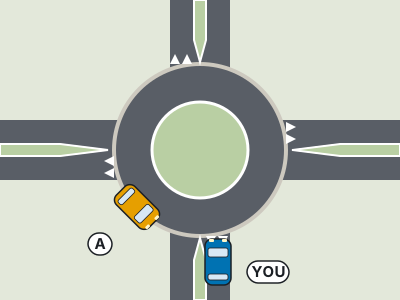
- Yield to circulating traffic and enter only after an adequate gap
- Stop in the circle before choosing an exit
- Enter first because circulating traffic must yield
- Pass a bicycle inside the roundabout to reach the exit
Show answer
Yield to circulating traffic and enter only after an adequate gap. The roundabout uses yield-at-entry control. An approaching driver slows, looks to the left, yields to traffic already circulating, and enters only when there is an adequate gap. Traffic in the roundabout has the right-of-way, so entering first reverses the rule. Once inside, proceed counterclockwise to your exit and turn on the right turn signal as you approach it. The manual also asks drivers not to pass a bicycle in the roundabout, because bicyclists ride in the lane just as other vehicles do.
Study this in the handbook: Speed limits, space cushion and work zones
11. Where is a New York driver prohibited from making a U-turn because visibility may be limited?
- On a straight road with visibility of 1,000 feet
- Only beside a parked vehicle
- At any intersection controlled by a green arrow
- Near the top of a hill or a curve where visibility is under 500 feet
Show answer
Near the top of a hill or a curve where visibility is under 500 feet. A U-turn is prohibited near a hilltop, curve, or other location where drivers cannot see your vehicle from 500 feet in either direction. A straight visible road is not automatically barred by this visibility rule, and a green arrow may permit a U-turn when otherwise legal. A parked vehicle alone is not the stated test. Check both sight lines and choose a location where approaching traffic can see you.
Study this in the handbook: Right of way, turns and U-turns
12. Which pavement-marking principle applies when a New York center line has one solid line and one broken line?
- Passing is prohibited for traffic on both sides
- Passing is permitted from either side at any speed
- Passing is permitted only from the side with the broken line, when safe
- The marking means the road is reserved for buses
Show answer
Passing is permitted only from the side with the broken line, when safe. A solid line and a broken line together divide the passing rule by direction. A driver beside the broken line may pass when the roadway is clear and the maneuver is safe, while the driver beside the solid line must not cross it to pass. This is different from double solid lines, which bar passing from either side. Identify the line nearest your lane before moving left, then check sight distance and oncoming traffic.
Study this in the handbook: Sign shapes and colors
13. What does a New York NO STOPPING sign allow a driver to do?
- Park for up to fifteen minutes with hazard lights on
- Stop only to obey a sign, signal, officer, or prevent a conflict
- Wait there whenever a passenger needs to exit
- Stand there if the driver remains in the vehicle
Show answer
Stop only to obey a sign, signal, officer, or prevent a conflict. NO STOPPING is stricter than a rule that merely limits parking. A driver may stop only when obeying a traffic sign, signal, or officer, or when stopping is necessary to avoid a conflict with another vehicle. Hazard lights, a waiting passenger, or remaining behind the wheel does not create a general exception. Use the sign as a cue to keep the vehicle moving unless one of those narrow reasons makes a stop necessary.
Study this in the handbook: Parallel parking and where you cannot park
14. Who yields at simultaneous right-angle stops?
- The left driver yields to the right driver
- The right driver yields
- Both go together
- The faster goes first
Show answer
The left driver yields to the right driver. Simultaneous stops at right angles follow the right-hand rule: the driver on the left yields to the driver on the right. Reversed, together, and faster readings each scramble the tiebreaker for four-way stops and uncontrolled corners alike. Right-side priority is predictable, which is exactly what ties need. Yield left, proceed right, and the intersection sorts itself. Yield left and proceed right, and the tie sorts itself out.
Study this in the handbook: Right of way, turns and U-turns
15. How likely is punishment for impaired driving?
- Apprehension and conviction chances are high
- Nobody gets caught
- Police ignore impairment
- Courts dismiss all cases
Show answer
Apprehension and conviction chances are high. Impaired drivers face strong enforcement: apprehension and conviction chances run high, backed by tough penalties and limited plea bargaining. Nobody-caught, ignored, and dismissed readings each promise impunity New York refuses. Checkpoints, patrols, and chemical tests close the net. Drive impaired and expect to be caught and convicted. Drive impaired in New York and expect to be caught and convicted. Checkpoints, patrols, and tests steadily close the enforcement net.
Study this in the handbook: Alcohol, drugs and DWI
16. Must the disability permit holder be served by the parked trip?
- No, anyone may borrow it
- Yes, the vehicle must operate to transport the described person
- Only on weekdays
- Only the driver matters
Show answer
Yes, the vehicle must operate to transport the described person. Credentials travel with their purpose: the vehicle must be in operation to transport the person with disabilities described in the registration or permit. Borrow-anyone, weekdays-only, and driver-only readings each detach the placard from the passenger it serves. An able-bodied driver running solo errands on another's permit violates the rule. Park reserved only while serving the recipient's trip from arrival to departure.
Study this in the handbook: Parallel parking and where you cannot park
17. How should you drive curves, turns, and ramps?
- Speed up through them
- Take additional care on them
- Close your eyes
- Use high beams only
Show answer
Take additional care on them. Geometry punishes speed: curves, turns, and expressway ramps demand additional care because centrifugal force and short sight lines shrink every margin. Speeding, eye-closing, and beams-only responses each surrender control where the road asks most. Advisory plaques often lower the recommended speed through these features, and exit ramps carry their own lower limits. Ease off before the bend, hold a steady line through it, and accelerate only on the straight.
Study this in the handbook: Railroad crossings, expressways, night and bad weather
18. What are examples of New York expressways?
- The Thruway, major interstates, and parkways
- City side streets
- Driveways and alleys
- Bike paths
Show answer
The Thruway, major interstates, and parkways. Expressways form a named network: the New York State Thruway, major interstate routes, and parkways are the manual's examples. Side streets, driveways, and bike paths each lack the divided, controlled-access, multi-lane design the definition requires. These roads carry the highest limits but demand ramp discipline and exit planning. Before traveling one, identify entrance and exit points on a map and know where to get on and off.
Study this in the handbook: Railroad crossings, expressways, night and bad weather
19. When practicing with a New York learner permit, how old must the supervising licensed driver be at minimum?
- At least 18 years old
- At least 21 years old
- At least 16 years old
- At least 25 years old
Show answer
At least 21 years old. A learner permit driver must practice with a licensed driver who is at least 21 years old. The supervisor also needs a license valid for the type of vehicle being driven and must sit in the front seat. The 18-year-old choice is too low for a supervising driver. A 16-year-old cannot satisfy the general supervision rule, and 25 adds an age requirement the manual does not state. Before practice begins, check both the supervisor's age and the vehicle-class license. The practical cue is front-seat supervision by a properly licensed adult aged 21 or older.
Study this in the handbook: Learner permits, junior licenses and the written test
20. What roadway feature does the yellow plus-shaped sign warn is ahead?

- A hospital entrance with no crossing traffic
- A rule prohibiting every turn at the next block
- An intersection where traffic may cross from either side
- A single-lane bridge with no intersecting road
Show answer
An intersection where traffic may cross from either side. The plus shape represents a crossroad, an intersection where traffic may enter from both sides. Reduce speed, search left and right, and be prepared for vehicles or pedestrians approaching the crossing. A hospital sign is a blue service sign, while a turn prohibition would use a regulatory symbol. A bridge warning would describe a different roadway feature. The intersecting arms of the yellow symbol are the cue to expect conflict from more than the direction directly ahead.
Study this in the handbook: Right of way, turns and U-turns
QualitySpace is expanding to New York
We are a California-based independent insurance brokerage working on licensing in more states. We cannot help with New York insurance yet. Leave your email and we will let you know when we can.
Every question is written from the official New York State Driver's Manual. Need paper? Printable NY practice test with answer key.
Last verified 2026-10-05. How we check every question · Study all 500 as flashcards
Frequently asked questions
How many questions are on this New York practice test?
This fixed set has 20 questions. It is test 3 of 25 from the 500 question New York bank. The real NY exam asks 20 questions and you need 14 correct.
What is the passing score for the real New York test?
You must correctly answer at least 14 of the 20 questions asked, including two of the four questions about road signs That figure comes from the official New York source cited on the DMV facts page.
How does this fixed test relate to the full New York bank?
Each numbered test is a fixed set of questions in a fixed order, so you can retake the same test later and compare. Every test mixes road signs and the other topics in about the same proportion as the full bank. Tests 1 to 25 together cover every question in the New York bank once. The full practice page mixes the whole bank at random.
Last verified 2026-10-05. See the New York DMV facts page for sourced state details.
Return to the full New York practice test · Study road signs