
Test 23 of 25 · 20 questions · Free 2026
NY Permit Practice Test 23
Jump to the test ↓A fixed 20 question set from the New York bank with answers and plain English explanations. The real NY exam is 20 questions, 70 percent to pass; take the full length version on the main practice page.
Question 1 of 20 · 0 right so far
All 20 questions in test 23
Every question below comes from the New York question bank on this page. Open a question to see the correct answer and the explanation. Nothing here is hidden behind a signup.
1. You are passing on a two-way New York road. You cannot pass if you cannot return to the right lane before an oncoming vehicle comes within what distance?
- 200 feet
- 500 feet
- 100 feet
- 50 feet
Show answer
200 feet. Before passing on the left, you must be able to return safely to the right lane before any oncoming vehicle comes within 200 feet of you. If you cannot, you may not start the pass. Fifty and 100 feet leave far too little room at highway closing speeds, and 100 feet is the distance tied to railroad crossings and obstructed bridges. Five hundred feet is the distance for dimming high beams, not the passing rule. When you return, check over your shoulder to see several feet of pavement before moving back.
2. What should you do if headlights suddenly fail?
- Stop in the lane
- Try emergency lights, parking lights, and directionals to leave the road
- Drive on blindly
- Abandon the car
Show answer
Try emergency lights, parking lights, and directionals to leave the road. Dead headlights leave backups: try emergency lights, parking lights, and directional signals, which may still work and give enough light to leave the roadway safely. Lane-stopping, blind-driving, and abandoning readings each surrender options the electrical leftovers provide. Dimming lights mean drive to service or pull off for help. Keep rolling only toward the shoulder. Dimming lights mean drive to service or pull fully off for help.
3. A driver is considering passing on a two-way road. Which marking rules out passing from that lane?
- A single broken white lane line
- A solid yellow center line in the driver's lane
- A dashed yellow line beside the shoulder
- A solid white line separating same-direction lanes
Show answer
A solid yellow center line in the driver's lane. A solid yellow center line in your lane means you cannot pass on the left. The broken white line describes lane changes or passing when safe, and a white line separates traffic moving in the same direction rather than opposing traffic. A dashed yellow shoulder marking is not the prohibition described here. The practical cue is to identify the line nearest your vehicle before moving across the center: if your side is solid yellow, stay behind the vehicle ahead and wait for a lawful passing opportunity.
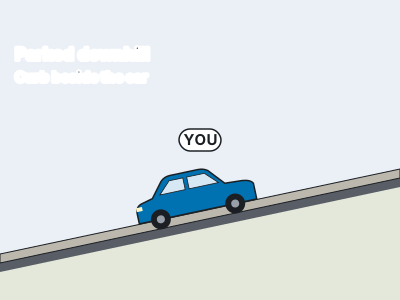
4. When parked facing downhill beside a curb in New York, where should the front wheels point?
- Away from the curb and into traffic
- Straight ahead regardless of the grade
- Toward the curb
- Toward the center of the road only on a one-way street
Show answer
Toward the curb. Facing downhill, turn the front wheels toward the curb so a rolling vehicle would move into the curb rather than into the travel lane. Straight wheels remove that backup protection, and turning outward sends the vehicle toward traffic. The direction is tied to both the slope and the curb, not to whether the road is one-way. Before leaving the car, set the parking brake and position the wheels to help stop unintended movement.
5. A New York licensed driver is convicted of a moving violation in Pennsylvania. How does New York handle it?
- The Pennsylvania points are added to the New York record
- Two points are added automatically
- No violation points are added to the New York record
- The license is revoked for 90 days
Show answer
No violation points are added to the New York record. New York does not put out-of-state moving violation convictions on its point record, with one exception: offenses committed in Canada. So copying Pennsylvania's points or adding two automatic points is wrong. The ticket still matters, though. If the driver fails to answer a moving violation ticket in most states, the New York license is suspended until the ticket is satisfied. A revocation of at least 90 days applies to an out-of-state alcohol or drug conviction for drivers over 21, not to an ordinary moving violation.
6. What record review faces reinstated drivers?
- DMV reviews the lifetime record of reinstatement applicants
- Records are ignored
- Only one year is checked
- Reviews never happen
Show answer
DMV reviews the lifetime record of reinstatement applicants. Reinstatement opens the whole book: DMV reviews the lifetime record of every driver applying to reinstate after revocation. Ignored, one-year, and never readings each shrink the toughest licensing review in the nation. Persistent drunk and dangerous drivers face permanent denial. Every old conviction counts when the license comes back up. Persistent drunk and dangerous drivers face permanent license denial. No old conviction is ever forgotten here.
7. A New York driver over 21 refuses a chemical test within five years of a prior refusal revocation. What is the minimum revocation?
- Six months
- 18 months
- One year
- Five years
Show answer
18 months. New York raises the refusal penalty for repeat conduct. A first refusal by a driver over 21 brings a minimum one-year revocation, but a refusal within five years of an earlier refusal revocation, or of any alcohol or drug-related violation, brings a minimum 18-month revocation. One year is the first refusal figure, which is why it is tempting. Six months is the minimum for a first DWI. Five years is the lookback window, not the revocation length. A $750 civil penalty also applies before relicensing.
8. May you pass a car stopped at a crosswalk?
- Never pass a vehicle stopped at a crosswalk for a pedestrian
- Pass quickly
- Honk and pass
- Swerve around
Show answer
Never pass a vehicle stopped at a crosswalk for a pedestrian. Stopped-at-crosswalk cars shield walkers: never pass a vehicle stopped at a crosswalk to let a pedestrian cross. Quick, honk, and swerve readings each run over the pedestrian the stopped car protects. The walker is hidden by the very car inviting the pass. Stop behind, wait for the crossing to finish, then proceed only when the way is truly clear. Stop behind the car, wait for the crossing to finish, then proceed when truly clear.
9. Can you file a crash report online?
- File online through the motorist crash report page
- Only by mail
- Only in person
- By phone only
Show answer
File online through the motorist crash report page. DMV accepts digital crash reports: drivers can submit online by finding the File a Motorist Crash Report page. Mail-only, in-person-only, and phone-only readings each deny the web channel the manual provides. Paper MV-104 from offices and agents remains available. Either route must beat the ten-day deadline. Paper MV-104 from offices and agents remains available as backup always. Either route, paper or online, must beat the ten-day deadline.
10. When may you enter the traffic lane?
- Force into traffic
- Enter whenever
- Enter the lane only when safe
- Block the lane
Show answer
Enter the lane only when safe. Entry is conditional, not entitled: after the final left-shoulder check, drive into the traffic lane only when safe to do so. Forcing, whenever, and blocking readings each claim space the stream has not yielded. Parked cars hold no priority; the gap must truly fit. Wait for the real opening, then join the flow at its pace. The safe gap is earned by waiting, never taken by forcing.
11. What is driving within the range of your headlights?
- Hold a speed that stops within headlight range
- Always drive the limit at night
- Outdrive your headlights
- Use parking lights only
Show answer
Hold a speed that stops within headlight range. Night speed answers to visibility: drive at a speed allowing a safe stop within the lit distance, called driving within the range of the headlights. Always-at-limit, outdriving, and parking-lights readings each break the rule that stopping distance must fit inside sight distance. Low beams reach about three hundred fifty feet at best, less in rain or fog. Slow until the stop fits the light, and darkness stays navigable.
12. What may be posted as a speed limit in a New York work area?
- Exactly 15 MPH in every work area
- Only the normal speed limit
- At least 55 MPH on every highway
- As low as 25 MPH (40 km/h)
Show answer
As low as 25 MPH (40 km/h). A New York work area may have a posted speed limit as low as 25 MPH, or 40 km/h. The value is a possible work-zone limit, not a universal requirement that every work area use exactly 25 MPH. Fifteen MPH is not the figure stated, and a 55 MPH rule would ignore the reduced speeds used where people and equipment are near traffic. Even without a posted limit, the manual says to drive at a reduced speed through the work zone and obey flag persons. The cue is orange work-area signs followed by a lower posted limit.
13. Where do most traffic crashes occur?
- At intersections when a driver turns
- On empty rural roads
- In parking garages only
- On straight expressways
Show answer
At intersections when a driver turns. Intersections dominate crash statistics: most traffic crashes happen there when a driver makes a turn. Empty-road, garage-only, and straight-expressway readings each point where conflicts are rarest instead of densest. Turns cross paths with oncoming traffic, crossing pedestrians, and blind-side cyclists all at once. Master right-of-way plus correct turn positions, and the commonest crash scene turns safest. Master right-of-way plus turn positions, and intersections turn safest.
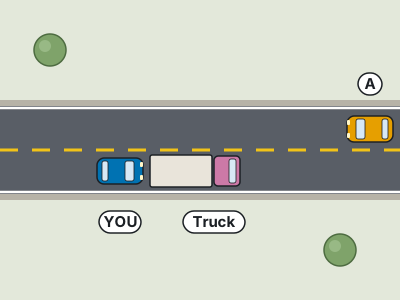
14. What does one broken yellow center line permit on a New York two-way road?
- Travel in the lane used by oncoming traffic
- Passing only for traffic traveling uphill
- No crossing under any condition
- Passing from either direction when it is safe
Show answer
Passing from either direction when it is safe. A broken yellow center line indicates that passing may be allowed from either direction when the driver can do so safely. The broken marking is not a guarantee that an overtake is safe, and it does not limit the permission to uphill traffic. A driver must still check sight distance, opposing vehicles, intersections, and other hazards before crossing. The visual cue is the dashed center line: it signals a possible passing opportunity, subject to the full safety check.
15. In New York, when may a vehicle stop within 15 feet of a fire hydrant?
- When hazard lights are on
- Never, for any reason
- When the hydrant is on the opposite side of the street
- Only if a licensed driver remains in the vehicle to move it in an emergency
Show answer
Only if a licensed driver remains in the vehicle to move it in an emergency. You cannot park, stop or stand within 15 feet, about 5 meters, of a fire hydrant unless a licensed driver remains in the vehicle to move it in an emergency. That exception is the only one, and it requires a licensed driver at the wheel, not just flashing hazard lights. The same list bans double parking, stopping on a sidewalk or in a crosswalk, and stopping in an intersection unless signs or meters permit it.
16. A round yellow railroad crossing warning sign with RR and an X is ahead, and you are following a bus. What does the New York manual warn?
- Buses may cross without slowing
- Most buses and some trucks must stop at railroad crossings, so be prepared for the bus to stop
- The bus will accelerate across the tracks
- Only trains with horns require a stop
Show answer
Most buses and some trucks must stop at railroad crossings, so be prepared for the bus to stop. The yellow sign with the black RR letters and X symbol means a railroad crossing is ahead, so use caution and be prepared to stop. The manual adds a specific warning for drivers following a bus or truck: most buses and some trucks must stop at railroad crossings whether or not a train is coming, so the vehicle ahead may stop suddenly. Leave extra following distance and never assume the crossing is clear because the bus is moving.
17. How many questions are on New York's written knowledge test for a passenger vehicle license?
- 15
- 20
- 25
- 40
Show answer
20. The New York written test asks 20 questions. Passing requires at least 14 correct overall, with an additional requirement involving the four road-sign questions. The numbers 15, 25, and 40 can sound plausible if an applicant confuses this test with another state's exam or a commercial test. Keep the format together in memory: twenty questions, fourteen needed, and two of four signs required.
18. When may you return after passing a truck?
- Pull in immediately
- Pull in when beside the cab
- Return only when the whole front shows in your mirror
- Never return
Show answer
Return only when the whole front shows in your mirror. Passes end with full clearance: do not pull ahead of a truck until its whole front appears in the mirror. Immediate, beside-cab, and never readings each misjudge the length passed. Cutting short forces emergency braking from tons of steel. See the whole front, signal, then ease over. See the whole front, signal, then ease over carefully. Cutting short forces emergency braking from tons of steel.
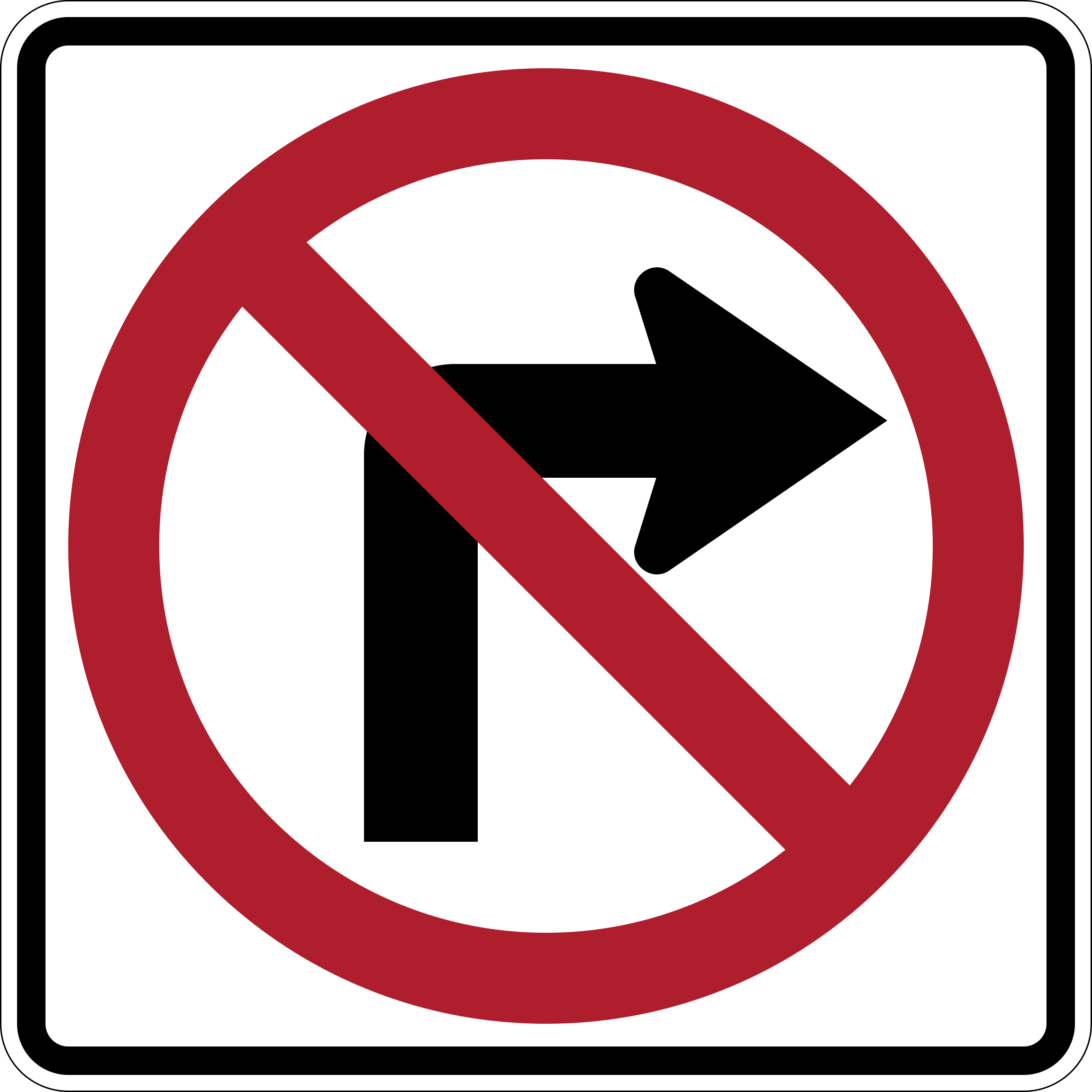
19. A red-slash sign with a right-facing arrow tells a New York driver to avoid:
- Driving straight in the marked lane
- Turning right at the posted location
- Parking beside the right curb
- Using a right-side mirror
Show answer
Turning right at the posted location. A right-facing arrow crossed by red identifies a no-right-turn restriction. The prohibition applies to the pictured turn, not to straight travel, curbside parking, or ordinary mirror use. A driver must choose another legal movement and should not assume that a clear intersection makes the turn permissible. The manual explains that regulatory signs communicate rules for traffic direction, lane use, turns, speed, and parking. Here the arrow supplies the specific rule, while the slash signals that the turn is barred.
20. Are regular seat belts proper restraints for children?
- Yes, always
- Yes, for tall children
- No, the law excludes them as not designed for children
- Only in trucks
Show answer
No, the law excludes them as not designed for children. Adult belts do not fit children legally: vehicle seat belts are not defined as appropriate child restraint systems because they are not designed for children. Always, tall-child, and trucks-only readings each seat children in belts that cannot protect them. Booster and safety seats sized to the child fill the gap. Fit the restraint to the child, never the reverse. Fit the restraint to the child, never the reverse, every trip.
QualitySpace is expanding to New York
We are a California-based independent insurance brokerage working on licensing in more states. We cannot help with New York insurance yet. Leave your email and we will let you know when we can.
Every question is written from the official New York State Driver's Manual. Need paper? Printable NY practice test with answer key.
Last verified 2026-09-06. How we check every question · Study all 500 as flashcards
Frequently asked questions
How many questions are on this New York practice test?
This fixed set has 20 questions. It is test 23 of 25 from the 500 question New York bank. The real NY exam asks 20 questions and you need 14 correct.
What is the passing score for the real New York test?
You must correctly answer at least 14 of the 20 questions asked, including two of the four questions about road signs That figure comes from the official New York source cited on the DMV facts page.
How does this fixed test relate to the full New York bank?
Each numbered test is a fixed set of 20 questions in a fixed order, so you can retake the same test later and compare. Every test mixes road signs and the other topics in about the same proportion as the full bank. Tests 1 to 25 together cover every question in the New York bank once. The full practice page mixes the whole bank at random.
Last verified 2026-09-06. See the New York DMV facts page for sourced state details.
Return to the full New York practice test · Study road signs