
Test 25 of 25 · 20 questions · Free 2026
NY Permit Practice Test 25
Jump to the test ↓A fixed 20 question set from the New York bank with answers and plain English explanations. The real NY exam is 20 questions, 70 percent to pass; take the full length version on the main practice page.
Question 1 of 20 · 0 right so far
All 20 questions in test 25
Every question below comes from the New York question bank on this page. Open a question to see the correct answer and the explanation. Nothing here is hidden behind a signup.
1. Which headlights should you use in snow or fog?
- High beams
- Parking lights
- Low-beam headlights
- No lights
Show answer
Low-beam headlights. Snow, rain, sleet, and fog punish bright light: for better visibility in these conditions, keep headlights on low beam to cut under the glare. High beams bounce back blinding white, parking lights mark nothing ahead, and darkness hides the road entirely. Low beams plus reduced speed plus earlier signals form the foul-weather trio the manual prescribes. Aim low, slow down, and telegraph every move sooner.
2. May you stop opposite road work?
- Always allowed
- Allowed with cones
- Banned if your vehicle blocks traffic
- Allowed at night
Show answer
Banned if your vehicle blocks traffic. Work zones condition the ban on blockage: no stopping next to or opposite road work, construction, or obstructions when the vehicle blocks traffic. Always, cones, and night readings each miss the blocking test that decides legality. Crews and equipment already squeeze the road; a parked car can seal it. Pass the zone before stopping, or ensure the lane stays passable.
3. Which subjects are examined on New York's written test for a Class D, M, DJ, MJ or E license?
- Only vehicle maintenance and commercial cargo rules
- Rules of the road, safe driving techniques, road signs, and alcohol and drug laws
- County route maps and emergency vehicle mechanics
- Federal tax rules and automobile insurance pricing
Show answer
Rules of the road, safe driving techniques, road signs, and alcohol and drug laws. New York's written test covers four study areas: rules of the road, safe driving techniques, road signs, and laws about alcohol and drug use while driving. The commercial cargo choice belongs to a different licensing track, while county maps and insurance pricing are not listed as test subjects. Use the four areas as a study checklist, then pay special attention to road signs because the permit test includes a separate sign requirement. This approach connects the license class to the material the state actually examines.
4. When a New York driver turns left, which traffic must be yielded to?
- Only vehicles that have already stopped
- Traffic behind the turning vehicle
- Oncoming traffic close enough to create a hazard
- No traffic if the turn signal is active
Show answer
Oncoming traffic close enough to create a hazard. New York requires a left-turning driver to yield to traffic coming toward the vehicle when that traffic is close enough to be a hazard. A turn signal announces the plan but does not give the turning vehicle priority. Vehicles behind you are not the deciding conflict, and waiting only for stopped vehicles ignores moving traffic. Before crossing the opposing lane, judge distance and speed, then wait whenever the gap feels uncertain. The useful cue is the approaching vehicle’s path, not whether your signal has been flashing for several seconds.
5. How close to a STOP sign, YIELD sign, or traffic light may a vehicle park or stand in New York?
- No closer than 15 feet
- No closer than 20 feet
- No closer than 50 feet
- No closer than 30 feet
Show answer
No closer than 30 feet. New York bars parking or standing within 30 feet of a traffic light, STOP sign, or YIELD sign. The other distances in the choices belong to other items on the same statewide list: 15 feet from a fire hydrant, 20 feet from a crosswalk at an intersection, and 50 feet from a railroad crossing. Each is a separate rule with its own distance, so match the number to the object. These are statewide rules that apply even where no sign is posted, so a curb with no markings near a STOP sign is still off limits within 30 feet.
6. Where must you stop when a stop line is painted?
- Before the stop line
- Past the crosswalk
- In the intersection
- Beside the sign
Show answer
Before the stop line. Stop lines mark the halt point: drivers must come to a stop before the stop line where one is painted. Past-crosswalk, in-box, and beside-sign readings each roll beyond the line protecting pedestrians and cross traffic. Without lines or crosswalks, stop before the intersection with a clear view. The paint commands; the bumper obeys. The paint commands the stop; the bumper must always obey.
7. Under New York's Leandra's Law, what charge can a driver face for DWI with a child under 16 in the vehicle?
- A traffic infraction with a $300 fine
- A misdemeanor with no jail
- A class E felony, punishable by up to four years in prison
- Only a warning if the child is buckled
Show answer
A class E felony, punishable by up to four years in prison. Leandra's Law makes drunk driving with a young passenger far more serious in New York. A driver who commits one of these alcohol-related offenses with a child under 16 in the vehicle may be charged with a class E felony carrying up to four years in prison. It is not treated as a traffic infraction or as a misdemeanor without jail. Buckling the child in does not change the charge. The same law also makes it a felony to drive drunk on a conditional license.
8. In upstate New York, a junior license holder wants to drive alone at 10 p.m. When is that allowed?
- Only directly between home and work or a school course
- Any time, since upstate has no night limits
- Never, even with a parent
- Only with a friend who is 18 or older
Show answer
Only directly between home and work or a school course. Upstate, a junior license holder may drive unaccompanied from 5 a.m. to 9 p.m. Between 9 p.m. and 5 a.m., driving alone is limited to trips directly between home and employment or a school course; any other night driving requires a licensed parent, guardian, or person in loco parentis in the car. So upstate does have a night limit. Because a parent can make night driving possible, the never choice is wrong too. An 18-year-old friend is not an approved companion.
9. A New York crash causes $1,000 or more in damage to one person's property. How soon must a report be filed with the DMV?
- Within 10 days
- Within 24 hours
- Within 30 days
- Only if the police did not come to the scene
Show answer
Within 10 days. In New York, any crash involving $1,000 or more in damage to the property of any one person must be reported to the DMV on form MV-104, and the report is due within 10 days of the event. Telling the insurance company does not end the legal duty. Twenty-four hours and thirty days are not the stated deadline. Failing to file a required crash report is a criminal offense and can lead to an indefinite license suspension until the report is filed.
10. A New York traffic signal is flashing red. Which sequence is required before proceeding?
- Slow down, sound the horn, and continue
- Stop fully, yield the right-of-way, then go when safe
- Wait for the signal to become steady green
- Turn right without stopping if no car is visible
Show answer
Stop fully, yield the right-of-way, then go when safe. The sequence for a flashing red signal is complete stop, yield, and proceed when safe. It functions as a STOP sign, so an empty first glance does not excuse a rolling approach. Sounding the horn does not replace yielding, and waiting for a steady green misunderstands the signal's operation. A right turn also requires the same stop and safety check. Use the three-part cue every time the red lamp flashes: stop, yield, then move only after the intersection is clear.
11. How close to a railroad crossing may a New York driver park?
- No closer than 15 feet
- No closer than 20 feet
- No closer than 100 feet
- No closer than 50 feet
Show answer
No closer than 50 feet. You cannot park your vehicle within 50 feet, about 15 meters, of a railroad crossing, and the manual separately tells drivers not to stop on the tracks. Fifteen feet is the hydrant distance and 20 feet is the fire station driveway distance, so those numbers are easy to mix up. One hundred feet goes well beyond the stated rule. Keeping parked cars back from the crossing helps other drivers see the tracks and any train that is coming.
12. How do trucks make right turns?
- Turn from the right edge
- Swing left before turning right
- Turn without signaling
- Turn at full speed
Show answer
Swing left before turning right. Wide rigs swing wide: trucks move left before turning right to clear the corner. Right-edge, unsignaled, and full-speed readings each cut the arc trailers must have. Watch truck turn signals closely and never squeeze the right-side gap. The swing is deliberate; respect it. Watch truck signals closely and never squeeze the right gap. The wide swing is deliberate; always respect it fully.
13. On a New York two-way road, what does a double solid yellow center line mean?
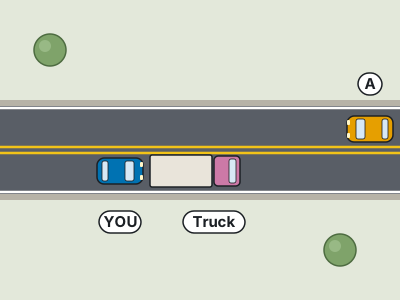
- Passing is allowed for both directions when traffic is light
- Do not pass across the lines from either direction
- Only trucks may cross to overtake
- The roadway is changing to one-way traffic
Show answer
Do not pass across the lines from either direction. A double solid yellow center line separates opposing traffic where passing is prohibited in both directions. Light traffic does not remove the marking's restriction, and vehicle size does not create a special crossing privilege. The lines also do not announce a one-way road. The useful cue is the paired solid pattern: keep your vehicle in its lane and wait for a lawful passing section rather than crossing the center. Drivers must still watch for turns or other movements specifically allowed by the roadway rules.
14. A red circle with a slash over a U-shaped arrow means the driver must not:
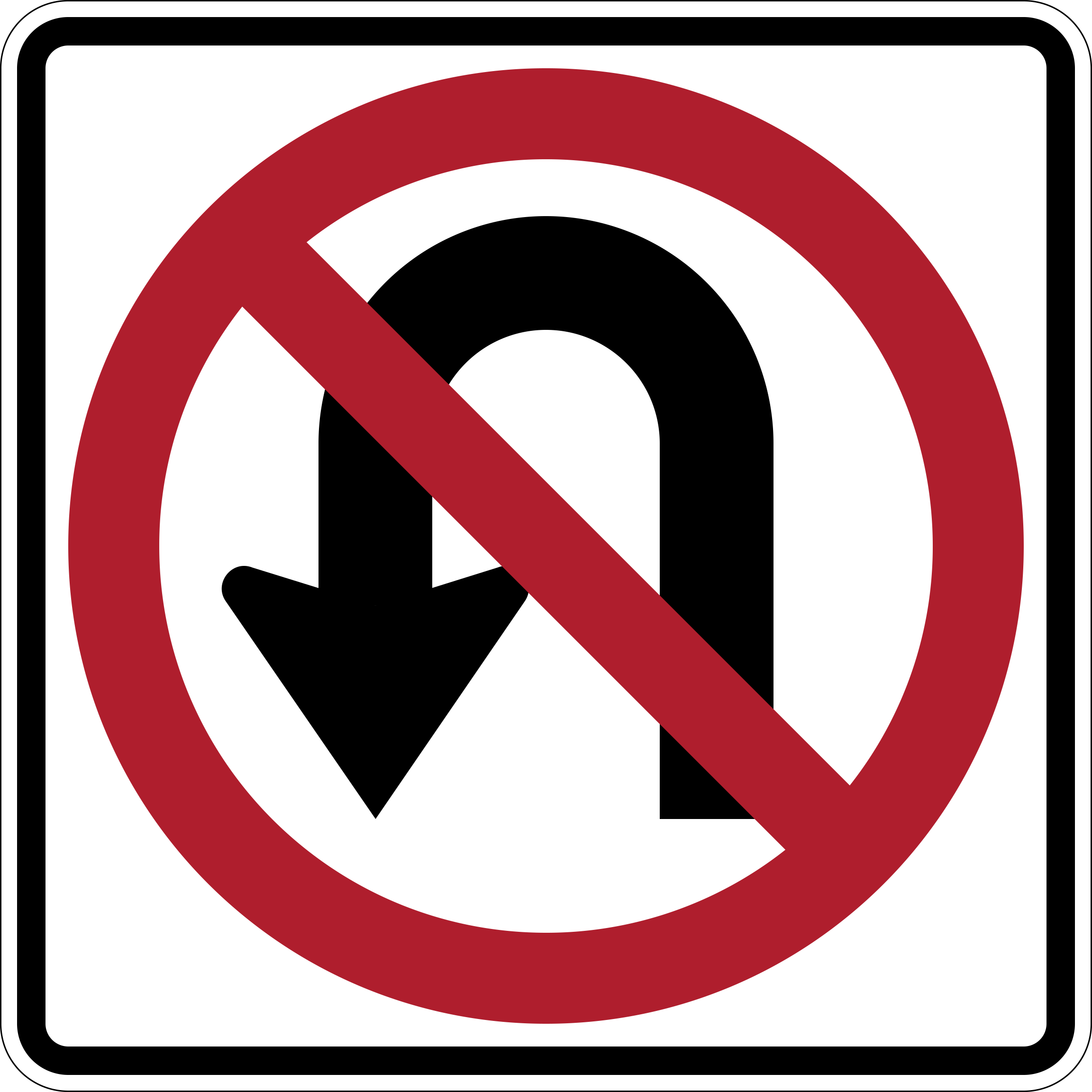
- Turn left at the next intersection
- Pass a slower vehicle on a two-lane road
- Make a U-turn at that location
- Enter a railroad crossing
Show answer
Make a U-turn at that location. The crossed-out U-shaped arrow identifies a no U-turn restriction, so the driver must continue without reversing direction at that point. A left-turn prohibition would show a left-facing arrow, while a passing restriction concerns lane movement rather than a turning maneuver. The railroad choice describes a separate warning symbol and has no connection to the slash over the arrow. Use the arrow itself as the cue: identify the movement pictured, then treat the red slash as a ban on that movement.
15. When may you proceed across railroad tracks if traffic is stopped beyond the crossing?
- As soon as the crossing signals stop, even if the exit is blocked
- Only when there is room for your entire vehicle on the other side
- When your front wheels reach the first rail
- After entering halfway and waiting on the tracks
Show answer
Only when there is room for your entire vehicle on the other side. A driver must not enter railroad tracks unless there is room for the entire vehicle to clear the crossing. A quiet signal does not guarantee a clear exit, and stopping halfway exposes the vehicle to a train. Reaching the first rail is not a safety threshold. Look beyond the tracks before proceeding. If vehicles occupy the far side, remain back until the route is open from approach to exit.
16. Should you switch off with a stuck gas pedal?
- Never turn off the ignition while moving
- Turn it off immediately
- Remove the key
- Shift to park
Show answer
Never turn off the ignition while moving. Stuck accelerators keep the key on: never turn off the ignition while moving, since steering control can vanish or the wheel can lock. Immediate-off, key-out, and park readings each trade a runaway engine for no steering at speed. Hook the shoe under the pedal first; if that fails, shift neutral and brake to the shoulder. Steer first, stop second, switch off third.
17. How should wheels point while awaiting a left turn?
- Crank wheels left early
- Turn wheels right
- Remove your hands
- Keep wheels straight until turning
Show answer
Keep wheels straight until turning. Straight wheels are rear-end armor: keep them straight while waiting so a hit from behind cannot shove the car into oncoming traffic. Early-left, right-turned, and hands-off readings each aim the car at disaster before the gap opens. Only begin steering as the turn itself begins. Patience in the wheels prevents the secondary head-on. Patience in the wheels prevents the secondary head-on collision.
18. A New York driver's convictions add up to six points within 18 months. What Driver Responsibility Assessment applies?
- $100 each year for three years
- $250 each year for three years
- $50 one time
- Nothing, if a point reduction course is completed
Show answer
$100 each year for three years. The Driver Responsibility Assessment is a DMV charge on top of court fines. Six points within any 18 months costs $100 a year for three years, and each additional point in that period adds $25 a year for three years. The $250 yearly figure is the assessment for alcohol or drug-related convictions and chemical test refusals. A crash prevention course does not reduce the points used to calculate this assessment, so it cannot erase the bill. Failing to pay leads to suspension of the license or permit.
19. Unless a different sign is posted, what is the speed limit in New York City?
- 30 mph
- 55 mph
- 35 mph
- 25 mph
Show answer
25 mph. New York City has a 25 mph speed limit unless another limit is posted. The statewide 55 mph default does not override this city rule, and 30 or 35 mph may apply only where a different sign establishes it. Look for the posted limit on the specific street and then account for pedestrians, traffic, and visibility. The short exam cue is city streets default to 25, subject to signs.
20. How does the New York manual characterize BAC standards for commercial drivers?
- They are tougher than the standards described for ordinary drivers
- They are identical to every standard for ordinary drivers
- They apply only when a commercial vehicle carries passengers
- They are less strict because the driver is professionally trained
Show answer
They are tougher than the standards described for ordinary drivers. The New York manual warns that BAC standards and penalties for commercial drivers are tougher than the general standards described in that chapter. The identical, passenger-only, and less-strict choices reverse or narrow that warning. The manual directs commercial applicants to the Commercial Driver's Manual for complete information, so a passenger vehicle threshold should not be substituted automatically. The study cue is the license context: commercial operation brings stricter alcohol standards and penalties, requiring the specialized CDL material.
QualitySpace is expanding to New York
We are a California-based independent insurance brokerage working on licensing in more states. We cannot help with New York insurance yet. Leave your email and we will let you know when we can.
Every question is written from the official New York State Driver's Manual. Need paper? Printable NY practice test with answer key.
Last verified 2026-09-06. How we check every question · Study all 500 as flashcards
Frequently asked questions
How many questions are on this New York practice test?
This fixed set has 20 questions. It is test 25 of 25 from the 500 question New York bank. The real NY exam asks 20 questions and you need 14 correct.
What is the passing score for the real New York test?
You must correctly answer at least 14 of the 20 questions asked, including two of the four questions about road signs That figure comes from the official New York source cited on the DMV facts page.
How does this fixed test relate to the full New York bank?
Each numbered test is a fixed set of 20 questions in a fixed order, so you can retake the same test later and compare. Every test mixes road signs and the other topics in about the same proportion as the full bank. Tests 1 to 25 together cover every question in the New York bank once. The full practice page mixes the whole bank at random.
Last verified 2026-09-06. See the New York DMV facts page for sourced state details.
Return to the full New York practice test · Study road signs